







ABE MAGAZINE | NEWS O’CLOCK — INTERNATIONAL TRADE
Wednesday, October 28, 2026
Germany’s long-standing economic relationship with Asia is undergoing a significant transformation as Europe’s largest economy faces the prospect of a record trade deficit with the region in 2026. A new report from Germany Trade & Invest projects that the country’s trade gap with Asia-Pacific economies could approach €146 billion, driven largely by declining exports to China and increasing imports from the region. The figures reveal more than a temporary imbalance in international commerce. They point to a fundamental shift in industrial competition, as Chinese manufacturers strengthen their positions in automobiles, machinery and advanced technologies, challenging industries that have traditionally formed the foundation of Germany’s economic success.
Germany Faces a Record Trade Imbalance With Asia-Pacific
Germany is on course to record its largest trade deficit with Asia-Pacific economies in 2026, according to projections from Germany Trade & Invest (GTAI), the country’s state-owned trade promotion agency.
The report, reviewed by Reuters and published on October 28, forecasts that German exports to 29 major Asia-Pacific economies will decline by 3.2% to €185.3 billion this year. Imports from the same economies are expected to increase by 6.4% to €330.9 billion.
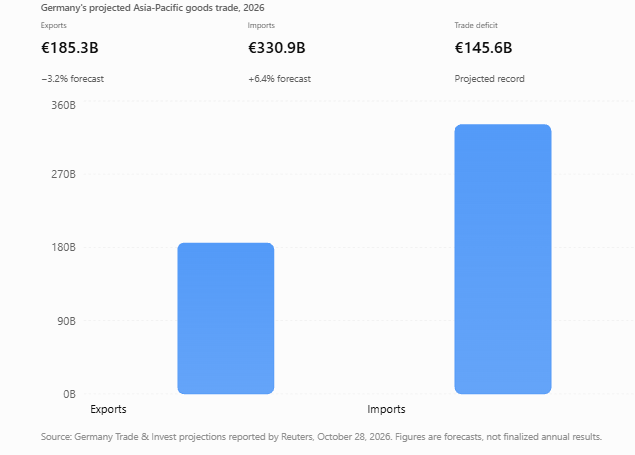
The difference between these projected import and export values produces a trade deficit of approximately €145.6 billion, commonly rounded to nearly €146 billion.
Importantly, these are forecasts for the full year, not confirmed final trade results. The report indicates the direction of Germany’s international trade relationships based on available information and expectations for the remaining months of 2026.
The figures nevertheless reveal an important structural challenge. Germany continues to import substantial quantities of products from Asia while its ability to sell certain industrial goods into the region is weakening.
For an economy historically associated with high-quality manufacturing and export competitiveness, the shift raises questions about whether its traditional industrial strengths remain sufficient in an increasingly competitive global market. Reuters+1
China Is at the Centre of Germany’s Export Problem
China accounts for approximately half of Germany’s goods trade with Asia-Pacific economies, making developments in the Chinese market particularly important to German manufacturers.

According to GTAI, if China were excluded from the regional calculations, German exports to the remaining Asia-Pacific economies would be projected to increase by 2.8% in 2026. The corresponding regional trade deficit would fall to just under €35 billion.
This contrast is revealing.
Germany’s commercial relationships with other Asian economies are not uniformly deteriorating. In several markets, German companies are expanding their activities and identifying new opportunities.
The principal difficulty is that the weakening trade relationship with China is large enough to outweigh those gains.
For decades, China’s industrial expansion created enormous demand for German machinery, automobiles, chemicals and manufacturing equipment. German companies benefited from the development of Chinese factories, infrastructure and consumer markets.
However, China’s industrial capabilities have advanced considerably. Domestic manufacturers increasingly produce equipment and technologies that previously required substantial imports from overseas suppliers.
As a result, German businesses are encountering a market that is not only becoming less dependent on their products but is also producing increasingly capable competitors.
This transformation is particularly visible in the automotive and machinery industries, where Germany has historically enjoyed a strong international reputation. MarketScreener India
German Automotive and Machinery Exports Are Under Pressure
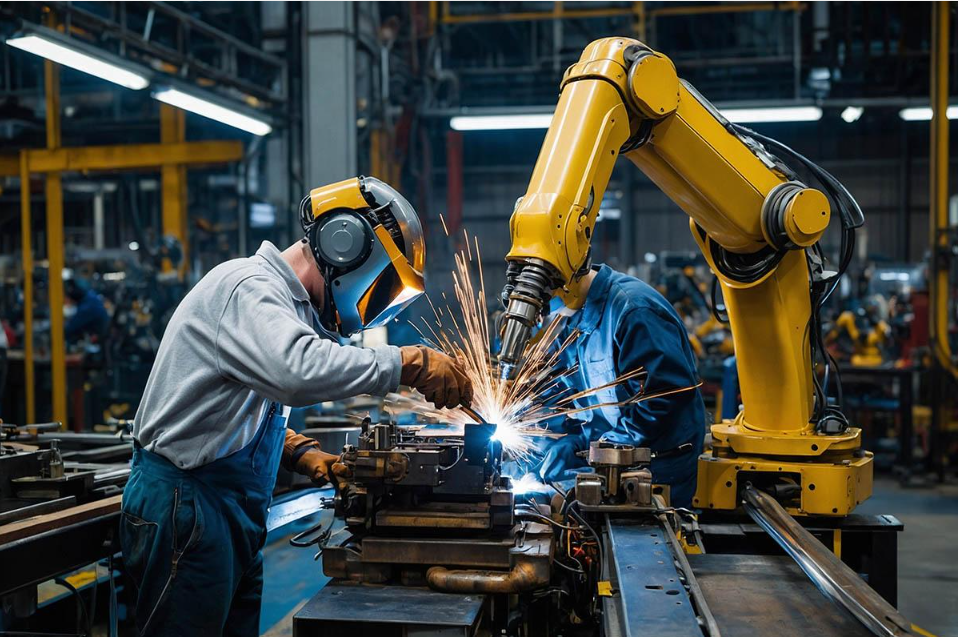
The GTAI report provides evidence of how China’s changing industrial landscape is affecting two of Germany’s most important export sectors.
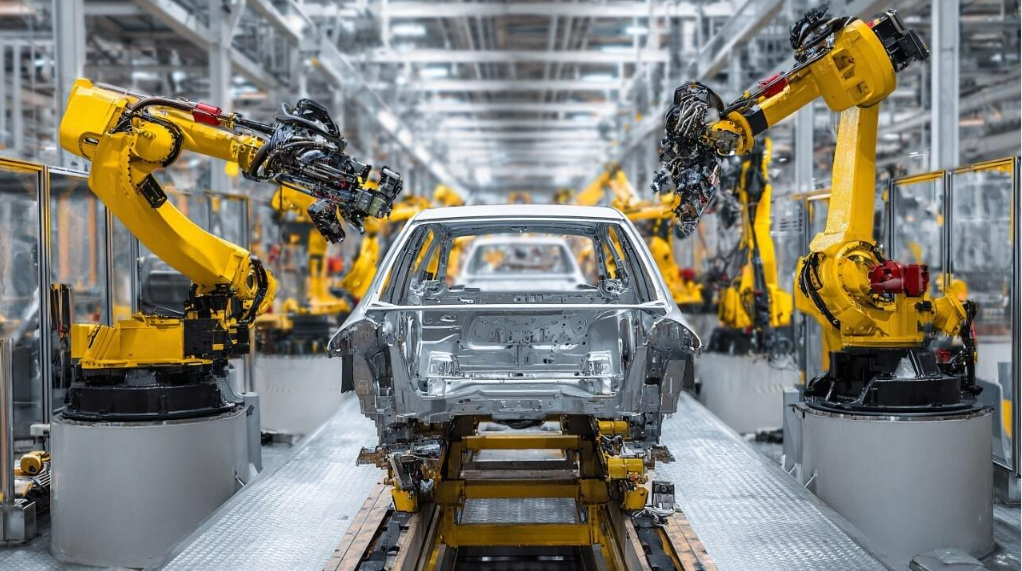
German machinery exports to China declined by 18% during the first seven months of 2026 compared with the same period a year earlier. Automotive exports fell by approximately 30% over that period.
Unlike the full-year trade deficit projection, these figures describe reported developments during the first seven months of 2026.
The automotive industry provides an especially important example of the competitive transformation.
German manufacturers such as Volkswagen, BMW and Mercedes-Benz established strong positions in China as the country’s middle class expanded and demand for passenger vehicles increased.
However, Chinese automakers have become increasingly competitive, particularly in electric vehicles. Domestic manufacturers have benefited from technological development, extensive battery supply chains and growing consumer acceptance of locally produced vehicles.
GTAI reported that German car sales in China have fallen to roughly half their previous peak of more than five million vehicles.
For German manufacturers, the challenge is no longer simply maintaining access to the Chinese market. It is demonstrating that their products remain competitive in an industry undergoing rapid technological change.
Electric vehicles require different supply chains, software capabilities and production strategies from traditional combustion-engine vehicles. Manufacturers that once competed primarily through mechanical engineering and established brand reputations must increasingly compete through battery performance, digital technology and cost efficiency.
The implications extend beyond major automotive companies. Germany’s industrial economy includes numerous smaller suppliers that provide specialized machinery, components and engineering services to large manufacturers.
When major exporters lose market share, the effects can spread through these supplier networks, potentially influencing investment, employment and regional economic activity.
The reported decline therefore raises a broader question about how Germany can preserve its industrial competitiveness while global manufacturing capabilities continue to evolve. AOL+1
India and Southeast Asia Offer New Opportunities
Despite the challenges facing German exporters in China, other Asian economies are becoming increasingly important commercial partners.
India represents one of the clearest examples.
According to GTAI, German exports to India have nearly doubled over the past decade, while imports from the country have expanded by a similar proportion.
The composition of trade is also changing. Although clothing remains an important imported product, German companies are increasingly sourcing pharmaceutical goods and machinery components from India.
This development suggests that India is becoming more deeply integrated into industrial supply chains rather than serving only as a market for finished consumer products.
Southeast Asia presents additional opportunities.
GTAI expects German exports to the 11-member Association of Southeast Asian Nations to increase more rapidly than imports during 2026, partly because of aircraft deliveries.
The region is also becoming a more important source of electrical equipment and electronics, reflecting the expansion of manufacturing capabilities across Southeast Asian economies.
Japan, meanwhile, remains a relatively stable destination for German products, despite the depreciation of the Japanese yen against major international currencies over recent years.
These developments suggest that Germany’s economic future in Asia will depend increasingly on relationships extending beyond China.
However, diversification is unlikely to provide an immediate replacement for the scale of Germany’s existing commercial relationship with the Chinese economy.
Building new markets requires investment, local partnerships, regulatory understanding and products adapted to different consumer and industrial needs.
For German companies, the objective may therefore be to develop a broader and more balanced network of trading relationships rather than attempting to substitute one major market with another. MarketScreener India
Germany’s Trade Challenges Are Becoming a Diplomatic Priority
The publication of the GTAI projections coincides with German Chancellor Friedrich Merz’s visit to Asia, including Japan, South Korea and Singapore.
During the trip, Merz has emphasized the importance of closer cooperation between European and Asian economies in trade, technology and security.
On October 28, Reuters reported that Merz urged Japan to support a proposed alliance of countries committed to maintaining rules-based international trade.
The initiative reflects concerns about tariffs, economic coercion and the increasing use of trade policy as an instrument of geopolitical influence.
China responded by urging Germany and the European Union to maintain a balanced approach to international economic relations and preserve the stability of global supply chains.
For Germany, the diplomatic challenge is particularly complicated.
China remains a major trading partner and an important source of manufactured goods, even as Chinese companies become increasingly formidable competitors.
Germany must therefore balance the benefits of commercial cooperation with concerns about industrial competitiveness and concentrated supply-chain dependencies.
The emerging diplomatic strategy appears to recognize that economic resilience requires stronger relationships with multiple international partners.
However, diplomatic agreements alone cannot restore competitiveness. German manufacturers must also improve productivity, develop new technologies and respond to changing international demand. Reuters+1
A Trade Deficit Does Not Tell the Entire Economic Story
A large trade deficit can attract considerable attention, but it should not automatically be interpreted as evidence of economic failure.
Trade balances measure the difference between the value of goods exported and imported over a given period. They do not directly measure national prosperity, productivity or the overall financial health of an economy.
Imports can benefit businesses by providing affordable equipment, components and materials. Consumers may also benefit from access to competitively priced products.
Similarly, a trade deficit with one region can coexist with trade surpluses elsewhere.
What makes Germany’s projected deficit particularly significant is not simply its size, but the changing composition of the underlying trade relationship.
Declining exports of machinery and automobiles suggest that industries central to Germany’s manufacturing identity are encountering more difficult competitive conditions.
At the same time, increasing imports of advanced manufactured products may indicate that Asian suppliers are strengthening their positions in sectors previously dominated by European producers.
This combination deserves attention because it concerns the future structure of industrial production, not merely the movement of goods across borders.
For Germany, maintaining its economic position will depend on how effectively businesses respond to these changes through innovation, investment and international market development.
THE ABE TAKE: Germany’s Challenge Is Not Asia’s Growth, but Its Own Industrial Adaptation
Germany’s projected €146 billion trade deficit with Asia-Pacific economies reflects a fundamental change in the international economic order.
For decades, German manufacturers benefited from an industrial model built around advanced engineering, strong export markets and demand from rapidly developing economies.
China was an important part of that model.
As Chinese businesses expanded, German companies supplied the machinery, automobiles and technologies required to support industrial growth and rising consumer demand.
Today, that relationship is changing.
China is no longer simply a destination for German industrial products. It has become a powerful manufacturer in many of the same industries, increasingly competing through technological capabilities, production scale and pricing.
The central lesson is that economic success in one period does not guarantee competitiveness in the next.
Germany’s industrial reputation remains valuable, but reputation alone cannot protect market share when customers have access to increasingly capable alternatives.
The growth of India and Southeast Asia offers opportunities for diversification, yet entering new markets should not be confused with solving the underlying competitive challenge.
German businesses must also examine whether their products, production methods and investment priorities remain aligned with the changing global economy.
For policymakers, the challenge is to create conditions that encourage innovation, improve industrial productivity and support businesses adapting to new technologies.
For companies, it means recognizing that international competitiveness is not a permanent achievement. It requires continuous investment, technological development and responsiveness to changing customer expectations.
The broader implications extend beyond Germany.
Other advanced manufacturing economies, including Japan, South Korea, Canada and the United States, face similar questions about how to maintain industrial advantages as emerging economies develop more sophisticated production capabilities.
Germany’s projected trade deficit should therefore be viewed less as a verdict on the country’s economic future and more as a warning about the need for industrial transformation.
The decisive question is not whether Germany can return to the trade relationships of the past.
It is whether Europe’s largest economy can develop a new competitive position in a global market where former customers are increasingly becoming rivals.
ABE MAGAZINE
Understand More. Think Bigger.