







ABE MAGAZINE | ABE FOUNDERS
November 14, 2026
By ABE Editorial Desk
The future of agriculture is often imagined through enormous machines, advanced laboratories and technologies developed far from the fields they are intended to serve. But for two entrepreneurs building a young Canadian robotics company, innovation began with a camper trailer parked beside a cornfield.
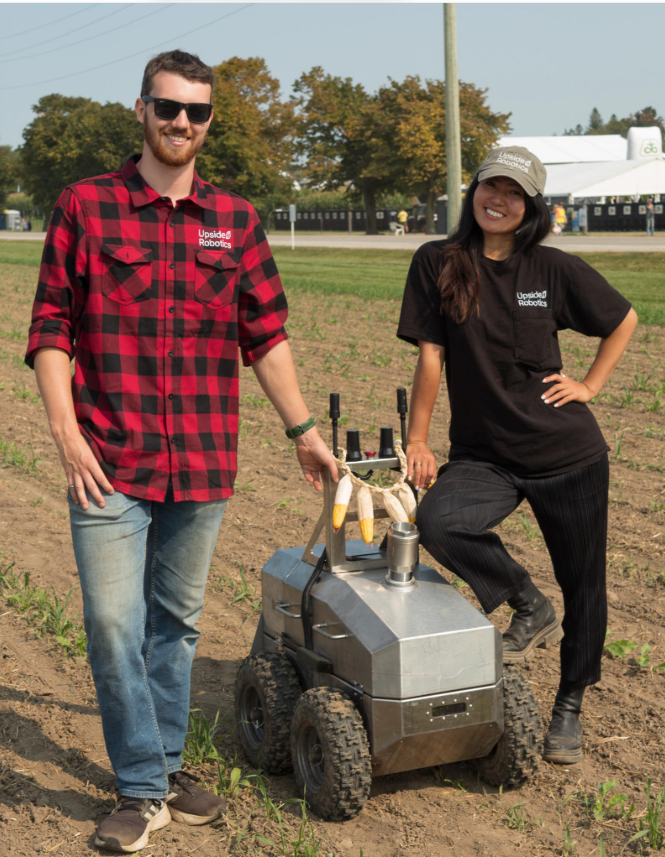
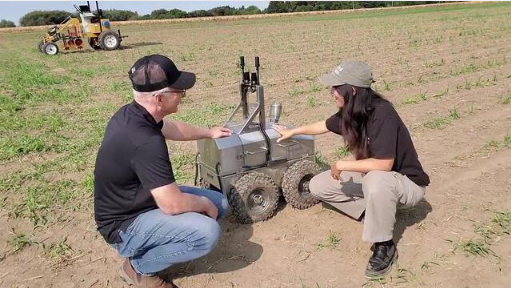
In 2024, Jana Tian and Sam Dugan spent much of their first growing season working alongside Ontario farmers, testing an early agricultural robot and learning how crops respond to fertilizer. They were not experienced farmers, nor did they arrive with a fully developed commercial product. What they had was a conviction that one of agriculture’s most expensive problems could be addressed through smaller machines, better data and more precise decisions.
Their company, Upside Robotics, is now emerging as a promising Canadian agricultural technology business. Founded in 2024 and based in Waterloo, Ontario, the startup develops autonomous robots that deliver nutrients to crops throughout the growing season. Its ambition is to help farmers reduce fertilizer waste, protect soil health and improve profitability without sacrificing crop performance.
The company has attracted investor attention, secured early commercial customers and expanded its field operations. Yet the more important question is whether its technology can prove itself economically across thousands of farms. That challenge makes Upside Robotics an interesting example of how emerging businesses move from a promising idea toward a potentially scalable industry.
Two Founders, One Agricultural Problem
Upside Robotics was founded by two entrepreneurs whose professional backgrounds were different but complementary.
Jana Tian, the company’s chief executive, studied chemical engineering at Imperial College London and previously worked in food development and consulting. Her experience in the food industry exposed her to agricultural supply chains and the difficult relationship between environmental objectives and farmers’ financial realities.
Sam Dugan, the company’s chief technology officer, studied mechatronics engineering at the University of Waterloo. His background included robotics, autonomous vehicles and engineering work involving complex machines. He had been building robots since childhood and brought the technical experience necessary to translate the company’s idea into physical equipment.
The founders met through the Entrepreneurs First startup ecosystem in 2023. They shared an interest in building a business that could address a meaningful environmental problem, but their opportunity emerged from a practical agricultural challenge rather than a purely technological ambition.
Farmers rely on fertilizer to maintain productivity, particularly when growing nutrient-intensive crops such as corn. However, traditional application methods can deliver nutrients before crops are ready to absorb them, potentially increasing costs and environmental losses.
Tian and Dugan believed that applying fertilizer in smaller quantities throughout the growing season could offer a better alternative. Their challenge was developing machinery capable of entering fields repeatedly without damaging crops or requiring constant human supervision.
From a Camper Trailer to Working Fields
Many technology startups begin by developing software, attracting investors and refining their products in controlled environments. Upside Robotics took a different approach because its technology could only be properly tested where farmers actually worked.
During the 2024 growing season, the founders purchased a camper trailer and moved between agricultural fields. They spent long days observing crop conditions, operating early machines and discussing practical problems with farmers.
Dugan initially developed a simple robot in approximately two weeks. The early device required manual operation, but it allowed the founders to collect field data and understand how their fertilizer delivery system might function.
The experience was essential because agricultural machinery faces challenges that cannot be fully reproduced in a laboratory. Uneven ground, changing weather, different soil conditions and the physical characteristics of crops all affect whether a machine can operate reliably.
The founders also learned that farmers were willing to consider unfamiliar technology when its financial value was understandable. Environmental benefits mattered, but reducing costs and maintaining yields were essential to securing commercial interest.
That lesson influenced the company’s development. Rather than presenting robotics as an impressive innovation in itself, Upside Robotics began positioning its technology as a tool for improving farm economics.
How the Technology Works
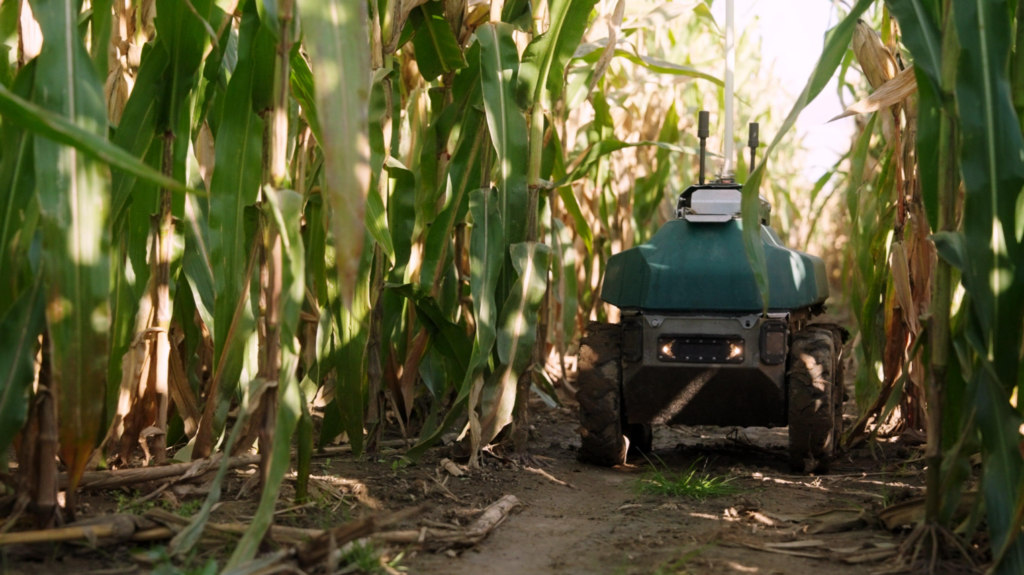
Upside Robotics develops lightweight autonomous machines that travel between rows of corn and apply nutrients directly where plants need them.
The company’s robots use information about soil conditions, weather and crop development to determine when fertilizer should be delivered. Instead of relying entirely on a large application at the beginning of the season, the system is designed to distribute nutrients in smaller, more frequent quantities.
The machines are considerably smaller than conventional agricultural equipment. According to the company, its current design is approximately 22 inches wide, allowing it to navigate between standard 30-inch corn rows. Each unit carries a fertilizer tank and can return to a base station for refilling and recharging.
The business also incorporates software that processes agricultural data and adjusts nutrient delivery. In principle, this combination of robotics and agronomy could allow farmers to respond more precisely to changing crop requirements.
The company reports that its approach can reduce nitrogen fertilizer use by as much as 70%, with potential savings of up to US$150 per acre while maintaining crop performance. These are significant claims, particularly for producers managing large areas of farmland.
However, they should be understood as company-reported results rather than universally established outcomes. Performance can vary according to soil conditions, weather, crop requirements and existing fertilizer practices. Independent, multi-season comparisons will be important as the technology expands.
Early Customers and a Growing Business
Upside Robotics has moved beyond the earliest stages of product experimentation, although it remains a young company.
According to reporting published in February 2026, the startup expanded from approximately 70 acres in 2024 to 1,200 acres during the 2025 growing season. The founders also reported complete customer retention among their early customers and a waiting list exceeding 200 farms.
In an April interview, Tian said the business had grown from four initial customers to 22 farms. The company was targeting approximately 3,000 acres of operations during the 2026 season, representing a substantial expansion from its first trials.
These figures suggest meaningful early interest, but they do not establish long-term commercial success. A waiting list is not equivalent to recurring revenue, and acreage served does not reveal the company’s profitability.
The economics of agricultural robotics will depend on several factors: manufacturing costs, maintenance, field coverage, customer pricing, equipment reliability and the financial benefits delivered to farmers.
A startup may demonstrate that its technology works while still struggling to produce it at a price customers can afford. Upside Robotics must therefore solve two problems simultaneously: improving agricultural performance and building an efficient commercial operation.
The $7.5 Million Investment
In February 2026, Upside Robotics announced a US$7.5 million seed financing round led by Plural, with participation from Garage Capital, Entrepreneurs First and the founders of Clearpath Robotics.
The University of Waterloo reported that the financing brought the company’s total funding to more than US$11 million. The investment is intended to support research, product development and expanded deployment.
For an emerging hardware company, raising capital is particularly important. Unlike software businesses that can distribute products digitally, robotics startups must manufacture equipment, test physical components and maintain machines operating in unpredictable environments.
These requirements can make growth expensive. Additional customers may require more robots, spare parts, technical support and manufacturing capacity before the business achieves substantial operating efficiency.
The involvement of investors with experience in robotics is potentially valuable because they understand the difficulties of commercialising physical technology. Nevertheless, investor support does not eliminate the risks associated with manufacturing, reliability and customer adoption.
The financing gives Upside Robotics additional time and resources to demonstrate that its technology can grow beyond its early customer base. Whether it can do so profitably remains an open question.
Why Canada Became the Starting Point
The founders considered where their company would have the best opportunity to develop. Although they initially connected through an international startup ecosystem, they chose Ontario as their operating base.
The Waterloo region offered engineering talent, robotics expertise and a network of manufacturers. Ontario’s agricultural industry also provided access to corn growers willing to participate in field trials.
This combination was important. The company needed engineers capable of building machines, but it also needed farmers who could explain practical problems and test proposed solutions under commercial conditions.
Canada’s agricultural technology ecosystem has advantages that extend beyond financial investment. Universities, specialised manufacturers and established farming communities can support the development of products that require close cooperation between different industries.
However, building a successful agricultural technology business in Canada does not guarantee international competitiveness. Expanding into the United States or other markets will introduce different farming practices, operating conditions and commercial expectations.
The founders have identified the American Corn Belt as a potential expansion opportunity. Entering that market could significantly increase the company’s addressable customer base, but it would also require stronger operational capacity and evidence of consistent performance.
The Difficult Economics of Agricultural Innovation
Upside Robotics is entering a market where customers are generally disciplined about spending.
Farmers make investment decisions under pressure from fertilizer prices, equipment costs, commodity markets and unpredictable weather. A technology that appears environmentally beneficial must still demonstrate that it can protect or improve their financial position.
The company’s proposed value is straightforward: reducing unnecessary fertilizer application could lower input costs while maintaining crop productivity. Smaller autonomous machines may also reduce some of the soil compaction associated with heavier equipment.
Yet the financial calculation is more complicated than fertilizer savings alone. Farmers must consider the price of the service, equipment reliability, possible disruptions during the growing season and whether the technology can operate efficiently across their particular fields.
Competition is another challenge. Precision agriculture already includes variable-rate application systems, advanced tractors, sensors and other forms of automation. Upside Robotics must demonstrate that its approach offers advantages over established practices, not merely that autonomous robots are technically impressive.
The company may ultimately succeed by becoming a specialised service provider, a technology platform or an equipment business. Its precise long-term commercial structure will depend on how customers prefer to purchase and use the technology.
What Comes Next for Upside Robotics?
The next stage of the company’s development will be defined by execution rather than invention alone.
Upside Robotics must manufacture more machines, improve reliability, support a growing customer base and collect enough field data to demonstrate consistent agricultural results. Expansion will test whether the systems developed in early trials remain effective across different farms and operating conditions.
The company also needs to show that its financial model works for both sides of the transaction. Farmers must receive measurable value, while Upside Robotics must generate sufficient revenue to cover manufacturing, maintenance, research and customer support.
Its progress so far is encouraging. The founders have identified a real problem, worked directly with customers, developed functioning technology and attracted financing. Those are meaningful achievements for a business established only two years ago.
But early progress should not be confused with inevitability. Many promising hardware startups encounter difficulties when moving from controlled deployments to widespread commercial use.
The company’s future will depend on whether its machines can become a dependable part of ordinary farm operations rather than an interesting technological experiment.
THE ABE TAKE
Upside Robotics represents the kind of emerging business that deserves attention before it becomes widely recognised.
Its founders did not begin with a desire to build another technology platform simply because artificial intelligence and robotics were attracting investment. They identified a costly agricultural problem and developed a product intended to address it.
Their decision to live beside cornfields and work directly with farmers demonstrates an important principle of entrepreneurship: understanding the customer is often more valuable than perfecting a product in isolation.
The company’s early funding and commercial traction are promising, but its long-term success will depend on economics rather than publicity. A robot that reduces fertilizer waste is valuable only if farmers can use it reliably and affordably, and if the business supplying it can operate sustainably.
Upside Robotics also illustrates a broader opportunity for Canadian entrepreneurship. Companies do not need to compete exclusively in consumer software or digital services. Agriculture, manufacturing and industrial automation contain difficult problems that can support meaningful businesses when approached with technical expertise and commercial discipline.
For now, Upside Robotics remains a young company with substantial work ahead. That uncertainty is precisely what makes its story worth following.
The next generation of influential businesses may not begin in famous corporate headquarters. Some may begin in a camper trailer, beside a cornfield, with two founders trying to solve a problem that established industries have learned to tolerate.
ABE MAGAZINE
Understand More. Think Bigger.