









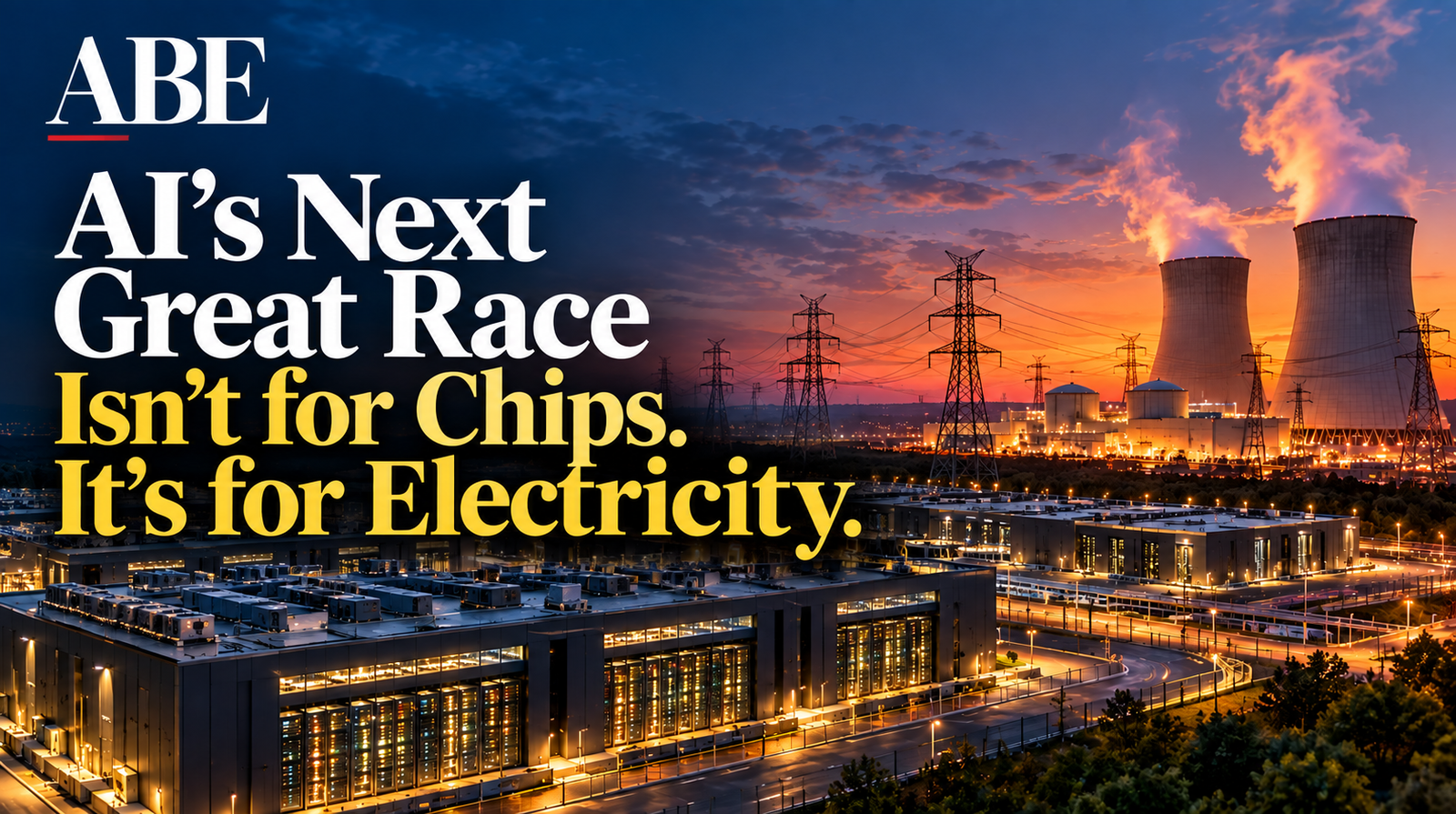
THE BIG STORY | ABE | OCTOBER 7, 2026
For much of the artificial-intelligence boom, the industry’s most important constraint appeared to be computing power. Nvidia’s advanced processors became extraordinarily valuable as Microsoft, Google, Amazon, Meta and a growing number of AI companies raced to build increasingly powerful models and the enormous data centres required to operate them. Billions of dollars flowed into semiconductor manufacturing, cloud infrastructure and new computing facilities, while governments began treating access to advanced chips as a matter of economic and national security. Yet as that infrastructure has expanded, another constraint has moved steadily into view, one that cannot be solved simply by designing a faster processor or ordering another shipment of GPUs: the enormous amount of electricity required to keep the AI economy running.
Google’s latest agreement with Constellation Energy illustrates how significantly that challenge is beginning to influence corporate strategy. The arrangement covers 3,590 megawatts of power in the PJM electricity market and includes a 20-year commitment associated with 890 megawatts of additional nuclear capacity that Constellation plans to create through upgrades to existing reactors. Constellation expects to invest more than $4.3 billion as part of those upgrades, while a separate 15-year agreement covers another 2,700 megawatts. What makes the arrangement significant is not simply its size, but what it reveals about the changing nature of competition in artificial intelligence: technology companies that once concentrated primarily on software, semiconductors and computing infrastructure are increasingly being forced to think like industrial companies, securing long-term supplies of electricity and becoming more deeply involved in the physical energy systems on which their digital ambitions depend.
The shift is happening because artificial intelligence, despite being experienced almost entirely through screens, has an enormous physical footprint. Training and operating sophisticated models requires data centres containing thousands of processors alongside networking equipment, storage systems and cooling infrastructure, all of which consume electricity. As AI tools become embedded in search engines, office software, cloud platforms, consumer devices and corporate operations, the infrastructure required to support them is expanding as well. The U.S. Energy Information Administration now expects American electricity consumption to reach record levels in both 2026 and 2027, rising from 4,195 billion kilowatt-hours in 2025 to 4,288 billion this year and 4,356 billion next year, with the expansion of data centres supporting artificial intelligence and cryptocurrency among the important sources of additional demand.
Those numbers point toward a challenge that the technology industry cannot approach in quite the same way it approached earlier computing bottlenecks. Semiconductor capacity can be expanded, new processors can be designed and additional servers can be ordered, but electricity infrastructure operates on very different timelines. Power plants, transmission lines and substations can require years of planning, permitting, financing and construction, while critical equipment such as transformers can itself become difficult to procure quickly. A company may therefore possess the capital to buy tens of thousands of AI processors and the land required for another data centre while still confronting a more fundamental question: whether enough reliable electricity can actually be delivered to the site.
That question is beginning to change the geography and economics of the AI boom. For decades, technology companies could treat electricity as something largely provided by the surrounding economy, much as they relied on roads, water systems and other public infrastructure. The extraordinary power requirements of modern data centres are making that assumption harder to sustain. In regions experiencing particularly rapid development, a proposed facility can represent such a large new source of demand that its arrival becomes a significant issue for utilities, grid operators, regulators and existing customers. The AI industry is consequently moving from being merely a large purchaser of electricity toward becoming an active participant in determining how new electricity supply is financed and developed.
SILICON VALLEY MEETS THE POWER INDUSTRY
Google’s agreement with Constellation provides an important example of what that new relationship could look like. Rather than relying exclusively on electricity already available within the system, the companies plan to increase output from existing nuclear facilities by upgrading equipment including turbines, generators and other plant systems. The additional 890 megawatts would amount to roughly the output of a large conventional nuclear reactor, but without requiring an entirely new plant to be constructed from the ground up. The first additional capacity is expected to become available beginning in 2028, allowing Google to support its growing electricity needs while Constellation receives the long-term commercial certainty required to justify billions of dollars of investment.
The arrangement belongs to a much broader movement. Microsoft has pursued nuclear electricity for its data-centre operations through an agreement supporting the planned restart of a reactor at Three Mile Island in Pennsylvania, while Amazon and other major technology companies have also moved closer to nuclear generation as they search for large quantities of dependable electricity. Google itself has pursued additional energy arrangements beyond the latest Constellation agreement. What once might have appeared to be a collection of unusual energy deals is increasingly beginning to resemble a structural change in the relationship between the technology and electricity industries.
The attraction of nuclear power is particularly revealing. For years, nuclear energy in the United States faced difficult economics as plants competed against cheap natural gas and rapidly expanding renewable generation, while the extraordinary expense and long development periods associated with new reactors discouraged construction. Artificial intelligence has altered part of that calculation because data centres place a premium not merely on electricity, but on large quantities of electricity that can be supplied reliably around the clock. Existing nuclear plants fit that requirement unusually well, and the possibility of restarting retired facilities or increasing the output of operating reactors can be more practical in the near term than waiting for an entirely new generation of plants to be built.
This does not mean that nuclear power will become the sole energy source of the AI economy. Natural gas remains central to American electricity generation, while solar and wind capacity continues to expand and battery storage is becoming increasingly important to the operation of modern grids. The EIA expects renewables to account for a growing share of U.S. electricity generation through 2027, even as nuclear maintains a substantial position and natural gas remains the largest source. The likely outcome is therefore not a single technology replacing all others, but an increasingly complicated energy system in which technology companies combine nuclear, gas, renewables, storage and efficiency measures in an attempt to secure the reliability and scale their data centres require.
The larger significance is that energy strategy is becoming inseparable from AI strategy. A technology company deciding where to invest tens of billions of dollars in computing infrastructure must increasingly consider the availability of generation, transmission capacity, local permitting rules and the willingness of utilities to accommodate extraordinary new loads. Electricity is becoming part of the competitive equation in much the same way that access to advanced semiconductors became one during the first stage of the generative-AI boom.
THE AI SUPPLY CHAIN IS GETTING MUCH BIGGER
For investors, that development changes the meaning of the AI supply chain. The earliest beneficiaries were relatively easy to identify: Nvidia supplied the processors, semiconductor manufacturers produced advanced chips, memory companies provided essential components and cloud providers sold access to computing capacity. As the industry expands, however, it is becoming increasingly difficult to separate the digital infrastructure of AI from the industrial infrastructure surrounding it.
A modern AI data centre needs far more than servers. It needs transformers to change voltage, switchgear to control electricity, cooling equipment to manage enormous quantities of heat, substations to connect the facility to the grid, transmission capacity to move electricity across long distances and generating assets capable of producing that electricity in the first place. It also requires engineers, construction companies, specialised equipment manufacturers and land located where sufficient power can realistically be delivered. The companies supplying those necessities may never build an artificial-intelligence model themselves, yet they can still become essential participants in the industry’s expansion.
That creates the possibility that the second great wave of AI wealth will spread much further beyond Silicon Valley than the first. Utilities, nuclear operators, electrical-equipment manufacturers, natural-gas suppliers, renewable developers, battery companies and engineering businesses could all benefit if the enormous infrastructure plans announced by technology companies translate into sustained electricity demand. Constellation’s share price reaction to the Google agreement offered an early indication of how investors are beginning to think about that opportunity, with the stock rising sharply after the arrangement was announced.
The dynamic is particularly important because electricity is not an optional component of artificial intelligence. A technology company can reduce office space, delay hiring or change marketing expenditure when conditions deteriorate, but a data centre filled with expensive processors has little value if those machines cannot be supplied with reliable power. As companies invest ever larger amounts in computing equipment, securing the energy required to operate that equipment becomes increasingly important to protecting the investment itself. The result is a powerful commercial relationship between some of the world’s wealthiest technology companies and an electricity industry that, until recently, attracted far less attention from the investors captivated by AI.
The transformation is already becoming visible in the PJM market, which serves roughly 67 million people across a large part of the eastern United States. Rapid growth in electricity demand, including from data centres, has contributed to concerns about future supply and higher capacity costs, prompting debate over whether exceptionally large new customers should be required to bring additional generation to the system or accept limitations when the grid is under severe stress. Google and Constellation have presented their arrangement partly as a model for addressing that problem by connecting large new sources of demand with investment in additional electricity supply.
If that principle spreads, the economics of building an AI data centre could change considerably. Securing land, processors and construction financing would remain essential, but developers might increasingly need to demonstrate where the electricity will come from and how the infrastructure necessary to provide it will be financed. Access to power could therefore influence which regions attract the next generation of data-centre investment, creating advantages for places with abundant generation, strong transmission networks and regulatory systems capable of approving new infrastructure quickly.
THE QUESTION OF WHO PAYS
The expansion also creates a difficult question that reaches far beyond Silicon Valley: who should pay for the electricity system required by the AI boom?
Power grids are shared infrastructure. The same network serving a giant data centre also supplies homes, hospitals, factories and small businesses, which means that enormous increases in demand can have consequences for people with no direct connection to the technology industry. Building additional generation and upgrading transmission systems requires capital, and regulators will increasingly have to determine how those costs should be distributed between the companies creating new demand and the wider population of electricity customers.
The issue becomes more sensitive when electricity prices are already under pressure. The EIA expects U.S. wholesale electricity prices to average about $52 per megawatt-hour in 2026, approximately 11% above 2025 levels, although weather, fuel prices and regional market conditions contribute to that increase alongside growing demand. The agency expects particularly significant price pressure in parts of the Mid-Atlantic and Midwest, regions where data-centre development has become an increasingly important factor in electricity planning.
Google and Constellation are effectively proposing one answer to the problem. Their agreement links a large corporate customer with private investment intended to create additional electricity capacity rather than simply consuming more of the supply already available. If similar arrangements become common, technology companies could play a much larger role in financing the expansion of America’s energy system, providing long-term contracts that make expensive generation projects economically viable while reducing the risk that ordinary customers are asked to shoulder the full cost of infrastructure built primarily to serve data centres.
Whether that model can work at the scale the AI industry may eventually require is far from certain. Electricity markets differ considerably between regions, new infrastructure can face political opposition, and the speed at which technology companies want to expand may still exceed the speed at which power systems can respond. What is increasingly clear, however, is that electricity policy and artificial-intelligence policy can no longer be treated as separate subjects. Decisions about power generation, transmission, permitting and pricing will increasingly influence how quickly the AI industry can grow and where that growth occurs.
THE INDUSTRIAL ECONOMY BENEATH ARTIFICIAL INTELLIGENCE
There is a broader lesson in what is happening. The most important technological revolutions often appear digital or mechanical at first, only for their wider economic consequences to emerge through the infrastructure required to support them. The automobile was not merely a story about car manufacturers; it transformed oil, steel, roads, suburbs, retail and global manufacturing. The internet did not stop with software companies; it produced enormous demand for fibre-optic networks, semiconductor fabrication, telecommunications equipment and data centres. Technologies capable of changing the economy rarely remain confined to the industry in which they were invented.
Artificial intelligence appears to be following the same pattern. Its first stage was dominated by research laboratories, software companies and semiconductor designers, but its expansion is now pulling capital into power generation, construction, electrical equipment and other parts of the industrial economy. The technology may be digital, yet building it at global scale is becoming an intensely physical undertaking, one requiring the coordination of industries whose investment cycles and infrastructure can span decades rather than software-release schedules.
That is why the electricity race matters even if the largest technology companies ultimately succeed in securing all the power they require. The process of doing so could redirect hundreds of billions of dollars of investment, influence the future of nuclear energy, accelerate construction of new generation and transmission, reshape regional electricity markets and create a new class of companies positioned to profit from the infrastructure behind AI. It could also generate political conflict if communities conclude that the benefits of the technology are flowing to its owners while the costs of expanding the electricity system are being shared more broadly.
The semiconductor race is not disappearing. Nvidia’s processors remain crucial, and access to advanced computing will continue to shape competition among the world’s largest technology companies. What is changing is the realization that computing power cannot be separated from electrical power. A company may possess the best models, the most sophisticated chips and billions of dollars available for investment, but none of those advantages matter very much if the infrastructure needed to operate them cannot be built quickly enough.
Google’s agreement with Constellation therefore represents something larger than another corporate energy contract. It is an early example of what happens when the ambitions of the artificial-intelligence industry collide with the physical limits of the economy. Technology companies that spent decades making computing feel almost invisible are discovering that the next stage of their growth depends on very visible things: power plants, transmission lines, substations, construction projects and the communities in which all of that infrastructure must be built.
The first great race of the AI era was to build the most powerful models. The second was to secure the chips capable of running them. The next may be considerably larger, because it will involve not merely the technology industry but the energy system surrounding it.
Artificial intelligence is no longer simply asking how much computing power the world can produce. It is beginning to ask how much electricity the world can provide—and how quickly it can build more.
🔴 THE ABE TAKE
The most important implication of the AI electricity race is not that Google has become an energy company or that nuclear power will suddenly dominate the future. It is that artificial intelligence is crossing the boundary between a technology boom and an industrial transformation, and once that happens, the range of companies, communities and governments affected by it becomes much larger.
The enormous valuations created during the first stage of the AI boom concentrated attention on model developers and semiconductor companies, but history suggests that transformative technologies create some of their largest economic effects in the infrastructure built around them. If artificial intelligence requires a generational expansion of electricity production, transmission, data centres and industrial equipment, then part of the wealth created by AI may ultimately accrue to companies that never develop a model or manufacture a GPU.
That possibility also changes how the industry should be judged. The question is no longer simply whether artificial intelligence can become more capable, but whether the physical economy can expand quickly enough to support what technology companies are promising. The companies that solve that problem—whether they operate nuclear plants, manufacture transformers, build transmission networks or finance new generation—may become as important to the next stage of AI as the chipmakers were to the first.
The race for artificial intelligence began with algorithms and became a race for semiconductors. It is now reaching deeper into the economy, where success will depend on an older and more fundamental resource: the ability to produce enough power to turn all of those machines on.
ABE
Understand More. Think Bigger.