






ABE NEWS | OCTOBER 1, 2026
For most people, the artificial-intelligence boom exists on a screen.
It is ChatGPT answering a question. Claude writing code. An image appearing from a prompt. A company announcing another AI assistant.
But behind those digital products, something much more physical is happening.
Factories are getting busier.
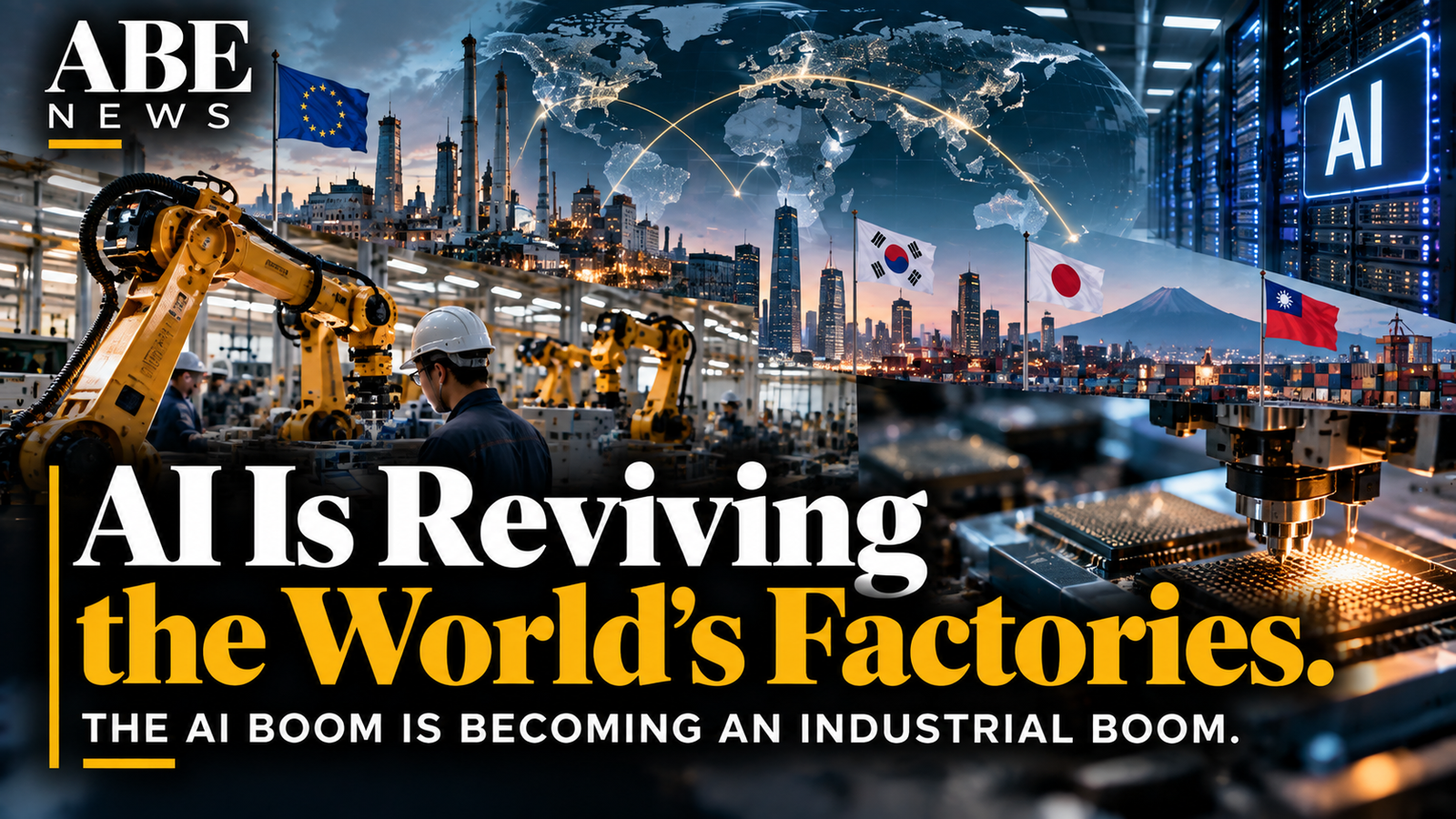
Manufacturers across parts of Europe and Asia reported stronger activity in September, with demand for semiconductors, machinery and other equipment connected to the AI investment boom helping drive the expansion. In the eurozone, manufacturing activity reached its strongest level in more than four years. South Korean factories saw export demand accelerate at its fastest pace in more than 15 years. Taiwan’s manufacturers are benefiting from the semiconductor cycle. And Japanese industrial confidence has climbed to an eight-year high. Reuters
The numbers reveal something important about where the AI revolution may be heading.
Artificial intelligence was supposed to transform software.
Increasingly, it is transforming the physical economy too.
AI NEEDS MUCH MORE THAN SOFTWARE
It is easy to think of artificial intelligence as an almost entirely digital technology.
But every AI model ultimately depends on an enormous physical system.
There are chips inside servers.
Servers inside data centres.
Cooling equipment keeping those machines from overheating.
Electrical infrastructure supplying enormous amounts of power.
Factories manufacturing semiconductors, networking equipment and electrical components.
Construction companies building the facilities that house everything.
And underneath all of it sits a global supply chain responsible for producing and moving the equipment.
That means every time a technology company announces billions of dollars in AI infrastructure spending, some of that money eventually travels far beyond Silicon Valley.
It reaches industrial companies.
That is beginning to show up in economic data.
EUROPE’S FACTORIES ARE MOVING AGAIN
Europe provides one of the clearest examples.
The eurozone’s Manufacturing Purchasing Managers’ Index rose from 52.7 in August to 52.9 in September, according to S&P Global data reported by Reuters.
Anything above 50 indicates expansion.
That makes September the third consecutive month of manufacturing growth and takes the index to its highest level since May 2022. Factory output reached a 55-month high, while new orders expanded at their fastest rate since early 2022. Reuters
That would already represent a significant change for a region whose industrial economy has spent years struggling with expensive energy, weak demand and competition from abroad.
But what is driving the recovery is particularly interesting.
Demand for investment goods — machinery and equipment businesses buy to expand their operations — has strengthened sharply.
S&P Global’s chief business economist Chris Williamson said demand for AI and defence-related equipment in particular was contributing to the surge.
The Netherlands led the expansion. Germany, Europe’s largest economy and its traditional industrial engine, recorded solid growth. France, Italy and Spain also expanded, although more modestly. Reuters
Manufacturers have even begun hiring again after more than three years of job reductions.
That does not mean Europe’s industrial problems have disappeared.
But it suggests that the AI investment cycle is beginning to create demand in parts of the economy that rarely appear beside the latest chatbot announcement.
ASIA IS SEEING THE SAME MONEY MOVE THROUGH ITS FACTORIES
The pattern extends much further.
Asia sits at the centre of the global electronics and semiconductor supply chain, making the region particularly exposed to the enormous infrastructure requirements of AI.
South Korea’s manufacturing sector expanded in September by its strongest margin in four months, while export demand grew at its fastest pace in 15½ years.
Semiconductors and automobiles were important contributors to that growth. The Straits Times
Taiwan — home to one of the world’s most important semiconductor ecosystems — also continued to benefit from strong demand for chips and AI-related goods.
Japan offers another glimpse of the transformation.
Confidence among large Japanese manufacturers rose to its highest level since March 2018 during the July-to-September quarter. The Bank of Japan said many manufacturers benefited from strong chip and AI-related demand as well as improving supply conditions. Reuters
Even Southeast Asia is competing for a larger role in the new supply chain.
German semiconductor manufacturer Infineon opened a $1.4 billion manufacturing facility in Thailand on Thursday, as the country tries to capture more investment from the global semiconductor industry. Reuters
Piece these developments together and AI begins to look much less like a software story.
It starts looking like an industrial one.
THE AI RACE IS BECOMING A RACE TO BUILD
The first phase of the generative-AI boom was dominated by models.
Who had the smartest one?
Who could generate the best images?
Who could write the best code?
Who could attract the most users?
The next phase increasingly depends on infrastructure.
The companies developing those models need enormous amounts of computing capacity.
And computing capacity cannot simply be downloaded.
It has to be built.
That is why technology companies are committing extraordinary amounts of capital to AI infrastructure.
Data centres require land, concrete, steel, transformers, cables, cooling systems, networking equipment, semiconductors and enormous quantities of electricity.
Suddenly, industries that seemed far removed from artificial intelligence become part of the AI economy.
An electrical-equipment manufacturer can benefit from AI.
A utility can benefit from AI.
A construction company can benefit from AI.
A semiconductor equipment supplier can benefit from AI.
Even the factories making the machinery used by other factories can participate.
That creates a much wider economic footprint than software alone ever could.
THIS COULD CHANGE WHERE THE AI MONEY GOES
Much of the financial excitement surrounding artificial intelligence has concentrated on a relatively small collection of technology companies.
But infrastructure investment spreads money differently.
Consider what happens when a company decides to build a massive data centre.
The chipmaker gets an order.
So does the server manufacturer.
The cooling-equipment company gets one.
The electricity provider gets one.
Construction contractors get work.
Equipment manufacturers receive orders.
Local governments may build supporting infrastructure.
Workers are required to construct and operate the facility.
And suppliers throughout the chain receive additional demand.
One dollar of AI investment can therefore move through numerous industries before the finished computing capacity ever comes online.
That is one reason the current manufacturing data matters.
It provides early evidence that the AI capital-spending boom is beginning to travel deeper into the economy.
BUT THERE IS A CONTRADICTION
The same factories benefiting from stronger demand are confronting another problem.
Their costs are rising.
Energy prices remain elevated, while inflationary pressures are strengthening in several economies. Eurozone manufacturers reported faster increases in both input costs and selling prices during September. Consumer-goods demand, meanwhile, remains weak as higher living costs pressure households. Reuters
And then there are interest rates.
Central banks are responding to inflationary pressure with tighter monetary policy, while global bond yields have climbed sharply.
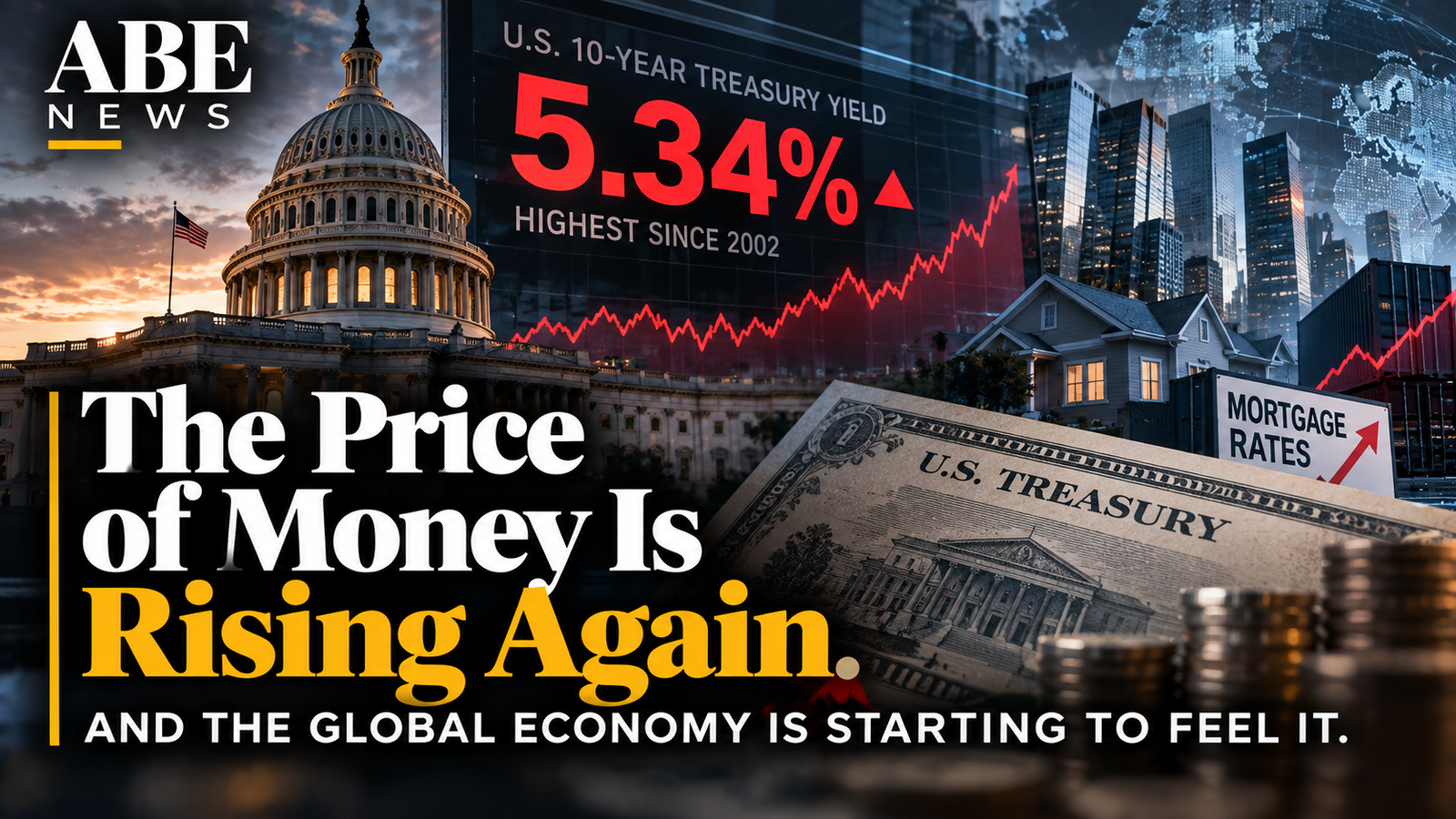
The U.S. 10-year Treasury yield reached 5.34% Thursday, its highest level since 2002, as the global bond selloff intensified. Reuters
That produces an unusual economic contradiction.
Companies are entering an enormous investment cycle precisely when financing those investments is becoming more expensive.
AI companies need more data centres.
Semiconductor manufacturers need more fabrication capacity.
Utilities need more generation and grid infrastructure.
Factories need more machinery.
But the money required to finance all of it costs more than it did during the ultra-low-interest-rate era.
The AI boom is simultaneously stimulating investment and contributing to an economic environment in which investment becomes more expensive.
How those two forces interact could become one of the defining economic stories of the next several years.
MANUFACTURING MAY MATTER MORE THAN WE THOUGHT
There is also a larger historical question here.
For decades, many advanced economies moved increasingly toward services.
Manufacturing shifted toward Asia and other lower-cost production centres. Software companies became some of the world’s most valuable businesses. Digital products could reach billions of people without requiring a factory for every market.
AI initially appeared to accelerate that transformation.
Instead, the infrastructure required to support AI could give advanced manufacturing new strategic importance.
Semiconductors are already treated as national-security assets.
Governments are competing to attract chip factories.
Countries are investing in electricity grids and data-centre capacity.
Companies are reconsidering where critical technology components should be produced.
Thailand’s new Infineon facility is one example of countries trying to position themselves inside those changing supply chains. Reuters
The AI race may therefore become partly a competition over who can manufacture the physical systems required to run intelligence at scale.
And that is a very different contest from simply building the best chatbot.
🔴 THE ABE NEWS TAKE
The biggest mistake we can make with artificial intelligence is assuming that the AI economy ends where the screen begins.
It doesn’t.
Every seemingly weightless digital interaction rests on something extraordinarily physical.
A prompt requires computation.
Computation requires chips.
Chips require factories.
Factories require machinery.
Data centres require electricity.
Electricity requires power generation and transmission.
And all of it requires capital.
Follow that chain far enough and artificial intelligence begins touching industries that existed long before anyone had heard of generative AI.
That is why the latest manufacturing numbers deserve attention.
If today’s investment continues, AI could become more than a technology boom. It could become one of the largest industrial investment cycles of the modern era.
But there is an important test ahead.
Building the infrastructure is the easy part to measure. Companies can count chips, servers, factories and data centres.
Eventually, all that infrastructure has to generate enough economic value to justify what was spent building it.
Until then, the world is making an enormous bet.
Not merely that artificial intelligence will become useful.
But that it will become useful enough to justify rebuilding parts of the physical economy around it.
AI may have started with software.
Its next chapter is being built in factories.
ABE NEWS
Business. Money. Style. The News.
Understand More. Think Bigger.
By ABE News Editorial Desk