



ABE NEWS | SEPTEMBER 28, 2026
For a few minutes, everything looks perfect.
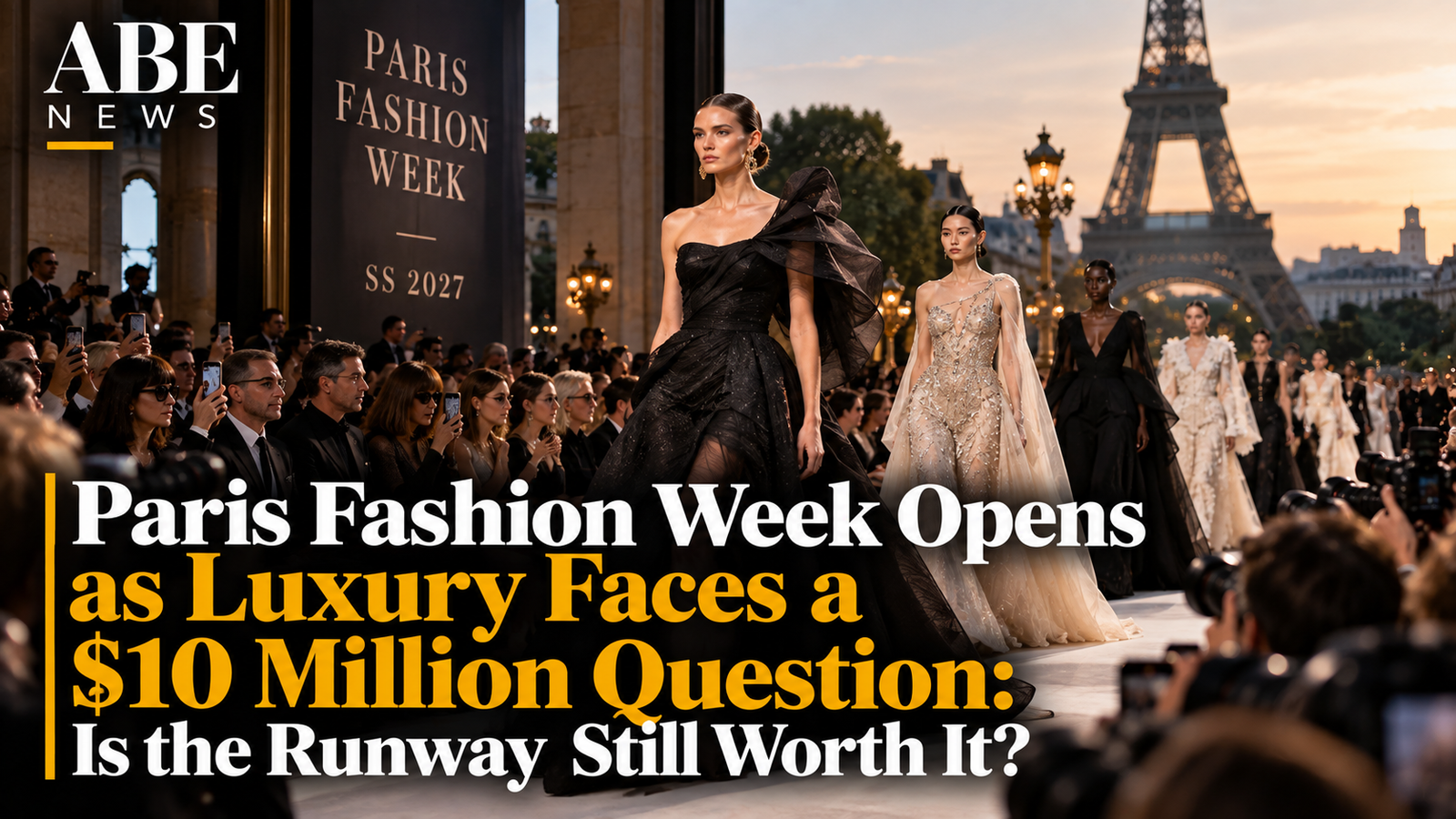
Models walk beneath carefully engineered lights. Celebrities occupy the front row. Photographers crowd around entrances. Images race across Instagram, TikTok and fashion magazines before the final model has even left the runway.
Then the lights go down.
And for some of the world’s largest luxury houses, the bill for those few minutes can reach €10 million — about $11.5 million.
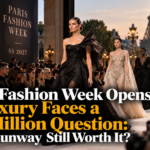
Paris Fashion Week opened Monday for its Spring/Summer 2027 womenswear season, beginning nine days of shows and presentations that will bring some of fashion’s biggest names to the French capital. The official calendar runs from September 28 through October 6.
But behind the spectacle, luxury fashion is confronting a much less glamorous question.
Is all this still worth the money?
The question has become increasingly difficult to ignore as demand weakens, consumers become more selective and some of the industry’s biggest companies struggle to convince shoppers that ever-higher luxury prices still represent value.
Runway shows have always been expensive.
Today, however, brands aren’t simply competing to make beautiful clothes.
They’re spending millions trying to remain culturally important.
And that may be becoming one of the most expensive competitions in fashion.
THE $10 MILLION FASHION SHOW
The economics of a major runway production can be extraordinary.
Industry experts told Reuters that shows can cost as much as €10 million ($11.47 million) to stage.
Think about what that means.
A fashion house can spend the equivalent of the annual budgets of many small companies on an event that may last less than half an hour.
The money isn’t simply paying for models walking down a runway.
Major productions can involve elaborate venues, custom-built sets, lighting, sound, security, casting, styling, transportation, hospitality, celebrity appearances and armies of staff working behind the scenes.
And finding the right Paris venue has itself become increasingly complicated. Le Monde reports that major houses compete for prestigious locations while smaller labels contend with scarce spaces, tighter safety requirements and mounting logistical challenges.
The physical show is only part of the equation.
The real product is attention.
A RUNWAY SHOW IS REALLY A GLOBAL ADVERTISEMENT
A luxury house isn’t spending millions simply to entertain several hundred people sitting beside a runway.
It is trying to create a cultural moment that millions of people will encounter elsewhere.
A celebrity arrives wearing the brand.
Photos spread online.
Fashion editors publish reviews.
Influencers dissect the collection.
Videos circulate across social platforms.
A handbag appears repeatedly in photographs.
A dress becomes the image associated with the season.
And suddenly a 15-minute event in Paris becomes a global marketing campaign.
That explains why the economics of a fashion show cannot be measured simply by asking how many clothes shown on the runway are sold.
The show can influence the desirability of the entire brand.
Someone watching Louis Vuitton’s runway may never purchase the jacket being presented.
But they might later buy a fragrance.
Or sunglasses.
Or a wallet.
Or a handbag.
Luxury companies are selling products, but they are also selling an image of the world those products supposedly belong to.
The runway helps manufacture that image.
THE PROBLEM: LUXURY ISN’T HAVING A GREAT YEAR
Those enormous marketing investments would be easier to justify if luxury were booming.
It isn’t.
Reuters reported last week that shares of LVMH, the world’s largest luxury group, had fallen 37% since the beginning of 2026 as of September 22.
Shares of Kering, owner of Gucci, had meanwhile erased the gains recorded since Luca de Meo became CEO a year earlier.
And the weakness extends beyond stock prices.
Federico Bazzani of Deloitte Advisory told Reuters that fewer than half of luxury brands are currently growing, while the remainder are losing ground.
That creates an uncomfortable situation.
Luxury houses need attention more than ever.
But the attention is becoming increasingly expensive to create.
LUXURY PRICES ROSE. SHOPPERS NOTICED.
For years, the industry’s biggest houses had enormous pricing power.
Prices rose.
And customers continued buying.
That encouraged brands to push prices higher still.
But there is a limit to how far even wealthy consumers will accept that equation.
Luxury adviser David Watts told Reuters that hefty price increases have made even affluent shoppers more concerned about whether expensive products actually represent value for money.
That leaves companies in a difficult position.
Lower prices and customers may begin questioning why products were so expensive in the first place.
Maintain high prices and some customers may simply walk away.
Reduce production and revenue suffers.
Maintain production while demand weakens and inventory becomes another problem.
This isn’t simply a fashion problem.
It’s a classic business problem:
How much can a company charge for exclusivity before customers decide the exclusivity isn’t worth the price?
THE MIDDLE-CLASS LUXURY SHOPPER IS PULLING BACK
Luxury doesn’t survive entirely on billionaires.
Over the past several decades, the industry expanded by bringing millions of aspirational consumers into its world.
Someone who couldn’t afford a couture dress could buy perfume.
Someone who couldn’t buy a $10,000 handbag could purchase a smaller leather good.
Someone who couldn’t afford an entire designer wardrobe could save for one recognizable luxury piece.
That expanded the industry’s customer base enormously.
But studies cited by Reuters from Bain and other consultancies indicate that middle-class consumers are reducing spending on luxury products.
That means brands are competing more aggressively for their wealthiest customers.
The response has been fascinating.
Instead of simply selling more products, companies are creating increasingly exclusive environments around those customers.
Private shopping spaces.
Personalized service.
Invitation-only events.
Special experiences.
Prada, for example, recently redesigned its Milan flagship with private spaces aimed at its biggest spenders.
Luxury is becoming more luxurious precisely because fewer customers may be willing to pay for it.
BUT SOMETHING BIGGER MAY BE CHANGING
The industry’s problem might not simply be economic.
It could also be cultural.
Consumers still want status, pleasure and memorable experiences.
But increasingly, they may not want to express those things exclusively through possessions.
Renzo Rosso, chairman of the group that owns Diesel, told a conference in Milan that consumers are increasingly prioritizing wellness, health, longevity, hotels and restaurants.
That shift could become one of the most important changes facing luxury.
Consider two ways someone might spend $5,000.
One is a handbag.
The other could be a week at an extraordinary hotel, fine dining, travel and experiences with friends or family.
Both communicate wealth.
Both create pleasure.
Both can carry social status.
But only one requires buying another physical object.
That puts fashion into competition with industries it may once have considered largely separate.
Luxury hotels.
Fine dining.
Wellness.
Travel.
Entertainment.
Experiences.
The competition for affluent consumers’ money is expanding.
PARIS NOW BECOMES THE TEST
And that is what makes this Paris Fashion Week particularly interesting.
The Spring/Summer 2027 women’s calendar runs through October 6, with 68 shows and 33 presentations scheduled, according to Vogue’s review of the official program.
Major houses including Dior, Louis Vuitton and Chanel are among the names being closely watched this season. Chanel is scheduled to show its Spring/Summer 2027 collection on October 5.
But the business question hovering above Paris won’t necessarily be:
Who designed the best dress?
It will be:
Who can make consumers care again?
That distinction matters.
A critically acclaimed collection doesn’t automatically solve a company’s financial problems.
A viral runway moment doesn’t necessarily translate into handbag sales.
And millions of social-media views aren’t the same thing as millions of dollars in profit.
Fashion houses must somehow convert cultural relevance into commercial demand.
That is why the runway still matters.
And why measuring its return has become so difficult.
WHY NOT JUST CANCEL THE SHOW?
If runway shows are so expensive, the obvious solution might appear simple:
Stop doing them.
Put the collection online.
Invite influencers.
Run a digital campaign.
Spend the €10 million elsewhere.
But luxury doesn’t operate like an ordinary consumer business.
Scarcity matters.
Theatre matters.
Tradition matters.
Physical presence matters.
And prestige often depends on doing things that aren’t economically efficient in the conventional sense.
A spectacular show inside an extraordinary Paris venue tells the audience something about the company before a single garment appears.
We can afford this.
We belong here.
People are watching us.
In luxury, those messages have commercial value.
If every fashion house abandoned physical shows and uploaded collections to the internet instead, the industry could save enormous amounts of money.
It might also destroy part of the mythology that allows it to charge enormous amounts of money in the first place.
THE RUNWAY IS BECOMING A MEDIA BUSINESS
This is perhaps the biggest reason fashion shows will survive.
Their audience has changed.
Fashion Week once primarily served buyers, editors, journalists and wealthy clients.
Today, someone sitting thousands of kilometres from Paris can watch a runway almost instantly.
A teenager who has never entered a Chanel boutique can follow the collection.
Someone who could never receive an invitation can watch celebrities arrive.
A single outfit can become a global meme within hours.
Fashion Week has therefore evolved from an industry trade event into something closer to a global media product.
The front row is still exclusive.
The content isn’t.
That creates an unusual contradiction.
Luxury depends on scarcity.
Social media depends on mass distribution.
Modern fashion houses are trying to use the second to preserve the value of the first.
THE WINNERS MAY BE THE BRANDS THAT CREATE WORLDS
The industry’s current slowdown doesn’t necessarily mean luxury is disappearing.
It may instead force brands to become better at explaining why they deserve luxury prices.
Deloitte’s Bazzani described the choice facing companies clearly: invest in innovation, customer experience and cultural relevance to justify pricing—or reconsider prices and accept lower margins.
That is a much bigger challenge than designing a new handbag.
It means creating an entire ecosystem around a brand.
Stores become destinations.
Hotels become brand extensions.
Restaurants become marketing.
Fashion shows become entertainment.
Celebrities become distribution.
Architecture becomes advertising.
And products become souvenirs from the world the brand has created.
The strongest luxury companies increasingly aren’t simply selling things.
They are selling access to a universe.
🔴 THE ABE NEWS TAKE
A €10 million runway show sounds absurd until you understand what luxury companies are actually buying.
They aren’t buying 15 minutes.
They’re buying relevance.
A place in the conversation.
Photographs across the world’s media.
Celebrity association.
Social-media attention.
Desire.
And, ultimately, the possibility that all of those things will persuade someone to walk into a store months later and spend thousands of dollars.
For decades, that equation worked extraordinarily well.
But luxury’s current slowdown introduces a dangerous question:
What happens when attention remains high but desire weakens?
Millions can watch a runway without buying anything.
A celebrity can generate millions of impressions without selling a handbag.
A collection can dominate social media for 24 hours and disappear from cultural memory a week later.
That means the industry’s challenge isn’t simply keeping the runway alive.
It is proving that spectacle still creates economic value.
Paris will spend the next nine days showing the world what luxury looks like in 2027.
Behind the lights, however, executives will be watching something much less glamorous.
Whether anyone still wants to pay for it.
ABE NEWS
Business. Money. Style. The News.
Understand More. Think Bigger.