





ABE NEWS | OCTOBER 1, 2026
For much of the past decade, the global economy became accustomed to one powerful idea: money could be borrowed cheaply.
Governments borrowed to finance spending. Companies borrowed to expand. Homebuyers benefited from relatively inexpensive mortgages. Investors poured money into stocks, technology companies and other assets because interest rates offered relatively little competition.
That world is moving further away.
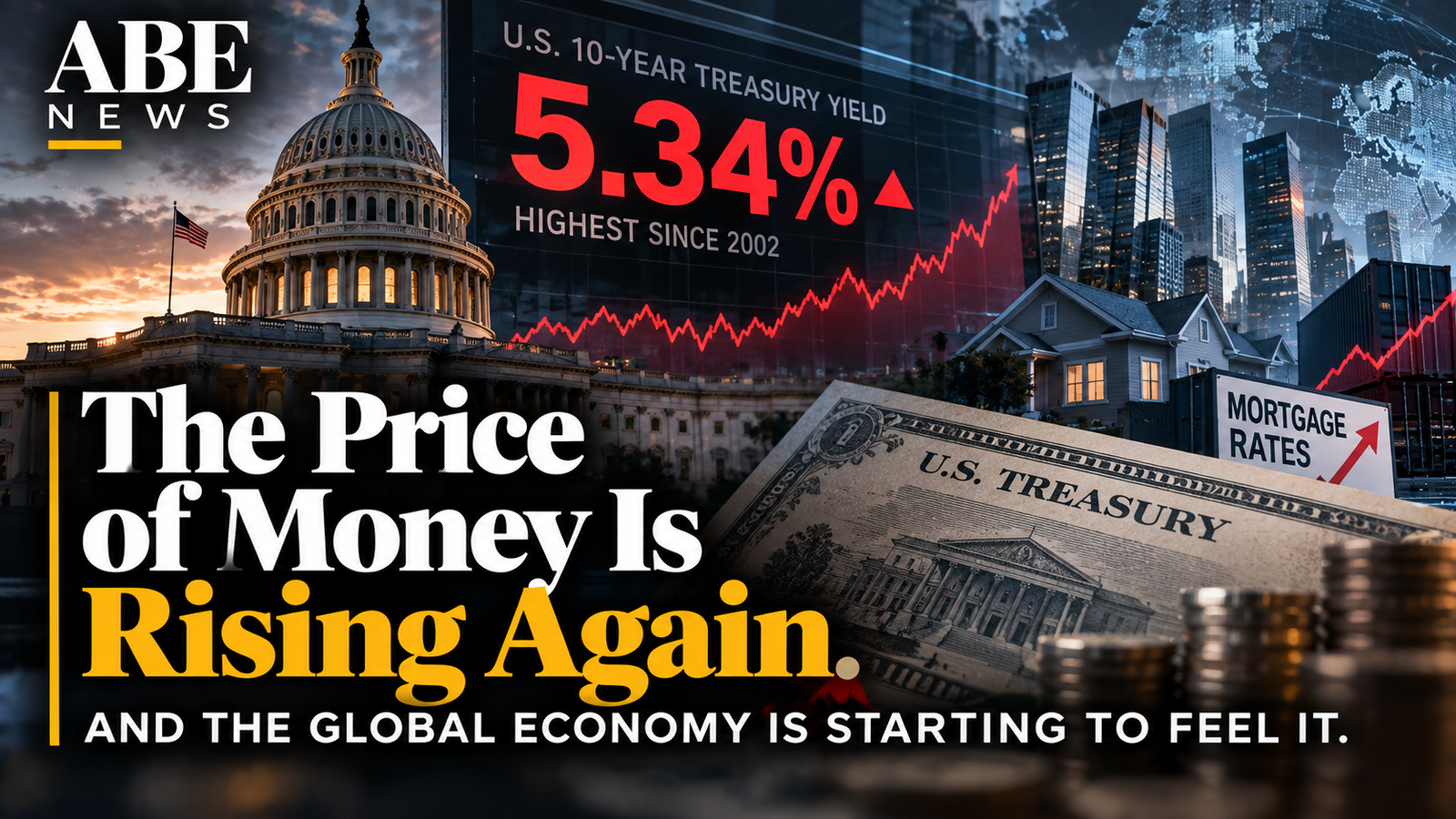
On Thursday, the yield on the 10-year U.S. Treasury climbed to 5.34% — its highest level since 2002. The move followed the bond’s biggest quarterly rise in yield since 1994, according to Reuters. The pressure is not confined to the United States. Britain’s 30-year government bond yield moved above 6%, its highest since 1998, while France’s 10-year yield approached 5%. Japan has also experienced a sustained rise in government borrowing costs. Reuters
Those numbers can sound like something that belongs entirely to Wall Street.
They don’t.
Government bond yields sit underneath enormous parts of the financial system. When they rise far enough, the effects can eventually reach mortgages, corporate loans, government budgets, stock valuations and investment decisions.
The price of money is rising again.
And this time, the forces pushing it higher are coming from several directions at once.
WHY BONDS ARE SUDDENLY SO IMPORTANT
A government bond is essentially an IOU.
Governments borrow money from investors and promise to repay it later, while paying interest along the way.
When investors become less willing to hold those bonds at existing prices, bond prices fall and their yields rise.
That is what has been happening across major economies.
The U.S. 10-year Treasury is particularly important because it serves as one of the world’s most influential financial benchmarks. Its yield helps shape borrowing costs and the prices investors are willing to pay for other assets.
At 5.34%, that benchmark has reached territory not seen in nearly a quarter-century. Reuters
The significance becomes easier to understand when you stop thinking about bonds and start thinking about everything connected to them.
A company considering a new factory has to ask whether borrowing still makes sense.
A household considering a mortgage has to calculate a larger monthly payment when financing costs rise.
A government issuing new debt must devote more money to interest.
And an investor considering an expensive stock suddenly has an alternative: earn a substantial return from government debt without taking the same corporate risk.
That changes financial decisions across the economy.
THIS ISN’T JUST ABOUT INFLATION
Inflation remains part of the story, particularly as higher energy prices increase concerns that price pressures could persist.
But the current bond selloff is more complicated.
Investors are also confronting strong economic growth, enormous government borrowing requirements and expectations that interest rates may remain higher for longer than markets previously anticipated.
And then there is an unusual new force entering the equation:
artificial intelligence.
The AI boom is no longer simply about software.
Building the infrastructure behind it requires enormous amounts of physical investment — data centres, semiconductor factories, electrical equipment, transmission infrastructure and power generation.
That spending can stimulate economic activity.
Factory surveys released Thursday showed manufacturing activity expanding across much of Europe and Asia. The eurozone manufacturing PMI reached 52.9 in September, its highest since May 2022, with stronger demand for AI-related capital goods contributing to the improvement. South Korean export demand grew at its fastest pace in more than 15 years, while Taiwan’s manufacturing PMI climbed to 56.7 amid strong semiconductor and AI demand. Reuters
That is good news for manufacturers.
But stronger growth can also make central banks less comfortable cutting interest rates — particularly when inflation remains a concern.
The strange result is that the same AI investment boom helping support economic growth may also be contributing to an environment where borrowing remains expensive.
THE GOVERNMENT DEBT PROBLEM GETS BIGGER
There is another side to higher interest rates that receives less attention.
Governments have to pay interest too.
And many entered this period already carrying enormous debt loads.
The Institute of International Finance recently estimated that advanced economies paid more than $3.3 trillion in interest over the past year on internationally traded government bonds alone, according to Reuters. Reuters
That creates a difficult cycle.
Governments borrow money.
Interest rates rise.
Old debt eventually has to be refinanced at higher rates.
Interest payments consume more of the government budget.
That leaves less money available for infrastructure, healthcare, defence, education or other priorities unless governments raise taxes, reduce spending or borrow even more.
France offers an example of why investors are paying attention.
Its 10-year government bond yield briefly reached 4.96% Thursday, while the gap between French and German 10-year borrowing costs widened to its highest level since the eurozone debt crisis era. France is simultaneously trying to navigate difficult budget negotiations. Reuters
Bond investors are effectively demanding more compensation to lend.
That pressure can eventually become political as well as financial.
WHAT THIS MEANS FOR COMPANIES
Businesses spent years operating in an environment where cheap financing encouraged expansion.
That calculation changes when money becomes expensive.
Imagine a company considering a $1 billion factory.
At very low borrowing costs, the project might produce an attractive return.
Increase the cost of financing substantially and the same factory can suddenly become less appealing.
Multiply that decision across thousands of businesses and higher rates can eventually slow investment throughout the economy.
Highly indebted companies face another problem.
They may have borrowed money several years ago when rates were much lower. As that debt matures, some will have to refinance at today’s higher rates.
That means a company can face significantly larger interest expenses without producing a single additional product.
The strongest companies may absorb those costs.
Weaker ones may cut investment, reduce hiring, sell assets or restructure debt.
AND THEN THERE ARE STOCKS
The bond market also competes with the stock market for investor money.
When government bonds paid extremely low yields, investors searching for higher returns had strong incentives to move into equities.
That helped support high valuations, particularly for fast-growing companies whose profits were expected far into the future.
A Treasury yield above 5% changes the comparison.
Investors can now earn meaningful returns from government debt.
That doesn’t automatically mean stocks collapse.
But companies increasingly have to justify why investors should accept greater risk when relatively safer assets are offering substantial yields.
Some of that tension is already appearing.
European shares came under pressure Thursday, while European banking stocks fell as much as 3%. U.S. stocks have remained comparatively resilient, however, and were still trading near high levels around the end of the quarter. Reuters
The divergence cannot continue indefinitely without investors making choices about where their money belongs.
THE MORTGAGE CONNECTION
For ordinary households, this is where an abstract financial story becomes much more tangible.
Government bond yields influence broader borrowing conditions.
Mortgage rates do not move perfectly alongside a single government bond, and the relationship differs across countries and mortgage structures. But when long-term market rates remain elevated, financing a home generally becomes more expensive.
The consequences can spread.
Higher mortgage payments reduce affordability.
Lower affordability can weaken housing demand.
Homeowners with variable-rate or renewing loans may have less disposable income.
And people spending more on interest have less money available for restaurants, travel, clothing, cars and other purchases.
One change in the financial system begins touching multiple industries.
That is why bond markets matter far beyond trading desks.
THE WORLD IS DISCOVERING WHAT EXPENSIVE MONEY FEELS LIKE
There is an irony in the current economy.
Some of the forces pushing borrowing costs higher are signs of strength.
Factories are receiving orders.
Companies are investing billions in artificial intelligence.
Economic growth has remained resilient.
Demand for semiconductors, power infrastructure and data centres is expanding.
Japan’s largest power generator, JERA, for example, announced Thursday that it is working with Dell Technologies and RHAELM on a planned $15 billion AI data centre near Tokyo, beginning with roughly 400 megawatts of capacity. Reuters
Investment on that scale creates economic activity.
But strong growth combined with inflation pressure can also convince investors that central banks will have to keep interest rates higher.
Markets have already moved dramatically.
Traders who previously expected U.S. rate cuts have reversed course following a Federal Reserve increase last month. Reuters reported Thursday that markets now expect at least three additional Fed increases before the middle of 2027. Reuters
The European Central Bank has also raised rates twice this year, with markets pricing additional increases.
The era of assuming that interest rates will quickly return to extremely low levels is being challenged.
🔴 THE ABE NEWS TAKE
The most important number in this story isn’t 5.34%.
It is the change in assumptions happening underneath it.
An entire generation of companies, investors and consumers built financial decisions during a period when borrowing money was unusually cheap.
That shaped everything.
It helped governments accumulate debt without immediately feeling the full cost. It made expensive homes easier to finance. It allowed companies to fund expansion cheaply. And it encouraged investors to pay extraordinary prices for assets whose profits might not arrive for years.
Expensive money reverses some of those incentives.
Suddenly, debt matters more.
Cash flow matters more.
Profitability matters more.
Government deficits matter more.
And the price paid for an investment matters more.
There is another fascinating contradiction developing.
The world may be entering one of the largest investment cycles in modern history as companies race to build the infrastructure required for artificial intelligence.
But that investment boom is arriving at precisely the moment when financing that infrastructure is becoming more expensive.
Those two forces are now colliding.
If AI produces the productivity and economic growth its biggest supporters expect, the investment may ultimately justify itself.
If it doesn’t, companies and investors could discover that they financed extraordinarily expensive infrastructure with extraordinarily expensive money.
That is why today’s bond selloff deserves attention far beyond Wall Street.
The world isn’t simply discovering that interest rates are higher.
It is discovering how differently the economy works when money itself becomes expensive.
ABE NEWS
Business. Money. Style. The News.
Understand More. Think Bigger.
By ABE News Editorial Desk