





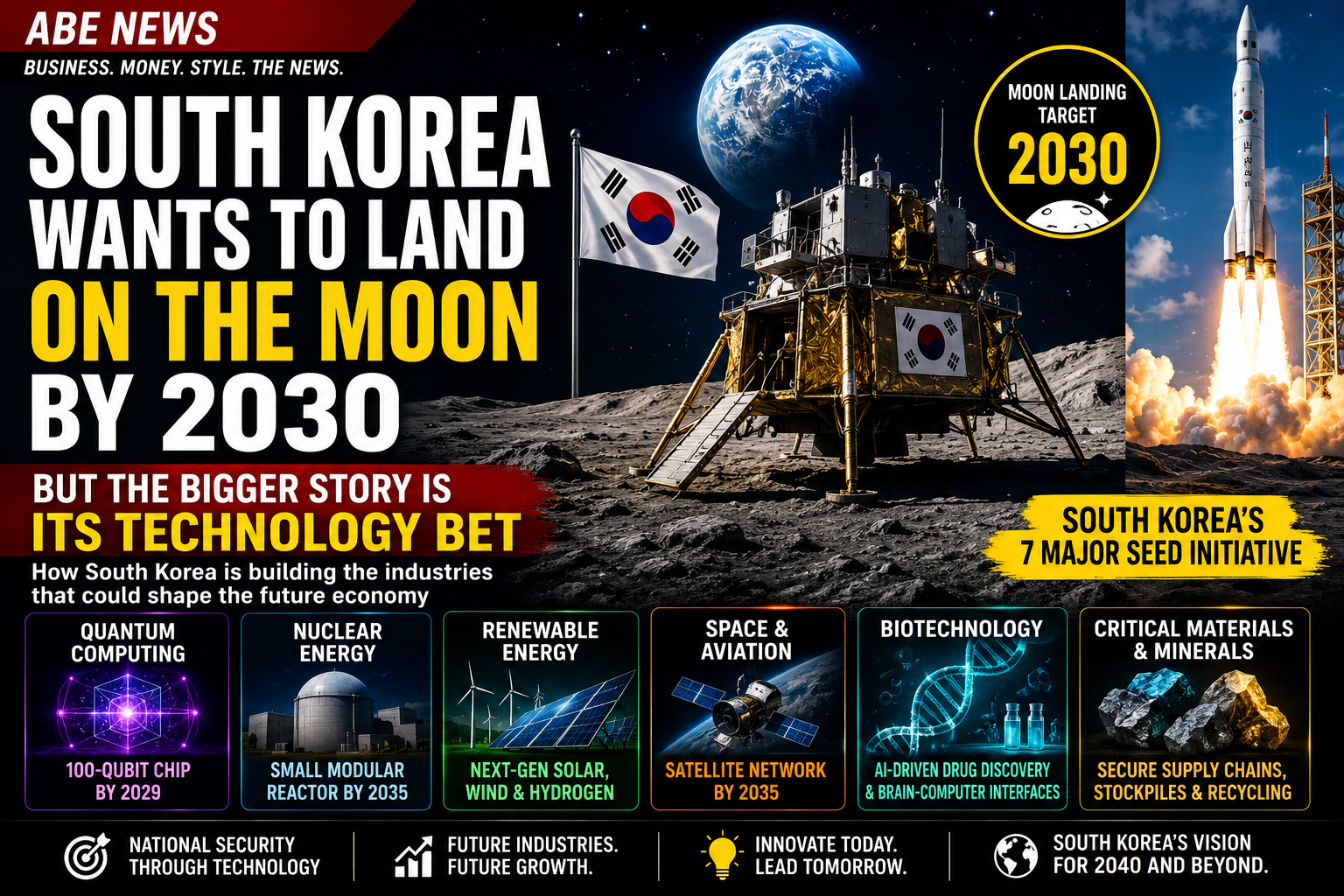
South Korea wants to land on the Moon by 2030.
That alone would be a major technological achievement.
But the Moon may actually be the least important part of the story.
South Korea has unveiled an ambitious national technology strategy covering quantum computing, nuclear energy, renewable energy, biotechnology, space, aviation and critical materials.
The country isn’t simply trying to build impressive technology.
It is preparing for something much bigger:
the industries that could shape the global economy over the next 10 to 20 years.
And South Korea doesn’t want to be watching from the sidelines.
South Korea Is Looking Beyond Chips and AI
South Korea is already one of the world’s most important technology economies.
Its semiconductor industry plays a major role in global electronics and increasingly in the infrastructure required for artificial intelligence.
But the government believes today’s strengths may not be enough for tomorrow.
Its new strategy, called the Seven Major SEED initiative, is designed to create additional engines of economic growth beyond semiconductors and AI.
The seven areas include:
- Small modular nuclear reactors
- Fusion energy
- Next-generation renewable energy
- Quantum technology
- Space and aviation
- Advanced biotechnology
- Critical minerals and materials
These aren’t small projects.
They’re industries that governments and companies around the world increasingly view as strategically important.
The Moon Is Part of a Much Larger Space Plan
One of the most eye-catching goals is a domestic Moon landing in 2030.
South Korea also wants to conduct another lunar lander mission in 2032.
But its space ambitions extend beyond exploration.
The country plans to develop an independent low-Earth-orbit satellite communications network by 2035 and explore technologies connected to space data centres.
South Korea also wants its companies to participate more deeply in the development of next-generation commercial aircraft.
In other words, the goal isn’t simply to plant a flag on the Moon.
It’s to build an industry.
Then There’s Quantum Computing
Another major target is quantum technology.
South Korea wants to develop a domestically produced error-corrected 100-qubit quantum processor by 2029.
By 2035, it wants to become a global leader in quantum-chip manufacturing.
Quantum computers work differently from the computers most people use today.
Instead of relying entirely on traditional bits represented as zeros or ones, quantum systems use quantum bits—or qubits—which can process certain types of information in fundamentally different ways.
If the technology develops successfully, it could eventually help solve extremely complex problems involving areas such as:
- Drug development
- Materials science
- Financial modelling
- Logistics
- Artificial intelligence
- Scientific research
The technology is still developing.
But countries increasingly see quantum computing as an area they cannot afford to ignore.
South Korea Is Also Betting on Nuclear Energy
Energy is another major part of the strategy.
South Korea wants to commercially deploy a domestically developed small modular reactor by 2035.
SMRs are smaller nuclear reactors designed to potentially offer more flexible construction and deployment than traditional large nuclear plants.
The government also wants to pursue electricity generated through nuclear fusion in the late 2030s.
Fusion has been one of science’s most difficult energy challenges for decades.
Successfully commercializing it could potentially transform how electricity is produced.
There is no guarantee that these timelines will be achieved.
But South Korea clearly wants its researchers and companies competing if the technology becomes commercially viable.
Renewable Energy Is Part of the Plan Too
The strategy isn’t limited to nuclear power.
South Korea also wants to develop:
- More efficient solar cells
- Advanced offshore wind technology
- Hydrogen-production systems
- AI-powered electricity-grid technology
That combination tells us something important.
The future energy competition may not have a single winner.
Countries are investing across several technologies because nobody knows exactly which systems will dominate the energy economy decades from now.
Biotechnology Could Become Another Growth Engine
South Korea is also targeting biotechnology.
The country wants to establish major AI-bio infrastructure by 2030 and commercialize brain-computer interface products by 2035.
Other areas include AI-assisted drug discovery, autonomous laboratories and advanced gene and cell therapies.
This reflects another major global trend:
Artificial intelligence is beginning to move beyond software.
It is increasingly being combined with medicine, biology, manufacturing, energy and scientific research.
The countries that build expertise across these intersections could create entirely new industries.
Why Critical Minerals Matter
Perhaps the least glamorous part of South Korea’s plan could be one of the most important.
Materials.
Advanced technologies require enormous quantities of specialized minerals and components.
Semiconductors need them.
Electric vehicles need them.
Batteries need them.
Renewable-energy infrastructure needs them.
Defence systems need them.
South Korea therefore plans to expand domestic processing and recycling, increase strategic stockpiles and diversify where important materials come from.
The country also plans to invest about 10 trillion won — approximately US$7.1 billion — by 2030 in materials, components and equipment technologies.
Because inventing tomorrow’s technology means little if you cannot secure the materials required to manufacture it.
Why Governments Are Investing So Aggressively
For decades, technology leadership was often discussed mainly as a business advantage.
Today, governments increasingly see it as something else:
national security.
Semiconductors demonstrated why.
When global chip shortages disrupted production during the pandemic, industries ranging from automobiles to consumer electronics suddenly discovered how dependent they were on a relatively small number of suppliers.
Artificial intelligence has created similar concerns.
So have critical minerals, batteries and energy infrastructure.
Countries increasingly don’t want their economies to depend entirely on technology controlled somewhere else.
South Korea’s strategy reflects that change.
There’s an Economic Problem Behind the Ambition
South Korea also faces a longer-term challenge.
Its working-age population is shrinking, while the country’s potential economic growth is slowing.
That means simply adding more workers cannot be the main engine of future growth.
Technology becomes increasingly important.
A smaller workforce that becomes significantly more productive through automation, advanced manufacturing, AI and new industries could help offset some of the economic pressure created by demographic change.
The technology strategy is therefore not just about international prestige.
It is also about South Korea’s future economy.
What This Means for Businesses
Government technology programs can eventually create opportunities far beyond government laboratories.
Building a quantum industry requires researchers, chipmakers and software companies.
Building a space industry requires aerospace manufacturers, communications companies and suppliers.
Advanced nuclear reactors require engineering companies and specialized materials.
Biotechnology requires pharmaceutical companies, laboratories and computing infrastructure.
Entire ecosystems can develop around these technologies.
And companies that establish themselves early can sometimes become global leaders when an industry eventually reaches commercial scale.
The Bigger Picture
Something important is happening around the world.
The competition between countries is increasingly becoming a competition over technology ecosystems.
Who builds the chips?
Who controls AI infrastructure?
Who develops quantum computers?
Who launches satellites?
Who produces advanced energy systems?
Who controls critical materials?
And who owns the intellectual property behind all of it?
These questions could shape economic power over the coming decades.
South Korea understands that.
Its Moon mission may capture the headlines.
But the real competition is happening much closer to Earth.
What’s Next?
Announcing ambitious targets is relatively easy.
Achieving them is much harder.
Quantum computing remains technically difficult.
Commercial fusion remains unproven.
Moon missions are expensive and risky.
Brain-computer interfaces face scientific, commercial and regulatory challenges.
South Korea will therefore have to turn government targets into actual technologies, companies and industries.
The government plans to establish a public-private task force designed to help commercialize technologies and address regulatory obstacles.
Whether the strategy succeeds will depend on execution.
But the direction is clear.
South Korea isn’t waiting to discover which industries dominate the 2030s.
It wants to help build them.
THE ABE NEWS TAKE
The most important part of South Korea’s technology strategy isn’t the Moon.
It’s the mindset behind it.
Countries used to compete primarily over factories, natural resources and trade.
Those things still matter.
But increasingly, economic power is also determined by who controls the technologies everyone else needs.
Semiconductors taught the world that lesson.
Artificial intelligence is reinforcing it.
Quantum computing, advanced energy, biotechnology and space could be next.
South Korea is essentially placing several bets at once.
Some will fail.
Some may take longer than expected.
But one successful technology could create companies, industries, exports and jobs that last for decades.
That’s why the billions being invested today shouldn’t simply be viewed as technology spending.
They’re investments in who South Korea wants to be in the economy of 2040.
And that may be the bigger story behind its journey to the Moon.
ABE NEWS
Business. Money. Style. The News.
Understand More. Think Bigger.