







ABE NEWS | TUESDAY, AUGUST 18, 2026
Two days ago, the question was:
What happens if the Strait of Hormuz stays disrupted?
Tuesday morning gave us another part of the answer.
A ship has been hit.
A crew casualty has been reported.
Oil has climbed above $90.
Iran says the strait will remain closed until the United States meets its conditions.
And one of the world’s most important energy routes is looking increasingly dangerous.
This isn’t simply another Middle East headline.
Because when ships become afraid to cross a waterway that once carried roughly one-fifth of the world’s oil and liquefied natural gas, the consequences don’t stay at sea.
They move into:
Oil prices.
Shipping costs.
Gasoline.
Inflation.
Businesses.
And eventually:
Your wallet.
🚨 What Happened Tuesday Morning?
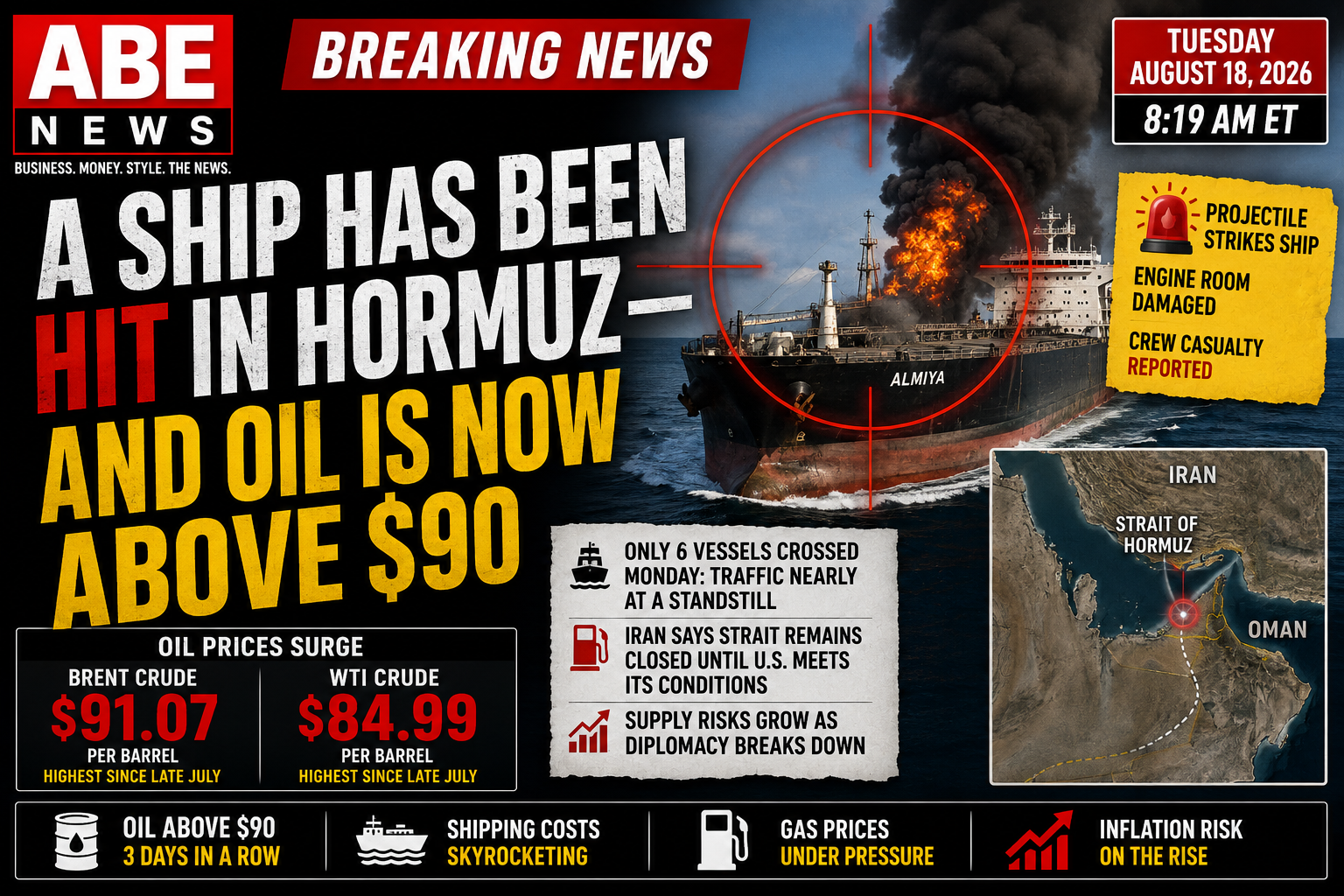
An unidentified projectile struck a vessel as it was sailing out of the Strait of Hormuz off the coast of Oman.
According to the UK Maritime Trade Operations center, the projectile damaged the ship’s engine room and resulted in a crew casualty.
Authorities are investigating.
And this part is important:
There was no immediate claim of responsibility.
So while tensions with Iran are central to the wider crisis, we do not yet know who was responsible for this particular attack.
That’s important journalism.
We report what is known.
We don’t turn suspicion into fact.
🛢️ Oil Has Now Crossed $90
Markets reacted to the deteriorating outlook.
Brent crude traded around:
$91.07 per barrel
Tuesday.
U.S. West Texas Intermediate crude was around:
$84.99 per barrel.
Both benchmarks reached their highest levels since late July during the session.
Oil has now risen for three consecutive sessions as hopes for a lasting U.S.–Iran agreement fade and traders worry about prolonged supply disruption.
That makes Sunday’s ABE NEWS story particularly important.
Then, Brent was around $88.
Our question was whether continued disruption could push the consequences further.
Now Brent has crossed $90.
But even that isn’t the most important number today.
🚢 Look at the Ships
Before the conflict, Hormuz was one of the busiest energy corridors on Earth.
Today?
Traffic remains extraordinarily limited.
Preliminary tracking data showed only six commodity vessels crossed the strait Monday.
Three entered the Gulf.
Three exited.
There were no very large crude carriers or LNG tankers recorded crossing.
Some vessels may travel with tracking systems switched off, so those numbers don’t capture absolutely everything.
But six is still an extraordinary number for such an important global trade route.
And that tells us something oil prices alone cannot.
Companies are treating this route as dangerous.
🇮🇷 Iran Says Hormuz Stays Closed
The diplomatic situation isn’t improving either.
Iran’s top negotiator Mohammad Baqer Qalibaf said Tuesday that the Strait of Hormuz will remain closed until the United States meets conditions contained in an interim agreement signed in June.
Iran’s demands include:
lifting the blockade on Iranian ports,
removing oil sanctions,
releasing frozen Iranian assets,
and
ending military threats and operations.
That June agreement was supposed to create a path toward a broader settlement.
Instead, it unraveled.
President Donald Trump declared the agreement “over” in July, and Iran subsequently declared it suspended.
Now negotiations are stalled.
And Iran has signaled a more aggressive posture.
That means businesses aren’t simply waiting for shipping conditions to improve.
They’re waiting for diplomacy to work.
🌏 China Isn’t Waiting
And this may be one of the most important developments in the entire story.
Two major Chinese state-controlled shipping companies have stopped sending their oil tankers through both the Strait of Hormuz and Bab el-Mandeb since late July.
Instead, they’re collecting oil outside the Gulf through ship-to-ship transfers.
Why?
Security.
China is the world’s largest oil importer.
Its shipping companies can’t simply stop obtaining oil.
So they’re adapting.
Longer journeys.
Different loading points.
More waiting.
More complicated logistics.
And significantly higher shipping costs.
That’s what businesses do when geopolitics breaks the normal system.
They build another system.
But another system usually costs more.
💰 And Shipping Costs Are Exploding
Here’s a number worth watching.
Reuters reported that daily freight rates on the Oman-to-China route were recently around:
$140,000 per day per vessel.
Before the Iran war, a very large crude carrier on a comparable route generated roughly $30,000 to $40,000 in daily profit, according to an industry executive.
War risk has transformed the economics of moving oil.
And remember:
Someone eventually pays for transportation.
Maybe the oil producer.
Maybe the refiner.
Maybe the shipping company.
Maybe the fuel distributor.
Maybe the consumer.
But the cost doesn’t simply disappear.
🇸🇦 Saudi Arabia Is Trying Something Different
There is one piece of potentially encouraging news.
Saudi Arabia has resumed some oil loading from inside the Strait of Hormuz.
Three very large crude carriers loaded approximately 2 million barrels each from Saudi terminals between August 12 and August 16.
More tankers could follow.
Saudi Aramco has also offered crude to Asian refiners using ship-to-ship transfers off Fujairah in the United Arab Emirates.
That could help ease some supply pressure.
But don’t confuse:
some oil moving
with:
Hormuz returning to normal.
Those are completely different things.
Shipping through the strait remains severely constrained.
⛽ Then This Reaches the Gas Pump
This is where ABE NEWS readers should connect today’s story to yesterday’s Canadian inflation report.
Yesterday we reported that Canadian gasoline prices were up 25.7% year over year in July.
Today oil is above $90.
Those aren’t unrelated worlds.
Crude oil prices influence the cost of producing gasoline.
If oil remains expensive for long enough, motorists can feel it.
Then transportation companies feel it.
Then airlines.
Then delivery businesses.
Then manufacturers.
Then retailers.
And eventually the question becomes:
How much of those additional costs get passed to customers?
That’s how an energy crisis can become an inflation problem.
🏦 And Then Central Banks Have a Problem
Imagine you’re a central banker.
You’ve spent years trying to bring inflation under control.
Underlying price pressures finally begin stabilizing.
Then geopolitics sends energy prices sharply higher.
What do you do?
Interest rates cannot reopen Hormuz.
They cannot protect tankers.
They cannot negotiate peace.
But central banks also cannot ignore energy inflation if it begins spreading throughout the economy.
That’s the danger.
The first-round effect is:
Oil gets expensive.
The second-round effect is:
Everything that depends on oil starts getting expensive.
The second one is what policymakers fear.
📦 This Is Bigger Than Oil
Hormuz isn’t only an oil story.
Before the war, around a fifth of global oil and LNG flows passed through the waterway.
And the broader Middle Eastern shipping system is under pressure elsewhere too.
Saudi exports through the Red Sea are facing disruption from the Houthi blockade.
That means companies aren’t dealing with one isolated shipping problem.
They’re navigating multiple chokepoints simultaneously.
And that’s where global supply chains become vulnerable.
For decades, companies optimized everything around one idea:
Efficiency.
The cheapest route.
The fastest supplier.
The lowest inventory.
The smallest transportation cost.
But crises keep teaching businesses another word:
Resilience.
Sometimes the cheapest supply chain isn’t the safest one.
🌍 What Happens Next?
There are three things to watch.
1. SHIPPING
Do more vessels begin crossing Hormuz?
Or does Tuesday’s attack make shipping companies even more reluctant?
2. DIPLOMACY
Can Washington and Tehran restart meaningful negotiations?
Iran says the strait remains closed until its conditions are met.
Washington has rejected extending the previous arrangement.
Something has to change for a durable settlement to emerge.
3. OIL
Brent has crossed $90.
The important question now isn’t whether it touched that number.
It’s:
Does it stay there?
A short spike is one thing.
Weeks or months of elevated energy prices would be a completely different economic story.
🔴 THE ABE NEWS TAKE
The most important number today isn’t $91.
It isn’t six ships.
And it isn’t even one-fifth of global energy flows.
It’s:
One.
One ship.
Because one attack can change how hundreds of other shipowners think.
And that is how geopolitical risk becomes economic risk.
The global economy doesn’t require every tanker to be attacked before there is a problem.
It only requires enough companies to believe:
“Sending my ship through there isn’t worth the risk.”
Then ships reroute.
Insurance becomes more expensive.
Freight becomes more expensive.
Oil becomes harder to move.
Supply chains adapt.
Businesses pay more.
And consumers eventually discover that something happening thousands of kilometres away has appeared on their receipt.
That’s why Hormuz matters.
It’s not simply a narrow waterway between Iran and Oman.
It’s a pressure point inside the global economy.
And Tuesday morning delivered another warning about what happens when pressure keeps building.
The ship was hit in Hormuz.
But the economic shockwave may travel much farther.
ABE NEWS
Business. Money. Style. The News.
Understand More. Think Bigger.