




ABE NEWS | SEPTEMBER 26, 2026
For more than a decade, Manchester City has represented one of football’s most extraordinary transformations.
A club purchased by Abu Dhabi investors in 2008 became a global sporting powerhouse, assembling some of the world’s best players, hiring elite managers, building a multinational football network and collecting trophies at a remarkable pace.
Now, the financial model behind that era faces its most consequential test.
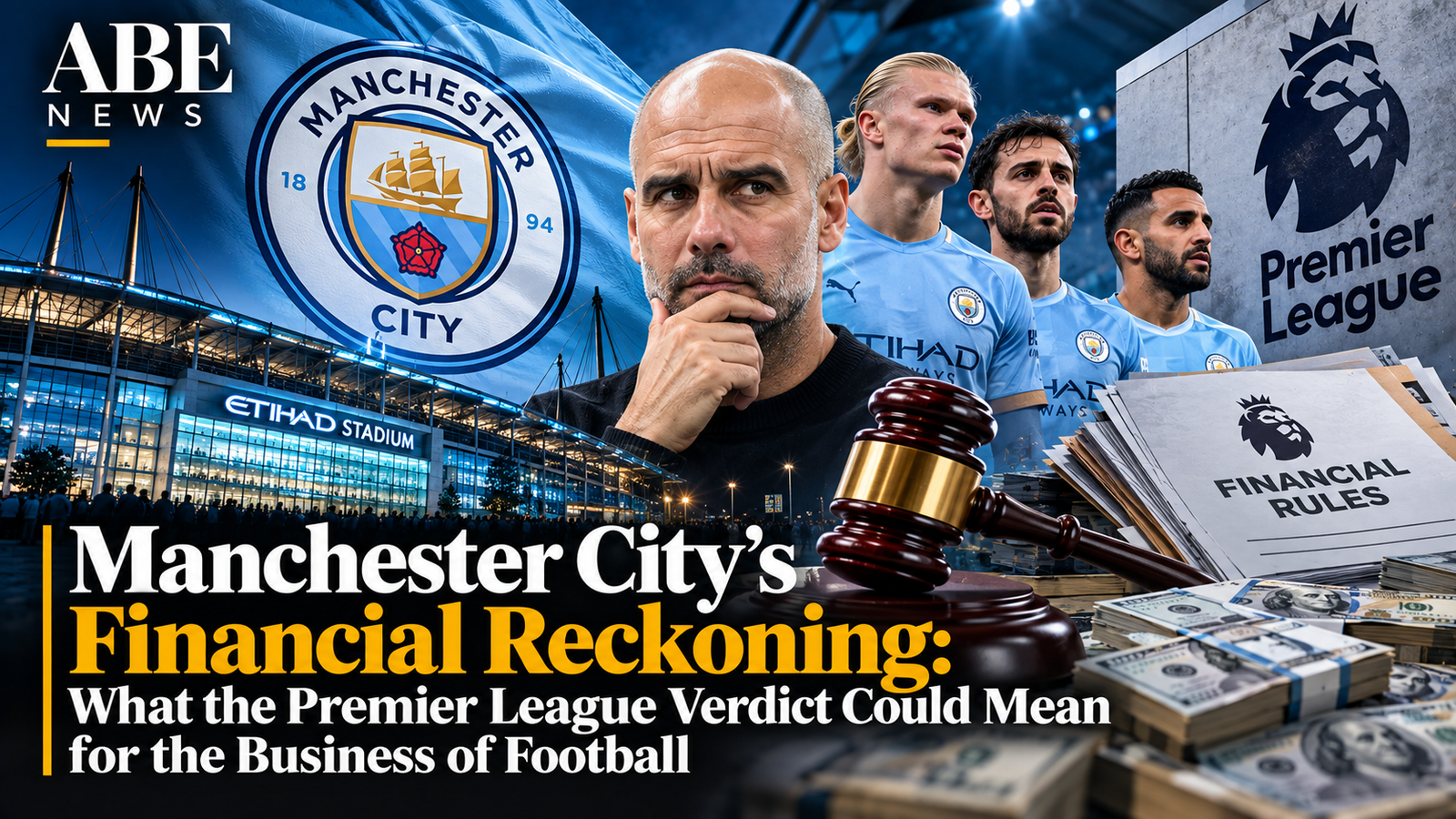
An independent commission has reportedly found Manchester City guilty on 114 of 115 Premier League financial-rule charges, according to multiple reports. The Premier League and Manchester City have not yet publicly released the commission’s final decision, and the club says the process remains ongoing. City has consistently denied wrongdoing and is expected to appeal.
No punishment has yet been determined.
That uncertainty is crucial. Possible sanctions should not be presented as settled fact.
But whatever ultimately happens to Manchester City, the case has already become about something considerably bigger than one football club.
It is about whether the financial rules governing the world’s richest domestic football league can effectively regulate its most powerful institutions — and what happens to the business of football when enormous private wealth collides with sporting regulation.
MORE THAN 100 CHARGES AND YEARS OF LEGAL WARFARE
The case stretches back years.
The Premier League formally referred Manchester City to an independent commission in February 2023 following an investigation that began in 2019.
The original allegations covered multiple areas, including the requirement to provide accurate financial information about revenue, sponsorship, related parties and operating costs; rules concerning manager and player remuneration; UEFA financial regulations; Premier League profitability and sustainability requirements; and requirements to cooperate with the league’s investigation.
The alleged conduct stretched across seasons from 2009-10 through 2022-23, depending on the category of charge.
City denied the allegations.
Now, reports say the independent panel has found the club guilty on virtually all counts. The Guardian reported that Premier League clubs were informed of the outcome at a shareholders’ meeting and required to sign non-disclosure agreements.
Manchester City responded by emphasizing that proceedings have not concluded.
“The Premier League process remains ongoing, with significant elements to be completed.”
The club also reiterated its position that the process should be independent and impartial.
That means football is still waiting for two things that could ultimately prove decisive:
the sanction and the appeal.
WHY THIS ISN’T JUST A FOOTBALL STORY
Manchester City’s rise coincided with an enormous transformation in the economics of football.
When the Abu Dhabi United Group bought City in 2008, the takeover was valued at roughly £200 million.
What followed demonstrated how quickly enormous capital could change the competitive position of a football club.
Elite players arrived.
Infrastructure expanded.
Commercial revenue grew.
Pep Guardiola eventually built one of the most successful teams of the modern era.
Between 2009-10 and 2022-23, City won seven Premier League titles, a Champions League, three FA Cups and six League Cups.
But modern football is not supposed to operate entirely according to one principle:
whoever has the wealthiest owner can spend whatever they want.
Financial regulations emerged partly to impose constraints on that model.
And that is what makes the Manchester City case so significant.
If financial rules cannot effectively constrain the biggest clubs, the credibility of those rules comes into question.
If they can, owners must accept that even extraordinary financial resources exist within regulatory boundaries.
THE BUSINESS MODEL OF MODERN FOOTBALL IS ON TRIAL TOO
Elite football clubs today look increasingly like multinational entertainment companies.
Their businesses stretch far beyond ticket sales.
Broadcasting rights generate billions.
Sponsors pay enormous amounts to associate themselves with clubs.
Shirts are sold around the world.
Stadiums have become commercial destinations.
Players themselves are global brands.
Social-media audiences can stretch into the hundreds of millions.
And investors increasingly treat football clubs as valuable international assets.
Manchester City sits near the centre of that transformation.
Its parent organization, City Football Group, has built a global network of football investments spanning multiple countries and continents.
That means regulatory decisions affecting Manchester City potentially reach beyond the standings of the Premier League.
They can affect the reputation of a global sports business.
WHAT COULD THE PUNISHMENT BE?
This is the question dominating football.
But it is also where reporting needs to be careful.
There is no confirmed sanction yet.
The independent panel still has to determine the consequences of its findings, according to reports published Friday and Saturday.
That means speculation about relegation, points deductions, fines or titles should not be reported as though any of those outcomes has been decided.
Former Manchester City chairman David Bernstein has already argued publicly that a purely financial penalty would not be sufficient, but that represents his view — not the commission’s decision.
City is also expected to appeal.
That could make the legal process substantially longer.
So the immediate question isn’t simply:
How will Manchester City be punished?
It is:
What punishment can the Premier League impose that survives the next stage of the legal fight?
A FINE MAY MEAN SOMETHING DIFFERENT TO A SUPER-RICH CLUB
The case exposes a fundamental problem in sports regulation.
Imagine two companies break the same rule and each receives a £10 million fine.
For one company, £10 million could threaten its survival.
For another, it could be manageable.
The punishment is technically identical.
Its economic impact is not.
That problem becomes especially important in football when clubs are backed by enormously wealthy owners.
A financial penalty that would devastate a smaller club might have substantially less deterrent effect on one with far greater financial resources.
This is why sporting regulators also have tools that affect competition rather than simply cash.
Points matter.
League position matters.
Qualification for European competition matters.
And ultimately, sporting success is the asset football clubs value most.
The challenge for regulators is ensuring that punishment is proportionate to established breaches while also surviving legal scrutiny.
THE PREMIER LEAGUE HAS ITS OWN REPUTATION AT STAKE
Manchester City isn’t the only institution being judged here.
So is the Premier League.
The league markets itself as one of the world’s premier sporting competitions.
Its global appeal depends partly on unpredictability and competitive legitimacy.
Fans need to believe that the rules apply across the competition.
Investors need predictable governance.
Sponsors need confidence in the product.
Broadcasters pay enormous sums because the Premier League represents premium global entertainment.
A financial regulatory system perceived as either ineffective or arbitrarily enforced can undermine that confidence.
That leaves the Premier League in an uncomfortable position.
A weak response could lead critics to question whether its financial rules have meaningful force.
An excessively severe response could provoke years of litigation and arguments over proportionality.
Whatever happens next will therefore help define the authority of the league itself.
OTHER CLUBS WILL BE WATCHING CLOSELY
Manchester City’s rivals have an obvious interest in the outcome.
Football is a zero-sum competition.
Only one club can win the Premier League.
Only a limited number can qualify for the Champions League.
Only two teams can reach a cup final.
And every league position can carry financial consequences.
During the period covered by the charges, Manchester City became the dominant force in English football.
That means the case inevitably raises questions among rival clubs and supporters about competitive consequences.
But those questions should remain separate from established facts.
There has been no final publicly announced sanction, and the expected appeal means the first-instance findings may themselves face further challenge.
Rewriting historical league tables or reallocating trophies remains speculation unless football authorities actually decide to take such action.
THE AGE OF THE BILLIONAIRE FOOTBALL OWNER IS CHANGING
The Manchester City case also belongs to a broader transformation.
Football clubs have become attractive assets for billionaires, private-equity firms, sovereign-linked investors and multinational investment groups.
That influx of capital has changed the sport.
It has helped finance extraordinary stadiums, training facilities and player acquisitions.
It has globalized club brands.
It has pushed valuations upward.
But it has also created a regulatory dilemma.
What happens when the financial capacity of an owner vastly exceeds the traditional economics of the club they purchase?
Without restrictions, enormous outside capital can potentially reshape competition very quickly.
With restrictions, regulators must decide what spending represents legitimate investment and what crosses the boundaries designed to preserve financial sustainability or competitive balance.
Manchester City’s case therefore isn’t simply about accounting.
It sits inside a much larger argument over what ownership should be allowed to buy in professional sport.
AND THE MONEY KEEPS GETTING BIGGER
That question becomes more important as football becomes more valuable.
The Premier League’s commercial reach extends across the world.
International broadcasters compete for rights.
American investors have purchased stakes in English clubs.
Middle Eastern capital has become increasingly visible.
Private-equity firms have entered sports ownership and financing.
Major technology companies have become potential distributors of live sport.
Football is no longer merely a competition between local sporting institutions.
It is an international entertainment industry.
And Manchester City has become one of its most recognizable global brands.
The bigger football becomes as a business, the more consequential its financial regulation becomes.
THE NEXT VERDICT MAY MATTER MORE THAN THE FIRST
Friday’s reported finding answers one major question.
But it opens another.
What happens now?
The sanction will determine how seriously the findings affect Manchester City competitively.
The expected appeal will determine whether those findings survive further scrutiny.
And the final resolution will establish a precedent that clubs, owners, lawyers and regulators across English football will study closely.
This could still take time.
Manchester City says significant elements of the process remain unfinished.
That is why the story should not be treated as finished.
It has entered another phase.
🔴 THE ABE NEWS TAKE
The Manchester City case is ultimately about something bigger than Manchester City.
Modern football has spent two decades becoming richer, more global and more attractive to some of the world’s most powerful investors.
But money creates a question that sport cannot avoid:
Where does investment end and competitive advantage become something regulators must constrain?
There is nothing inherently wrong with wealthy owners investing in football.
Capital can build stadiums, academies, businesses and extraordinary teams.
But a competition only works when its participants believe there are rules governing how that capital can be used — and that those rules apply regardless of how valuable or powerful a club becomes.
Manchester City maintains that it has done nothing wrong and is expected to continue challenging the findings. The Premier League has not yet publicly announced the commission’s final award or a sanction.
So the final chapter has not been written.
But the stakes are now clear.
This isn’t merely a fight over Manchester City’s past.
It is a fight over how football’s increasingly enormous future will be governed.
ABE NEWS
Business. Money. Style. The News.
Understand More. Think Bigger.