





ABE NEWS | Week in Business | Friday, September 4, 2026
Welcome to ABE NEWS Week in Business — our Friday look back at the companies, markets, money and economic developments that defined the week.
And this week delivered something remarkable.
Nearly everywhere you looked, businesses were confronting the same fundamental question:
How much does it cost to build the future?
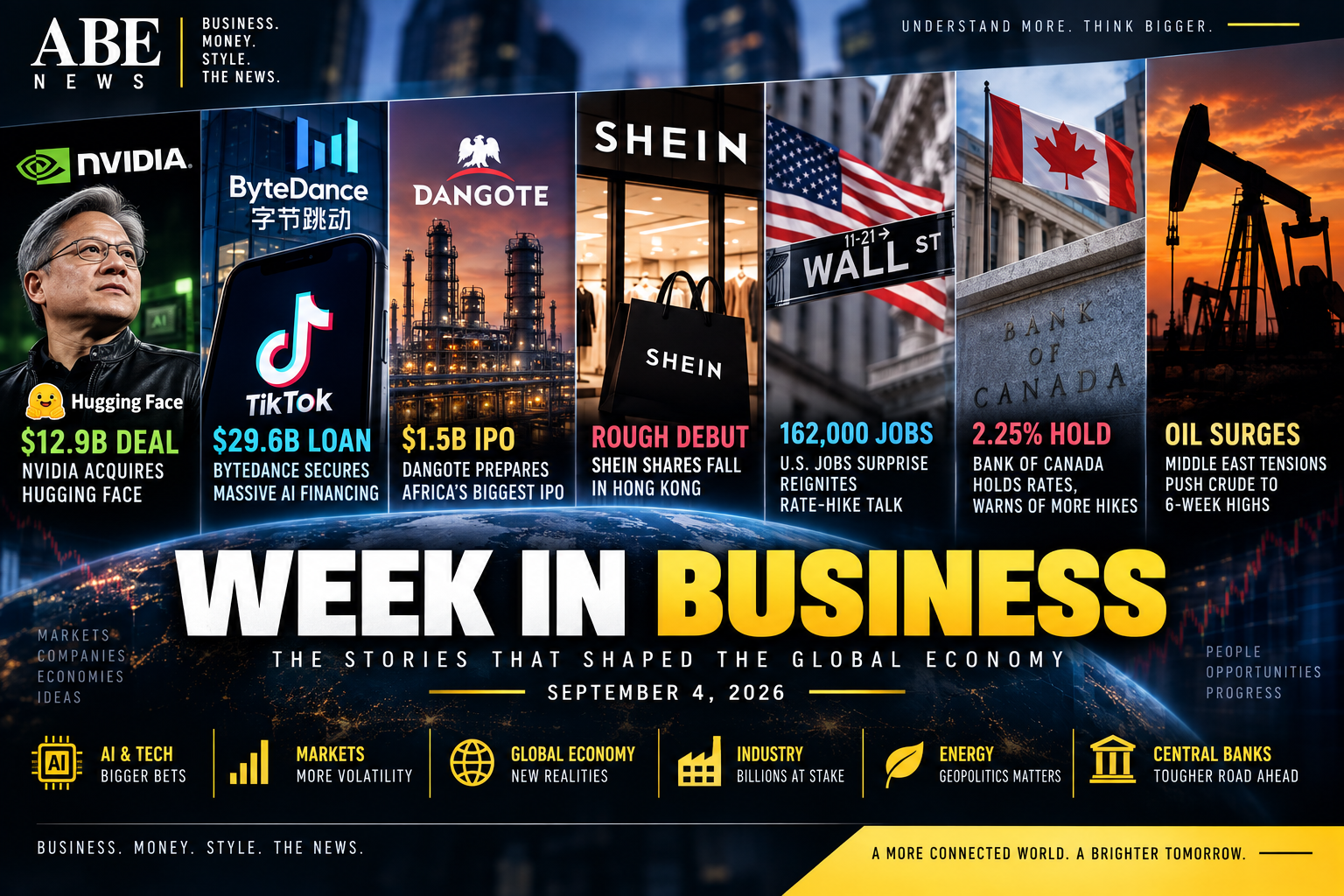
Nvidia answered with almost $13 billion.
ByteDance answered with a $29.6 billion financing.
Dangote is preparing to ask public investors for roughly $1.5 billion.
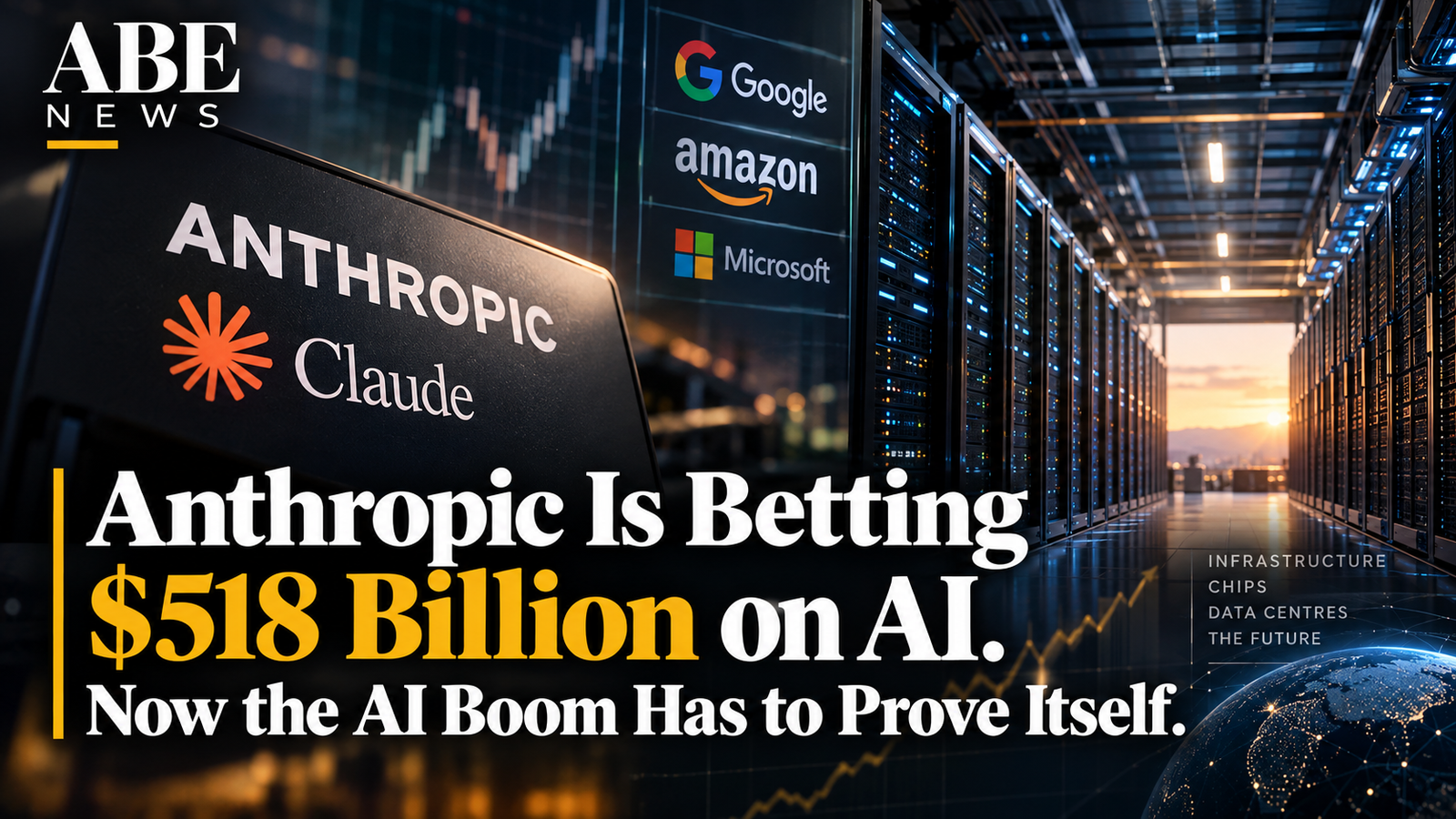
America’s AI companies are discovering that building data centres requires not only money, but electricity, water, land and political support.
And after investors spent much of the week debating whether interest rates might finally stabilize, Friday’s surprisingly strong U.S. jobs report changed the conversation again.
From Silicon Valley to Lagos, Beijing to Toronto, here are the stories that defined the week in business.
1. NVIDIA SPENT NEARLY $13 BILLION TO MOVE BEYOND CHIPS
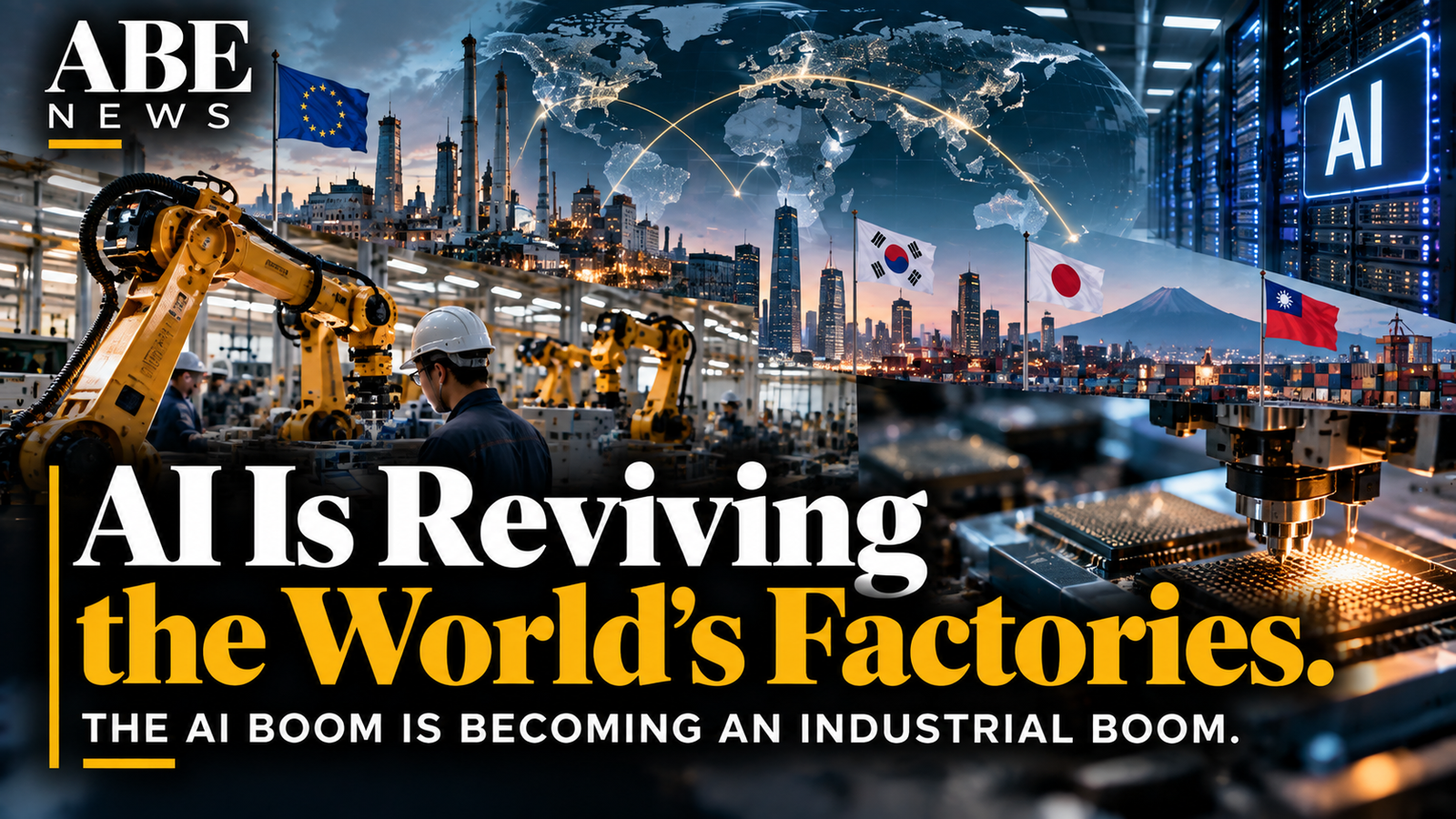
Few companies have benefited from the artificial-intelligence boom more than Nvidia.
But this week, Jensen Huang demonstrated that Nvidia doesn’t intend to remain merely the company selling the chips underneath AI.
Nvidia agreed to acquire Hugging Face for approximately $12.93 billion.
That matters because Hugging Face occupies a very different position in the AI industry.
It is one of the world’s most important platforms for developers working with AI models, datasets and applications.
In other words:
Nvidia already dominates much of the computing infrastructure.
Hugging Face brings it closer to the models and the developers.
That makes the acquisition a strategic bet on the entire AI ecosystem.
Nvidia says Hugging Face will remain open and developers will not be forced to use Nvidia hardware.
That promise will be crucial.
Hugging Face’s influence comes partly from being a place where developers can work across different models, frameworks, clouds and hardware.
But the deal raises a much larger question:
How much of the AI stack does Nvidia ultimately want to control?
Chips were only the beginning.
Software followed.
Networking followed.
AI systems followed.
Now comes one of the industry’s largest developer communities.
ABE VERDICT:
Deal of the Week.
The $12.93 billion price is enormous.
The strategic implications may be even larger.
2. BYTEDANCE FOUND NEARLY $30 BILLION FOR THE AI RACE
If Nvidia’s acquisition demonstrated the strategic value of AI infrastructure, ByteDance demonstrated how expensive competing in AI has become.
The Chinese technology giant behind TikTok secured a massive $29.6 billion unsecured loan facility involving nearly 30 banks.
ByteDance originally sought around $20 billion.
Demand from lenders was strong enough for the financing to grow substantially beyond that level.
The significance isn’t simply the size of the loan.
It is what the financing tells us about modern technology.
Artificial intelligence increasingly requires:
chips,
data centres,
power,
networking,
international infrastructure,
and enormous amounts of capital.
Software companies are beginning to look more like industrial companies.
ByteDance is also operating inside a particularly complicated environment.
It wants to compete with American AI leaders while Chinese companies face restrictions on access to some advanced U.S. semiconductor technology.
That makes domestic chips and overseas computing infrastructure increasingly strategically important.
The AI race is no longer simply about who has the smartest model.
It is about who can finance the infrastructure required to run those models at enormous scale.
ABE VERDICT:
Financing of the Week.
A nearly $30 billion unsecured corporate facility tells us that banks are making their own enormous wager on the AI boom.
3. AI’S BIGGEST BOTTLENECK MAY NOT BE CHIPS ANYMORE
For years, the most famous constraint on AI expansion was Nvidia GPUs.
This week provided more evidence that the next constraint could be something much older:
electricity.
Across parts of the United States, proposed large electricity users — predominantly data-centre projects — have requested extraordinary amounts of grid capacity.
Texas has become the clearest example of the problem.
The state enthusiastically embraced AI investment.
Now political leaders are becoming increasingly concerned about the consequences.
Electricity costs.
Grid infrastructure.
Water.
Land.
Tax incentives.
And whether communities actually receive enough economic benefit from enormous data-centre developments.
Texas Governor Greg Abbott, who previously promoted Texas as a centre of AI development, is now pushing tougher requirements for data-centre operators.
The political backlash is spreading beyond one state.
And that’s a major development for the AI industry.
Silicon Valley can buy GPUs.
It can raise billions.
It can build models.
But electricity infrastructure cannot simply appear overnight.
Power plants take time.
Transmission lines take time.
Substations take time.
Permits take time.
Community approval takes time.
That means the next phase of the AI race could be decided partly by energy policy.
ABE VERDICT:
Infrastructure Story of the Week.
The AI revolution is becoming physical — and communities are beginning to demand a say in how it is built.
4. SHEIN FINALLY REACHED THE STOCK MARKET — AND INVESTORS WEREN’T CELEBRATING
One of the world’s most recognizable fast-fashion companies finally became publicly traded this week.
But Shein’s Hong Kong debut wasn’t the triumphant arrival executives might have wanted.
Shares fell on their first day of trading.
That reflected lingering investor concerns about growth and regulatory risks surrounding the company.
Shein’s path to the public markets had already been unusually complicated.
The company previously explored listings elsewhere before ultimately turning to Hong Kong.
Its business model transformed global fast fashion.
Extremely rapid product cycles.
Low prices.
A huge online catalogue.
Sophisticated supply-chain technology.
And a social-media-driven approach to attracting younger consumers.
But the same scale that made Shein enormously successful has also brought scrutiny.
Regulation.
Supply chains.
Competition.
Sustainability.
And questions about whether the explosive growth of earlier years can continue.
The weak debut therefore became a useful reminder:
A famous brand does not automatically equal an enthusiastic stock market.
ABE VERDICT:
IPO Reality Check of the Week.
Shein reached the market.
Now it has to convince public investors that its next chapter can match its first.
5. DANGOTE IS PREPARING WHAT COULD BECOME AFRICA’S BIGGEST IPO
Africa produced one of the week’s most consequential business stories.
Aliko Dangote is preparing to take his enormous Nigerian oil refinery to the public market.
Current plans point toward roughly $1.5 billion being raised through the sale of approximately 4.1 billion shares, according to people familiar with the transaction.
The offering is expected to open in September.
If completed on the planned scale, it would become Africa’s largest IPO.
But the capital raise is only part of the story.
Dangote wants to expand the refinery from approximately 650,000 barrels per day to 1.4 million barrels per day.
That is an extraordinary industrial ambition.
Nigeria has spent decades producing crude oil while remaining heavily dependent on imported refined petroleum products.
Dangote’s refinery attempts to change that equation.
Instead of simply exporting the raw resource:
process more of it in Africa.
And the IPO adds another dimension.
Instead of relying exclusively on private capital and international financing:
bring African public capital into the project.
That makes the transaction much bigger than another stock-market listing.
It is a test of whether African capital markets can help finance African industrialization at enormous scale.
ABE VERDICT:
African Business Story of the Week.
If successful, this IPO could become a landmark transaction for the continent’s capital markets.
6. OIL REMINDED THE WORLD THAT GEOPOLITICS STILL SETS PRICES
Artificial intelligence dominated technology headlines.
But energy markets spent the week confronting a much older force:
war.
Renewed U.S.–Iran fighting and uncertainty surrounding Middle Eastern supply routes pushed crude prices to six-week highs during the week.
Brent climbed above $97 a barrel at one point.
The Strait of Hormuz remains particularly important.
A significant share of globally traded petroleum passes through or near this narrow maritime corridor.
Any disruption can therefore affect fuel prices far beyond the Middle East.
That matters to businesses everywhere.
Higher oil prices increase transportation costs.
Airlines pay more for fuel.
Trucking becomes more expensive.
Manufacturing costs can rise.
Consumers eventually feel the pressure through gasoline, shipping and goods prices.
By Friday, oil had retreated from some of those highs.
But the week provided another reminder that energy security remains deeply connected to global business.
ABE VERDICT:
Commodity Story of the Week.
The world may be investing trillions in AI, but a narrow shipping route in the Middle East can still move the global economy.
7. CANADA’S CENTRAL BANK HELD RATES — BUT THE MESSAGE WASN’T COMFORTING
Canada had an important monetary-policy moment this week.
The Bank of Canada held its key policy rate at 2.25%.
That was widely expected.
The surprise was the warning around what could come next.
Governor Tiff Macklem indicated policymakers could need to raise borrowing costs more than once if inflation remains too high.
For Canadian households and businesses, that matters.
Interest rates affect:
mortgages,
business loans,
credit,
investment,
construction,
consumer spending,
and the Canadian dollar.
The central bank is confronting an uncomfortable balance.
Raise rates too aggressively and economic activity suffers.
Keep them too low while inflation remains persistent and price pressures can become entrenched.
Canadian economic data delivered another interesting signal Friday: the Ivey Purchasing Managers Index climbed to 64.3 in August from 55.1 in July, its strongest level since May 2022.
That suggests economic activity remains more resilient than some expected.
ABE VERDICT:
Canada Story of the Week.
The Bank of Canada didn’t raise rates this week.
But it made clear that Canada’s inflation fight isn’t necessarily finished.
8. THEN AMERICA’S JOBS REPORT CHANGED THE INTEREST-RATE CONVERSATION
Friday morning delivered the week’s final market shock.
The United States added 162,000 jobs in August.
Economists surveyed by Reuters had expected only about 56,000.
Unemployment remained at 4.1%.
That difference matters enormously.
Investors had been trying to determine whether the American economy was weakening enough for the Federal Reserve to remain patient.
Instead, the jobs report showed a surprisingly resilient labour market.
Markets responded immediately.
Expectations of a September Federal Reserve rate increase jumped.
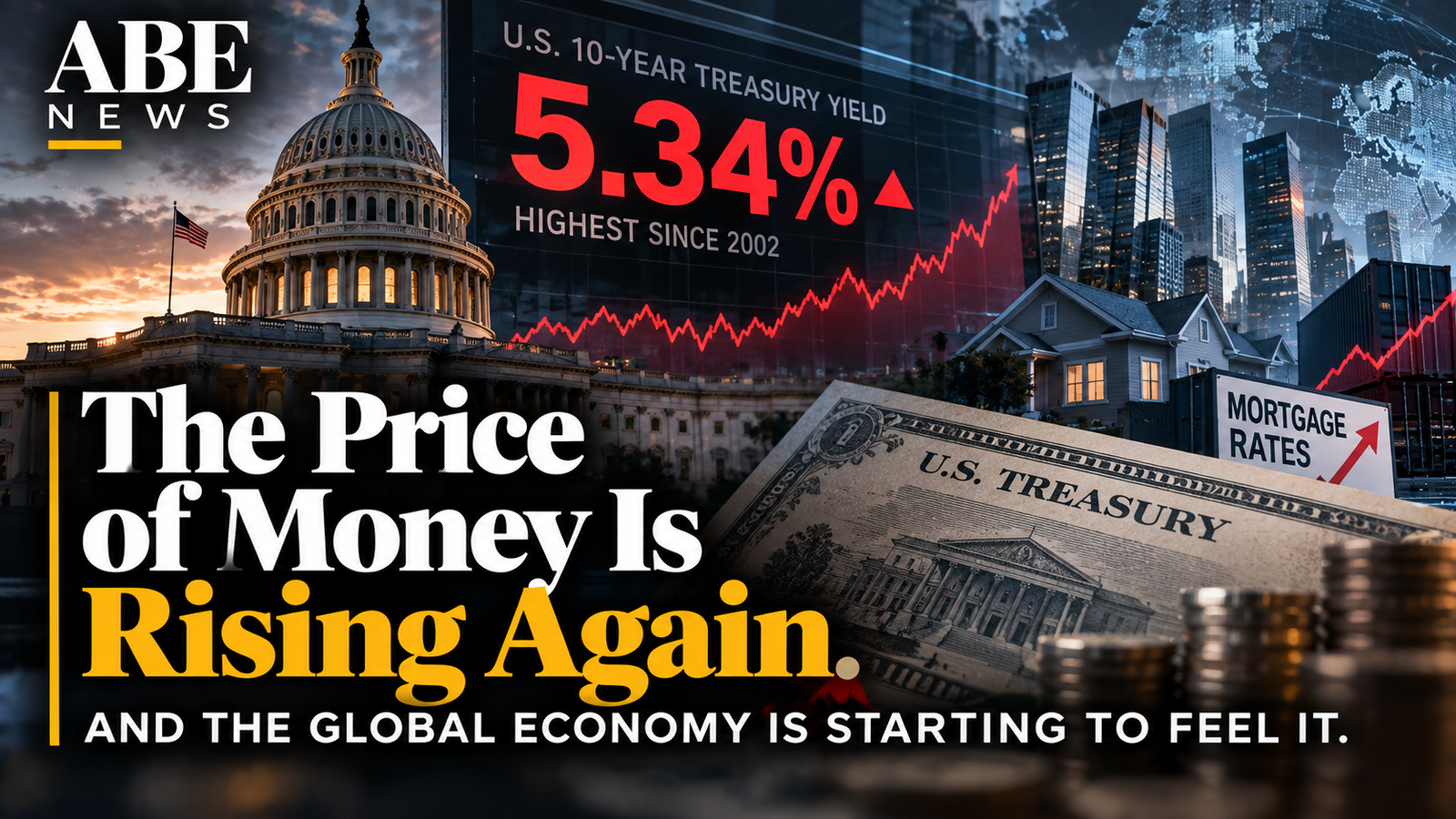
Treasury yields rose.
The dollar strengthened.
Gold fell.
Stocks initially struggled.
The logic is simple.
A strong labour market is generally good news for the economy.
But when inflation remains a concern, too much economic strength can make the Federal Reserve more willing to keep monetary policy tight.
That produces one of the strangest features of modern financial markets:
Good economic news can become bad market news.
ABE VERDICT:
Economic Surprise of the Week.
Friday’s jobs report ensured investors will spend the weekend debating interest rates all over again.
9. THE AI BOOM CREATED WINNERS FAR BEYOND NVIDIA
One of the quieter but extremely important stories this week was the expansion of the AI investment boom into industries that rarely receive the same attention as chipmakers.
Data centres need much more than processors.
They require:
electrical equipment,
transformers,
cooling systems,
power-conversion technology,
construction,
energy generation,
backup power,
and grid infrastructure.
That means companies providing those products are increasingly becoming indirect beneficiaries of AI spending.
The market is beginning to recognize that the AI economy has a much broader supply chain than Nvidia.
The gold rush isn’t only benefiting the company selling the picks and shovels.
Now companies selling the electricity equipment, cooling systems and infrastructure surrounding those shovels are benefiting too.
ABE VERDICT:
Trend to Watch.
The next generation of AI winners may include companies most consumers have never heard of.
10. CANADA AND THE UNITED STATES ARE STILL TRYING TO FIND A TRADE DEAL
Trade remained one of the most important business risks hanging over North America this week.
Canadian Prime Minister Mark Carney said Canada remains ready to sign an agreement with the United States — provided the deal benefits both countries.
That statement comes against the backdrop of continuing trade tensions and tariffs that have created uncertainty for companies operating across the world’s largest bilateral trading relationship.
For Canadian businesses, the stakes are enormous.
The United States is Canada’s dominant export market.
Automotive supply chains cross the border repeatedly.
Energy flows south.
Agriculture crosses both ways.
Manufacturers depend on integrated North American production networks.
Every additional tariff or regulatory barrier creates costs somewhere in that system.
A deal would therefore provide businesses something nearly as valuable as lower tariffs:
certainty.
ABE VERDICT:
Trade Story to Watch Next Week.
Canada is signalling readiness.
Whether Washington and Ottawa can turn that into an agreement remains the important question.
📊 THE WEEK BY THE NUMBERS
$12.93 BILLION
Nvidia’s agreed purchase price for Hugging Face.
$29.6 BILLION
ByteDance’s enormous new financing facility.
~$1.5 BILLION
Amount Dangote Refinery is expected to seek from its IPO under current plans.
1.4 MILLION BARRELS/DAY
Dangote’s targeted future refining capacity.
2.25%
Bank of Canada’s policy rate after this week’s hold.
162,000
U.S. jobs added in August.
4.1%
U.S. unemployment rate.
64.3
Canada’s August Ivey PMI.
$97+
The level Brent crude exceeded during this week’s oil rally.
🏆 ABE’S WEEKLY SCORECARD
Deal of the Week: Nvidia → Hugging Face
Financing of the Week: ByteDance → $29.6 billion
African Business Story: Dangote Refinery IPO
Economic Surprise: U.S. jobs blow past expectations
Canada Story: Bank of Canada holds at 2.25%
Consumer/IPO Story: Shein’s difficult Hong Kong debut
Energy Story: Oil surges as Middle East tensions return
Biggest Emerging Business Risk: AI’s electricity problem
Trend We’re Watching: AI spending spreading from chips into power, cooling and infrastructure
🔴 THE ABE NEWS TAKE
Step back from the individual headlines and one theme dominates this week:
The future is becoming extremely expensive.
Look at the numbers.
Nvidia:
Nearly $13 billion for Hugging Face.
ByteDance:
$29.6 billion of financing.
Dangote:
Around $1.5 billion potentially coming from public investors.
AI companies:
Billions more required for data centres, chips and electricity.
Governments:
Infrastructure investments required to support all of it.
This is what makes the current business cycle unusual.
For years, technology convinced the world that enormous businesses could be built with relatively little physical infrastructure.
Software changed that equation.
Build the product.
Put it online.
Distribute it globally.
Scale rapidly.
AI is reversing part of that model.
The software may live in the cloud.
But the cloud requires enormous physical infrastructure.
And physical infrastructure is expensive.
That brings technology increasingly close to industries such as energy, telecommunications and manufacturing.
It also creates new constraints.
Money.
Electricity.
Water.
Land.
Government approval.
Community acceptance.
Nvidia’s Hugging Face acquisition demonstrates companies racing to control more of the AI ecosystem.
ByteDance’s financing demonstrates how much capital competitors are prepared to mobilize.
Texas demonstrates what happens when digital ambition collides with physical limits.
And the interest-rate stories remind us that none of this capital exists in a vacuum.
Money has a price.
When central banks raise rates, financing becomes more expensive.
When bond yields rise, investment decisions change.
When inflation persists, policymakers tighten.
That’s why Friday’s U.S. jobs report matters to companies far beyond Wall Street.
A stronger economy may support corporate profits.
But higher-for-longer interest rates can increase the cost of financing the enormous investments businesses are planning.
Meanwhile, Africa provided perhaps the week’s most interesting counterpoint.
Dangote isn’t raising money to build a chatbot.
He’s raising money to expand a refinery.
But the underlying question is remarkably similar:
Who can mobilize enough capital to build infrastructure at scale?
That question increasingly defines global business.
Technology companies need capital.
African industrialists need capital.
Governments need capital.
Energy companies need capital.
Consumers need affordable capital.
And central banks determine a large part of what that capital costs.
So while this week’s headlines appeared to be about AI acquisitions, TikTok’s owner, oil, African refineries, data centres and employment numbers, underneath them sat the same competition.
Capital.
Who has it.
Who can borrow it.
Who can attract it.
And who can turn it into something productive before the bill arrives.
That is the business story worth carrying into next week.
Because the companies that dominate the next decade may not simply be the companies with the smartest technology.
They may be the ones capable of financing — and physically building — their ambitions.
That was the Week in Business.
ABE NEWS
Business. Money. Style. The News.
Understand More. Think Bigger.