







By ABE Editorial Desk
Singapore Warns Against a Divided Technology World
Singapore is seeking to protect its position as an international business and technology hub as competition between Washington and Beijing intensifies.
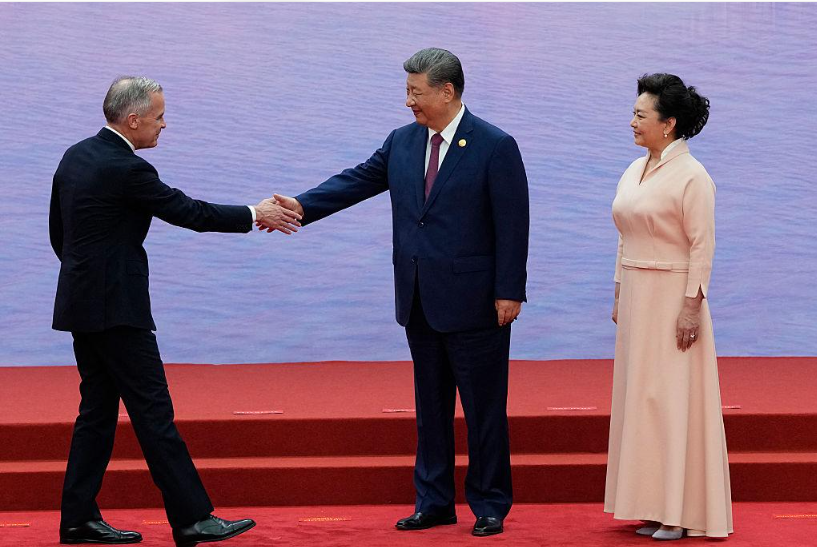
Speaking to Singaporean journalists in Beijing on November 21, Prime Minister Lawrence Wong warned that rivalry between the United States and China could increasingly divide the technologies available to other countries.
Wong acknowledged that some separation may be unavoidable in highly sensitive industries. However, he argued that countries should retain the freedom to adopt technologies from different suppliers wherever possible.
His comments followed a four-day visit to China, including participation in the Asia-Pacific Economic Cooperation summit in Shenzhen and meetings with Chinese officials.
The message reflects Singapore’s longstanding economic approach: maintaining international relationships while avoiding unnecessary dependence on any single major power.
For a small, trade-dependent economy, that flexibility is particularly important.
Why Singapore Refuses to Choose One Technology Partner
Singapore maintains extensive commercial relationships with both the United States and China.
American technology companies contribute to its digital economy, while Chinese businesses are increasingly active in sectors including electric vehicles, artificial intelligence and advanced manufacturing.
Choosing one technological ecosystem exclusively could limit investment, reduce competition and restrict access to emerging innovations.
Wong illustrated Singapore’s approach by pointing to autonomous vehicle development.
Chinese companies WeRide and Pony.ai are conducting autonomous driving projects in Singapore. American company Waymo is also pursuing a separate collaboration in the country.
These initiatives demonstrate how Singapore can evaluate competing technologies according to their commercial and practical benefits.
However, openness does not mean unrestricted access. Technologies must still meet domestic safety, cybersecurity and regulatory requirements.
The government’s challenge is preserving competition while managing the political and security concerns associated with foreign technology.
American Chip Restrictions Complicate the Strategy

The most immediate challenge involves advanced semiconductors.
Washington has tightened export controls designed to prevent sophisticated computing chips from reaching restricted destinations through intermediary countries.
Singapore, alongside several other economies, has faced additional scrutiny over the possibility that advanced chips could be traded or redirected through its commercial networks.
The restrictions create difficulties because Singapore operates as an important regional trading and logistics centre.
Some semiconductor transactions are recorded as sales involving Singapore even when the physical products never enter the country.
Wong has acknowledged Washington’s concerns while emphasizing that Singapore cannot enforce American export controls in foreign jurisdictions.
Nevertheless, the two governments are discussing information-sharing arrangements that could help American authorities investigate suspicious transactions.
Singapore has also warned that companies abusing its position as a trusted business hub will face appropriate enforcement action.
The issue illustrates how international technology trade increasingly depends on regulatory trust as well as commercial competitiveness.
A Trusted Business Hub Faces New Responsibilities
Singapore’s international reputation has been built partly on predictable regulations, efficient infrastructure and strong commercial institutions.
These advantages have attracted multinational companies seeking a regional headquarters or a base for Asian operations.
However, geopolitical competition is making neutrality more complicated.
Governments increasingly want assurances that advanced technologies will not be transferred to competitors through third countries.
Companies operating internationally must therefore consider export controls, cybersecurity standards, data protection and national security requirements.
For Singapore, preserving trust requires demonstrating that openness does not create opportunities for sanctions evasion or unlawful trade.
This creates a delicate balance.
Excessive restrictions could weaken Singapore’s attractiveness to investors. Insufficient oversight could damage its reputation and expose businesses to international regulatory action.
Maintaining commercial independence now requires more sophisticated enforcement and diplomatic cooperation.
China and Singapore Explore Deeper Economic Cooperation
Despite the challenges, Singapore continues expanding its economic relationship with China.
During Wong’s November visit, the two governments discussed cooperation involving artificial intelligence, trade, transportation and green industries.
Wong also met Chinese Premier Li Qiang in Beijing as both countries prepared additional bilateral initiatives.
The discussions reflect the importance of China to Singapore’s regional economic relationships.
At the same time, Singapore continues strengthening cooperation with American businesses and institutions.
This dual approach is not simply an attempt to avoid political confrontation. It reflects the commercial advantages of maintaining access to multiple sources of investment, technology and expertise.
For international companies, Singapore’s strategy could provide opportunities to develop products and establish partnerships across different markets.
However, the benefits will depend on whether geopolitical competition allows sufficient room for cross-border cooperation.
ASEAN Could Become More Important in a Fragmented Economy
Singapore’s strategy extends beyond its bilateral relationships with Washington and Beijing.
The Association of Southeast Asian Nations provides a broader platform through which regional economies can strengthen their bargaining power and economic integration.
Singapore will assume ASEAN’s rotating chairmanship in 2027.
Wong has emphasized the importance of deepening cooperation with partners including the European Union, India, Canada and Gulf economies.
Digital trade is expected to play an important role.
Regional initiatives aimed at improving cross-border data flows, electronic payments and digital commerce could reduce barriers for businesses operating across Southeast Asia.
Such arrangements may be particularly valuable for smaller companies that lack the resources to manage complicated international regulations independently.
A more integrated ASEAN could also provide greater resilience against disruptions caused by competition between larger economies.
Nevertheless, regional cooperation cannot eliminate every geopolitical risk. Member states have different economic priorities and relationships with major powers.
The Global Business Implications of Technological Fragmentation
The competition between the United States and China extends far beyond Singapore.
Advanced semiconductors, artificial intelligence infrastructure, cloud computing and telecommunications are increasingly viewed as strategically important industries.
Restrictions affecting these sectors can influence investment decisions across international supply chains.
Businesses may need to establish separate technology systems for different markets, increasing costs and operational complexity.
Smaller economies could face difficult choices about suppliers, technical standards and access to advanced equipment.
However, fragmentation may also create opportunities.
Countries with credible institutions, skilled workers and reliable infrastructure could attract companies seeking diversified operations.
Singapore is well positioned to compete for such investment, but it is not immune to the restrictions imposed by larger powers.
Its success will depend on maintaining international confidence while continuing to develop domestic technological capabilities.
THE ABE TAKE | Economic Independence Requires More Than Neutrality
Singapore’s technology strategy offers an important lesson for smaller economies navigating an increasingly divided international system.
Remaining open to competing technologies can encourage innovation, attract investment and prevent excessive dependence on individual suppliers.
However, openness alone is not sufficient.
Countries must also develop strong institutions, enforce commercial regulations and invest in their own technological capabilities.
The ability to maintain relationships with competing powers depends partly on whether those powers trust the country’s regulatory environment.
Singapore’s approach therefore represents a form of economic pragmatism rather than simple political neutrality.
It recognizes that international competition is unavoidable while attempting to preserve cooperation wherever possible.
For businesses, the broader lesson is equally significant. Diversified partnerships can reduce exposure to geopolitical disruption, but they must be supported by careful compliance and long-term planning.
As technology becomes an increasingly powerful instrument of geopolitical competition, the countries best positioned to prosper may be those capable of maintaining trust, attracting innovation and preserving meaningful economic choices.
ABE MAGAZINE
Understand More. Think Bigger.