







ABE NEWS | WEDNESDAY, AUGUST 19, 2026
Canada went to bed Tuesday night facing a 50% tariff.
It woke up Wednesday without one.
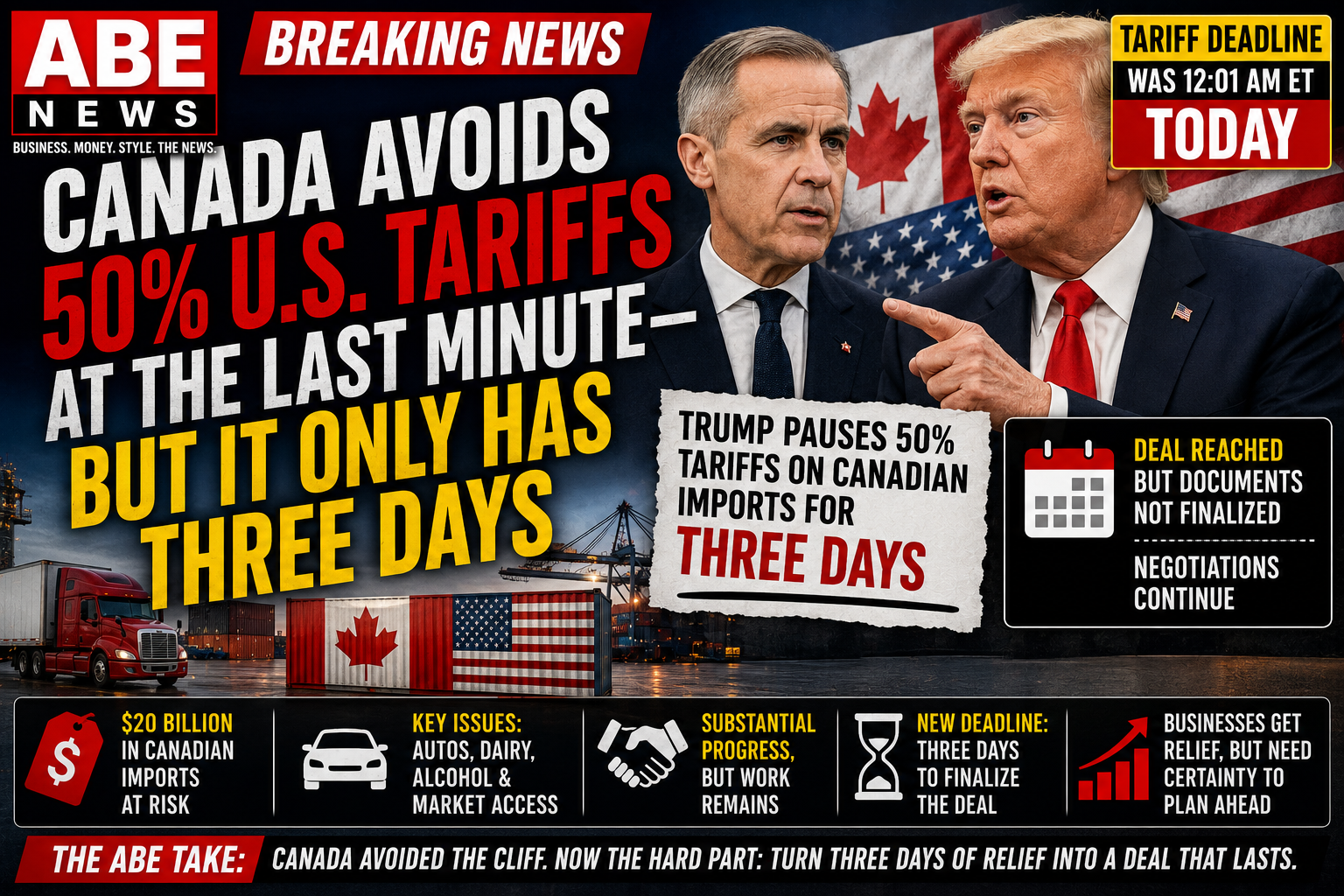
Less than two hours before nearly $20 billion worth of Canadian imports were supposed to face new U.S. tariffs, President Donald Trump stopped the clock.
But only for:
THREE DAYS.
Trump says Canada and the United States have a deal.
Canadian Prime Minister Mark Carney says “substantial progress” has been made.
But Carney also says something equally important:
There is still important work to do.
So Canada may have avoided the tariff wall Wednesday morning.
But this trade fight isn’t over.
The deadline just moved.
🚨 What Happened at the Last Minute?
The 50% U.S. tariffs were scheduled to begin at 12:01 a.m. Wednesday.
Canadian negotiators had spent days in Washington trying to prevent exactly that.
Prime Minister Carney and President Trump spoke Tuesday afternoon — their second conversation this week.
Then came the breakthrough.
Trump announced that he would pause the tariffs for three days because, in his words, the countries had a deal subject to finalizing documents.
Canada confirmed the pause.
But Ottawa was noticeably more cautious about declaring victory.
Carney said substantial progress had been made while emphasizing that negotiations weren’t finished.
That’s an important distinction.
A political announcement has happened.
A fully finalized agreement?
Not yet.
🇨🇦 What Canada Just Avoided
Had the tariffs taken effect Wednesday morning, approximately $20 billion in Canadian imports would have faced a new 50% U.S. duty.
And these weren’t obscure products.
The threatened tariffs covered goods ranging across Canadian industries, with vulnerable sectors including:
Wine.
Dairy.
Lumber and wood products.
And other manufactured and consumer goods.
Even Canadian products qualifying for preferential treatment under USMCA would have been exposed to the new duties.
For affected companies, 50% isn’t a small adjustment.
It can completely change whether selling a product in America makes financial sense.
💰 Why Three Days Matter to Businesses
Imagine you’re a Canadian manufacturer.
Yesterday you were preparing for your product to become dramatically more expensive entering the United States.
You may have been considering:
Increasing prices.
Absorbing part of the tariff.
Reducing shipments.
Cutting production.
Finding new customers.
Or even reducing workers.
Then, hours before the tariff begins:
Pause.
That’s obviously better than the tariff arriving.
But here’s the problem.
You still don’t know what your business environment looks like next week.
That’s why the Canadian Chamber of Commerce welcomed the temporary relief while warning that businesses need something more valuable:
certainty.
Three days buys time.
It doesn’t create predictability.
🥛 So What Is Actually in This Deal?
This is where we need to be careful.
We do not yet have a complete finalized agreement publicly confirmed by both governments.
But Washington has provided some clues.
The Office of the U.S. Trade Representative said the prospective agreement would include:
Broader market access for American goods.
Economic-security commitments.
Digital-trade alignment.
And other provisions.
A White House proclamation also said Canada had committed to addressing U.S. concerns involving:
Dairy products.
Alcoholic beverages.
Motor vehicles.
But Canada’s government had not publicly confirmed all of those specific commitments at the time of the announcement.
So ABE NEWS isn’t going to call those terms final until we know they are.
🚗 Cars Remain a Big Part of the Fight
One of the most complicated issues involves automobiles.
The two sides have discussed reducing existing U.S. Section 232 tariffs on Canadian vehicles from 25% to 15%.
But then comes the harder question:
What counts as American content?
Washington has pushed for tariff reductions to be calculated using only components actually produced in the United States.
Canada has pushed for a broader North American calculation that could include Canadian and Mexican components.
That sounds technical.
Economically, it isn’t.
Because modern cars aren’t simply:
American cars.
Canadian cars.
Mexican cars.
Parts can cross North American borders multiple times before a finished vehicle reaches a dealership.
Change how those parts are counted and you can change where companies decide to manufacture them.
🏭 And That Can Become a Jobs Story
This is where trade policy leaves government meeting rooms.
Look at Brampton, Ontario.
Stellantis has been considering options involving the future of its Brampton assembly plant after previously shifting planned Jeep Compass production to Illinois.
The plant employed roughly 2,200 workers before closing for retooling.
Canadian union Unifor has blamed U.S. auto tariffs for contributing to the uncertainty surrounding the facility.
That’s why arguments over tariffs and automotive content aren’t just technical trade disputes.
Behind the percentages are:
Factories.
Suppliers.
Investment.
Communities.
Jobs.
🇺🇸 America Has Something to Lose Too
There’s another side to this.
The United States and Canada don’t operate as completely separate economies.
Last year, the two countries traded approximately $880 billion worth of goods and services, according to AP.
Nearly 72% of Canada’s goods exports went to the United States.
Canada clearly has enormous exposure to the American market.
But American companies also rely on Canadian products, materials, energy and customers.
And tariffs imposed by Washington are collected from U.S. importers.
Those companies then decide whether to:
Absorb the cost.
Negotiate with suppliers.
Find another source.
Or pass some of the increase to American customers.
That’s why tariffs can hurt businesses on both sides of the border.
🥃 Alcohol Became Part of the Negotiation Too
There’s another dispute that shows just how broad this trade fight became.
Some Canadian provinces removed American alcohol from store shelves during the wider tariff confrontation.
U.S. officials have repeatedly objected.
After Tuesday’s announcement, the Distilled Spirits Council of the United States welcomed the pause and called for a negotiated solution that returns American spirits to Canadian retail shelves and restores zero-for-zero tariffs in the sector.
So when the final agreement arrives, don’t just watch cars and dairy.
Watch alcohol too.
🛢️ Then Trump Mentioned Keystone XL
And there was one more surprise.
Trump suggested that the Keystone XL pipeline could potentially return.
The project was cancelled by former President Joe Biden in 2021 after years of environmental and Indigenous opposition.
Trump offered no detailed plan Tuesday for how the project might actually be revived.
So for now:
That’s a political signal — not a confirmed pipeline restart.
But it’s worth watching.
Because energy has always been one of the deepest economic links between Canada and the United States.
📈 How Are Markets Reacting?
Interestingly, Canadian markets didn’t explode higher Wednesday morning simply because the tariff threat was paused.
Futures tracking the S&P/TSX Composite were roughly flat early Wednesday as investors processed the tariff reprieve and waited for another major event:
Federal Reserve minutes later today.
That muted reaction makes sense.
Markets like good news.
But they like certainty even more.
And right now, investors still don’t have the final document.
⏰ Now We Have Another Countdown
Yesterday’s countdown looked like this:
Wednesday, 12:01 AM → 50% tariffs.
That deadline has disappeared.
Now we have another one.
DAY 1
Finalize the documents.
DAY 2
Resolve remaining disagreements.
DAY 3
Either produce something durable…
or uncertainty returns.
That’s why the next three days could matter more than Wednesday’s relief itself.
🔴 THE ABE NEWS TAKE
Canada avoided the cliff.
But it hasn’t reached solid ground yet.
And that’s the distinction businesses care about.
Politicians can celebrate a three-day pause.
A company deciding whether to invest $500 million in a factory needs something different.
It needs to know:
What will the rules be next month?
Next year?
Five years from now?
Because uncertainty has a cost even when no tariff is being collected.
A business that doesn’t understand tomorrow’s rules may delay hiring.
Delay expansion.
Delay investment.
Change suppliers.
Or move production.
That’s why the biggest achievement won’t be delaying a 50% tariff for three days.
It will be replacing uncertainty with rules businesses on both sides of the border can actually plan around.
Trump says the countries have a deal.
Carney says important work remains.
Both statements can be true.
And that’s exactly why ABE NEWS isn’t calling this trade war over.
Canada got the headline it desperately wanted Wednesday morning:
No 50% tariff today.
Now comes the harder part.
Turning three days of relief into something that lasts.
ABE NEWS
Business. Money. Style. The News.
Understand More. Think Bigger.