







ABE NEWS | WEDNESDAY, AUGUST 19, 2026
A robot can run, dance, box and perform martial arts. That’s impressive. But on Wednesday, China’s best-known humanoid robot maker did something completely different:
It sent investors into a frenzy.
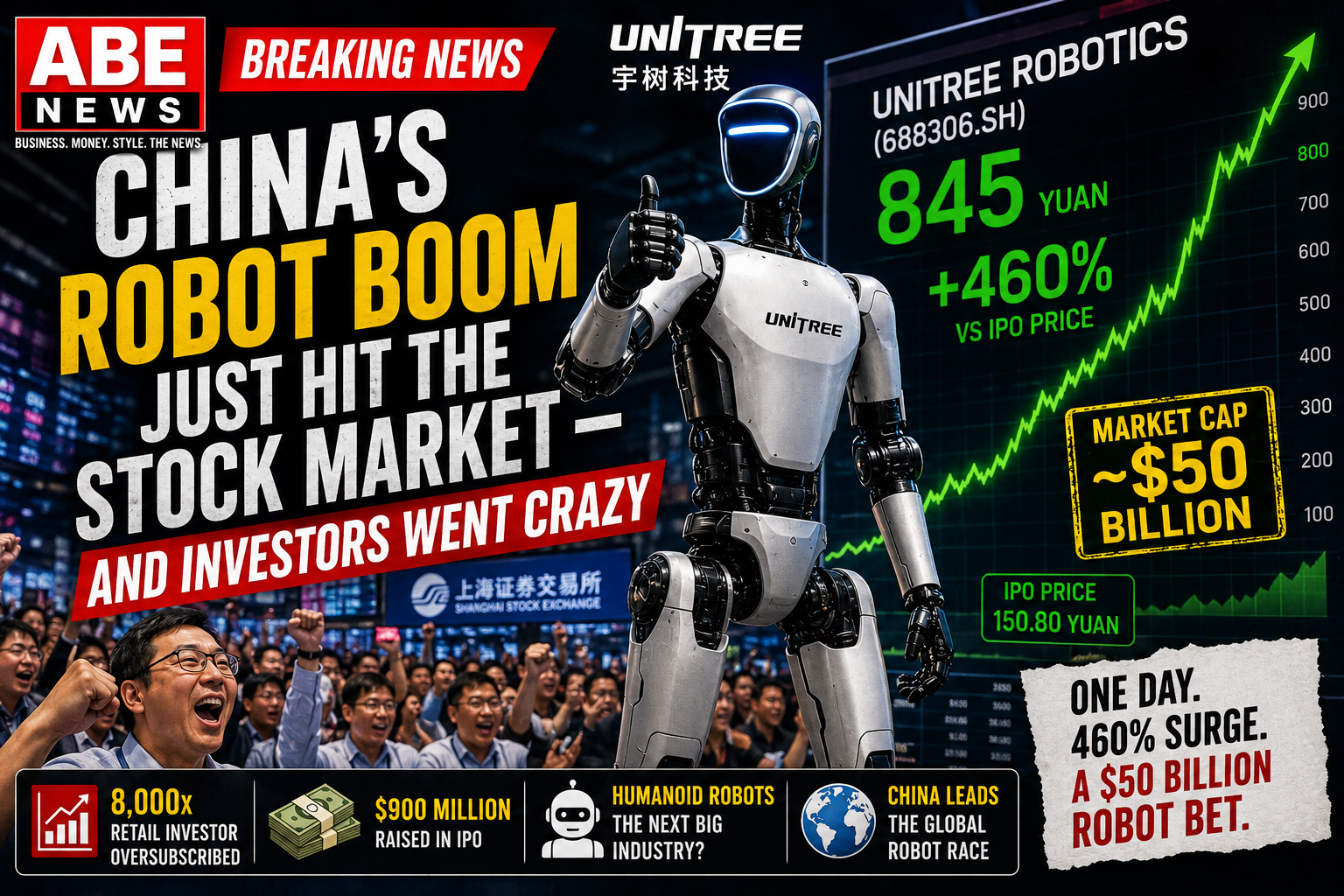
Unitree Robotics made its stock-market debut on Shanghai’s STAR Market, with shares priced at 150.80 yuan. They opened at 1,100 yuan and eventually closed at 845 yuan — 460% above the IPO price. At the closing price, Unitree was valued at roughly $50 billion.
The extraordinary debut raises a much bigger question than what Unitree’s shares are worth today: Are humanoid robots beginning the transition from impressive technology demonstrations into a serious global industry?
Investors Wanted In — Badly
The excitement started before trading even began. Retail investors subscribed for roughly 8,000 times the number of shares available to them, and Unitree raised about $900 million through the IPO. Founder Wang Xingxing, who still owns around 20% of the company, saw the paper value of his stake rise to more than $11 billion after Wednesday’s debut.
Unitree already produces humanoid robots and four-legged robotic dogs, and unlike many competitors in the young industry, the company is profitable. It reported about $250 million in revenue in 2025, with more than 40% coming from overseas.
But there’s a major difference between selling robots and proving that humanoid robots can become everyday workers.
Many machines are still primarily being used for research, demonstrations and performances rather than large-scale commercial work. That challenge was visible Wednesday at Beijing’s World Robot Conference, where more than 300 companies are displaying thousands of robotics products. Some machines performed impressive demonstrations, while others struggled with tasks humans consider simple.
And that’s where the real robotics race begins.
A robot doing a backflip makes a great video. A robot that can reliably spend eight hours moving materials around a factory, sorting packages or performing repetitive tasks creates economic value.
Chinese companies are already experimenting with those applications. Robots are being tested in logistics, hotels and manufacturing, although widespread commercial deployment remains limited.
Why China Is Betting Big on Robots
China sees robotics as more than another technology trend. It could help manufacturers increase productivity while the country deals with an aging population and a shrinking workforce.
It also plays directly into China’s manufacturing strength. Building humanoid robots requires motors, sensors, batteries, gears, actuators, electronics and sophisticated software — industries where China has spent years developing large supply chains and production capacity.
That has turned robotics into another front in the technology competition between China and the United States. Unitree competes in a field that includes Tesla’s Optimus project and Hyundai-owned Boston Dynamics.
But Unitree faces a major obstacle in America. The U.S. Federal Communications Commission recently banned imports of future models of foreign-made humanoid and quadruped robots, including Unitree products, citing national-security concerns. The Pentagon has also placed Unitree on a list of companies associated with China’s military industrial base. Unitree says its robots are intended for civilian use.
That could push Chinese robotics companies to expand more aggressively into Europe and other international markets instead.
But Is This Becoming a Bubble?
This is the uncomfortable part of Wednesday’s excitement.
A 460% first-day gain doesn’t prove Unitree is worth $50 billion.
It proves investors desperately wanted the stock.
The distinction matters.
Humanoid robotics could eventually become an enormous industry while investors simultaneously pay too much for individual robotics companies today. We’ve seen that combination before: revolutionary technologies don’t automatically produce sensible stock valuations.
And Unitree now has enormous expectations to meet.
The company needs to turn technological demonstrations into commercially useful machines, expand manufacturing, find repeat customers and prove robots can create enough economic value to justify their cost.
That’s much harder than having a spectacular IPO.
🔴 THE ABE NEWS TAKE
The biggest story isn’t that Unitree gained 460%.
It’s what investors believe comes next.
For generations, machines were usually designed around specific jobs: tractors farmed, forklifts moved pallets and industrial robot arms welded cars.
Humanoid robotics is chasing something different — a general-purpose machine that can operate in a world already designed around humans.
Our stairs, doors, tools, warehouses and factories were built for human bodies. If engineers eventually create robots intelligent and reliable enough to navigate that environment, companies may not have to rebuild the workplace around machines.
The machines could adapt to the workplace we already have.
Wednesday didn’t prove that’s going to happen.
It proved investors are increasingly willing to put enormous amounts of money behind the possibility that it will.
The robots have learned how to run and dance.
The companies have learned how to raise billions.
Now they have to prove the robots can work.
ABE NEWS
Business. Money. Style. The News.
Understand More. Think Bigger.