








ABE NEWS | September 5, 2026
The war between the United States and Iran has entered another dangerous phase.
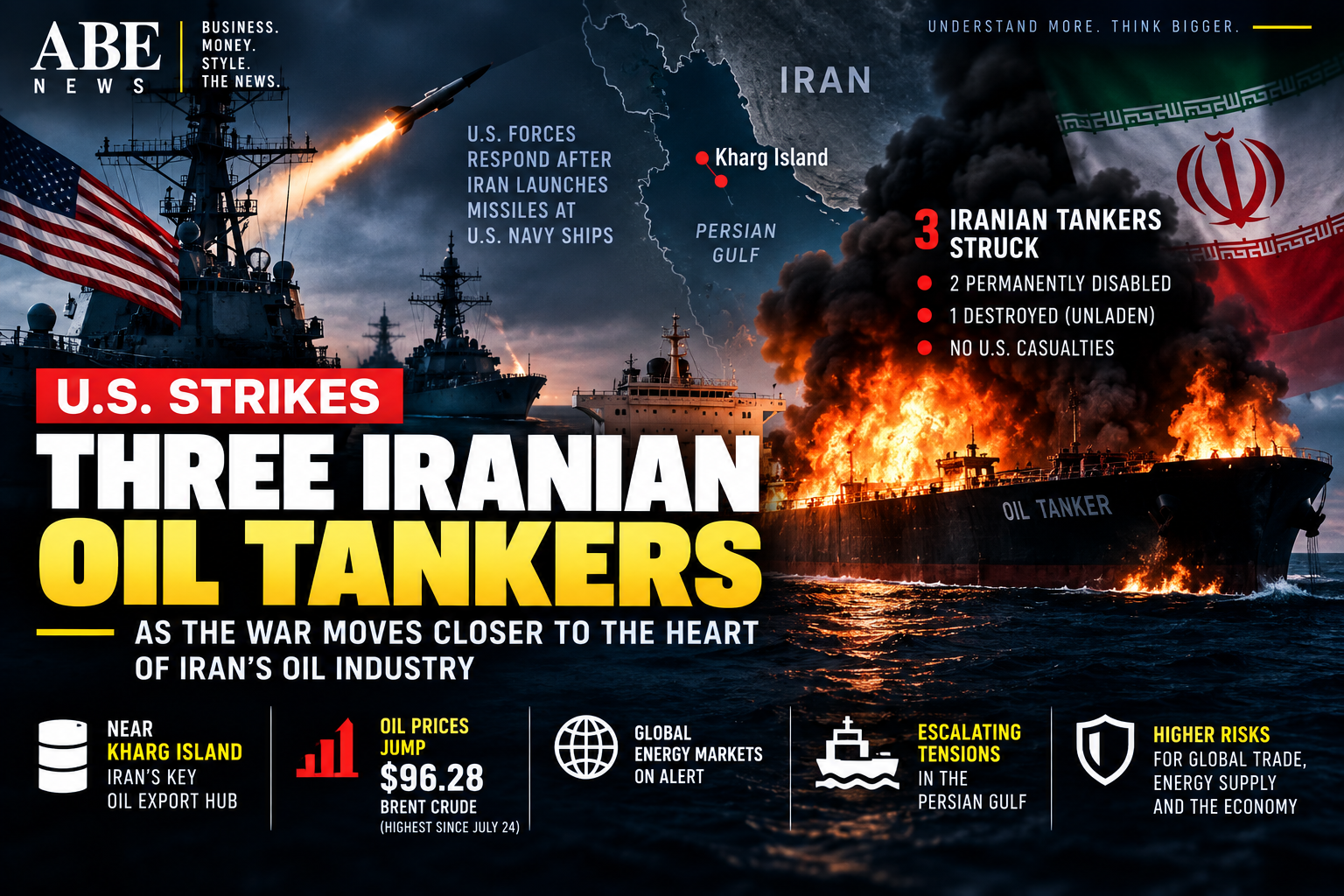
U.S. forces struck three Iranian crude-oil tankers on Saturday after Iran’s Islamic Revolutionary Guard Corps fired ballistic missiles toward two U.S. Navy warships, according to U.S. Central Command.
The American vessels — an aircraft carrier and a guided-missile destroyer — evaded the attacks.
No U.S. personnel were injured.
Then Washington retaliated.
Two Iranian tankers were permanently disabled, according to CENTCOM.
A third, which was not carrying cargo, was completely destroyed after its crew was warned to abandon the vessel.
But one location makes the escalation particularly important for the global economy.
One of the tankers was struck off the coast of Kharg Island.
Kharg is not simply another Iranian island.
It is the centre of Iran’s oil-export system.
Before the war, approximately 90% of Iran’s crude exports passed through Kharg Island.
That means Saturday’s attack has pushed the conflict closer to one of the most economically sensitive pieces of infrastructure in the Middle East.
And oil markets are watching closely.
Brent crude closed Friday at $96.28 a barrel, its highest closing level since July 24, as traders confronted renewed fears about Middle Eastern energy supplies.
The question now is no longer simply whether Washington and Tehran will continue exchanging military strikes.
It is whether their confrontation is beginning to move directly into the infrastructure that powers Iran’s economy — and influences energy prices around the world.
WHAT HAPPENED SATURDAY?
According to U.S. Central Command, Iran’s Islamic Revolutionary Guard Corps launched ballistic missiles toward two American naval vessels operating in regional waters.
The U.S. military says the ships successfully avoided multiple Iranian attacks.
Washington then responded against Iranian oil shipping.
CENTCOM identified three vessels.
The M/T Downy was struck off Kharg Island.
The M/T Stark 1 was struck near Jask.
And the M/T Kylo, also known as the Noxen, was destroyed in the Gulf of Oman after its crew was ordered to abandon ship.
CENTCOM described the tankers as part of a multibillion-dollar network used to finance the Revolutionary Guard and Iran-aligned groups.
Admiral Brad Cooper, commander of U.S. Central Command, framed the strikes explicitly as economic retaliation.
The message from Washington was straightforward:
Attack American ships, and the United States will impose a larger economic cost on Iran.
That represents an important development.
The U.S. is not merely targeting launchers, military bases or weapons.
It is attacking assets connected to the economic system that helps finance the Iranian state.
IRAN CONFIRMED A TANKER WAS HIT NEAR KHARG
Iranian media had reported the Kharg incident before CENTCOM publicly announced all three strikes.
Tasnim, a semi-official Iranian news agency, reported that four U.S. missiles struck a tanker near Kharg’s anchorage.
Local sources cited by Tasnim said there were no casualties and the crew was being evacuated.
There was initially no broader official announcement from Iranian authorities confirming all of CENTCOM’s account.
That distinction matters because information during active conflicts can be incomplete or disputed.
But both sides’ accounts establish one critical fact:
An Iranian oil tanker was attacked near Kharg Island.
And Kharg is strategically extraordinary.
WHY KHARG ISLAND MATTERS
Look at Iran’s oil industry and one small island immediately stands out.
Kharg sits in the Persian Gulf, roughly 25 kilometres from Iran’s coast.
For decades, it has served as the country’s principal crude-export terminal.
Pipelines transport oil from mainland production facilities to the island.
Storage tanks hold crude there.
Loading terminals transfer that crude onto enormous tankers.
Those tankers then carry Iranian petroleum into international markets.
Before the current war disrupted trade, approximately 90% of Iranian crude exports moved through Kharg Island.
Iran is also the third-largest producer in OPEC.
That makes Kharg one of the most economically sensitive locations in the country.
Damage the island’s export infrastructure badly enough and Iran’s ability to earn money from oil could be severely constrained.
That is why threats involving Kharg have attracted so much attention throughout the conflict.
TRUMP HAS THREATENED KHARG BEFORE
President Donald Trump has repeatedly raised the possibility of attacking Kharg Island.
On August 31, Trump posted an AI-generated video on social media alongside a claim that Kharg was being destroyed.
At the time, there was no evidence supporting the imagery presented in that video.
Iranian officials warned that an actual attack on the island would provoke a strong response.
Trump had also said earlier in the conflict that he wanted to take control of Kharg, before later saying a threatened operation there was temporarily off the table.
Saturday’s strike does not mean the United States has launched a full-scale assault on Kharg’s oil terminal.
That distinction is crucial.
The confirmed target was an oil tanker off the island.
But militarily and psychologically, the geography matters.
The United States has now demonstrated its willingness to attack an Iranian oil asset directly beside the country’s most important export hub.
THE WAR IS BECOMING AN ECONOMIC WAR
Wars are fought with missiles and aircraft.
They are also fought with money.
Iran relies heavily on petroleum exports to generate foreign currency and government revenue.
Those revenues support the wider economy and help finance state institutions.
Washington has therefore spent years attempting to constrain Iranian oil exports through sanctions.
The current conflict has taken that pressure much further.
The United States began a naval blockade of Iranian oil exports in April.
Iran’s export flows have since been severely disrupted.
Now American forces are directly attacking tankers CENTCOM says form part of the financial network supporting the Revolutionary Guard and its allies.
That means the pressure campaign is moving from:
sanctions
to
blockades
to
physical destruction of shipping assets.
That is a major escalation in economic warfare.
THE STRAIT OF HORMUZ MAKES THIS A GLOBAL PROBLEM
If this confrontation affected only Iranian oil, the consequences would still be significant.
But geography makes the situation much more dangerous.
The Persian Gulf contains some of the world’s most important oil producers.
Saudi Arabia.
The United Arab Emirates.
Kuwait.
Qatar.
Iraq.
Iran.
Much of the petroleum and liquefied natural gas produced in the region historically travels through a narrow maritime passage:
the Strait of Hormuz.
Before the war, roughly one-fifth of global oil supply moved through the waterway.
That means a conflict around Hormuz doesn’t merely threaten Iran.
It threatens one of the world’s most important energy arteries.
Iran has effectively shut the strait during the conflict, while the United States has sought to keep Gulf energy exports moving and restrict Iran’s own petroleum trade.
That creates an extraordinary strategic contest.
Iran’s leverage comes partly from geography.
America’s leverage comes from military power.
Global consumers sit downstream from both.
WHY OIL IS ALREADY NEAR $100
Brent crude closed Friday at $96.28 per barrel.
That was its highest closing level since July 24.
Saturday’s tanker strikes happened after markets had closed for the weekend.
That means traders will have new information to digest when oil trading resumes.
No one can responsibly say exactly how prices will respond.
Markets will evaluate several questions.
Will Iran retaliate?
Will shipping through the Gulf become more dangerous?
Will additional Iranian tankers be attacked?
Will Kharg itself become a direct target?
Could infrastructure belonging to other Gulf producers be threatened?
And could diplomatic efforts contain the escalation?
The answers could determine whether oil retreats, remains elevated or moves through the psychologically important $100-a-barrel level.
$100 OIL WOULD MATTER FAR BEYOND THE MIDDLE EAST
Oil prices flow through the global economy.
When crude becomes more expensive, refineries pay more for feedstock.
That can increase gasoline and diesel prices.
Trucking becomes more expensive.
Airlines face higher fuel bills.
Shipping costs can rise.
Manufacturers pay more for transportation and petrochemical inputs.
Consumers eventually absorb some of those costs.
And central banks notice.
That last point is particularly important.
The United States and Canada are already wrestling with inflation and interest-rate questions.
A sustained energy shock could complicate those calculations.
Central banks cannot produce oil.
They cannot reopen shipping lanes.
They cannot end wars.
But they do respond when higher energy costs begin spreading through consumer prices.
So a tanker being attacked thousands of kilometres away can eventually influence household budgets and interest-rate expectations elsewhere.
CHINA ALSO HAS A LOT AT STAKE
Iran’s oil trade has increasingly depended on Asian buyers, particularly China.
U.S. sanctions have attempted to restrict those flows.
But Iranian crude has continued reaching international markets through complex networks of traders, tankers and intermediaries.
Washington frequently describes parts of this system as Iran’s shadow fleet.
The United States argues that these networks allow Tehran to circumvent sanctions and generate revenue supporting the Revolutionary Guard and allied armed groups.
By physically disabling tankers associated with that system, Washington is attempting to increase the cost and risk of moving Iranian crude.
But that strategy also creates risks for international shipping.
Commercial operators must determine whether vessels, insurers, ports or counterparties could become entangled in the conflict.
War risk insurance can become more expensive.
Shipping routes can change.
And companies may simply decide that operating in certain waters isn’t worth the danger.
TANKERS ARE NOW PART OF THE BATTLEFIELD
This may be the most consequential shift.
Oil tankers are commercial infrastructure.
They are enormous floating pieces of the global energy system.
When tankers themselves become military targets, shipping risk changes dramatically.
CENTCOM says the three vessels it attacked were connected to the Revolutionary Guard’s financial network.
Iran, meanwhile, has threatened and targeted shipping associated with its adversaries.
That creates the possibility of a cycle.
Iran attacks shipping.
America attacks Iranian tankers.
Iran retaliates against additional vessels.
America responds again.
Every round increases the probability of miscalculation.
And because these confrontations occur near globally important shipping lanes, a bilateral conflict can rapidly generate international economic consequences.
THIS WAR HAS ALREADY LASTED FAR LONGER THAN EXPECTED
The current conflict began after U.S. and Israeli strikes on Iran in late February.
It has now continued for more than six months.
There have been periods of intense fighting.
Attempts at diplomacy.
Temporary reductions in hostilities.
Then renewed attacks.
An interim agreement reached in June raised hopes that the conflict could move toward resolution.
Those hopes have repeatedly collided with new military exchanges.
The latest escalation demonstrates how fragile the situation remains.
A missile fired at a naval vessel can trigger retaliation against oil infrastructure.
That retaliation can trigger another response.
And suddenly a conflict that appeared to be cooling is escalating again.
THERE IS ALSO A POLITICAL CLOCK
The war is unfolding just months before America’s November congressional elections.
Public opinion matters.
The conflict has already generated significant opposition inside the United States.
That creates a difficult political calculation for Washington.
The administration wants to demonstrate that attacks on American forces carry consequences.
But expanding the conflict risks additional casualties, higher energy prices and growing public dissatisfaction.
Iran faces its own pressure.
Its economy has been damaged by sanctions, war and the blockade.
Oil revenue is critical.
That makes attacks on petroleum infrastructure particularly painful.
Both sides therefore possess reasons to retaliate.
They also possess reasons to avoid uncontrolled escalation.
The danger is that those incentives can coexist right up until one side miscalculates.
WHAT HAPPENS IF KHARG ITSELF IS ATTACKED?
This is the scenario energy markets fear.
Again, Saturday’s confirmed strike was against a tanker off the coast of Kharg, not a confirmed large-scale destruction of Kharg’s export terminal.
But if the island’s loading facilities, storage infrastructure or pipelines became direct targets, the economic consequences could be much larger.
Iran’s export capacity could be further reduced.
Tehran could retaliate against regional energy infrastructure.
Shipping through the Gulf could face additional disruption.
Oil prices could rise sharply.
And other countries might be pulled more deeply into attempts to secure energy routes.
That is why Kharg’s name appearing in Saturday’s reporting matters so much.
The conflict is moving dangerously close to a location both sides understand has enormous strategic value.
🔴 THE ABE NEWS TAKE
The most important detail in today’s attack isn’t simply that the United States hit three Iranian tankers.
It is where one of them was hit.
Kharg Island.
Before this war, roughly 90% of Iran’s crude exports passed through that small piece of land.
Oil is one of Iran’s economic lifelines.
Kharg is the gateway.
And Washington is now demonstrating that assets operating beside that gateway are within reach.
That sends Tehran a very different message from another strike against a missile launcher.
The United States is saying:
We can hurt the system that finances you.
Iran has leverage too.
The Strait of Hormuz has historically carried roughly one-fifth of global oil supply.
Threatening shipping there creates costs not only for Washington but for the global economy.
And that is what makes this stage of the conflict particularly dangerous.
Both sides are increasingly targeting economic pressure points.
America can attack Iranian oil assets.
Iran can threaten maritime trade.
But neither side can completely control what happens to global markets afterward.
Oil was already at $96.28 before Saturday’s strikes.
If this escalates further, consumers thousands of kilometres away may eventually experience the consequences at petrol stations, airports, supermarkets and through inflation.
That is the uncomfortable reality of modern energy markets.
A missile near a small Iranian island can affect a family budget in Toronto.
A tanker disabled in the Persian Gulf can influence an airline in Europe.
A shipping disruption near Hormuz can change inflation calculations in Washington.
Globalization connects all of it.
And that’s why today’s strikes deserve attention beyond the battlefield.
The United States and Iran are no longer simply exchanging military blows.
They are increasingly attacking each other’s ability to impose economic pain.
Tankers have become targets.
Oil exports have become weapons.
Shipping lanes have become strategic assets.
And Kharg Island is moving closer to the centre of the confrontation.
The next question is therefore the one markets, governments and businesses will be asking all weekend:
Does Iran retaliate — and how far does the United States go next?
Because if the answer involves Kharg itself or wider Gulf shipping, today’s three tanker strikes may be remembered not as the climax of this escalation—
but as the beginning of a much more dangerous phase.
ABE NEWS
Business. Money. Style. The News.
Understand More. Think Bigger.