







ABE NEWS | TUESDAY, AUGUST 18, 2026
Oil is above $90.
Government borrowing costs are surging.
Technology stocks are falling.
And one U.S. interest rate has reached a level investors haven’t seen since 2007.
At first, those sound like four different stories.
They’re not.
Tuesday’s market selloff is showing exactly how quickly trouble in one part of the global economy can travel into another.
The chain looks something like this:
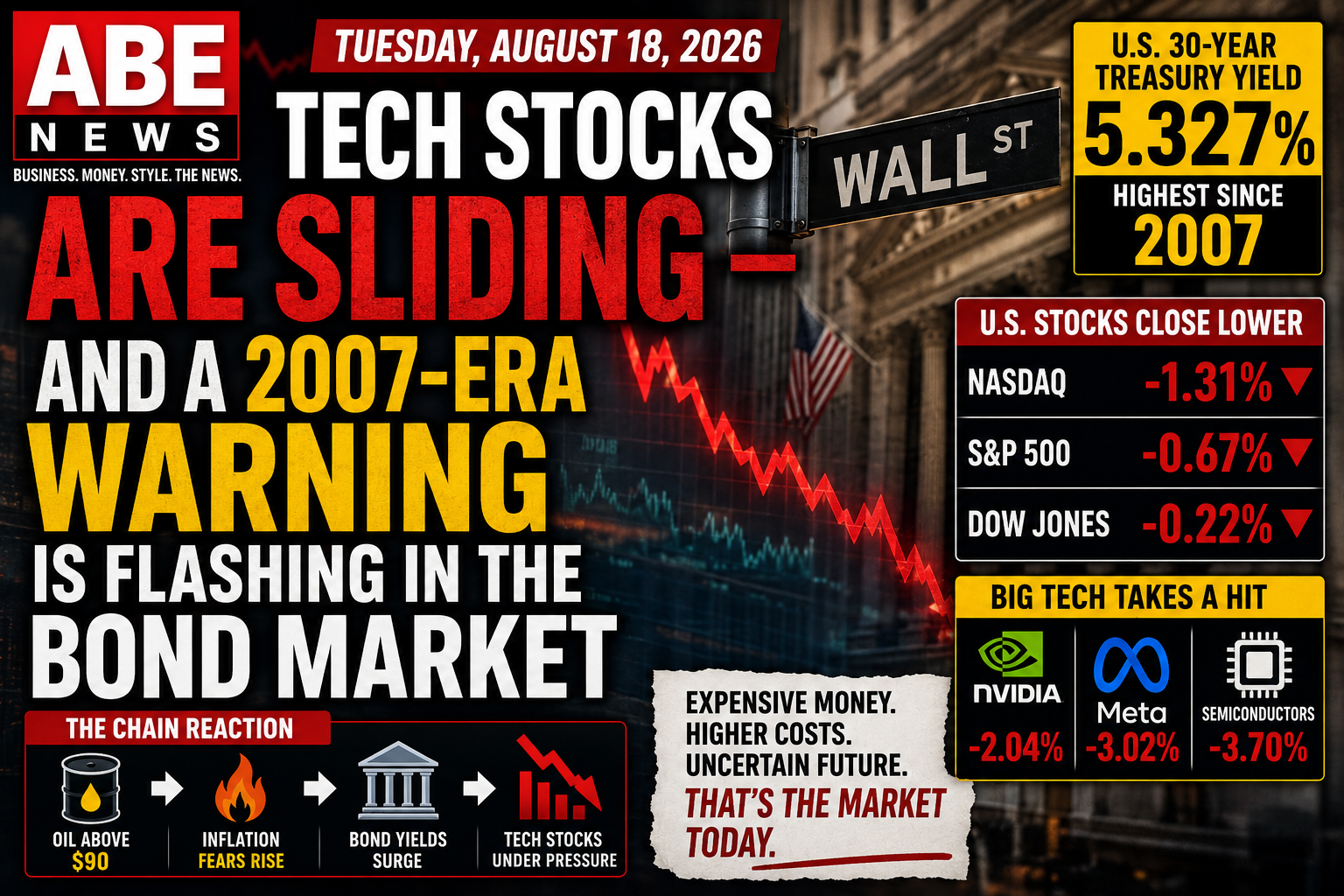
Middle East tensions → higher oil → inflation fears → higher bond yields → pressure on stocks.
And today, technology companies are sitting right in the middle of it.
📉 Wall Street Turns Red
U.S. stocks finished Tuesday lower, with technology taking the biggest hit.
The Nasdaq Composite fell 1.31%.
The S&P 500 lost 0.67%.
The Dow slipped 0.22%.
Those aren’t crash numbers.
But underneath the major indexes, something more interesting happened.
Semiconductor stocks were hit particularly hard.
Companies connected to the enormous AI and chip rally — including Nvidia and Micron — came under pressure after some had posted powerful gains in recent sessions.
So why are investors suddenly selling some of the market’s hottest companies?
For that, we need to leave the stock market.
And enter the bond market.
🚨 The 2007 Number
Tuesday, the yield on the 30-year U.S. Treasury bond reached 5.327%.
That’s its highest level in 19 years — since 2007.
The benchmark 10-year Treasury yield also climbed, reaching around 4.74% during the session.
That might sound like boring financial-market trivia.
It isn’t.
Treasury yields help establish the price of money across the economy.
They influence borrowing costs.
Mortgages.
Corporate debt.
Investments.
And how investors decide what an asset is worth.
When those yields move sharply higher, Wall Street pays attention.
🧠 First: What Is a Bond Yield?
Let’s make this simple.
When you lend money to the U.S. government by purchasing a Treasury bond, you expect a return.
That return is represented by the bond’s yield.
Bond prices and yields generally move in opposite directions.
Bond prices fall → yields rise.
Bond prices rise → yields fall.
So when we say Treasury yields are surging, it means investors are demanding greater returns for holding that debt.
And right now, there are several reasons for that.
🛢️ Reason #1: Oil
We already covered the first one this morning.
Brent crude moved above $90 per barrel as hopes for a resolution to the U.S.–Iran conflict faded and disruption around the Strait of Hormuz continued.
Higher oil creates another concern:
Inflation.
Oil doesn’t stay inside an oil barrel.
It becomes gasoline.
Jet fuel.
Transportation costs.
Shipping expenses.
Manufacturing costs.
And potentially higher consumer prices.
If investors believe inflation could remain elevated, they may demand higher yields for lending money over decades.
💰 Reason #2: America’s Debt
But Hormuz isn’t the entire explanation.
There’s another elephant in the room:
Government borrowing.
The U.S. debt pile is approaching $40 trillion, while investors are being asked to absorb enormous amounts of government debt.
Think about supply and demand.
If a government needs to sell enormous quantities of bonds, it needs buyers.
If buyers become less enthusiastic?
The government may effectively have to offer more attractive returns.
Higher yields.
And investors are increasingly questioning the long-term fiscal picture.
So Tuesday’s bond-market warning isn’t simply:
“Oil is expensive.”
It’s also:
“There is a huge amount of borrowing competing for money.”
🤖 And Then AI Enters the Story
Here’s where things get even more interesting.
Governments aren’t the only ones borrowing.
Technology companies are spending enormous amounts building the infrastructure behind artificial intelligence.
Data centres.
Chips.
Electricity infrastructure.
Networking equipment.
Cloud capacity.
And some of that investment is being financed through debt.
That means giant technology companies can find themselves competing for capital at the same time governments are issuing enormous quantities of bonds.
Reuters reports that investors see heavy borrowing by AI hyperscalers as another factor contributing to pressure in the bond market.
So AI isn’t just influencing the stock market anymore.
It’s beginning to matter in the competition for global capital.
📉 Why Does This Hurt Tech Stocks?
This is the most important part.
Technology companies — especially fast-growing ones — are often valued partly on how much money investors expect them to make years into the future.
Suppose someone tells you:
Give me $100 today and I’ll give you $150 ten years from now.
Whether that’s attractive depends partly on what else you can do with your $100.
If safe government bonds barely pay anything?
Waiting for that future $150 might look attractive.
But suppose government bonds suddenly offer much higher returns.
Now you have an alternative.
Why take enormous risk on a highly valued stock if a government bond can give you a meaningful return?
That’s one reason higher yields can reduce what investors are willing to pay for growth stocks.
And tech tends to feel that pressure particularly strongly.
🏦 Expensive Money Changes Everything
There’s another effect.
Higher yields can mean higher borrowing costs.
Imagine a technology company wants to borrow $10 billion to build data centres.
At 3%, the interest expense looks one way.
At 6%?
Completely different calculation.
The project hasn’t changed.
The building hasn’t changed.
The servers haven’t changed.
But the price of the money changed.
That’s why interest rates can affect investment even when nothing about the actual business has changed.
Money itself is an input.
And right now, that input is becoming more expensive.
🏠 This Doesn’t Stop on Wall Street
Here’s why ordinary people should care about something as obscure as a 30-year Treasury yield.
Government bond yields influence borrowing costs throughout the economy.
That can eventually affect:
Mortgages.
Business loans.
Corporate borrowing.
Investment decisions.
And other forms of financing.
Reuters notes that sovereign debt acts as a benchmark for borrowing costs across companies and households.
So when bond markets move violently, the consequences aren’t confined to traders staring at Bloomberg terminals.
Eventually, they can reach someone trying to buy a house.
🌍 And America Isn’t Alone
This is becoming a global bond story.
Germany’s 10-year government bond yield has reached its highest level since 2011.
Japanese 10-year borrowing costs climbed to around a 30-year high.
French yields have reached levels not seen since 2008.
Long-term borrowing costs are rising across several major economies.
Different countries have different problems.
But investors are wrestling with many of the same questions:
How much debt can governments keep issuing?
Where is inflation going?
How expensive will energy become?
How high will interest rates need to remain?
And how much return should investors demand for lending money for decades?
🇨🇦 Canada Felt It Too
Wall Street wasn’t the only market under pressure Tuesday.
Canada’s S&P/TSX Composite fell 0.8%, closing at a 12-day low.
Technology and metal-mining shares were among the biggest decliners.
It was the TSX’s third consecutive day of losses.
Again:
Different market.
Same global pressure.
Higher yields.
Geopolitical uncertainty.
Expensive energy.
Investors becoming more cautious.
🛡️ But Not Everything Fell
Here’s another clue about what investors are thinking.
While high-growth technology stocks struggled, investors moved toward more defensive sectors such as:
Healthcare.
Consumer staples.
Energy stocks also performed comparatively well as oil prices remained elevated.
That tells us investors aren’t simply saying:
“Sell everything.”
They’re asking:
“Where do I want my money if borrowing stays expensive and geopolitical risk remains high?”
That’s a much more interesting question.
📅 What Happens Next?
There are three things ABE NEWS is watching.
1. THE FED
Minutes from the Federal Reserve’s July meeting arrive Wednesday.
Investors will look for clues about how policymakers are thinking about inflation and interest rates.
2. HORMUZ
If oil keeps climbing because the Strait remains disrupted, inflation fears could remain alive.
If the geopolitical situation improves and oil falls sharply?
Some pressure could ease.
3. BIG TECH
The market will eventually have to decide whether enormous AI investment can produce profits large enough to justify today’s valuations — especially if the era of extremely cheap money is truly over.
🔴 THE ABE NEWS TAKE
For years, technology investors became accustomed to one enormous tailwind:
Cheap money.
When interest rates were extremely low, investors had powerful incentives to search for higher returns elsewhere.
Stocks benefited.
Growth companies benefited.
Technology benefited.
Risk benefited.
Now the calculation is changing.
A 30-year U.S. Treasury yielding above 5% suddenly gives investors another option.
And that’s why today’s most important technology story might not be about a new chip.
Or a new AI model.
Or another billion-dollar data centre.
It might be about something much older:
The price of money.
Because every investment eventually competes with every other investment.
If safe assets start offering attractive returns, risky assets have to work harder to justify their price.
That’s what Tuesday’s market is reminding investors.
And there’s an even bigger lesson.
This morning we talked about a ship in Hormuz.
Now we’re talking about Nvidia and Treasury bonds.
Those stories seem worlds apart.
But modern economics connects them remarkably quickly.
A ship gets hit.
Oil rises.
Inflation fears increase.
Bond yields climb.
Technology valuations come under pressure.
Stocks fall.
That’s globalization from the financial side.
And it shows why the most important question in markets isn’t always:
“What happened?”
Sometimes it’s:
“What happens next because it happened?”
ABE NEWS
Business. Money. Style. The News.
Understand More. Think Bigger.