







Inflation in the United States just delivered some encouraging news.
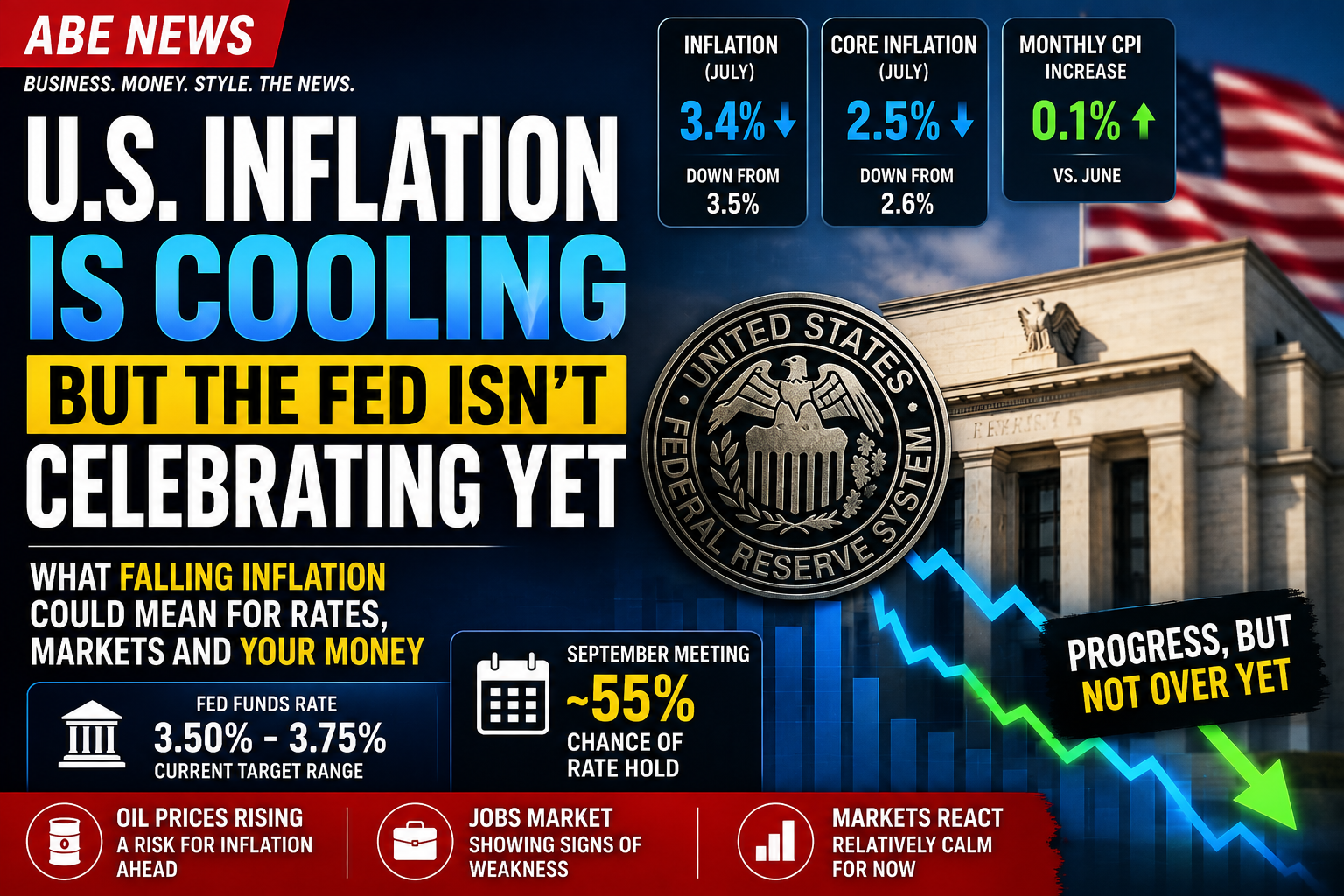
Consumer prices rose only 0.1% in July, while annual inflation eased to 3.4%, down from 3.5% in June.
Core inflation, which removes the more volatile food and energy categories, also moved lower to 2.5% annually.
For households that have spent years dealing with rising prices, that sounds like progress.
For financial markets, it could reduce pressure on the Federal Reserve to raise interest rates again.
But there is a reason nobody should declare the inflation battle over just yet.
Oil prices are rising again.
The labour market has recently shown signs of weakness.
And inflation remains well above the Federal Reserve’s long-term target.
The next few weeks could therefore become extremely important for businesses, consumers and investors.
Inflation Is Moving in the Right Direction
The latest Consumer Price Index shows that price pressures are continuing to moderate.
July’s 0.1% monthly increase followed a 0.4% decline in June.
Core prices increased 0.2% during July.
Neither number surprised economists significantly.
And sometimes, boring economic data is exactly what markets want.
Investors had been worried that inflation could come in hotter than expected and increase pressure on the Federal Reserve to raise interest rates.
That didn’t happen.
Instead, the report suggests inflation is continuing to cool gradually.
But 3.4% Inflation Is Still Inflation
There is an important distinction between lower inflation and lower prices.
When inflation falls from 3.5% to 3.4%, it doesn’t mean prices suddenly become cheaper.
It means prices are generally increasing at a slightly slower rate.
That distinction matters for households.
Someone buying groceries, paying rent or purchasing insurance may not immediately feel much relief simply because an inflation report improved.
And at 3.4%, annual inflation remains above the Federal Reserve’s 2% goal.
Progress has been made.
The job isn’t finished.
Why the Federal Reserve Is Watching
Interest rates are one of the Federal Reserve’s most important tools for controlling inflation.
When inflation becomes too high, higher rates can reduce borrowing and spending.
But those same rates also make mortgages, business loans and other forms of credit more expensive.
The Federal Reserve currently has its benchmark interest rate between 3.50% and 3.75%.
July’s inflation report makes another immediate increase somewhat harder to justify.
Financial markets are currently giving roughly a 55% probability that rates remain unchanged at the Fed’s September meeting.
But that isn’t a guarantee.
Another inflation report and another employment report will arrive before policymakers make their decision.
The Jobs Market Changes the Equation
Inflation isn’t the only thing the Federal Reserve has to worry about.
Recent employment data showed unexpected job losses in July.
That creates a difficult balancing act.
If the Fed raises interest rates too aggressively, it risks putting additional pressure on an already weakening economy.
If it keeps rates too low while inflation remains elevated, price pressures could strengthen again.
The central bank therefore has to consider two different risks at the same time:
Inflation staying too high.
And:
The economy becoming too weak.
That’s why one encouraging CPI report isn’t enough to determine what happens next.
Why Businesses Should Care
Interest-rate decisions eventually reach almost every part of the economy.
A company considering a new factory may need financing.
A small business may need a loan to purchase equipment.
A developer may need billions of dollars to finance construction.
A technology company may borrow money to expand.
When interest rates remain high, those investments become more expensive.
Some businesses delay expansion.
Others reduce hiring.
Some projects simply stop making financial sense.
That means today’s inflation report isn’t just something for economists and Wall Street traders.
It can eventually influence real business decisions.
What It Means for Consumers
Consumers feel interest rates too.
They influence:
- Mortgages
- Auto loans
- Credit cards
- Personal loans
- Housing activity
- Savings returns
If inflation continues cooling, the Federal Reserve gains more flexibility.
But consumers shouldn’t expect borrowing costs to suddenly collapse because of one report.
The Fed still needs evidence that inflation is moving sustainably toward its target.
Markets Liked What They Saw
Financial markets reacted relatively calmly to the report.
U.S. stock futures remained higher.
Short-term Treasury yields declined.
The dollar weakened slightly.
Those moves suggest investors saw the report as encouraging without viewing it as a dramatic change in the economic outlook.
Essentially, inflation didn’t give the Federal Reserve a strong reason to become more aggressive.
For markets, that was enough.
Then There’s Oil
This may become the biggest complication.
Oil prices have been climbing amid continued instability in the Middle East.
Higher oil prices can eventually affect more than what drivers pay at the pump.
Energy influences transportation.
Transportation influences shipping.
Shipping influences the cost of moving products.
Businesses facing higher energy costs may eventually attempt to pass some of those expenses to customers.
That creates the possibility that inflation improves during one month only to face renewed pressure later.
July’s inflation report therefore tells us where prices were.
Oil could help determine where they go next.
Why the Rest of the World Is Watching
The Federal Reserve doesn’t control only an American story.
Its decisions influence financial markets around the world.
Changes in U.S. interest rates can affect currencies, investment flows, borrowing costs and global asset prices.
Businesses operating internationally also pay attention because changes in the U.S. dollar can affect imports and exports.
That means an inflation number released in Washington can influence financial decisions thousands of kilometres away.
The Bigger Picture
The inflation story has changed.
A few years ago, the biggest question was whether inflation could be brought under control at all.
Today, the question is more complicated:
Can inflation return toward 2% without seriously damaging economic growth?
July’s numbers provide some evidence that progress is continuing.
But energy prices and a softer labour market mean policymakers cannot simply celebrate and move on.
The final stretch may prove harder than the beginning.
What’s Next?
Two things now matter enormously.
Inflation.
And jobs.
The Federal Reserve will receive another round of inflation and employment data before its September 15–16 policy meeting.
If inflation continues cooling while employment remains weak, keeping rates unchanged could become increasingly attractive.
If energy prices push inflation higher again, the decision becomes much more difficult.
For investors, businesses and consumers, September could therefore become one of the most closely watched Federal Reserve meetings of the year.
THE ABE NEWS TAKE
Inflation falling doesn’t mean the economic problem disappears.
It means the problem is changing.
The Federal Reserve spent years trying to slow prices without breaking the economy.
Now it has to determine when enough has been done.
Move too aggressively, and businesses and households could face unnecessary financial pressure.
Move too slowly, and inflation could return.
That balance is what makes today’s numbers important.
The headline may be that inflation cooled.
But the real story is what happens next.
Because interest rates don’t remain inside central-bank meeting rooms.
They eventually reach mortgages.
Business loans.
Stock markets.
Hiring decisions.
Construction projects.
And household budgets.
Understanding inflation therefore isn’t only about understanding prices.
It’s about understanding the direction of the economy.
ABE NEWS
Business. Money. Style. The News.
Understand More. Think Bigger.