



ABE NEWS | SEPTEMBER 28, 2026
For generations, Saudi Arabia’s economic power has rested on something buried beneath its desert: oil.
Petroleum transformed the kingdom into one of the world’s wealthiest countries, financed enormous infrastructure projects and gave Saudi Arabia influence stretching far beyond the Middle East.
Now the kingdom wants to prove it can manufacture something considerably more complicated.
Cars.
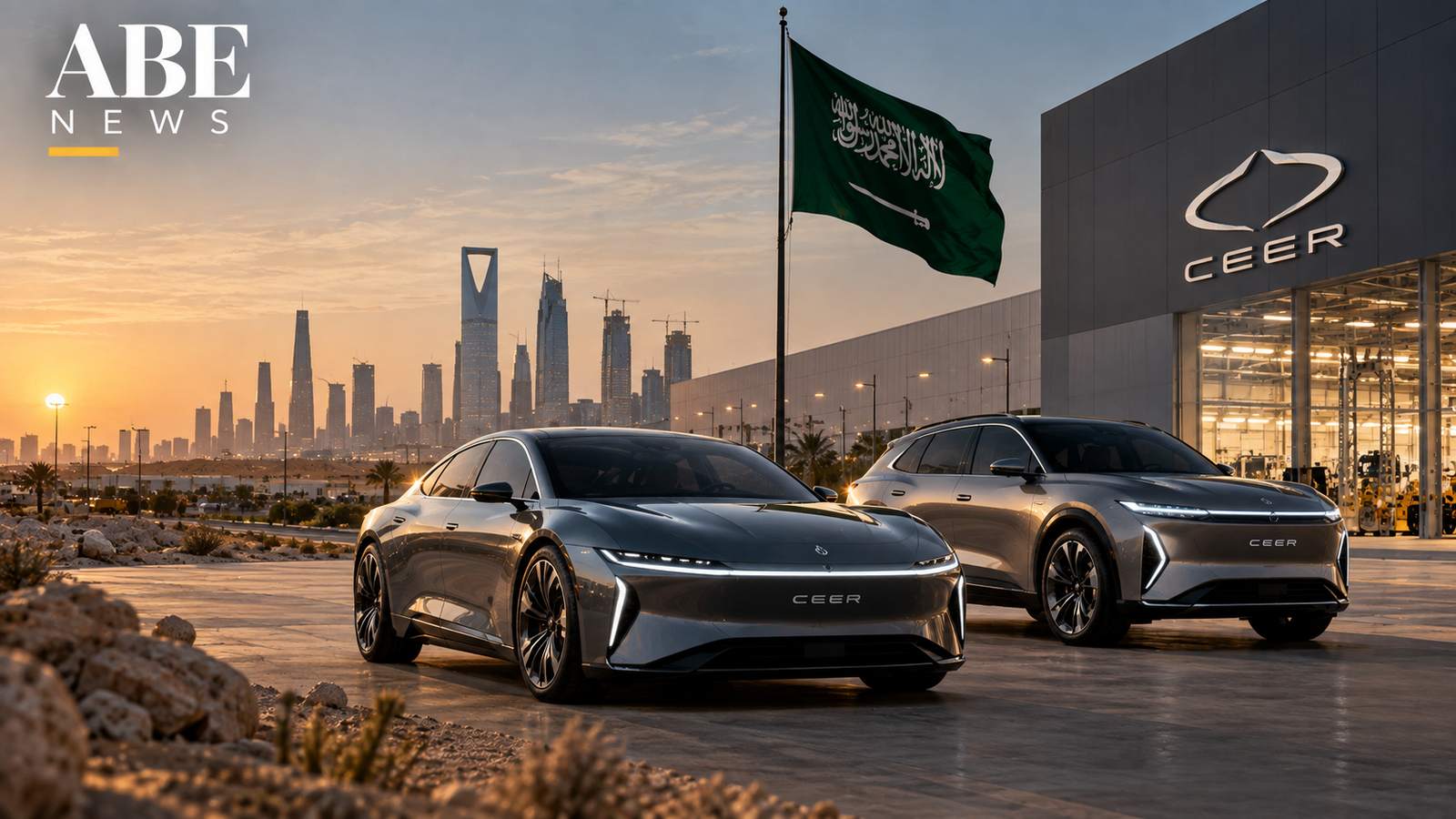
Saudi Arabia’s first homegrown automotive brand, Ceer, has unveiled its first production-bound vehicles: a premium electric sedan and SUV called EXOBOT. Sales in Saudi Arabia are expected to begin in early 2027, with five additional mainstream models planned between 2028 and 2030.
At first glance, this is another electric-vehicle launch.
It isn’t.
Ceer is part of a much larger economic experiment: Saudi Arabia is trying to use the enormous wealth generated by oil to build industries capable of surviving in a future where the kingdom cannot depend as heavily on oil.
And automobiles could become one of the biggest tests yet of whether that transformation can actually work.
MEET SAUDI ARABIA’S FIRST CAR BRAND
Ceer was established in 2022 as a joint venture between Saudi Arabia’s Public Investment Fund (PIF) and Taiwanese electronics manufacturing giant Foxconn.
The company isn’t merely importing cars and attaching a Saudi badge.
It is attempting to establish the capabilities required to design, engineer, manufacture, sell and service vehicles from Saudi Arabia. Ceer says its manufacturing complex at King Abdullah Economic City will produce the EXOBOT sedan and SUV locally.
The first two vehicles are deliberately ambitious.
Rather than entering the market with an inexpensive commuter car, Ceer is launching premium electric vehicles with futuristic designs, including upward-opening doors and pillarless body structures.
CEO Jim DeLuca told Reuters the objective was to demonstrate what Saudi Arabia was capable of producing.
But the vehicles themselves may ultimately be less important than the factories being built around them.
Saudi Arabia isn’t simply trying to create a Saudi car.
It is trying to create a Saudi automotive industry.
THE CAR IS SAUDI. THE KNOWLEDGE IS GLOBAL.
Building an automobile industry from almost nothing is extraordinarily difficult.
A modern vehicle contains thousands of components produced by an enormous network of suppliers.
There are batteries, semiconductors, seats, electrical systems, suspension components, software, safety systems, glass, steel, aluminium and countless other pieces.
Saudi Arabia does not yet possess the automotive supply chain that countries such as Germany, Japan, South Korea, China and the United States spent decades developing.
So Ceer is importing expertise while attempting to localize production.
Foxconn provides electrical architecture for the EXOBOT vehicles, while BMW has provided engineering support. Suppliers including Lear, Benteler, Shin Young and China’s Fangxin have established manufacturing operations in Saudi Arabia, encouraged partly by government incentives.
Ceer separately lists partnerships with companies including BMW, Hyundai Transys, Rimac, Siemens and several major component manufacturers. The company says it is targeting 45% local content by 2034.
That strategy reveals what Saudi Arabia is really buying.
Not merely car parts.
Knowledge.
Factories bring engineers.
Suppliers bring manufacturing processes.
International partners bring technology.
Employees acquire skills.
Domestic companies enter supply chains.
Over time, the hope is that capabilities initially imported from overseas begin taking root inside the country.
That is how industrial ecosystems are built.
SAUDI ARABIA HAS TRIED THIS BEFORE
There is a reason to be cautious.
Saudi Arabia has wanted a domestic automotive industry for years.
Previous attempts struggled.
A proposed Jaguar Land Rover factory was abandoned more than a decade ago. Toyota declined a Saudi manufacturing proposal in 2019, citing factors including high labour costs and the absence of a sufficiently developed local supplier network.
Those failures exposed a basic economic reality.
Having money doesn’t automatically create an industry.
Factories require suppliers.
Suppliers require customers.
Manufacturers require skilled workers.
Workers require training.
And the entire ecosystem needs sufficient production volume to make the economics work.
Saudi Arabia can finance factories.
It cannot simply purchase decades of industrial experience overnight.
Ceer therefore represents an attempt to solve several of those problems simultaneously.
THE BIGGER BET IS VISION 2030
The automotive push sits inside Saudi Arabia’s broader Vision 2030 economic transformation.
The fundamental problem is straightforward.
Saudi Arabia became extraordinarily wealthy from oil.
But an economy heavily dependent on a single commodity is vulnerable.
Oil prices rise and fall.
Energy technologies change.
Governments around the world are trying to reduce carbon emissions.
And Saudi Arabia has a young population that needs productive private-sector employment.
The kingdom therefore wants more economic activity in areas including tourism, entertainment, technology, logistics, mining and advanced manufacturing.
Automobiles fit almost perfectly into that strategy.
A successful car industry doesn’t create only assembly-line jobs.
It can support component manufacturers, logistics companies, engineering businesses, software developers, battery suppliers, dealerships, financing companies and maintenance networks.
PIF projects that Ceer could contribute more than $8 billion to Saudi GDP by 2034, improve the kingdom’s trade balance by more than $21 billion, and support roughly 30,000 direct and indirect jobs. Those are PIF projections rather than guaranteed outcomes.
The distinction matters.
Building factories is the beginning.
Selling enough cars profitably is the test.
THE ELECTRIC-VEHICLE MARKET HAS BECOME BRUTAL
Ceer is entering the automotive business at an unusually difficult moment.
Chinese manufacturers have transformed the competitive landscape.
Companies such as BYD have demonstrated that Chinese automakers can compete aggressively on electric-vehicle technology, manufacturing efficiency and price.
Traditional automakers are simultaneously spending billions restructuring their businesses for electric vehicles while consumer demand has proved less predictable than many companies expected.
And several heavily funded EV startups have collapsed.
Arrival failed.
Lordstown failed.
Fisker failed.
The lesson is becoming increasingly clear:
Building an attractive electric vehicle is not enough.
An automaker must manufacture it reliably, control costs, create distribution and service networks, attract customers and eventually reach sufficient scale to become profitable.
Reuters’ automotive analysis this month highlighted scale as one of the industry’s defining challenges, particularly for newer companies.
Ceer CEO Jim DeLuca understands that danger particularly well.
He previously led Vietnamese EV maker VinFast, which spent heavily pursuing international expansion and later underwent restructuring. His strategy for Ceer is deliberately more cautious: establish the company in Saudi Arabia first, expand into neighbouring markets beginning around 2028, and then pursue broader Middle Eastern and North African growth.
As DeLuca put it:
“It only takes one mistake and you can kill a startup.”
For a sovereign-backed automaker, that may sound surprising.
But even unlimited patience cannot guarantee customers.
AND CEER ISN’T BETTING EVERYTHING ON ELECTRIC
Perhaps the most revealing part of Ceer’s strategy is that the company is already adapting.
It was originally conceived as a pure electric-vehicle manufacturer.
Its future lineup will now include plug-in hybrids and combustion-engine vehicles, alongside EVs, allowing the company to respond to changing customer demand.
That is significant.
Saudi Arabia’s objective is apparently becoming broader than building an EV company.
It wants an automobile industry.
If consumer preferences shift, the industrial strategy can shift with them.
The EXOBOT may be electric.
The larger ambition is manufacturing.
THE KINGDOM IS BUILDING AN ECOSYSTEM, NOT JUST CEER
Ceer is only one piece of Saudi Arabia’s automotive strategy.
PIF has also backed the development of EV manufacturing in Saudi Arabia through Lucid, while partnering with Hyundai on local vehicle production. PIF describes these investments as components of a broader effort to establish a domestic automotive ecosystem and localize more of the supply chain.
That matters because a country doesn’t become an automotive power through one company.
The real prize is clustering.
Imagine multiple manufacturers operating factories within the same country.
Suddenly a supplier considering whether to build a plant isn’t selling components to one customer.
It may have several.
More suppliers arrive.
Costs fall.
Workers gain experience.
Engineering expertise accumulates.
Universities adapt training programs.
Local businesses enter the supply chain.
Eventually, an ecosystem begins reinforcing itself.
China followed its own much larger version of this process over decades.
Saudi Arabia is attempting to accelerate it with sovereign capital.
FROM IMPORTING CARS TO EXPORTING THEM
Saudi Arabia has historically been a major importer of vehicles.
Ceer’s long-term strategy attempts to reverse part of that relationship.
The EXOBOT sedan and SUV will initially target Saudi buyers.
Regional expansion is expected to follow.
Ceer’s future mainstream vehicles are being designed to comply with international regulatory requirements, potentially allowing them to be sold in markets beyond the Gulf.
If that strategy works, Saudi Arabia could eventually export vehicles rather than merely importing them.
That would matter for the country’s trade balance.
But it would also carry symbolic significance.
For decades, Saudi Arabia exported the raw energy that powered the world’s cars.
It now wants to export some of the cars themselves.
THE REAL COMPETITION ISN’T TESLA
It would be tempting to describe Ceer as Saudi Arabia’s answer to Tesla.
That misses the bigger story.
Ceer doesn’t need to become Tesla for Saudi Arabia’s industrial strategy to succeed.
The more important question is whether Ceer can help create an industry that did not previously exist at scale.
A functioning domestic automotive sector could generate skilled employment, attract foreign investment, create supplier networks and develop manufacturing expertise even if Ceer never becomes one of the world’s largest automakers.
That means its success should ultimately be measured by more than vehicle sales.
How much production becomes local?
How many Saudi workers acquire advanced manufacturing skills?
How many suppliers establish operations?
Can those suppliers eventually serve companies beyond Ceer?
Can Saudi Arabia manufacture competitively without permanently depending on enormous government support?
Those questions will determine whether Ceer becomes an industrial catalyst or simply an expensive national project.
OIL IS FUNDING THE ATTEMPT TO MOVE BEYOND OIL
There is an unavoidable irony at the centre of the entire project.
Saudi Arabia can afford to attempt this transformation largely because of the industry it wants to become less dependent upon.
Oil.
Decades of petroleum revenue created the sovereign wealth that PIF can now deploy into electric vehicles, tourism, technology, infrastructure and manufacturing.
In effect, Saudi Arabia is using the wealth of the old energy economy to purchase a position in the next one.
That isn’t necessarily contradictory.
It may be the strategy.
The kingdom understands that oil will remain economically important for years.
The question is what Saudi Arabia builds while that remains true.
Ceer is one answer.
🔴 THE ABE NEWS TAKE
The EXOBOT is easy to photograph.
The factory behind it is more important.
Saudi Arabia’s automotive experiment will not ultimately succeed because its first cars have futuristic doors, impressive screens or striking designs.
It will succeed if those cars create something much harder to see:
industrial capability.
Suppliers.
Engineers.
Factories.
Skills.
Export markets.
Private businesses capable of surviving without permanent state support.
That is the difference between launching a car and building an industry.
Saudi Arabia possesses something most automotive startups can only dream about: access to enormous capital and a government determined to create the conditions for manufacturing.
But money alone does not guarantee industrial success.
Ceer still has to compete against Chinese manufacturers operating at extraordinary scale, established global automakers with decades of expertise and consumers who ultimately care more about price, quality and reliability than national economic strategies.
That makes EXOBOT more than Saudi Arabia’s first major automotive product.
It is an early test of one of the biggest questions surrounding Vision 2030:
Can Saudi Arabia turn oil wealth into industries that eventually stand on their own?
The answer won’t come when the first EXOBOT rolls off the production line.
It will come years later, when we find out whether an entire industry followed it.
ABE NEWS
Business. Money. Style. The News.
Understand More. Think Bigger.