








BUSINESS | ABE | OCTOBER 6, 2026
Uber spent years building an app people opened when they needed a ride. Then it trained millions of those same people to open it when they wanted dinner.
Now it wants businesses to do the same thing.
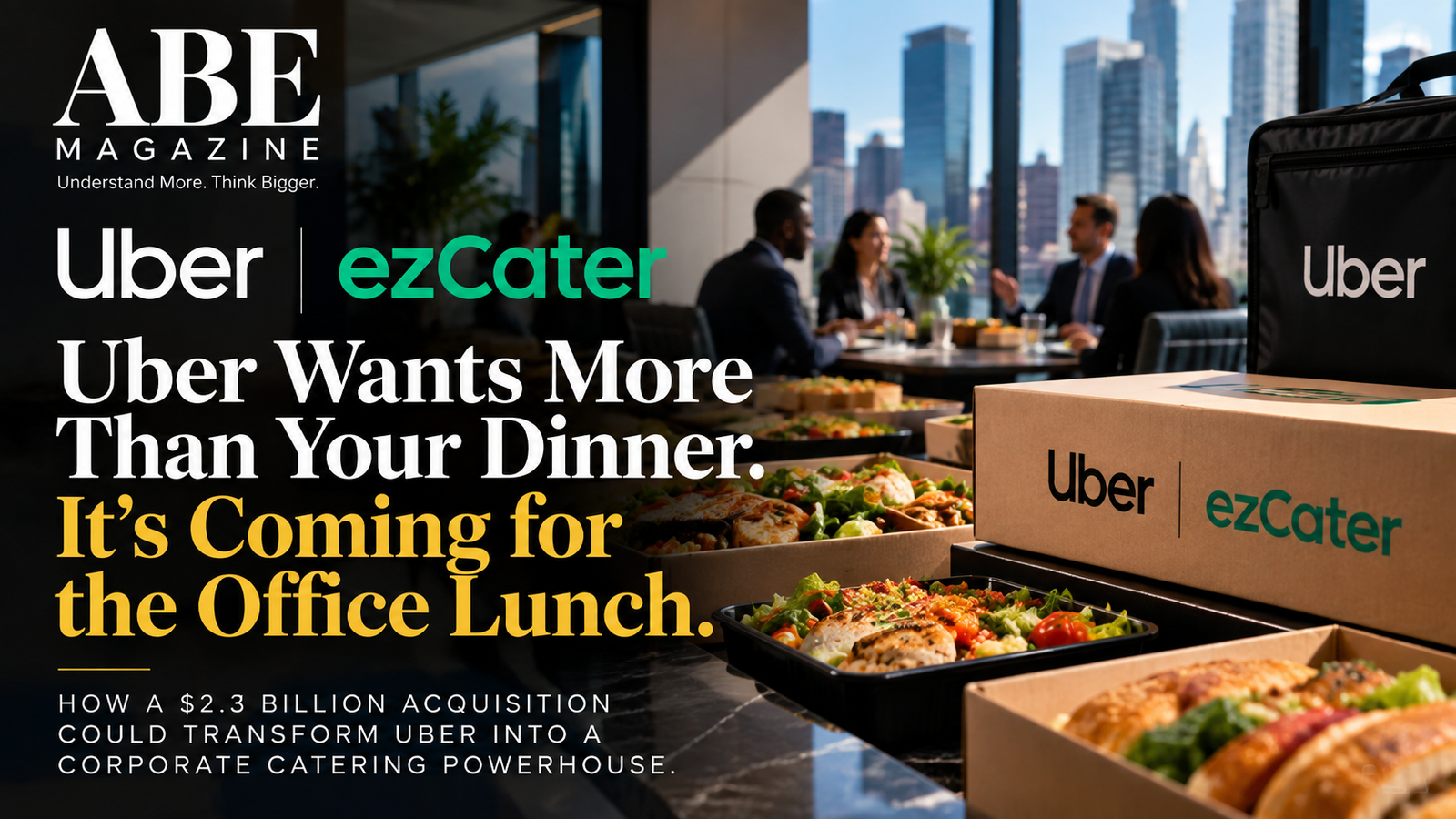
Uber has agreed to acquire U.S. workplace-food platform ezCater for $2.3 billion in cash, pushing the company deeper into corporate catering, employee meal programs and large group orders. The deal brings together ezCater’s workplace-food operation, Uber Eats’ restaurant network and Uber for Business’s relationships with corporate customers. Uber Investor Relations
At first glance, it looks like another food-delivery acquisition.
But the more interesting story is what Uber is becoming.
The company increasingly looks less like the ride-hailing service that made it famous and more like an enormous distribution network—one designed to move people, meals and eventually a much wider range of goods through the same technological infrastructure.
And corporate lunch could be particularly valuable territory.
THE $400 LUNCH ORDER
A person ordering dinner through a delivery app might spend $20 or $30. A company feeding an office can spend hundreds—or thousands.
Uber says the average ezCater order exceeds $400. The platform generated more than $2.5 billion in gross bookings during the past 12 months, and its network now covers more than 140,000 restaurants across the United States. Uber also says ezCater is profitable on an adjusted operating-income basis and expects the acquisition to improve margins. Uber Investor Relations
That changes the economics of delivery.
Sending a driver across a city with one person’s sandwich is one business. Using similar logistics infrastructure to deliver a $500 office order is potentially a much more attractive one.
There is also another valuable difference: who is paying.
Corporate catering moves Uber beyond relying exclusively on individual consumers deciding whether they can justify another delivery fee. Businesses have recurring meetings, conferences, training sessions, employee programs and events. Some can become predictable, high-frequency customers.
That is exactly the kind of spending Uber wants flowing through its ecosystem.
THE OFFICE IS BECOMING A FOOD MARKET
The timing matters.
As companies continue experimenting with hybrid work and return-to-office policies, food has increasingly become part of the effort to persuade employees to spend more time together physically.
Research published by ezCater earlier this year found that 91% of workplaces surveyed planned to spend the same amount or more on food in 2026, while one in five expected to increase spending by more than 25%. It also found daily or weekly employee meal programs had increased 26% year over year. The figures come from ezCater’s own surveys and platform data, so they should be understood as company research rather than an independent measure of the entire market. ezCater
Still, they illustrate why Uber sees an opportunity.
The workplace meal is no longer necessarily just a tray of sandwiches ordered for the occasional board meeting. Companies are using food as an employee benefit, a tool for bringing distributed teams together and, increasingly, part of the infrastructure of hybrid work.
ezCater has been positioning itself accordingly. Earlier this year it rebranded around its expansion from a catering marketplace toward an enterprise workplace-food platform, and it has been building integrations and tools for companies to manage food spending and recurring meal programs. ezCater
Uber isn’t simply buying access to catering restaurants.
It is buying its way deeper into the workplace.
DELIVERY IS NO LONGER UBER’S SIDE BUSINESS
There was a time when Uber Eats could reasonably be considered an extension of Uber’s core ride-hailing operation.
That distinction is becoming harder to make.
Delivery accounted for roughly 37% of Uber’s revenue in the second quarter, according to Reuters, and has recently been one of the company’s strongest growth engines. Reuters
The ezCater acquisition also follows Uber’s agreement in July to acquire Germany’s Delivery Hero in a transaction valued at $14.8 billion, another enormous bet on the future of delivery. Reuters
Together, the moves point toward a broader strategy.
Uber already possesses the difficult infrastructure: consumers, restaurants, merchants, corporate customers, drivers, payments, routing technology and a globally recognized app.
The question is how many transactions it can push through that network.
A ride to the airport.
Dinner at home.
Groceries.
A company lunch.
Catering for 150 people.
The more categories Uber can layer onto the same ecosystem, the less dependent it becomes on any single one of them.
DOORDASH IS STILL STANDING IN THE WAY
There is another reason Uber needs to keep expanding: competition.
DoorDash remains the leader in U.S. restaurant delivery, while Uber Eats has broader international reach. Analysts cited by Reuters expect ezCater to help Uber narrow that gap by giving it a stronger position in high-value workplace orders. Reuters
Rather than fighting only over the same individual dinner customer, Uber can expand the battlefield.
Corporate catering gives it access to transactions with larger order values and potentially stronger economics. It can also connect Uber Eats with Uber for Business, giving corporate customers another reason to remain inside Uber’s ecosystem.
And restaurants have an incentive to participate.
One $500 catering order can be considerably more valuable than a collection of small individual deliveries, particularly if workplace customers become recurring buyers.
That means Uber isn’t merely chasing more orders.
It’s chasing better orders.
UBER’S BIGGER PROBLEM
All of this is happening while the business that originally defined Uber faces a longer-term technological threat.
Autonomous vehicles are moving closer to commercial reality, and investors are increasingly asking what robotaxis could mean for a company whose ride-hailing model was built around connecting human drivers with passengers.
Uber shares have fallen about 15% this year as investors weigh that uncertainty, according to Reuters. Reuters
That doesn’t mean ride-hailing is disappearing tomorrow.
But it gives Uber another reason to ensure the company of the future is much larger than rides.
Delivery, advertising, corporate services, freight and other businesses can turn the Uber network into something more diversified—and potentially more defensible—than the original taxi-disruption story.
ezCater fits neatly into that transformation.
THE PLATFORM BEHIND EVERYDAY COMMERCE
Uber’s most valuable asset may ultimately not be cars or food.
It may be demand.
Millions of people already have the app. Restaurants already connect to the platform. Companies already use Uber for Business. Drivers and couriers already move through its network.
Every additional service has the potential to make that network more useful.
And every new reason to open Uber gives the company another opportunity to capture a transaction.
That’s why a $2.3 billion catering acquisition deserves more attention than the phrase food delivery deal suggests.
Uber isn’t merely trying to deliver more lunches.
It is trying to become infrastructure for an increasingly large share of everyday commerce.
🔴 THE ABE TAKE
The most interesting part of Uber’s ezCater acquisition isn’t catering.
It’s frequency, scale and ownership of the customer relationship.
The great consumer platforms become powerful when they stop solving one problem and become the place where users solve many related problems. Amazon moved beyond books. Google moved beyond search. Uber’s ambition increasingly appears to follow the same logic in physical services.
Transportation gave Uber its network.
Food delivery increased how frequently customers could use it.
Corporate catering brings larger transactions and businesses into that network.
The strategic question is therefore no longer whether Uber can win another piece of food delivery.
It’s whether Uber can transform a network originally built to move people into a platform capable of moving an increasingly large part of the economy.
That is a much bigger business than getting someone home on Friday night.
ABE
Understand More. Think Bigger.