








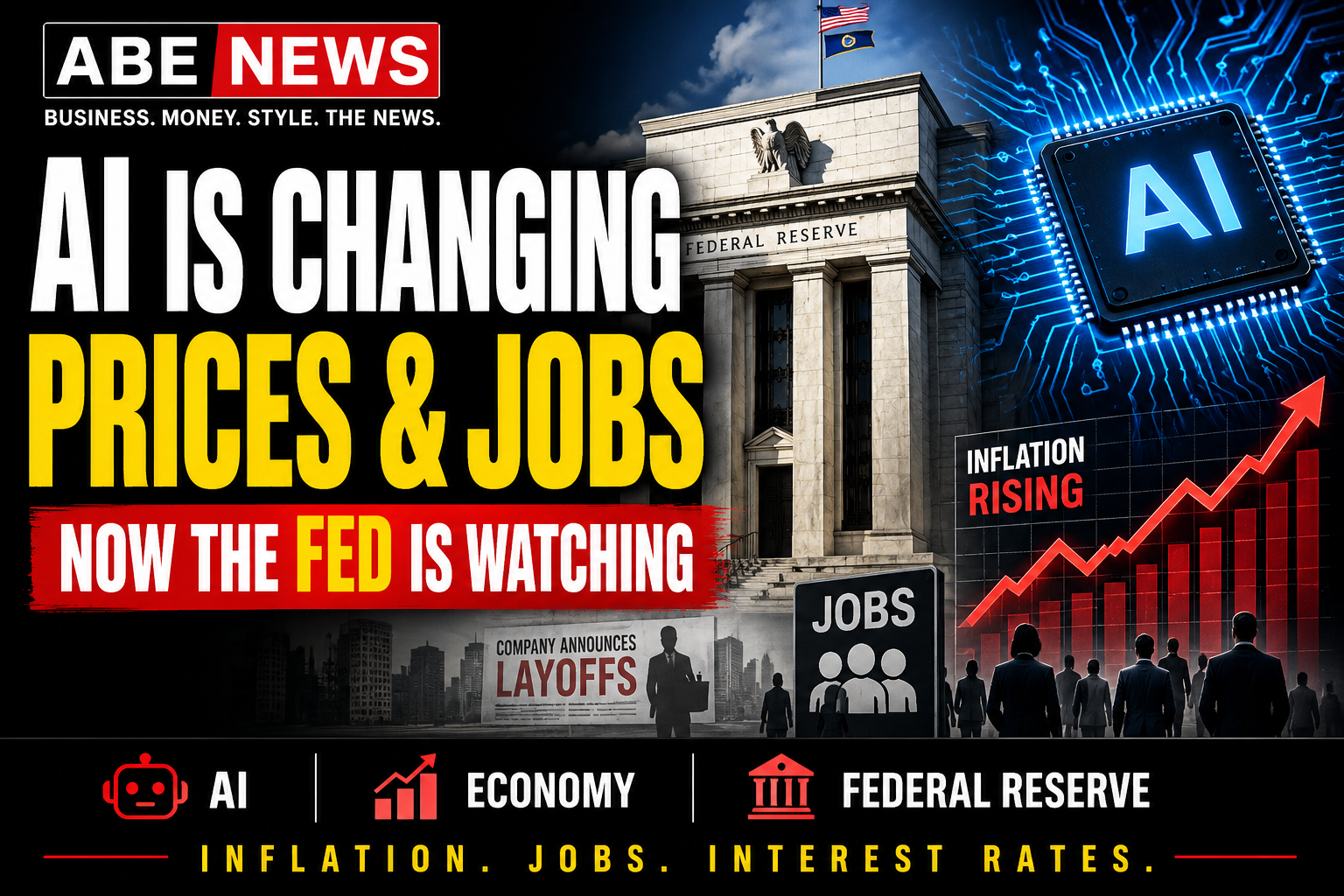
Artificial intelligence has spent the last few years changing one thing after another.
First, it changed technology.
Then it changed Wall Street.
Then companies started spending hundreds of billions of dollars building the infrastructure needed to power it.
Now AI is beginning to enter a place that could affect almost everyone:
the Federal Reserve’s economic calculations.
The effects are still relatively small.
But signs are appearing in two areas the Fed watches extremely closely:
prices and jobs.
Computer prices are showing AI-related pressure.
Chip shortages are becoming more important.
Companies are increasingly citing AI when announcing layoffs.
And Federal Reserve officials are beginning to ask a much bigger question:
What happens when the AI boom becomes large enough to influence inflation, employment and eventually interest rates?
AI Is Creating an Enormous Investment Boom
The scale of the AI buildout is difficult to ignore.
Technology companies are spending enormous amounts of money on:
data centers.
AI chips.
servers.
electricity.
networking equipment.
construction.
And the specialized workers needed to build all of it.
AI hyperscalers have also raised hundreds of billions of dollars in financing as companies race to expand computing capacity.
That investment can be good for economic growth.
It creates demand.
It creates construction.
It creates new infrastructure.
And potentially, it creates technologies that allow businesses to become dramatically more productive.
But there is another side.
When thousands of companies suddenly want the same chips, computers, electricity and specialized workers, demand can grow faster than supply.
And when that happens?
Prices rise.
We’re Starting to See It in Computers
This is where AI starts becoming an inflation story.
July’s U.S. inflation data showed price pressure appearing in some technology-related categories.
Prices for personal computers and peripherals increased 3.5% in July alone.
Economists at Morgan Stanley cited by Reuters believe AI-related pressures are beginning to spread beyond software into electronics and other technology products.
One reason is chips.
The massive expansion of AI data centers has created intense demand for memory chips and other components.
If AI companies are willing to pay more to secure those chips, manufacturers of other electronics can face higher costs too.
And that creates an interesting chain reaction.
AI company needs more computing.
↓
Data center needs more chips.
↓
Chip demand increases.
↓
Component prices rise.
↓
Computers and electronics become more expensive.
↓
Some of those increases eventually reach consumers.
Suddenly, something that looked like a technology story starts becoming an inflation story.
But AI Isn’t Driving America’s Inflation Problem
Not yet.
And this distinction is important.
Technology-related products still represent a relatively small portion of the inflation indexes policymakers watch.
Reuters notes that information technology hardware and services account for less than 2% of the Consumer Price Index.
Software and accessories carry a much larger weight in the Federal Reserve’s preferred Personal Consumption Expenditures measure than they do in CPI, but even there the category represents only about 1.2% of the basket.
Compare that with things like:
housing.
transportation.
food.
energy.
Those categories affect inflation far more.
So it would be wrong to say:
“AI is causing inflation.”
The evidence doesn’t support that.
A better way to describe what is happening is:
AI is beginning to create inflation pressure in certain corners of the economy.
And the Federal Reserve is watching to see whether those corners get bigger.
Then There Are the Jobs
This may eventually become the more important story.
Companies have spent years telling workers that AI will make them more productive.
But businesses are also beginning to reorganize around the technology.
And sometimes that means fewer workers.
U.S. employers announced 33,429 planned job cuts in July, according to Challenger, Gray & Christmas data cited by Reuters.
That was actually the lowest monthly total in two years.
So this isn’t evidence that AI has suddenly created a nationwide employment crisis.
But look underneath the headline number.
When employers gave a reason for their announced layoffs, AI was cited in roughly one-third of them.
And July marked the fifth consecutive month in which artificial intelligence was the leading stated reason for job cuts.
That is difficult to ignore.
AI May Not Destroy Jobs the Way People Expect
There’s another complication.
Technology doesn’t usually affect employment in one direction.
It destroys some tasks.
Changes others.
And creates entirely new ones.
AI could reduce demand for certain office jobs while increasing demand for:
engineers.
electricians.
data-center technicians.
construction workers.
energy specialists.
chip designers.
cybersecurity professionals.
And people who know how to use AI effectively inside traditional businesses.
Chicago Fed President Austan Goolsbee recently argued that even if AI takes some work, it may take tasks within jobs rather than simply eliminating entire occupations.
That difference matters enormously.
Because replacing a task is not the same thing as replacing a worker.
The Federal Reserve Has a Problem
The Federal Reserve has two major responsibilities.
Keep prices stable.
And support maximum employment.
AI could eventually push those goals in opposite directions.
Imagine AI infrastructure spending pushes demand for chips, electricity, construction and skilled workers higher.
That could create inflation pressure.
The Fed might normally respond with higher interest rates.
But now imagine AI simultaneously allows businesses to automate more work and reduces demand for certain employees.
That could weaken the labor market.
The Fed might normally respond to that with lower interest rates.
See the problem?
AI could potentially create inflationary pressure in one part of the economy while creating deflationary or employment pressure somewhere else.
That’s one reason policymakers can’t simply look at “AI” and decide whether rates should go up or down.
The Fed Is Watching the AI Buildout Itself
There is another issue.
Money.
The AI boom isn’t being financed entirely with cash.
Companies are increasingly borrowing to fund enormous infrastructure projects.
That has attracted the attention of several Federal Reserve officials.
New York Fed President John Williams told Reuters he does not currently see the AI boom as a bubble-like financial stability threat.
But Kansas City Fed President Jeff Schmid has raised concerns about complicated financing relationships across data centers, energy providers and other participants.
San Francisco Fed President Mary Daly has also said the speed and scale of AI investment deserves attention.
The concern isn’t simply:
“Are AI companies spending too much?”
It’s:
“What happens to everyone connected to that spending if expected AI returns don’t arrive?”
Why This Matters for Businesses
For businesses, AI is entering a completely different stage.
The first stage was experimentation.
Companies tried ChatGPT.
Employees tested AI tools.
Businesses added chatbots.
Executives announced AI strategies.
The second stage was investment.
Buy chips.
Build data centers.
Train models.
Hire engineers.
Connect AI to company systems.
But the next stage is harder.
Economics.
Does AI reduce costs?
Does it increase productivity?
Does it eliminate jobs?
Does it create better jobs?
Does it increase prices?
Does it lower prices?
And most importantly:
Does all this investment produce enough money to justify what companies are spending?
Those questions are moving AI beyond Silicon Valley.
They are turning it into a question for economists, governments and central banks.
Why This Matters for Interest Rates
The timing makes the story even more important.
The Federal Reserve is already trying to determine whether inflation is cooling enough to avoid another rate increase.
U.S. producer prices were unchanged in July, while the annual increase slowed to 4.7% from 5.5% in June.
Financial markets were pricing roughly a 67.6% probability that the Fed keeps its benchmark rate at 3.50%–3.75% at its September meeting, according to CME FedWatch data cited by Reuters on Thursday.
But Richmond Fed President Tom Barkin said Thursday that it remains an open question whether rates ultimately need to rise again.
And interestingly, he specifically identified surging demand for supplies and labor from the AI buildout as one of the shocks contributing to current price pressure.
That’s significant.
AI has moved from technology conferences and earnings calls into conversations about monetary policy.
The Bigger Picture
For years, people have asked:
Will AI change the economy?
We may be approaching the point where that question becomes outdated.
The better question could soon be:
How much is AI already changing it?
Look at the connections.
AI creates demand for chips.
Chip demand affects electronics prices.
AI requires data centers.
Data centers affect electricity demand.
Infrastructure construction affects labor and materials.
Automation affects employment.
Productivity affects wages and economic growth.
Corporate borrowing affects financial markets.
And eventually all of those things can affect inflation and interest rates.
AI doesn’t exist in a separate “technology economy.”
It is becoming connected to the ordinary economy.
What’s Next?
Watch three things.
First: employment.
If AI continues appearing as a reason for layoffs while overall unemployment begins rising, the Federal Reserve will have much more reason to pay attention.
Second: technology prices.
If chip shortages spread into computers, phones, cars and other products, AI-related inflation could become more visible.
Third: productivity.
This might ultimately matter most.
If companies spend enormous amounts on AI but productivity barely improves, the economics become difficult.
But if AI allows businesses to produce significantly more with the same resources?
Then the entire equation changes.
Higher productivity can allow an economy to grow faster without necessarily creating the same inflation pressure.
And that could eventually influence how the Federal Reserve thinks about the economy itself.
THE ABE NEWS TAKE
AI has spent years promising to change the future.
Now it has to survive the economics of the present.
That’s the transition worth watching.
The first AI race was about who could build the best model.
Then it became about who could buy the most chips.
Then who could build the biggest data centers.
But none of those races can continue forever without answering a more basic question:
What does AI actually do to the economy?
If it makes workers dramatically more productive, creates new industries and allows businesses to produce more at lower cost, today’s enormous investments could look remarkably cheap in hindsight.
But if companies spend hundreds of billions building AI infrastructure while simultaneously pushing component prices higher, increasing debt and eliminating jobs without generating comparable productivity?
The conversation changes.
And that’s why the Federal Reserve paying attention matters.
Central banks don’t set interest rates because a technology is exciting.
They care when that technology begins changing:
prices.
jobs.
productivity.
investment.
and economic growth.
AI is beginning to touch all five.
The biggest sign that artificial intelligence is transforming the economy may not be another chatbot.
It may be the moment America’s central bank has to start factoring AI into the price of money itself.
ABE NEWS
Business. Money. Style. The News.
Understand More. Think Bigger.