







CANADA — Something interesting is happening inside the Canadian economy.
Factories are getting busier.
Companies are receiving more orders.
And some manufacturers are hiring more workers.
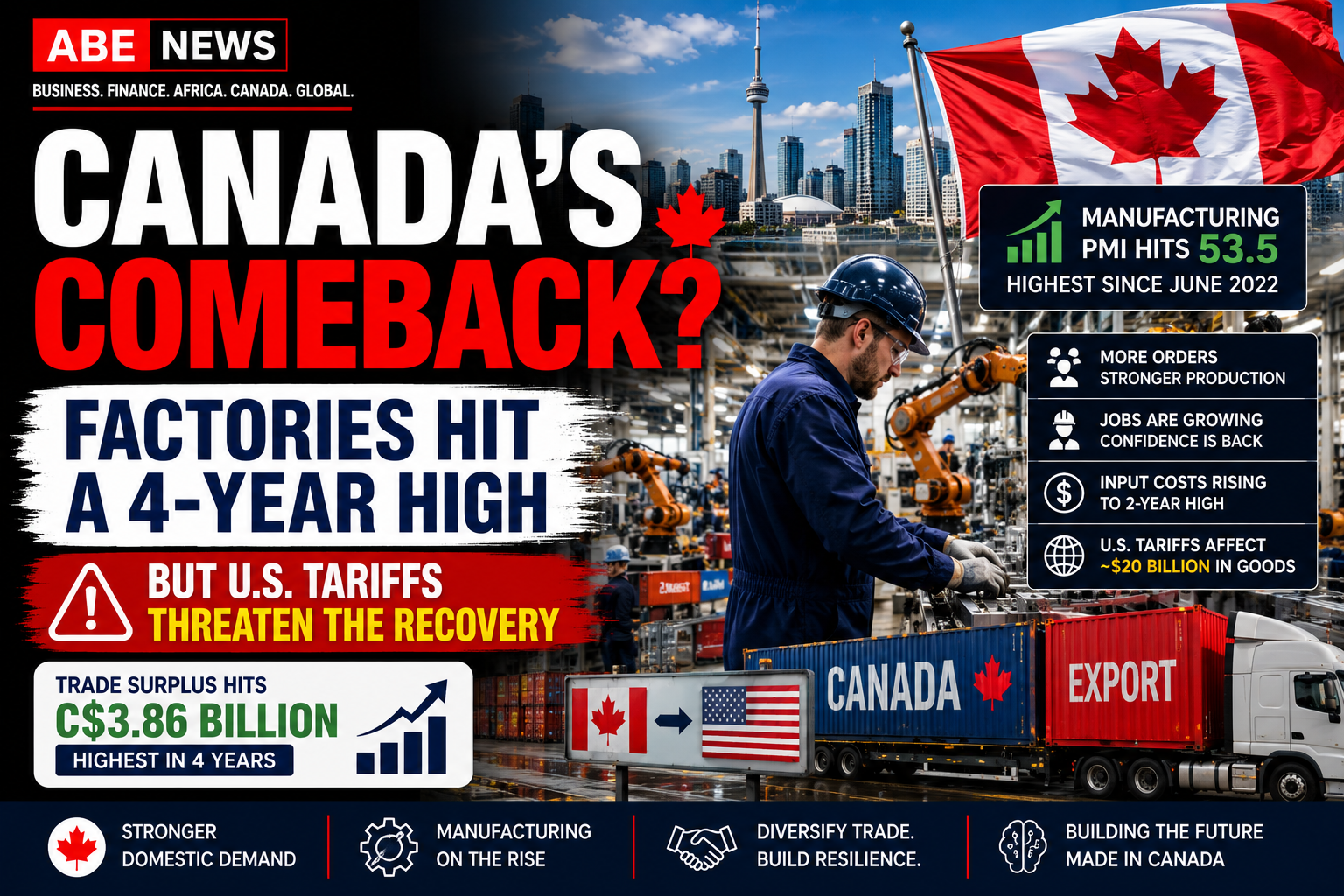
Canada’s manufacturing sector expanded in July at its fastest pace in more than four years, according to new industry data.
At first glance, that sounds like exactly the kind of economic news Canada needs.
But underneath the positive numbers is a much bigger question:
Can Canada’s manufacturing comeback continue while businesses face U.S. tariffs, rising costs and an uncertain global economy?
For Canada, the answer matters far beyond factory floors.
It could help determine where Canadians work, what the country exports and how dependent the economy remains on the United States.
1. Canadian Manufacturing Just Hit a Four-Year High
One of the easiest ways economists measure factory activity is through something called the Purchasing Managers’ Index, or PMI.
The basic idea is simple.
A reading above 50 generally means manufacturing activity is expanding.
Below 50 means it is contracting.
Canada’s manufacturing PMI climbed from 53.0 in June to 53.5 in July.
That’s the highest reading since June 2022.
It was also the seventh consecutive month that the index remained at or above the 50 level.
That’s an encouraging sign.
But what’s causing the growth?
2. Canadians Are Helping Drive the Recovery
Interestingly, the biggest source of strength isn’t necessarily coming from overseas.
It’s coming from inside Canada.
Domestic demand helped manufacturers receive more orders and increase production.
The index measuring new orders climbed to 53.5, while the output index increased to 52.6.
Companies became confident enough about their workloads that some manufacturers also increased staffing.
That’s important.
Manufacturing isn’t just about producing cars, machinery or industrial equipment.
Factories support entire networks of businesses.
Transportation companies move their products.
Warehouses store them.
Suppliers provide materials.
Engineers design equipment.
Construction companies build facilities.
And workers spend their salaries throughout the wider economy.
So stronger manufacturing can create economic activity far beyond the factory itself.
3. But Canada Has a Big Problem: The United States
Canada and the United States have one of the most important trading relationships in the world.
That relationship is incredibly valuable.
But it also creates a vulnerability.
Canada remains heavily dependent on American customers.
In June, approximately 69.5% of Canadian exports went to the United States.
That means when American trade policy changes, Canadian businesses can feel the consequences very quickly.
The U.S. recently announced new tariffs affecting nearly $20 billion worth of Canadian goods, according to Reuters.
For Canadian manufacturers trying to sell products into the American market, that creates uncertainty.
And businesses hate uncertainty.
A company considering building another factory or hiring hundreds of workers wants to know:
Will we still be able to sell our products competitively next year?
If nobody knows what future tariffs will look like, some companies may delay those investments.
4. The Cost of Making Things Is Also Rising
Tariffs aren’t the only problem.
Manufacturers are also dealing with higher production costs.
Canada’s manufacturing input-price index jumped to 68.3 in July — its highest level since July 2022.
Higher energy costs and global geopolitical instability have contributed to those pressures.
That’s dangerous because businesses eventually have to decide what to do with those extra costs.
They can accept smaller profits.
They can cut costs elsewhere.
Or they can increase prices.
If many companies choose the third option, consumers could eventually feel it too.
5. Canada’s Trade Numbers Tell Another Interesting Story
There’s another reason to watch Canadian manufacturing closely.
Canada recently recorded its largest merchandise trade surplus in four years.
The country posted a C$3.86 billion trade surplus in June, according to Statistics Canada data reported by Reuters.
Exports increased 0.4% when measured in Canadian dollars.
More importantly, actual export volumes increased 1.1%, while import volumes declined 1.5%.
Metal and non-metallic mineral product exports also jumped substantially.
However, part of the increase in the dollar value of trade came from a weaker Canadian dollar.
So the headline number shouldn’t be interpreted as proof that every part of Canada’s export economy is booming.
The picture is more complicated.
6. Canada Needs More Than the United States
This may ultimately be the biggest lesson.
The United States will almost certainly remain Canada’s most important economic partner.
The two economies are deeply connected.
But depending too heavily on one customer creates risk.
Imagine running a company where almost seven out of every ten products you export go to one buyer.
That buyer is extremely valuable.
But that buyer also has enormous power over your business.
Canada faces a similar problem at a national scale.
The country therefore has a strong reason to build deeper trading relationships with other markets.
Europe.
Asia.
Latin America.
And Africa.
The goal shouldn’t necessarily be to trade less with America.
It should be to create more opportunities everywhere else.
7. Manufacturing Could Become Important Again
For years, much of the global economic conversation focused on software, finance and digital technology.
But physical industries are becoming strategically important again.
Semiconductors.
Energy.
Critical minerals.
Electric vehicles.
Defence equipment.
Data centres.
Advanced machinery.
Robotics.
All of them require enormous physical supply chains.
Canada has several advantages here.
It has natural resources.
It has access to energy.
It has an educated workforce.
It sits beside the world’s largest economy.
And it has trade relationships with major economies around the world.
The challenge is turning those advantages into globally competitive Canadian businesses.
THE ABE NEWS TAKE
Canada’s manufacturing numbers are encouraging.
But one strong month doesn’t mean the country’s industrial problems have disappeared.
The more important question is what happens next.
If Canada can attract investment, increase productivity, build globally competitive companies and diversify where it sells its products, today’s manufacturing recovery could become something much larger.
But if tariffs continue rising and Canadian businesses remain overwhelmingly dependent on one export market, the recovery could prove fragile.
Canada doesn’t simply need more factories.
It needs a strategy for what those factories will build, who will buy their products and how Canadian companies will compete in the next global economy.
That is the number ABE NEWS will be watching.
— ABE NEWS
Sources
Reuters — Canadian factory PMI rises to four-year high on firmer domestic demand
Reuters — Canadian trade surplus hits four-year high in June