








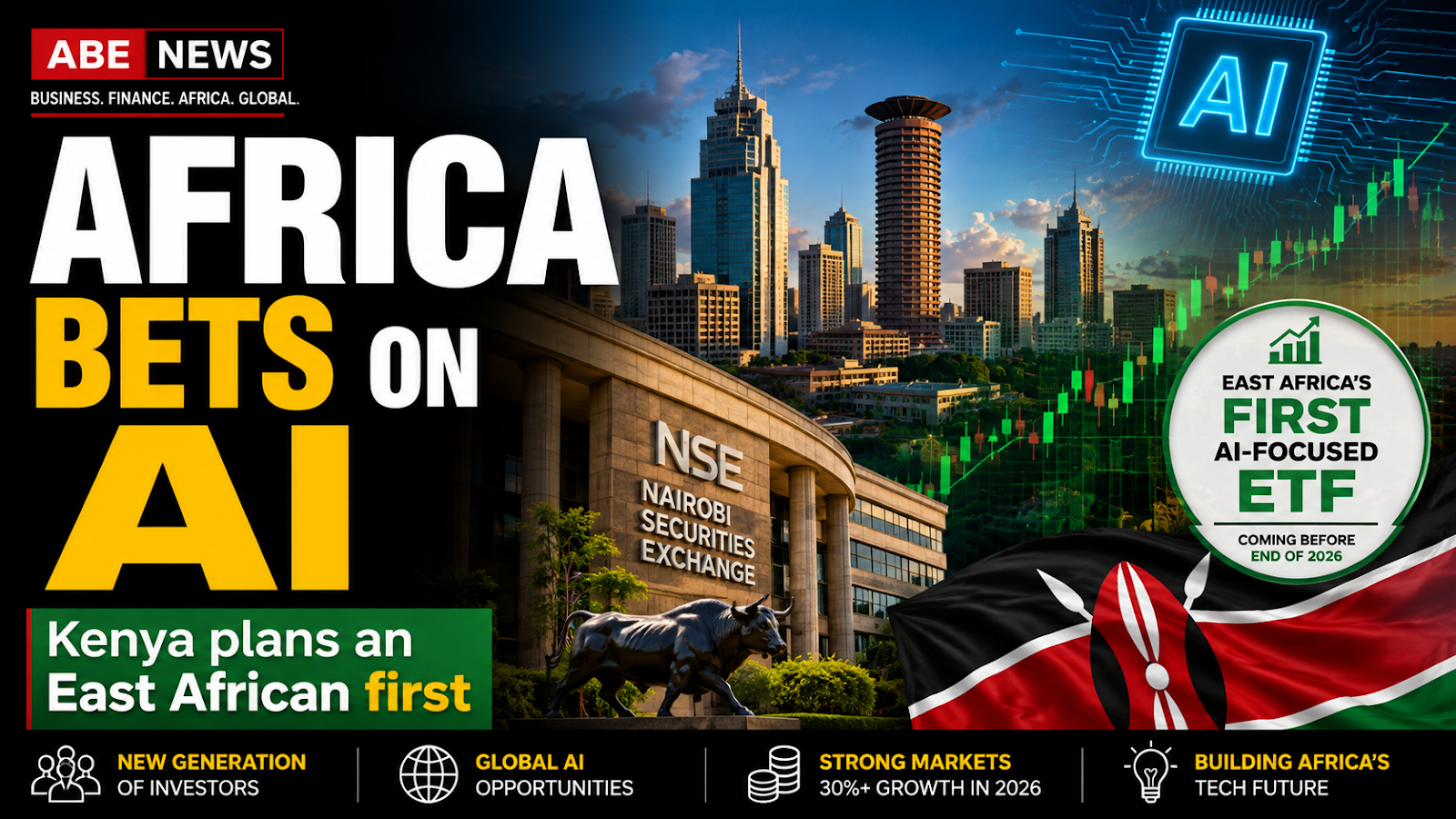
Artificial intelligence may soon become much easier for ordinary Kenyan investors to invest in.
The Nairobi Securities Exchange (NSE) is working on what it says would be East Africa’s first exchange-traded fund focused on artificial intelligence companies.
The exchange plans to make the investment product available before the end of 2026, although the exact timing could change depending on market conditions and regulatory discussions.
But this story is bigger than one new investment fund.
It shows something important happening across Africa:
A new generation of African investors is looking beyond traditional industries and toward technology, artificial intelligence and global markets.
So, What Exactly Is Kenya Planning?
The Nairobi Securities Exchange wants to create an AI-focused ETF.
ETF stands for Exchange-Traded Fund.
That sounds complicated, but the idea is actually quite simple.
Instead of buying shares in only one company, an ETF can give an investor exposure to a collection, or “basket,” of investments.
Think of it like buying one basket containing several different fruits instead of buying only apples.
An AI ETF works in a similar way.
Instead of betting everything on one technology company, the fund can provide exposure to a group of businesses connected to artificial intelligence.
NSE chief executive Frank Mwiti told Reuters that companies such as Microsoft, Anthropic and OpenAI could be used as references as the exchange develops the product.
Why Kenya Is Doing This Now
There is a simple reason:
Young investors want different opportunities.
For decades, African stock markets have largely been associated with traditional sectors such as banking, telecommunications, manufacturing, agriculture and energy.
Those industries remain extremely important.
But younger investors are growing up in a completely different economy.
They use smartphones for banking.
They follow global technology companies.
They hear about AI almost every day.
And many want access to the industries they believe could shape the next several decades.
Mwiti told Reuters that demand for an AI investment product is particularly strong among newer and younger investors.
That could represent an important shift in African investing.
Kenya’s Stock Market Is Already Growing
The timing is also interesting because Kenya’s stock market has been performing strongly.
According to Reuters, Kenya’s equity market has gained just over 30% so far in 2026, while the value of the equities market has reached a record 4 trillion Kenyan shillings, or roughly $31 billion.
And more people are entering the market.
Safaricom began offering access to stock trading through its M-Pesa platform in February, helping bring about one million new investors into the market, according to the NSE CEO.
That may be one of the most important parts of this story.
Africa has hundreds of millions of young people, and smartphones could eventually make investing available to people who previously had little access to financial markets.
Why an AI ETF Could Matter for Africa
There is another problem the NSE is trying to solve.
Many of the world’s largest AI companies are not listed on African stock exchanges.
That means an African investor who wants exposure to global technology companies may need to invest through foreign markets.
The proposed fund could make that process easier by allowing investors to access an AI-related investment product through their local market.
The fund would most likely be denominated in Kenyan shillings, which the NSE says could help reduce foreign-exchange risk for local investors.
And Kenya has already been experimenting with new types of investment products.
Earlier this year, the Spearhead Africa Infrastructure Fund became the first infrastructure fund listed on the NSE after raising KSh 3.4 billion, with investments intended for areas including renewable energy, digital infrastructure, logistics and electrification.
The AI ETF would push that evolution even further.
But There Is a Big Risk: The AI Boom Could Be a Bubble
There is one major warning.
AI-related stocks have experienced enormous investor excitement.
And when investors become extremely excited about a new technology, prices can sometimes rise faster than the businesses themselves can justify.
That is how financial bubbles can develop.
Interestingly, the Nairobi Securities Exchange itself appears aware of this risk.
Mwiti said the exchange could delay the ETF if it believes the global AI rally has become too expensive or overheated.
That caution matters.
Giving African investors access to global technology opportunities is important.
But protecting inexperienced investors from excessive speculation is important too.
Could Other African Countries Follow?
This is where the story becomes much bigger.
If Kenya successfully launches the fund and investors embrace it, other African financial markets could eventually consider similar products.
South Africa already has the continent’s largest and most developed stock market.
Nigeria has a huge population and rapidly growing technology ecosystem.
Countries including Ghana, Rwanda, Egypt and Morocco are also developing their financial and technology sectors.
The long-term opportunity is therefore not simply about Africans buying shares connected to American AI companies.
The bigger opportunity would be for Africa to eventually build enough large technology companies that African businesses themselves become major components of future technology investment funds.
That would represent a much deeper transformation.
Africa would move from primarily consuming technology created elsewhere to increasingly building, financing and owning technology itself.
The Bigger Picture
Kenya’s proposed AI ETF may look like a small financial product today.
But it represents something much larger.
African capital markets are changing.
Technology is changing.
And the expectations of young African investors are changing with them.
The real question isn’t simply whether Kenya’s AI ETF succeeds.
It is whether Africa’s financial markets can evolve quickly enough to connect the continent’s growing population, capital and entrepreneurs with the industries shaping the future.
If that happens, Nairobi’s AI experiment may eventually be remembered as part of something much bigger.
Africa’s investment revolution may only be beginning.
— ABE NEWS
Sources
Reuters — Kenya’s stock exchange plans East Africa’s first AI-focused ETF