




Oil is rising.
Ships are being attacked.
Traffic through one of the most important waterways in the global economy has nearly ground to a halt.
The United States says its naval blockade of Iran could continue indefinitely.
And Wall Street?
Almost nothing.
Global stocks entered Friday trading close to record highs. The MSCI All-World index was heading toward a third consecutive weekly gain, while the VIX — Wall Street’s famous “fear index” — was heading for its fourth straight weekly decline.
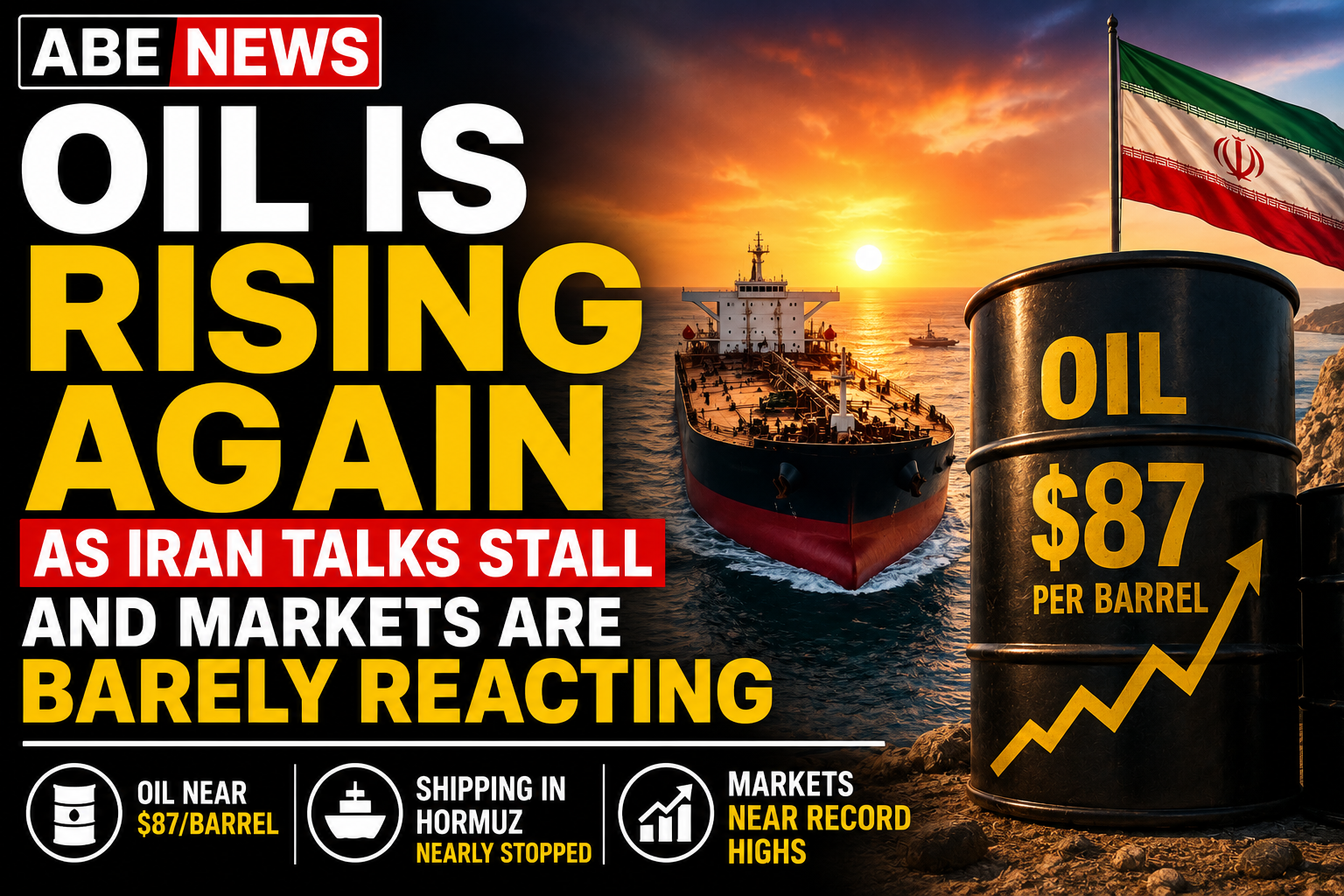
At the same time, Brent crude was trading around $87 a barrel and heading for a roughly 6% weekly gain as efforts to end the Iran conflict remained stalled.
That creates a strange picture.
One part of the global economy is flashing danger.
Another appears remarkably calm.
And the question isn’t simply why oil is rising.
It’s:
Why aren’t investors more afraid?
The Strait of Hormuz Is Still the Center of the Story
There are few stretches of water more important to the global economy than the Strait of Hormuz.
Before the current conflict, roughly one-fifth of global oil and liquefied natural gas passed through the narrow waterway between Iran and Oman.
That makes Hormuz much more than a regional shipping route.
It is one of the world’s major energy arteries.
And traffic through it is now severely disrupted.
Before the war, more than 130 ships could cross the strait daily.
On Wednesday?
Five commodity vessels were recorded crossing.
On Thursday?
Nine.
Early Friday, Reuters reported no visible crossings in ship-tracking data, although some vessels may have been moving with their transponders switched off.
That’s an extraordinary change.
Then Two More Ships Were Attacked
The risk isn’t theoretical.
Two vessels belonging to the Abu Dhabi National Oil Company were attacked while passing through the Strait of Hormuz on Thursday evening.
No injuries were reported.
The United Arab Emirates blamed Iran for the attacks, while Iran had not immediately commented on the accusation.
It was the second incident involving ADNOC-linked vessels in less than a week.
Iran has previously threatened action against ships it says are connected to hostile countries or are attempting to transit the strait without authorization.
So shipping companies aren’t simply dealing with higher fuel costs or longer routes.
They’re dealing with the possibility that moving through one of the world’s most important energy corridors could put vessels and crews directly inside a geopolitical confrontation.
And the U.S. Says Its Blockade Could Continue Indefinitely
There was another important development this week.
U.S. Defense Secretary Pete Hegseth said the United States has enough military capability to maintain its naval blockade of Iranian ports indefinitely, rotating ships in and out of the region as necessary.
Washington is also preparing additional economic measures against Iran.
Treasury Secretary Scott Bessent said further measures aimed at increasing Iran’s economic isolation are expected next week.
Iran, meanwhile, has said it will not fully reopen the waterway until its conditions — including sanctions relief and the release of frozen assets — are addressed.
That means neither side currently appears ready to simply back down.
And peace negotiations have made little progress.
Oil Markets Are Feeling It
Brent crude was hovering around $87 per barrel Friday.
West Texas Intermediate was around $81.
More importantly, Brent was on track for roughly a 6% gain for the week.
Natural gas has been moving too.
European natural-gas futures were heading toward a roughly 10% weekly increase.
That’s what happens when markets begin questioning whether future energy supplies will arrive as easily as expected.
But something else is happening underneath the headline prices.
Asia Is Already Looking Somewhere Else for Oil
Some Asian refiners aren’t waiting for Hormuz to normalize.
They’re finding alternatives.
At least four Asian refiners purchased U.S. crude this week as they tried to secure supplies for later in the year.
South Korea’s GS Caltex bought 2 million barrels of U.S. Mars crude.
Japan’s Eneos purchased 2 million barrels of West Texas Intermediate crude.
Taiwan’s CPC bought another 2 million barrels of WTI, alongside crude from West Africa.
And here’s the number that shows how much the trade map is changing:
U.S. crude exports to Asia reached a record 2.35 million barrels per day in July.
Before the Iran war, Asia sourced more than half of its crude from the Middle East.
That’s not just an oil-price story.
That’s a supply-chain story.
Geography Is Becoming a Business Decision
For decades, companies built supply chains around efficiency.
Where can we get something cheapest?
How quickly can we move it?
How much inventory do we actually need?
Geopolitical instability changes those calculations.
Now the questions become:
Where is the safest supply?
Which shipping route will remain open?
How much inventory should we hold in case something closes?
Should we pay more today to guarantee supply tomorrow?
That’s why Asian refiners buying American and West African crude matters.
Businesses aren’t simply reacting to today’s price.
They’re buying insurance against tomorrow’s disruption.
So Why Are Stock Markets So Calm?
This might be the most interesting part of the entire story.
Global equities remain near record levels.
The MSCI All-World index is heading for another weekly gain.
And the VIX volatility index is on track for its longest weekly declining streak since May 2025.
In simple terms:
investors don’t appear particularly frightened.
Part of the explanation is inflation.
Recent U.S. consumer and producer inflation reports were less alarming than markets feared, reducing expectations that the Federal Reserve will raise interest rates in September.
Strong corporate earnings have also helped support investor confidence.
So markets are effectively balancing two stories.
On one side:
war, oil and geopolitical uncertainty.
On the other:
cooler inflation, strong earnings and potentially stable interest rates.
Right now, the second story appears to be winning.
But That Calm Could Become the Risk
Markets don’t have to panic every time something dangerous happens.
In fact, geopolitical events often have surprisingly short-lived effects on financial markets.
But there is a difference between being rationally calm and becoming too comfortable with risk.
A portfolio manager quoted by Reuters described a growing disconnect between geopolitical uncertainty and market volatility.
His warning was important:
The current balance may not last forever.
A major escalation — or even a clear resolution — could force investors to suddenly reprice risk much more aggressively than current market movements suggest.
That’s the danger.
Sometimes markets adjust gradually.
Sometimes they don’t.
Why This Matters for Businesses
Oil doesn’t stay inside the oil industry.
Higher energy prices can move through an economy.
Airlines pay more for jet fuel.
Trucking companies pay more for diesel.
Manufacturers pay more for transportation.
Farmers face higher energy and fertilizer costs.
Retailers pay more to move goods.
Consumers eventually feel some of those costs too.
And if businesses begin rerouting ships or sourcing energy from farther away, transportation costs can increase even when the underlying commodity price doesn’t.
That’s why Hormuz matters to companies thousands of kilometres away from the Middle East.
They may never send a ship through the strait.
But they can still receive the bill.
The Bigger Picture
For years, businesses optimized global supply chains around one idea:
efficiency.
The Iran conflict is another reminder that the next era may increasingly be about:
resilience.
Companies may accept higher costs to diversify suppliers.
Countries may prioritize energy security over the cheapest available barrel.
Refiners may buy crude from farther away.
Businesses may carry more inventory.
And governments may spend more protecting critical shipping routes.
Those decisions make the global economy less fragile.
But they can also make it more expensive.
And that creates a difficult trade-off.
The cheapest supply chain isn’t always the safest.
The safest supply chain isn’t always the cheapest.
What’s Next?
Three things matter now.
First: Hormuz traffic.
If vessel crossings begin recovering, pressure on energy markets could ease quickly.
If traffic falls even further, concern about physical supply will grow.
Second: U.S.-Iran negotiations.
Washington is preparing additional economic pressure while Tehran continues demanding sanctions relief and access to frozen assets.
Without movement from either side, the disruption could continue.
Third: the market’s patience.
Investors have tolerated remarkable geopolitical uncertainty while stocks remain near record highs.
The real test comes if oil rises enough to push inflation expectations higher again.
Because then the two stories supporting today’s market — cooling inflation and stable interest rates — could begin to weaken.
THE ABE NEWS TAKE
The strangest thing happening in markets right now isn’t that oil is rising.
It’s how normal everything else feels.
One of the world’s most important energy routes is severely disrupted.
Commercial vessels have been attacked.
Two governments are making competing claims over the same strategic waterway.
A U.S. naval blockade could continue indefinitely.
And businesses thousands of kilometres away are already changing where they buy oil.
Yet stock markets remain near records.
Maybe investors are right.
Maybe the conflict remains contained.
Maybe alternative oil supplies continue filling the gaps.
Maybe diplomacy eventually wins.
But markets have a habit of making dangerous situations look manageable —
until something changes the calculation.
That’s why Hormuz matters.
Not because every disruption automatically creates a financial crisis.
But because so much of the global economy still depends on physical things moving through very specific places.
Ships.
Oil.
Gas.
Food.
Components.
The digital economy may move at the speed of light.
The physical economy still has to fit through a strait.
And right now, one of the most important ones in the world isn’t working normally.
ABE NEWS
Business. Money. Style. The News.
Understand More. Think Bigger.