






THE ABE HOOK
Americans haven’t stopped spending.
But they may finally be getting more careful about where their money goes.
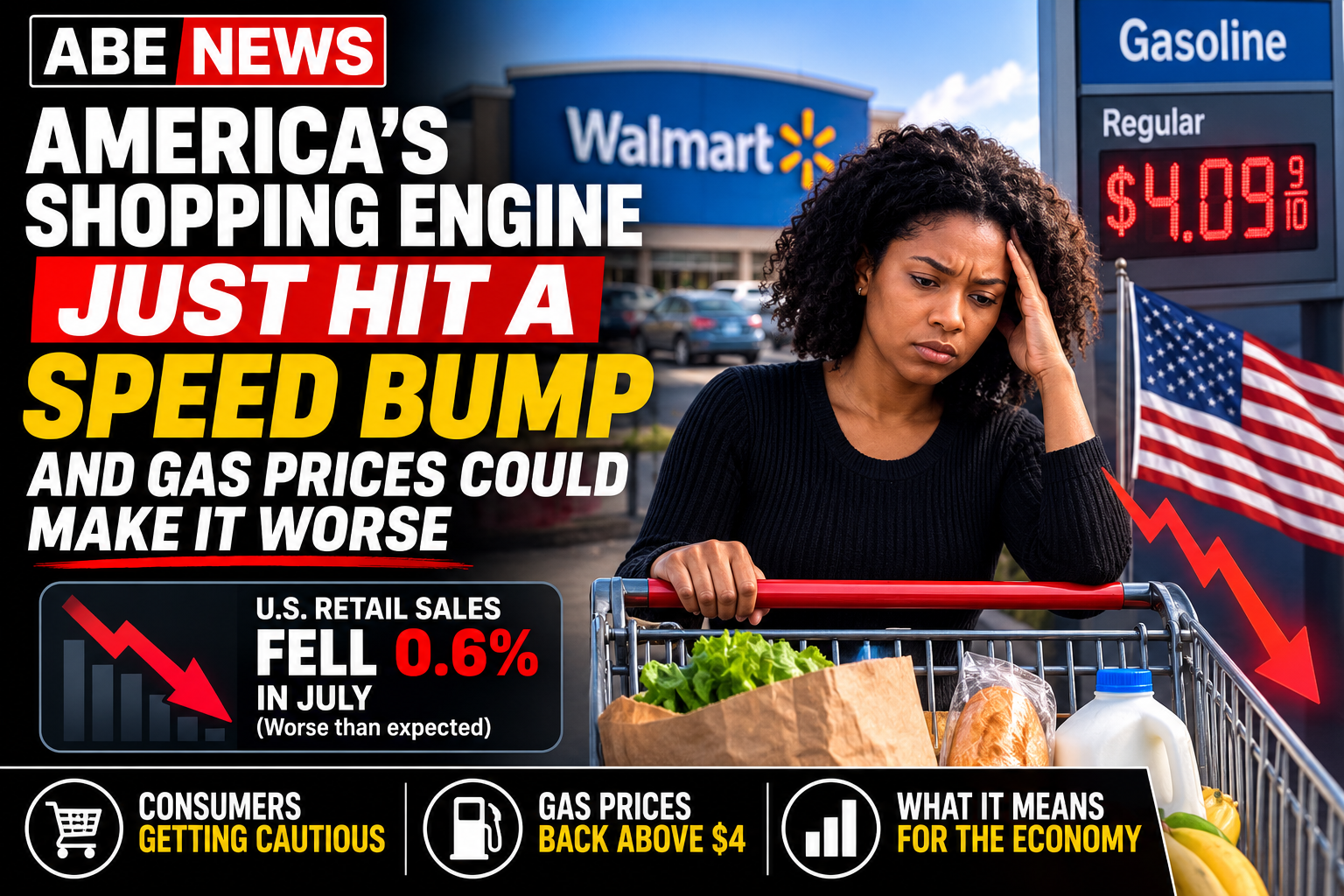
After months of surprisingly strong consumer spending, July delivered a warning: retail sales fell much more than economists expected.
And with gasoline back above $4 in parts of the country as the Middle East conflict pressures energy costs, the American consumer could be heading into a much tougher second half of 2026.
THE ARTICLE
For much of 2026, one part of the U.S. economy has continued to surprise economists:
the consumer.
Interest rates remained elevated.
Energy prices climbed.
Geopolitical uncertainty increased.
Yet Americans kept spending.
That resilience helped consumer spending grow at a 3.2% annualized rate during the second quarter, according to Commerce Department data reported by Reuters.
July, however, looked different.
U.S. retail sales unexpectedly dropped 0.6% from the previous month.
Economists surveyed by Reuters had expected them to rise 0.1%.
That’s a fairly significant miss.
And underneath that headline are clues about what could happen next.
The Earlier Spending Boost Is Fading
One reason consumers had remained surprisingly strong was unusually large tax refunds.
Those refunds helped households absorb some of the higher gasoline costs caused by the Middle East conflict.
But economists say much of that money has now been spent.
There were other reasons July looked weak.
Amazon moved Prime Day from July into June this year, pulling some purchases forward.
Competing retailers also ran promotions around the event.
Vehicle sales declined.
And lower gasoline prices during July reduced the dollar value of sales reported by gas stations.
So one month doesn’t mean American consumers suddenly stopped shopping.
But there’s another number worth watching.
The Core Number Fell Too
Economists often strip out categories such as automobiles, gasoline, building materials and food services to get a better picture of underlying consumer demand.
Those so-called core retail sales fell 0.4% in July.
Economists had expected a 0.3% increase.
That makes the report harder to dismiss as simply gasoline or car sales.
There really was some softness underneath.
But There’s Another America
Here’s where the story gets interesting.
The stock market has been booming.
The S&P 500 has risen roughly 14% this year, increasing the wealth of households that own significant amounts of stocks.
That creates two very different consumer experiences.
Someone with a large investment portfolio may look at record markets and feel considerably richer.
Someone living mostly from their paycheck may look at the gasoline pump, grocery bill and monthly expenses and feel exactly the opposite.
Economists at PNC Financial told Reuters they are seeing more evidence of older and higher-income households using wealth gains to support spending.
That could help explain why overall consumption has remained strong even while many households continue complaining about prices.
And Gasoline Is Becoming Important Again
This is where today’s retail story connects with this morning’s ABE NEWS oil story.
The Iran conflict remains unresolved.
Energy markets remain under pressure.
And the coming week will bring earnings from major retailers including Walmart, Target, Home Depot and Lowe’s.
Those companies could provide one of the clearest pictures yet of whether higher fuel costs are changing how households spend their money. Reuters notes gasoline is now above $4 per gallon, adding pressure to household budgets.
Think about what happens when filling the car suddenly costs another $15 or $20.
That money has to come from somewhere.
Maybe it’s one fewer restaurant meal.
Maybe clothes wait another month.
Maybe the family skips an unnecessary purchase.
Multiply those decisions across millions of households and they start showing up in corporate earnings.
That’s Why Retailers Matter Next Week
Walmart and Target don’t just tell us how Walmart and Target are doing.
They provide a window into the American household.
If consumers begin shifting toward necessities and away from discretionary purchases, retailers will see it.
Home Depot and Lowe’s could reveal whether borrowing costs and inflation are causing households to postpone renovation projects.
And Deere could show whether higher fuel and input costs are reaching farmers.
Together, those reports will help answer a much bigger question:
Is July’s retail decline just noise — or the beginning of something?
THE ABE NEWS TAKE
For years, economists have been waiting for the American consumer to crack.
It hasn’t happened.
Every time inflation rose, interest rates stayed high or confidence weakened, households somehow kept spending.
And they still might.
One weak month doesn’t create a recession.
But July gives us something worth watching.
Because underneath America’s strong headline economy, consumers aren’t all experiencing the same reality.
Some households are watching their stock portfolios hit new highs.
Others are watching the number on the gasoline pump.
Both can be true at the same time.
And that may become one of the biggest economic stories of the second half of 2026.
The question isn’t whether Americans will completely stop spending.
They probably won’t.
The question is whether millions of households begin making small decisions to spend a little less.
Because individually, those decisions don’t look important.
Across the world’s largest consumer economy?
They can change everything.
ABE NEWS
Business. Money. Style. The News.
Understand More. Think Bigger.