








ABE NEWS | September 4, 2026
The artificial-intelligence race has produced enormous chip orders, gigantic data centres and technology companies spending hundreds of billions of dollars on computing infrastructure.
Now it is producing something else:
enormous amounts of debt.
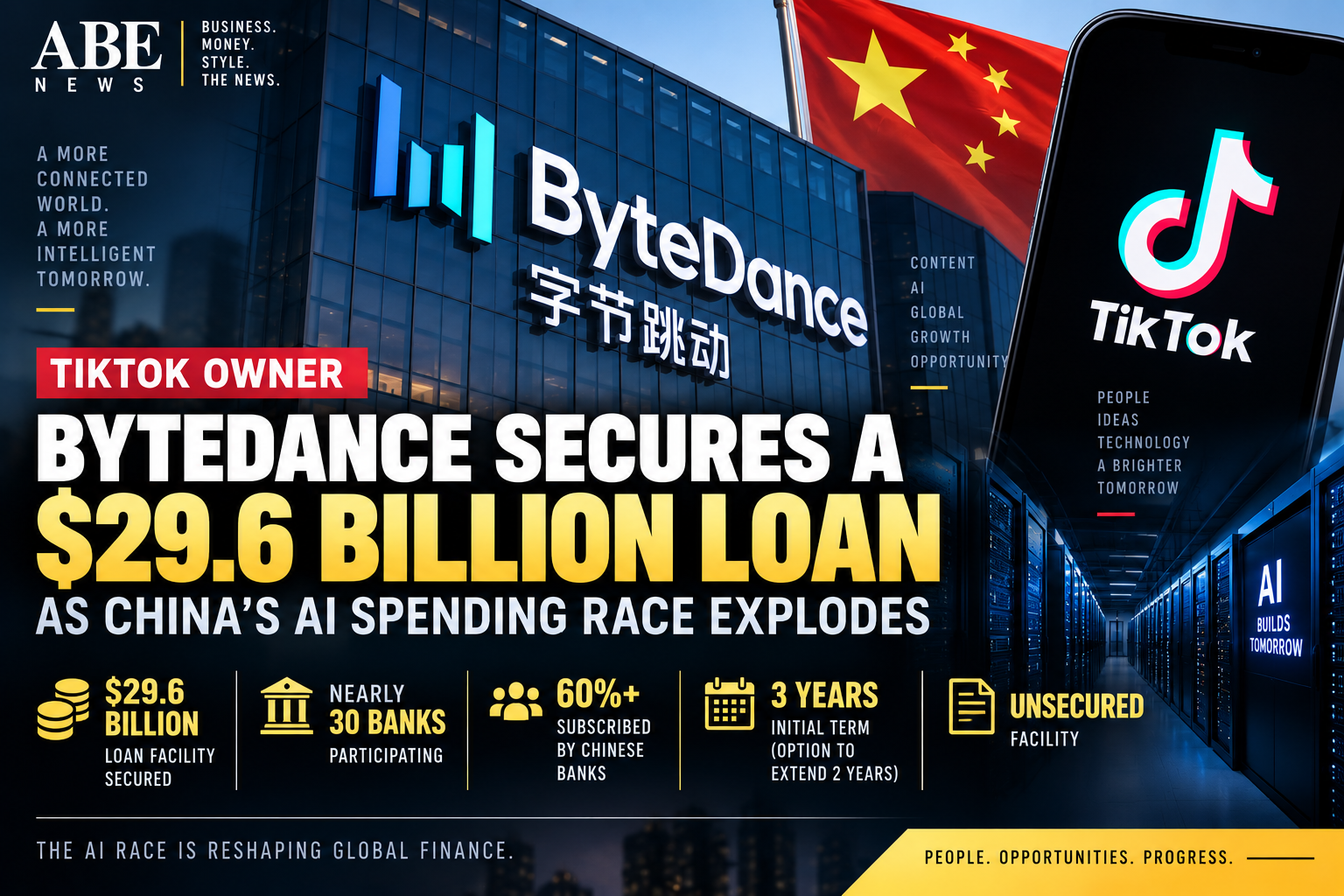
ByteDance, the Chinese technology giant behind TikTok and Douyin, has secured a staggering $29.6 billion loan from nearly 30 banks, as the company accelerates its push into artificial intelligence and international computing infrastructure.
The three-year unsecured facility is the second-largest loan made in Asia this year, surpassed only by SoftBank’s $40 billion financing in March to support its investments in OpenAI.
But perhaps the most remarkable part is that ByteDance originally wasn’t asking for $29.6 billion.
It was seeking approximately $20 billion.
Banks wanted to lend it so much money that ByteDance increased the facility by nearly $10 billion.
Chinese banks subscribed to more than 60% of the total, while lenders from the United States, Europe and Singapore are also participating.
The financing is being coordinated by Citigroup and JPMorgan and is expected to be formally signed shortly.
Officially, ByteDance told lenders the money would be used for general corporate purposes.
But people with direct knowledge of the transaction told Reuters that the financing will primarily support ByteDance’s growing artificial-intelligence ambitions.
Those ambitions increasingly require something extraordinarily expensive:
chips, data centres and computing power.
And ByteDance’s $29.6 billion financing provides another indication that the AI race is evolving into one of the largest capital-spending competitions in modern corporate history.
FROM $20 BILLION TO $29.6 BILLION
ByteDance initially approached the loan market seeking around $20 billion.
That alone would have represented an enormous corporate financing.
Then lenders responded.
Demand was so strong that the company increased the facility to $29.6 billion.
Nearly 30 banks are participating.
More than 60% of the commitments came from Chinese lenders, according to one person familiar with the financing.
American, European and Singaporean banks are participating as well.
The loan has an initial maturity of three years, with options allowing it to be extended for another two years.
But another feature makes the transaction particularly striking.
There is no major pool of assets securing it.
THE $29.6 BILLION LOAN IS UNSECURED
ByteDance isn’t pledging shares or corporate assets as collateral for the new dollar-denominated facility.
That makes it an unsecured loan.
For a transaction approaching $30 billion, that is unusual.
One person familiar with the deal described such a large unsecured facility as extremely rare and said lenders are essentially relying on ByteDance’s reputation and perceived creditworthiness.
That tells us something important about how global banks view the company.
ByteDance remains privately held.
TikTok continues to face political and regulatory challenges in the United States and elsewhere.
The technology industry is changing rapidly.
Artificial intelligence requires enormous spending.
Yet banks are still prepared to lend ByteDance tens of billions of dollars without requiring traditional asset collateral.
That represents an extraordinary vote of financial confidence.
WHY DOES BYTEDANCE NEED SO MUCH MONEY?
ByteDance is best known internationally for TikTok.
But describing it merely as a social-media company increasingly misses what the business is becoming.
ByteDance operates Douyin, TikTok’s Chinese counterpart.
It owns major content and productivity platforms.
It has enormous advertising operations.
It develops recommendation algorithms used across its products.
And increasingly, it is trying to become a major artificial-intelligence company.
Its AI efforts include large models and the popular Doubao AI ecosystem in China.
ByteDance is competing against Chinese technology giants including Alibaba, Tencent and Baidu.
Internationally, it is competing in an industry dominated by companies such as OpenAI, Google, Anthropic, Meta and Microsoft.
That competition requires enormous computing resources.
And computing resources require enormous amounts of capital.
THE AI CHIP RACE IS PART OF THE STORY
AI models require specialized processors for both training and inference.
For years, Nvidia has dominated that market.
But U.S. export controls have restricted China’s access to some of Nvidia’s most advanced AI processors.
That has forced Chinese technology companies to look for alternatives.
Reuters reported in June that ByteDance was in discussions with Shanghai-based Iluvatar CoreX about buying AI chips for inference workloads.
The company was also considering a similar arrangement with Baidu.
That reflects a broader transformation underway in China’s technology industry.
Chinese companies don’t merely want more AI chips.
They increasingly need a domestic AI-computing ecosystem capable of functioning even if access to the most advanced American technology becomes more restricted.
ByteDance’s spending therefore intersects with a much larger strategic competition between China and the United States.
THEN THERE ARE THE DATA CENTRES
The physical infrastructure behind AI doesn’t stop at chips.
Those processors need somewhere to operate.
That means data centres.
Huge ones.
Filled with thousands of servers.
Connected through high-speed networking.
Supplied by enormous quantities of electricity.
Cooled continuously.
And increasingly spread across different countries.
A person familiar with ByteDance’s financing told Reuters that the new facility will help fund projects outside China.
ByteDance is already an important customer for a number of data centres being constructed across Southeast Asia.
In some cases, the company acts as an “offtaker.”
That means ByteDance signs binding agreements to purchase a specified amount of a data centre’s future capacity.
Those commitments give developers confidence that someone will actually use the infrastructure they are spending billions to construct.
ByteDance is therefore becoming part of the financial foundation underneath Southeast Asia’s data-centre boom.
AI IS BECOMING AN INFRASTRUCTURE BUSINESS
This is one of the biggest changes occurring in technology.
The first wave of excitement surrounding generative AI was mostly about software.
ChatGPT.
Image generators.
AI assistants.
Coding tools.
Chatbots.
But underneath all of those products is an industrial system.
Semiconductor factories produce processors.
Data centres house them.
Power plants generate electricity.
Transmission lines move that electricity.
Cooling infrastructure keeps machines operating.
Fibre networks connect computing clusters.
And enormous amounts of capital finance everything.
That means the AI race isn’t simply a race to develop better algorithms.
Increasingly, it is a race to finance and construct infrastructure.
ByteDance’s $29.6 billion loan belongs to that new reality.
CHINA’S AI COMPANIES FACE A UNIQUE PROBLEM
American AI companies have extraordinary access to capital and computing infrastructure.
Microsoft has invested heavily in OpenAI.
Amazon has backed Anthropic.
Google owns enormous data-centre infrastructure.
Meta can spend tens of billions of dollars annually from its own cash flow.
Nvidia provides much of the underlying computing technology.
Chinese companies face an additional challenge.
They must compete with those businesses while operating under increasingly strict U.S. technology restrictions.
Advanced semiconductor equipment is restricted.
Some AI chips cannot freely be sold into China.
Technology transfers face political scrutiny.
That forces Chinese technology companies to build alternative supply chains while simultaneously trying to keep pace with rapidly advancing American models.
Doing both is expensive.
Very expensive.
BYTEDANCE HAS ALREADY BEEN BORROWING BIG
This isn’t the company’s first giant loan.
ByteDance last tapped the global loan market in September 2024, when it raised approximately $10.8 billion from around 20 Chinese and international lenders.
Two years later, the new facility is almost three times as large.
That progression illustrates how quickly the financial requirements of the technology industry are changing.
A $10 billion technology financing once looked enormous.
Now one company is arranging almost $30 billion while another Asian technology investor, SoftBank, has raised $40 billion to support its OpenAI ambitions.
The numbers are beginning to resemble infrastructure financing rather than traditional software-company spending.
Because increasingly, that is exactly what AI is.
THE BANKS ARE MAKING AN AI BET TOO
The lenders participating in ByteDance’s financing aren’t merely making a conventional corporate loan.
They are indirectly betting on the economics of artificial intelligence.
Banks believe ByteDance will generate enough future cash to service an enormous unsecured facility.
And lender appetite was strong enough to push the deal almost $10 billion above its original target.
That suggests financial institutions remain enthusiastic about financing the AI buildout despite growing questions about whether the industry’s enormous capital expenditure will eventually generate sufficient returns.
This debate is becoming one of the biggest questions in global markets.
Technology companies are spending at extraordinary rates.
Data centres are being proposed everywhere.
Power demand is rising.
Debt issuance is increasing.
Chipmakers are expanding.
But eventually, those investments need to generate economic returns.
AI cannot remain a capital-spending story forever.
It has to become a profit story.
THE CAPITAL REQUIREMENTS KEEP GETTING BIGGER
Consider what is happening across the industry.
Technology companies need increasingly sophisticated chips.
Those chips cost enormous amounts of money.
AI models require larger computing clusters.
Data centres require electricity infrastructure.
Cloud companies are expanding globally.
And companies fear that spending too little could cause them to fall behind competitors.
That creates a powerful incentive:
Spend now or risk losing the AI race.
The result is an arms race in capital expenditure.
Even companies with enormous cash flows are increasingly turning to debt markets and outside financing.
The AI race is therefore spilling into global bond and loan markets.
That matters far beyond Silicon Valley or Beijing.
AI BORROWING CAN AFFECT THE REST OF THE ECONOMY
When technology companies borrow tens of billions of dollars, they compete for capital with other borrowers.
Governments borrow.
Manufacturers borrow.
Property companies borrow.
Infrastructure developers borrow.
Consumers borrow indirectly through banks.
The global pool of capital is enormous, but it isn’t unlimited.
The more money investors and banks direct toward AI infrastructure, the more important questions become about how that capital is allocated.
Already, economists and central bankers are watching the enormous financing requirements associated with artificial intelligence.
The industry could ultimately require trillions of dollars of investment in computing infrastructure over the remainder of the decade.
ByteDance’s $29.6 billion loan is only one transaction.
But it demonstrates the direction.
THE U.S.–CHINA DIMENSION MAKES THIS EVEN BIGGER
There is another unusual aspect of the financing.
ByteDance is a Chinese company.
Yet American and European banks are participating alongside Chinese and Singaporean institutions.
That demonstrates how complicated economic competition between China and the West has become.
Governments may impose technology restrictions.
Politicians may fight over TikTok.
Washington may limit advanced chip exports.
China may push technological self-sufficiency.
But global finance remains deeply interconnected.
A Chinese technology giant can still arrange a nearly $30 billion dollar-denominated facility involving banks from multiple continents.
Geopolitical competition and financial globalization are occurring simultaneously.
That tension will likely define much of the next decade.
TIKTOK GIVES BYTEDANCE SOMETHING AI STARTUPS DON’T HAVE
ByteDance also enters the AI race with an advantage many startups lack.
Distribution.
TikTok has an enormous international audience.
Douyin dominates short-form video in China.
ByteDance’s applications already reach hundreds of millions of people.
That matters because building a powerful AI model is only part of creating a successful AI business.
Companies also need users.
OpenAI built distribution through ChatGPT.
Google has Search, Android, YouTube and Workspace.
Microsoft has Windows and Office.
Meta has Facebook, Instagram and WhatsApp.
ByteDance has TikTok and Douyin.
If it successfully integrates increasingly powerful AI into those ecosystems, it could potentially distribute new AI products at enormous scale.
That helps explain why banks may be willing to bet so heavily on its future.
THE REAL COMPETITION IS GETTING BIGGER THAN MODELS
For the past several years, AI competition has often been measured through model benchmarks.
Whose model reasons better?
Whose chatbot codes better?
Whose system is cheaper?
Whose model is multimodal?
Those questions still matter.
But the competition is broadening.
Companies increasingly need control over:
capital.
chips.
data centres.
energy.
models.
developers.
distribution.
Winning AI may ultimately require strength across the entire stack.
ByteDance’s financing gives it more firepower to compete across that system.
🔴 THE ABE NEWS TAKE
ByteDance’s $29.6 billion loan tells us something fundamental about where artificial intelligence is heading.
AI is becoming one of the most capital-intensive industries on Earth.
The popular image of the technology industry is still shaped by the software era.
A few programmers.
Laptops.
An office.
A clever idea.
Build software once.
Distribute it to millions of users at almost no additional cost.
Artificial intelligence is changing that equation.
The software still matters.
But behind the software now sit warehouses filled with some of the most expensive computers ever manufactured.
Those computers consume enormous amounts of electricity.
They require specialized cooling.
High-speed networks.
Power infrastructure.
And constant replacement as newer chips arrive.
That requires capital on a scale historically associated with energy companies, telecommunications networks and heavy industry.
ByteDance originally wanted $20 billion.
Banks offered so much support that the company expanded the facility to $29.6 billion.
And they are lending that money without ByteDance pledging major assets as collateral.
That tells us two things.
First, lenders have extraordinary confidence in ByteDance.
Second, global finance still believes the AI infrastructure boom has much further to run.
But there is a question underneath all of this enthusiasm.
Who eventually pays for the AI race?
Today, banks are willing to provide billions.
Investors are willing to fund data centres.
Technology companies are willing to spend.
Governments are supporting domestic semiconductor industries.
But all of that capital ultimately expects a return.
AI products must eventually generate enough economic value to justify the infrastructure being constructed around them.
ByteDance believes they will.
SoftBank believes they will.
Microsoft believes they will.
Google believes they will.
Meta believes they will.
OpenAI believes they will.
Banks increasingly appear to believe it too.
And that’s why this $29.6 billion transaction matters.
It isn’t simply a loan to the company that owns TikTok.
It is another enormous financial wager on the proposition that artificial intelligence will become infrastructure for the global economy.
If that wager succeeds, today’s spending could look small compared with what comes next.
If it fails, the world may eventually discover that it financed one of the largest technology investment booms in history faster than the economics could justify.
For now, the money is still pouring in.
And ByteDance just secured nearly $30 billion more of it.
ABE NEWS
Business. Money. Style. The News.
Understand More. Think Bigger.