





ABE NEWS | September 4, 2026
Africa could be days away from one of the biggest stock-market listings in its history.
Nigeria’s Dangote Group is preparing to sell shares in the Dangote Petroleum Refinery, the enormous Lagos-based industrial complex built by billionaire entrepreneur Aliko Dangote.
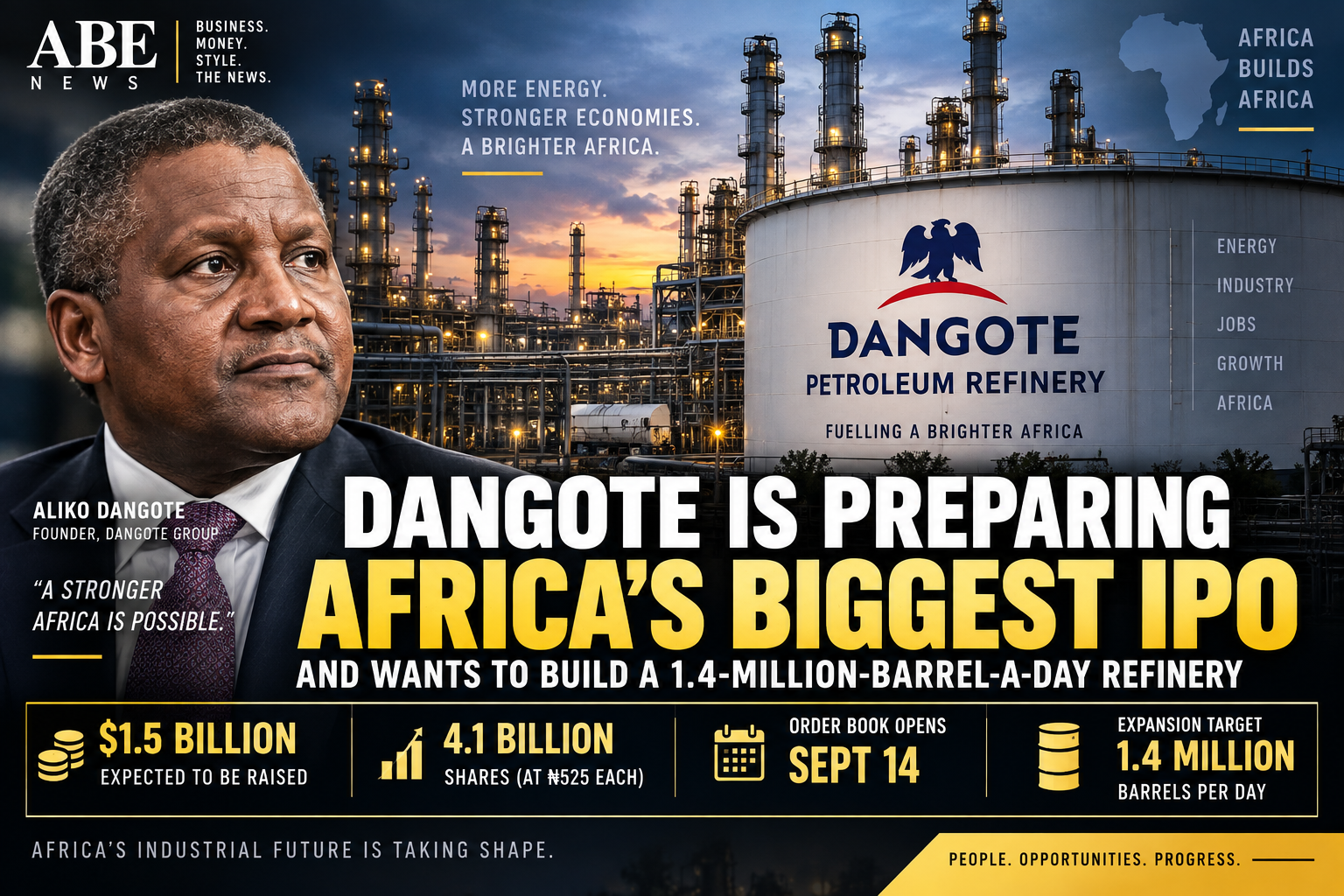
According to people with direct knowledge of the transaction, the company is planning to sell approximately 4.1 billion shares at ₦525 each, potentially raising around $1.5 billion.
The order book is scheduled to open on September 14.
If the offering proceeds as planned, Reuters says it is set to become Africa’s largest IPO.
But the significance extends far beyond the stock market.
Dangote wants to use new capital to help finance an extraordinary expansion of the refinery — from its current 650,000 barrels per day to approximately 1.4 million barrels per day.
That would more than double its original nameplate capacity and potentially transform an already enormous Nigerian industrial project into one of the most powerful refining operations anywhere in the world.
For Africa, the bigger question is even more important.
Can the continent begin using its own capital markets to finance the industrial infrastructure it has historically depended on foreign investors, governments and lenders to build?
Dangote is about to test that idea at extraordinary scale.
4.1 BILLION SHARES
The proposed numbers are enormous.
People familiar with the transaction told Reuters that approximately 4.1 billion shares are expected to be offered.
The working price is around ₦525 per share, equivalent to roughly $0.40 at current exchange rates.
Earlier discussions had considered a range of approximately ₦500 to ₦595, which could have produced proceeds of roughly $1.55 billion to $1.8 billion.
The latest reporting points toward the ₦525 level and approximately $1.5 billion in proceeds.
There is also expected to be a 15% greenshoe option.
That mechanism would allow additional shares to be sold if investor demand significantly exceeds the original offering.
One important detail remains unknown:
How much of the refinery will public investors actually own?
The sources did not disclose what percentage of the business the 4.1 billion shares represent.
Dangote Refinery itself has declined to comment on the private offering terms.
So while the IPO appears close, some important details remain to be finalized or publicly disclosed.
SEPTEMBER 14 COULD BECOME A LANDMARK DATE
Aliko Dangote told investors and analysts during a business meeting in Botswana on Thursday that the refinery IPO would open within approximately 10 to 12 days.
The latest transaction information points to September 14.
That would turn a project financed and controlled primarily as part of Dangote’s private industrial empire into a company in which public investors can participate.
And that matters because the refinery is unlike an ordinary African IPO candidate.
This is one of the continent’s largest industrial assets.
It processes crude oil.
Produces fuel.
Affects Nigerian energy markets.
Competes with imported petroleum products.
And sits at the centre of a broader attempt to change Africa’s relationship with its own natural resources.
AFRICA PRODUCES OIL — BUT IMPORTS FUEL
That contradiction has existed for decades.
Africa contains some of the world’s important oil-producing countries.
Nigeria.
Angola.
Libya.
Algeria.
Others possess significant reserves.
Yet many African economies still import enormous quantities of refined petroleum products.
Why?
Because extracting crude oil and refining it are two different industrial capabilities.
A country can pump crude from the ground and export it abroad.
Foreign refineries convert it into gasoline, diesel, aviation fuel and other petroleum products.
Those products can then be shipped back.
The result is economically frustrating.
A resource-producing country exports raw material while importing a higher-value finished product.
Nigeria lived with that contradiction for years despite being one of Africa’s biggest crude producers.
Dangote’s refinery was built partly to change it.
THE $20 BILLION INDUSTRIAL GAMBLE
Building the refinery was an extraordinary undertaking.
The project cost roughly $20 billion.
Located in the Lekki Free Zone near Lagos, the complex became the largest single-train refinery in the world.
Its original nameplate capacity is approximately 650,000 barrels per day.
The refinery reached that full capacity in February and has already tested production of around 700,000 barrels per day.
That alone makes it an enormous industrial facility.
But Dangote doesn’t intend to stop there.
He wants to double capacity.
THE NEXT TARGET: 1.4 MILLION BARRELS EVERY DAY
Dangote says his ambition is to increase the refinery’s capacity to approximately 1.4 million barrels per day.
That is difficult to comprehend until you put the number in perspective.
At 1.4 million barrels every day, the refinery would process more than half a billion barrels annually if operated continuously near full capacity.
And the expansion isn’t expected to take decades.
Dangote Refinery CEO David Bird has previously said the company aims to reach the new capacity within approximately three years.
The IPO is expected to help finance that expansion alongside debt and other sources of capital.
The company says expanding the existing complex should cost substantially less than the roughly $20 billion required to build the original refinery from scratch.
That makes the economics potentially attractive.
The expensive foundations already exist.
Now Dangote wants to scale them.
WHY DOES AFRICA NEED SUCH A HUGE REFINERY?
Because the continent remains structurally short of refined petroleum products.
Population is growing.
Cities are expanding.
Transportation demand is increasing.
Air travel is expanding.
Manufacturing requires energy.
Trucking requires diesel.
Agriculture requires fuel.
Petrochemicals are used across enormous sections of the economy.
Yet many African countries remain dependent on imported refined products.
That creates several vulnerabilities.
Foreign exchange leaves the continent.
Countries become exposed to global shipping disruptions.
Currency depreciation makes imported fuel more expensive.
International refining margins affect domestic prices.
And geopolitical conflicts thousands of kilometres away can suddenly raise transportation costs across African economies.
A large African refining industry cannot eliminate those risks.
But it can reduce some of them.
THE TIMING COULD BE FORTUNATE
Global refining economics have also strengthened.
Conflict in the Middle East has disrupted parts of global energy markets and increased demand for alternative fuel supplies.
That has improved margins for refiners capable of supplying international markets.
Nigeria is therefore bringing enormous new refining capacity online during a period when energy security has once again become a global priority.
International Energy Agency chief Fatih Birol said this week that Nigeria could potentially double energy-sector investment within five years, arguing that reliable energy partners are increasingly valuable amid geopolitical instability.
That makes the Dangote expansion part of something larger.
Nigeria isn’t merely trying to produce more oil.
It is attempting to capture more of the economic value surrounding that oil.
THE IPO COULD CHANGE NIGERIA’S STOCK MARKET
There is another reason the offering matters.
Nigeria’s capital market is much smaller than the markets of the United States, Europe or major Asian economies.
A company of Dangote Refinery’s scale entering the public market could substantially deepen it.
Large institutional investors need large, liquid companies in which they can deploy capital.
Pension funds need investment opportunities.
Retail investors want access to major domestic businesses.
International investors need assets large enough to justify entering a market.
A successful Dangote Refinery listing could potentially satisfy all of those groups.
And because the offering is expected to focus significantly on African investors, it could become an important experiment in mobilizing capital from within the continent itself.
AFRICANS COULD OWN PART OF THE INDUSTRIAL GIANT
That is perhaps the most symbolic aspect of the IPO.
Until now, ordinary investors have not been able to simply buy shares in Dangote Refinery through a public exchange.
The IPO changes that.
The refinery would move from being primarily a privately controlled industrial asset into the public capital markets.
That does not mean Aliko Dangote is surrendering control.
The exact stake being sold hasn’t yet been disclosed.
But public ownership changes the relationship between a company and the economy around it.
Shareholders expect financial reporting.
Governance becomes more visible.
Performance is scrutinized.
Valuations become public.
And ordinary investors can participate in the company’s financial success — while also taking on its risks.
THIS IS NOT A RISK-FREE INVESTMENT
The scale of the refinery can make the opportunity look almost irresistible.
But large industrial assets carry large risks.
Oil prices fluctuate.
Refining margins fluctuate.
Maintenance is expensive.
Debt matters.
Currency movements matter.
Government policy matters.
Nigeria’s fuel market has a long history of regulation and political intervention.
Competition can change.
Global energy demand can evolve.
And doubling refinery capacity to 1.4 million barrels per day will itself require enormous capital and flawless execution.
Investors will therefore need much more information than a headline about Africa’s largest IPO.
They will need to understand the refinery’s debt.
Cash flow.
Margins.
Capital expenditure.
Corporate structure.
Dividend policy.
Expansion costs.
And the valuation implied by the final share price.
Those details will become increasingly important as the prospectus and final offering terms emerge.
DANGOTE IS BUILDING BEYOND NIGERIA
The refinery IPO isn’t Aliko Dangote’s only expansion plan.
He also says Dangote Cement is likely to pursue a secondary listing on the London Stock Exchange in October.
That could broaden access to international capital and investors.
And his refining ambitions are moving beyond West Africa.
Dangote has announced plans for a new refinery on the Kenyan coast, in partnership with East African governments.
The project is expected to take approximately three years and would supply refined petroleum products to Kenya and neighbouring countries.
Dangote says the project is expected to launch on September 30.
If completed, it would represent the group’s largest refining investment outside Nigeria.
That suggests a much bigger strategy.
Dangote may be trying to build not simply a Nigerian refinery business, but a Pan-African refining network.
AN AFRICAN INDUSTRIAL STRATEGY IS EMERGING
For decades, one of the biggest criticisms of African economic development has been the continent’s dependence on commodity exports.
Cocoa leaves Africa.
Chocolate is manufactured elsewhere.
Crude oil leaves Africa.
Fuel is refined elsewhere.
Minerals leave Africa.
High-value industrial products return.
That structure limits how much value stays inside local economies.
Industrialization attempts to move further along that chain.
Instead of simply exporting crude oil, refine it.
Instead of exporting minerals, process them.
Instead of exporting agricultural commodities, manufacture finished products.
That creates more complicated industries.
More technical jobs.
More domestic suppliers.
More infrastructure.
And potentially more economic value.
Dangote’s refinery is an unusually large example of that philosophy.
BUT ONE COMPANY CANNOT INDUSTRIALIZE A CONTINENT
It is important not to exaggerate.
One refinery — even an enormous one — cannot solve Africa’s industrial challenges.
The continent still faces infrastructure deficits.
Electricity shortages.
Expensive capital.
Currency volatility.
Transport bottlenecks.
Regulatory uncertainty.
Skills gaps.
Political risk.
And fragmented markets.
Building industrial assets is only part of the challenge.
Keeping them competitive for decades is harder.
The Dangote refinery itself has already faced disputes over crude supply, pricing and its relationship with Nigerian regulators and the country’s state oil company.
Scale creates influence.
But it also creates complexity.
THE IPO COULD BECOME A TEST OF AFRICAN CAPITAL
The most interesting part of this offering may ultimately have little to do with oil.
It may be about capital.
African businesses frequently complain that financing major infrastructure is extraordinarily difficult.
Interest rates can be high.
Local capital markets are shallow.
Currencies can be volatile.
International investors may demand large risk premiums.
That makes billion-dollar industrial projects difficult to finance.
Dangote’s proposed IPO asks a different question:
Can African public markets help finance African industrialization?
If investors enthusiastically support the offering, other large companies may take notice.
Infrastructure owners may consider listings.
Family-controlled businesses may open themselves to public capital.
Governments may push harder to deepen domestic markets.
Pension funds may gain access to larger industrial investments.
One successful IPO cannot create that transformation by itself.
But landmark transactions can change expectations.
DANGOTE’S PERSONAL STORY MAKES THE MOMENT EVEN BIGGER
Aliko Dangote has spent decades building one of Africa’s largest industrial empires.
Cement.
Sugar.
Salt.
Fertilizer.
Oil refining.
His businesses grew by targeting products African economies consume in enormous quantities but historically imported.
That strategy made him Africa’s richest person.
The refinery represents his most ambitious project.
It required years of construction.
Billions of dollars.
Enormous borrowing.
Technical expertise from around the world.
And persistence through repeated delays.
Now he wants public investors to participate in its next phase.
That marks a significant transition.
Building the refinery was the first challenge.
Turning it into a publicly traded, expanding industrial giant may be the next.
IF 1.4 MILLION BPD HAPPENS, THE CONSEQUENCES COULD BE GLOBAL
At 650,000 barrels per day, Dangote Refinery already matters to regional fuel markets.
At 1.4 million barrels per day, its influence would be substantially larger.
The refinery could supply enormous quantities of gasoline, diesel, aviation fuel and other products across Africa and potentially international markets.
Traditional exporters of refined fuel to Africa would face more competition.
Shipping patterns could change.
African countries could source more petroleum products regionally.
Nigeria could potentially earn additional foreign exchange from refined-product exports rather than primarily exporting crude.
And Lagos could become an increasingly important node in global petroleum markets.
That is the industrial logic behind the expansion.
🔴 THE ABE NEWS TAKE
The Dangote Refinery IPO matters because it combines three stories that are usually discussed separately:
African capital.
African industrialization.
African ownership.
Africa possesses extraordinary natural resources.
But owning resources is not the same as owning the industries that transform them into higher-value products.
That distinction has shaped the continent’s economic history.
Nigeria has produced crude oil for decades.
Yet Nigerians spent years depending heavily on imported refined fuel.
That contradiction is exactly what Dangote set out to attack.
First came the refinery.
Now comes the attempt to scale it.
And this time, public investors could help finance the next stage.
Approximately 4.1 billion shares.
A working price around ₦525 each.
Roughly $1.5 billion potentially raised.
A September 14 opening.
And a long-term target of 1.4 million barrels per day.
Those numbers are impressive.
But the bigger idea matters more.
Africa has often financed development by looking outward.
Foreign governments.
Foreign banks.
Foreign development institutions.
Foreign investors.
Dangote’s IPO creates an opportunity to ask whether more of the capital required to build Africa’s industrial future can also come from African investors and African capital markets.
That doesn’t mean the project should receive automatic celebration.
Investors should scrutinize it.
They should examine the debt.
The valuation.
The margins.
The expansion costs.
The governance.
The risks.
Being an African industrial champion does not exempt a company from financial discipline.
In fact, the opposite should be true.
If this is going to become one of Africa’s most important publicly traded industrial companies, transparency and accountability become even more important.
But if the IPO succeeds, the implications could extend beyond Dangote.
Other entrepreneurs will watch.
Other industrial companies will watch.
African stock exchanges will watch.
International investors will watch.
Because the question isn’t simply whether Dangote can sell billions of dollars of refinery shares.
The deeper question is whether Africa can build, finance and ultimately own more of the industrial infrastructure required to transform its resources into prosperity.
A $1.5 billion IPO won’t answer that question by itself.
But it could become one of the most important tests yet.
ABE NEWS
Business. Money. Style. The News.
Understand More. Think Bigger.