





Luxury fashion has spent years competing for one increasingly difficult thing:
attention.
Brands have hired celebrities.
They have paid influencers.
They have staged enormous runway shows.
They have flooded social media with campaigns designed to become the next viral moment.
But some of the world’s biggest luxury names are now looking somewhere very different.
The ballet.
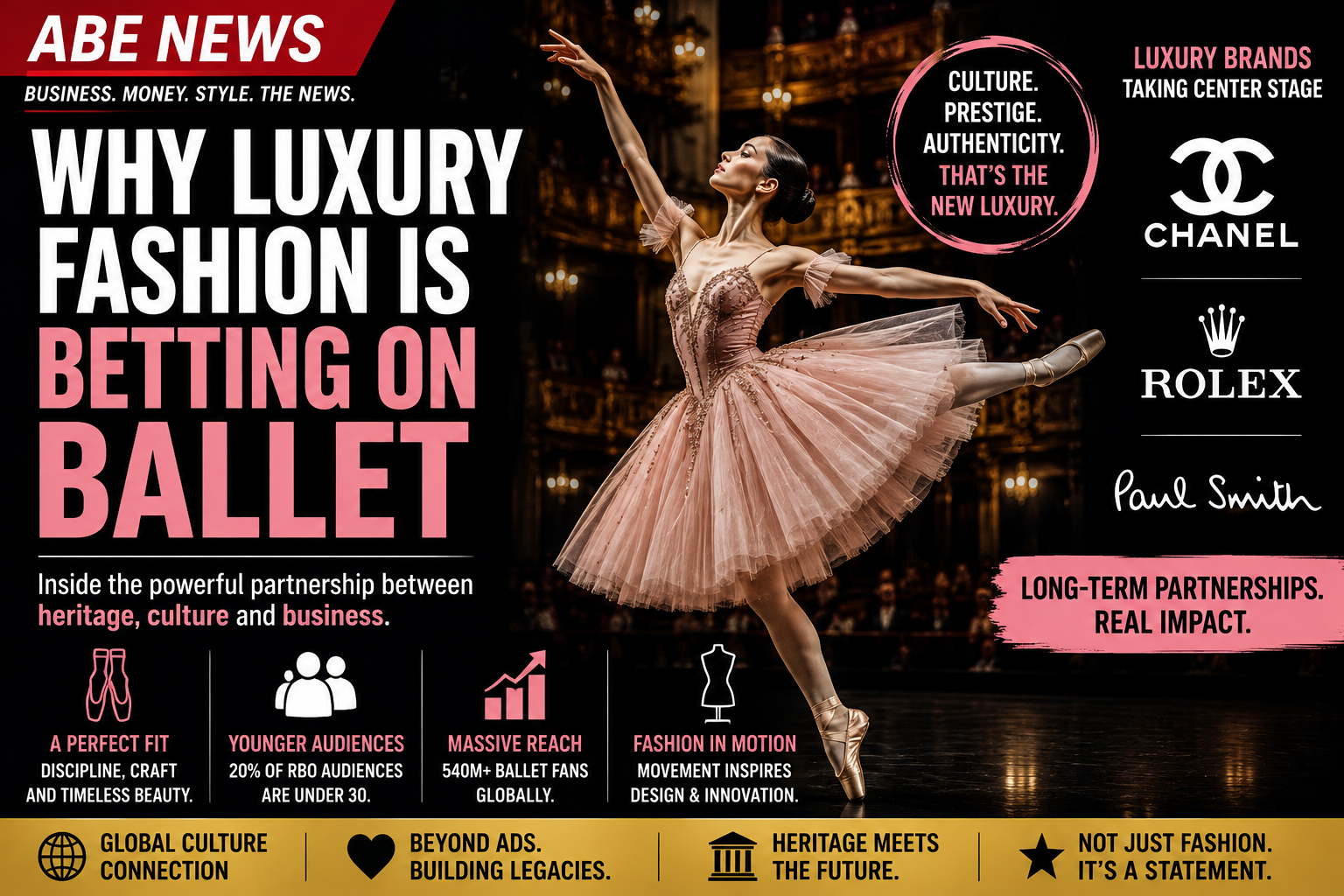
Chanel, Rolex, Paul Smith and other major brands are building relationships with ballet institutions, dancers and performances.
At first, fashion and ballet might seem like a natural creative partnership.
But there is a much bigger business story underneath.
Luxury brands aren’t simply interested in beautiful costumes and famous dancers.
They’re looking for something increasingly difficult to manufacture through advertising alone:
culture, credibility and prestige.
Why Ballet?
Luxury businesses sell more than products.
A handbag may be made from leather.
A watch may be made from steel.
A dress may be made from silk.
But the world’s most powerful luxury companies aren’t simply selling materials.
They’re selling meaning.
History.
Craftsmanship.
Exclusivity.
Identity.
And ballet already represents many of those ideas.
Becoming an elite ballet dancer can require years of training, discipline and technical mastery.
Luxury brands often tell a similar story about their own products: craftsmanship developed over generations rather than something produced quickly for mass consumption.
That makes ballet an unusually natural cultural partner.
Chanel Has Been Doing This for Generations
The relationship between fashion and ballet isn’t new.
Coco Chanel worked with the Ballets Russes more than a century ago and designed costumes for the 1924 production Le Train Bleu.
That relationship between the Chanel house and dance has continued in different forms.
Today, Chanel supports major dance institutions and events, including the Paris Opera and the BAAND Together Dance Festival at Lincoln Center.
The important part isn’t simply that Chanel sponsors ballet.
It’s the consistency.
Long-term cultural relationships can feel very different from a celebrity being paid to promote a product for one season.
For luxury brands, that authenticity matters.
Rolex Is Playing the Long Game Too
Rolex provides another example.
The watchmaker’s relationship with London’s Royal Ballet and Opera stretches back 18 years, and it now holds principal-partner status for the Royal Opera.
That’s not a quick marketing campaign.
It’s a long-term association between two institutions.
And that may be precisely the point.
Luxury companies spend decades trying to build brands that feel permanent.
Supporting institutions that have existed for generations can reinforce that image.
Instead of telling customers:
“We’re prestigious.”
The brand places itself inside environments people already associate with prestige.
Ballet Is Finding a Younger Audience
There is another reason fashion companies are paying attention.
Ballet isn’t only attracting traditional arts audiences.
Younger consumers are becoming increasingly interested.
According to the Royal Ballet and Opera, half of its ticket bookers in 2025 were new customers, while 20% of audiences across ballet and opera were under 30.
Its digital audience is significant too.
The organization has more than seven million followers across social platforms, including approximately 1.6 million on Instagram and 1.3 million on TikTok.
The RBO estimates there are more than 540 million ballet fans globally.
For fashion companies trying to reach younger consumers without appearing to chase every internet trend, that creates an interesting opportunity.
The Dancers Are Becoming Influencers Too
The relationship works because ballet itself has changed.
Professional dancers increasingly have their own substantial online audiences.
Their social-media accounts can combine rehearsals, performances, travel, fashion and everyday life.
That means dancers can exist in two worlds simultaneously:
traditional culture and modern influence.
Fashion companies normally have to choose between heritage and internet relevance.
Ballet can offer both.
A dancer can perform in a centuries-old production at night and appear in front of hundreds of thousands of social-media followers the next morning.
That combination is valuable.
Luxury Is Looking Beyond Traditional Advertising
There is a broader change happening in marketing.
Consumers see advertisements constantly.
On Instagram.
TikTok.
YouTube.
Websites.
Streaming platforms.
Billboards.
Eventually, another sponsored post can simply become background noise.
Luxury companies therefore need different ways to create emotional connections with customers.
Culture offers one.
A private ballet performance doesn’t feel like an Instagram advertisement.
Neither does backstage access, an exclusive arts event or a collaboration between a designer and choreographer.
Yet all of those experiences can strengthen someone’s relationship with a brand.
That’s particularly important when dealing with wealthy clients.
Ballet Gives Luxury Brands Something Money Can’t Easily Create
There is a concept in branding called cultural capital.
It isn’t financial capital.
It’s the status and credibility that comes from being connected to respected ideas, institutions and cultural traditions.
A company can spend millions advertising that it is sophisticated.
But sophistication is difficult to manufacture through advertising alone.
Ballet already carries associations with art, discipline, history and refinement.
Brands can enter that world through genuine partnerships.
And when the relationship lasts for years rather than weeks, the association becomes stronger.
There’s Also a Very Practical Fashion Connection
Ballet isn’t useful only because of prestige.
It also gives designers something fashion desperately needs:
movement.
Clothing isn’t actually designed to exist on mannequins.
People walk in it.
Dance in it.
Sit in it.
Move in it.
Ballet allows designers to see how fabric behaves on the human body in extreme motion.
Pleats expand.
Silk flows.
Jackets bend.
Skirts rotate.
Shapes that may appear one way in a photograph can look completely different during movement.
That creates opportunities for designers to present clothes as something alive rather than static.
Fashion and Ballet Can Reach Each Other’s Audiences
The partnerships also create a valuable exchange.
A fashion customer may discover ballet through a brand collaboration.
A ballet audience may encounter a designer they previously knew little about.
Designer Saul Nash described working on costumes for choreographer Wayne McGregor’s Alchemies as an opportunity to bring his work into a different cultural environment and reach people who might not previously have encountered it.
That cross-pollination can be powerful.
The partnership isn’t simply:
Brand → customer.
It becomes:
Fashion → ballet → culture → new audiences.
And The Numbers Can Be Significant
These collaborations can generate substantial attention.
A festive partnership between Paul Smith and the Royal Ballet and Opera generated 361,000 views across three collaborative social posts, while its reported combined press reach reached 46.7 million.
Meanwhile, the RBO says its Covent Garden venue receives roughly one million visitors annually and sells more than 660,000 tickets across a season.
Suddenly, ballet doesn’t look like an obscure cultural sponsorship.
It looks like a sizeable global audience.
Why This Matters for the Luxury Business
Luxury companies face a difficult challenge.
They need to grow.
But becoming too common can damage the exclusivity that makes luxury desirable in the first place.
Social media makes that problem even harder.
A luxury brand wants millions of people to know it exists.
But it still wants customers to feel that owning its products means belonging to something special.
Ballet offers an interesting solution.
It can provide broad cultural visibility while maintaining an atmosphere of exclusivity.
That balance is extremely valuable.
The Bigger Picture
This story isn’t really about ballet.
It’s about what marketing may be becoming.
The internet made it possible for brands to reach billions of people.
Artificial intelligence is making it easier than ever to produce advertisements, images and promotional content.
But when content becomes easier to create, authenticity becomes more valuable.
That’s why brands may increasingly invest in things that cannot be generated instantly:
Real performances.
Real artists.
Real institutions.
Real history.
Real experiences.
Luxury companies aren’t abandoning digital marketing.
They’re trying to build something around it that feels deeper.
What’s Next?
Expect the relationship between fashion and culture to become even stronger.
Ballet is only one example.
Luxury companies are already deeply involved in art, architecture, cinema, music and major sporting events.
The objective is increasingly bigger than selling products.
Brands want to become part of culture itself.
And the companies that successfully achieve that can create something more valuable than a viral campaign.
They can create relevance that lasts.
THE ABE NEWS TAKE
Luxury used to be about scarcity.
Today, it is increasingly about meaning.
Anyone with enough advertising money can place a campaign in front of millions of people.
That doesn’t automatically make people care.
Culture works differently.
You cannot create centuries of artistic tradition with a marketing budget.
You cannot manufacture the discipline required to become an elite dancer overnight.
And you cannot fake a genuine relationship with an institution for very long.
That’s why ballet is interesting to luxury brands.
It gives them access to something advertising alone struggles to provide:
credibility.
The smartest luxury companies understand that the future of marketing may not be about making more noise.
It may be about finding places where people are still willing to pay attention.
And right now, some of those brands believe that place is the stage.
ABE NEWS
Business. Money. Style. The News.
Understand More. Think Bigger.