






For years, betting companies became one of the most familiar sights in English football.
Their names appeared across the front of Premier League shirts, placing gambling brands in front of millions of supporters watching matches around the world.
But that era is changing.
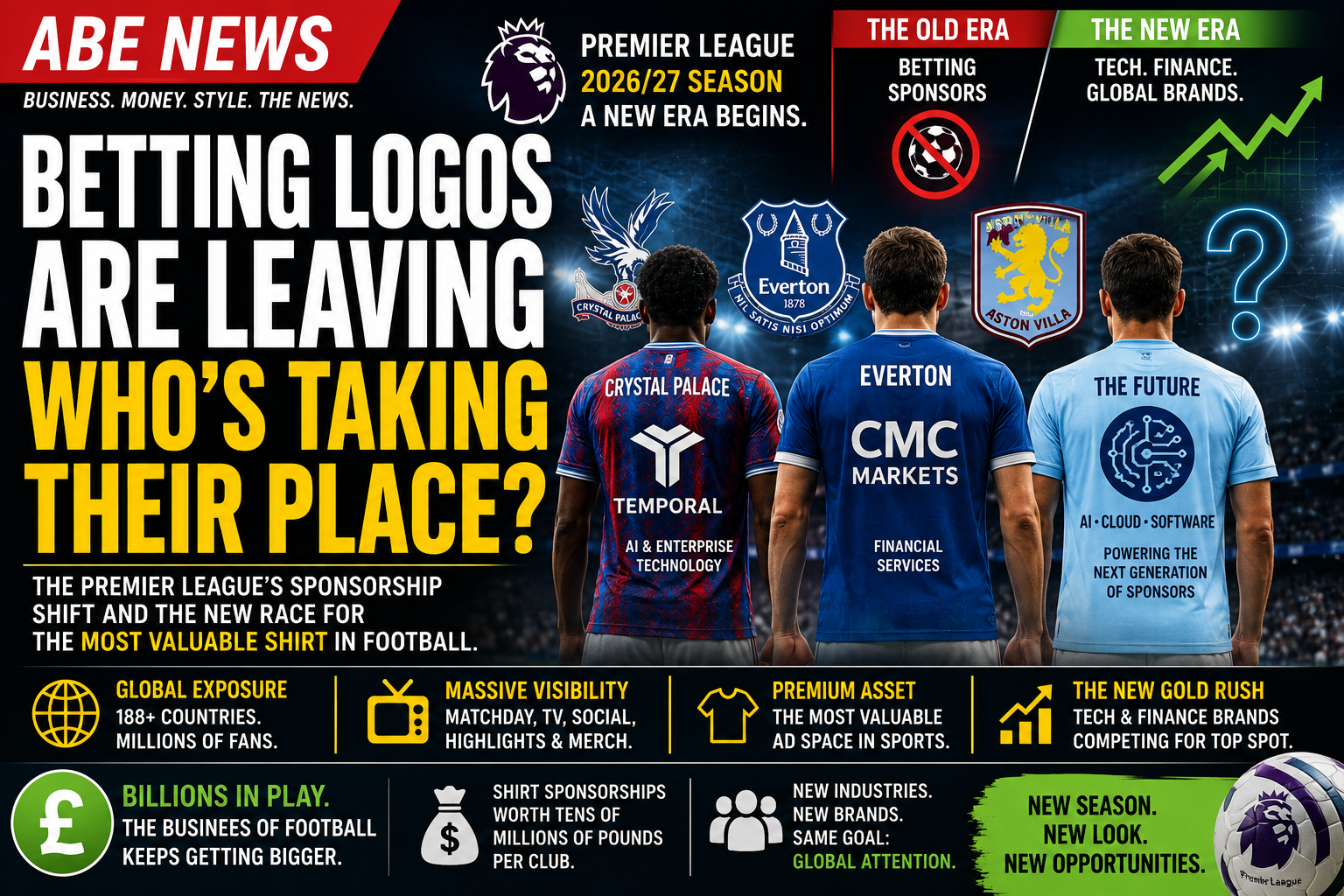
Beginning with the 2026/27 Premier League season, clubs have collectively stopped displaying gambling companies as front-of-shirt sponsors.
That creates an obvious question.
Who replaces them?
The answer is beginning to emerge.
Financial technology companies.
Artificial intelligence businesses.
Software firms.
Tourism and investment organizations.
And potentially an entirely new generation of companies willing to spend heavily for one thing the Premier League can offer almost instantly:
global attention.
Why Betting Companies Loved Football
Football sponsorship is fundamentally an attention business.
A company paying to appear on the front of a Premier League shirt isn’t simply buying space on fabric.
It’s buying exposure.
Every time a player scores, the sponsor appears.
Every photograph.
Every highlight.
Every interview.
Every social-media post.
Every televised match.
And because the Premier League has a huge international following, a sponsor can use one English football club to put its brand in front of consumers across Europe, Asia, Africa, North America and beyond.
That made football particularly attractive to online betting companies.
Many gambling businesses operate digitally and across multiple countries.
They didn’t need supporters to visit a physical shop.
They needed people to recognize their names.
Premier League football provided exactly that.
But the Premier League Decided Things Had to Change
In 2023, Premier League clubs collectively agreed to remove gambling sponsorship from the front of matchday shirts beginning after the 2025/26 season.
The Premier League described itself as the first UK sports league to voluntarily take such a measure, following consultations involving clubs, the league and the British government.
The change doesn’t eliminate gambling advertising from English football.
Betting companies can still appear in some other sponsorship positions, including shirt sleeves and training kits under the current rules.
But the most valuable piece of advertising real estate—the centre of the match shirt—is changing.
And that has created a commercial opportunity.
Welcome to Football’s New Sponsorship Race
According to a new Nielsen Sports analysis, the companies moving into the space left by betting brands are far more diverse.
Among the examples highlighted are:
Crystal Palace → Temporal, an AI and enterprise technology company.
Everton → CMC Markets, a financial services company.
Aston Villa → Visit Rwanda, representing a very different type of international partnership.
Nielsen says the broader shift includes fintech businesses, software companies and sovereign investment interests.
That tells us something important.
Football sponsorship is becoming attractive to industries that didn’t traditionally dominate football shirts.
Why Tech Companies Want Football Fans
Imagine you’re building an enterprise software company.
Your technology may be powerful.
But outside your industry, almost nobody knows your name.
Traditional advertising could take years to build recognition.
Premier League sponsorship offers a shortcut.
Put the company’s name across the chest of a club.
Suddenly that name appears in stadiums, newspapers, television broadcasts, video games, social media and merchandise around the world.
Nielsen’s Andy Milnes says challenger companies—particularly those in fintech and AI—are using sports sponsorship to build global credibility at scale.
That word matters:
credibility.
A relatively unknown company appearing beside one of the world’s most watched sporting competitions can suddenly look much larger.
Football Shirts Are Global Billboards
A Premier League shirt isn’t really local advertising anymore.
A supporter could buy the same jersey in London.
Toronto.
Lagos.
New York.
Dubai.
Singapore.
Johannesburg.
The club may come from one English city, but its commercial audience can stretch across continents.
That gives shirt sponsorship something many forms of advertising struggle to provide:
repeated global visibility.
And unlike an advertisement that disappears after 30 seconds, supporters voluntarily purchase shirts carrying the sponsor’s name.
They then wear the advertisement themselves.
That’s an extraordinary marketing model when you think about it.
Why Losing Gambling Money Isn’t Necessarily Easy
There is another side to the transition.
Betting companies became major football sponsors partly because they were willing to spend.
Removing that category from the front of shirts can therefore create a financial gap for some clubs.
Nielsen acknowledges that the departure of gambling logos creates short-term commercial pressure.
Premier League clubs still need sponsorship revenue.
Player salaries are enormous.
Transfer fees can reach tens of millions of pounds.
Stadiums require investment.
Academies cost money.
Commercial income helps finance the entire operation.
So clubs cannot simply remove a betting company and leave the shirt empty.
They need replacements capable of paying competitive prices.
The Next Big Sponsor Could Be Software
This may be the most interesting prediction in the Nielsen report.
The firm expects a secondary “Tech Gold Rush” in Premier League sponsorship and believes software-infrastructure businesses could become the dominant front-of-shirt category by 2028.
Think about how dramatic that change would be.
For much of the last decade, football supporters became accustomed to betting brands.
A few years from now, the names across Premier League shirts could increasingly belong to:
Cloud companies.
AI infrastructure providers.
Fintech platforms.
Cybersecurity businesses.
Enterprise software firms.
The shirt may remain the same.
The industries buying the attention could look completely different.
Why Finance Is Interested Too
Financial companies face a similar problem to technology businesses.
Trust matters enormously.
A consumer may hesitate to put money into a financial platform they’ve never heard of.
Sports sponsorship can help create familiarity.
If someone sees the same company associated with their football club every weekend for several years, that brand becomes recognizable.
Recognition doesn’t automatically create trust.
But it can be the first step.
That’s one reason fintech companies increasingly see major sports properties as powerful marketing platforms.
This Isn’t Just About England
The commercial significance extends far beyond the United Kingdom.
Premier League clubs increasingly operate like global entertainment brands.
They tour internationally.
They sell merchandise internationally.
They build international supporter communities.
Their players have audiences across continents.
That means companies entering Premier League sponsorship aren’t necessarily targeting British customers alone.
They may be targeting the world.
And that’s exactly why newer global technology and financial companies are interested.
The Bigger Picture
Football has become much more than sport.
It’s media.
Entertainment.
Advertising.
Technology.
Tourism.
Fashion.
Finance.
And global business.
The logos appearing on football shirts tell us something about which industries currently have both money and ambition.
Telecommunications companies once dominated.
Airlines became major players.
Betting companies expanded aggressively.
Now technology and financial businesses may be preparing for their turn.
Look closely at football shirts over the next several seasons and you may actually be watching changes in the global economy.
What’s Next?
The 2026/27 Premier League season begins on August 22, meaning supporters will soon see the new sponsorship landscape in competitive matches.
The front-of-shirt restriction is only one part of a broader debate about gambling advertising in British sport.
The UK is also considering additional restrictions that could affect sponsorship involving unlicensed gambling companies, while football authorities already operate a wider gambling-sponsorship code built around protection, social responsibility, reinvestment and integrity.
But commercially, the race has already started.
The question isn’t whether Premier League shirts will remain valuable advertising space.
They almost certainly will.
The question is which industries will dominate them next.
THE ABE NEWS TAKE
A football shirt looks like sportswear.
To a business, it’s something completely different.
It’s media space.
The Premier League has spent decades building an audience that companies around the world desperately want access to.
That’s why the departure of gambling companies doesn’t mean sponsorship disappears.
It means the competition for that attention changes.
And the companies moving in tell us something about where money is flowing.
AI wants credibility.
Fintech wants trust.
Software companies want recognition.
Global investors want visibility.
Football can offer all four.
The Premier League’s betting-sponsor era may be ending.
But the business of selling attention is only getting bigger.
ABE NEWS
Business. Money. Style. The News.
Understand More. Think Bigger.