









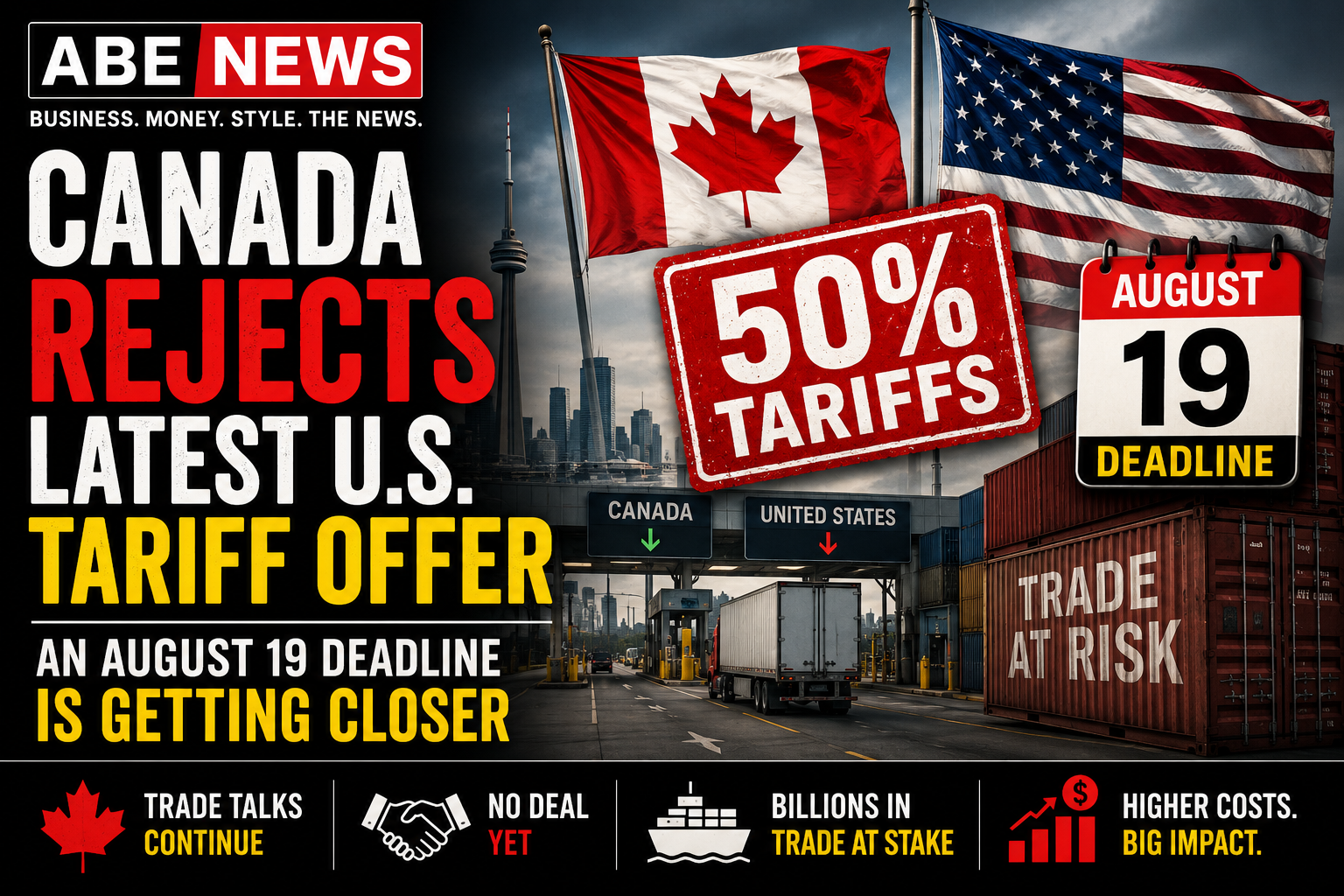
Canada and the United States are talking.
But they still don’t have a deal.
And with an August 19 tariff deadline getting closer, what looks like another disagreement between governments could soon become a much bigger issue for businesses, workers and consumers.
Canadian officials are reportedly unhappy with Washington’s latest proposal to reduce tariffs, suggesting that major differences remain even as negotiations continue.
The clock is now becoming part of the story.
Canada and the U.S. Are Still Negotiating
Canadian Trade Minister Dominic LeBlanc and Chief Trade Negotiator Janice Charette have been holding talks with U.S. Trade Representative Jamieson Greer in Washington.
The negotiations have intensified as the August 19 deadline approaches.
President Donald Trump has threatened 50% tariffs on a wide range of Canadian imports unless Canada addresses several U.S. complaints involving automobiles, alcohol and dairy products.
The proposed tariffs would affect nearly $20 billion worth of Canadian goods, according to the U.S. Trade Representative’s office.
That’s approximately 5.2% of the $383 billion in goods the United States imported from Canada in 2025.
And there’s another important difference this time.
Goods covered by the United States-Mexico-Canada Agreement would not receive the exemptions they received under some previous tariff measures.
The Latest U.S. Offer Wasn’t Enough
The United States reportedly presented Canada with another proposal on Tuesday.
The proposal would reduce some tariffs.
But according to reporting cited by Reuters, Canadian officials believe the reductions don’t go far enough.
That leaves both governments negotiating with less than a week before the threatened tariffs take effect.
Canada wants relief from tariffs already imposed by Washington.
The United States, meanwhile, wants concessions from Canada.
Among the issues being discussed are Canadian tariffs on American automobiles, dairy quota rules and the availability of American alcohol in Canadian stores. Canada has also sought reductions in U.S. tariffs affecting Canadian steel and aluminum.
Why Businesses Should Care
Tariffs sound like something that happens at the border.
Their effects don’t necessarily stay there.
When importing something becomes more expensive, companies have several choices.
They can absorb the additional cost.
They can find another supplier.
They can reduce investment.
Or they can pass some of the cost to customers.
That’s why prolonged trade disputes can eventually affect everything from manufacturing and transportation to retail prices and hiring decisions.
Canada is particularly exposed because of the enormous amount of trade that crosses the U.S.-Canada border.
A tariff affecting even a relatively small percentage of that trade can matter significantly to individual industries and businesses.
There’s Also a Bigger Negotiation Coming
This dispute isn’t happening in isolation.
Canada, the United States and Mexico also face the broader future of their North American trade relationship.
Reuters reports that side agreements reached during the current negotiations are expected to feed into the wider review of the United States-Mexico-Canada Agreement (USMCA).
That means decisions being negotiated now could influence trade relationships well beyond August 19.
THE ABE TAKE
The most important part of this story isn’t whether Canada accepts one proposal or whether Washington lowers one tariff.
It’s certainty.
Businesses can adjust to higher costs.
They can change suppliers.
They can change prices.
They can even redesign supply chains.
What is much harder to manage is constantly changing trade policy.
If companies don’t know what importing a product will cost three months from now, investment decisions become harder. Expansion becomes riskier. Hiring becomes harder to plan.
Canada and the United States have spent decades building deeply connected supply chains.
Cars can cross the border during production. Canadian materials feed American factories. American products fill Canadian stores.
That means a trade fight doesn’t simply create a Canadian problem or an American problem.
It creates friction inside a business system both countries helped build.
August 19 therefore isn’t just another political deadline.
For businesses watching from both sides of the border, it’s another test of whether North American trade is becoming more predictable — or entering a period where uncertainty itself becomes a cost.
— ABE NEWS