





Wall Street has spent much of 2026 worrying about three things:
inflation.
interest rates.
and whether the AI boom has gone too far.
On Thursday, investors got reasons to worry a little less.
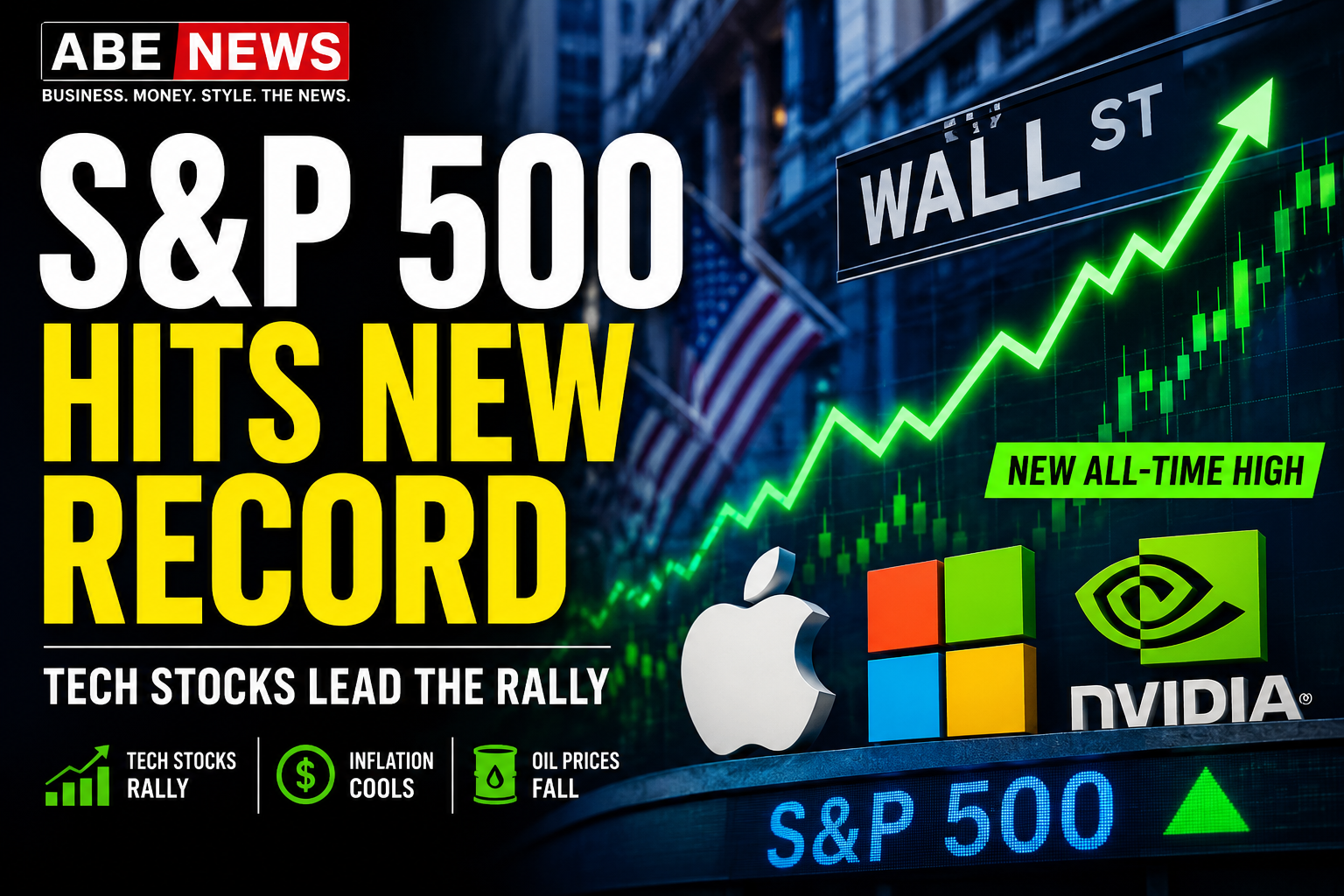
The S&P 500 climbed to a new intraday record, technology stocks moved higher, oil prices fell and fresh U.S. inflation data came in softer than economists expected.
Microsoft rose about 1.4%.
Nvidia gained around 0.6%.
Apple added roughly 0.5%.
And the S&P 500 technology sector climbed about 1%.
By 10:09 a.m. ET, the S&P 500 was up 0.73% at roughly 7,805, while the Nasdaq had gained 0.92%.
At first, this looks like another good day on Wall Street.
But there is a bigger story underneath.
Investors aren’t simply buying technology stocks again.
They’re making a bet about what comes next for inflation, interest rates, oil and the enormous amount of money being poured into artificial intelligence.
Big Tech Is Back
Technology stocks have been through a rough stretch.
The Nasdaq fell about 10% from its all-time high in late July, as investors rotated away from some technology companies and questioned whether massive spending on AI infrastructure would actually produce enough profit.
Now that mood is beginning to change.
Strong corporate earnings have helped technology shares recover, and investors returned to several of the market’s biggest companies on Thursday.
Microsoft.
Nvidia.
Apple.
Dell.
HP.
All moved higher during the session.
But something important has changed.
Investors aren’t rewarding AI spending simply because it is AI spending anymore.
They increasingly want results.
The AI Boom Is Entering a Different Phase
For the last several years, saying “artificial intelligence” could transform the way investors looked at a company.
Businesses announced AI products.
Technology giants ordered enormous numbers of chips.
Data centers expanded.
Capital spending exploded.
And investors often rewarded the companies making the biggest bets.
But eventually every investment has to answer one question:
Where is the money?
The market is becoming less tolerant of companies that keep increasing spending without showing a convincing path toward profitability.
At the same time, companies demonstrating that their technology investments can produce stronger revenue, productivity or earnings are still being rewarded.
That distinction matters.
The AI boom isn’t necessarily ending.
It may simply be becoming more disciplined.
Then Inflation Gave Wall Street Another Reason to Buy
Technology wasn’t the only thing pushing stocks higher.
The U.S. Producer Price Index was unchanged in July.
Economists had expected prices to rise 0.2%.
Goods prices actually fell 0.7%, while services prices increased 0.2%.
Compared with a year earlier, producer prices increased 4.7%, down from 5.5% in June.
That might sound like another boring economic statistic.
It isn’t.
Producer prices help show what businesses are paying before many of those costs eventually reach consumers.
If those pressures begin cooling, it can make the inflation problem easier for the Federal Reserve to manage.
And that leads directly to something Wall Street cares about enormously:
interest rates.
The Federal Reserve Is Back at the Center of the Story
The Federal Reserve’s benchmark interest rate currently sits between 3.50% and 3.75%.
The central bank has been trying to control inflation without unnecessarily damaging economic growth.
That creates a difficult balance.
Raise rates too much and borrowing becomes more expensive.
Businesses invest less.
Consumers spend less.
Economic growth can weaken.
But keep rates too low while inflation remains high and prices can accelerate again.
Thursday’s producer-price report gave the Fed a little more room.
After the numbers were released, traders increased their bets that the Federal Reserve would leave rates unchanged in September, with market pricing showing roughly a 65% probability of a hold at one point Thursday morning.
For Wall Street, that’s important.
Especially for technology.
Why Technology Companies Care So Much About Interest Rates
Many technology companies are valued partly on profits investors expect them to generate years into the future.
Higher interest rates make those future earnings less valuable in today’s money.
They also make borrowing more expensive.
That can hurt companies spending billions on:
AI chips.
Data centers.
Cloud infrastructure.
Research.
New factories.
Acquisitions.
So when investors believe interest rates may stop rising, technology stocks can become more attractive.
That’s one reason a seemingly small inflation report can suddenly move hundreds of billions of dollars across financial markets.
Oil Just Added Another Twist
There was another major development Thursday.
Oil prices fell sharply.
Brent crude dropped to around $87 a barrel, while U.S. West Texas Intermediate crude fell to roughly $81 during late-morning trading.
Earlier in the session, both had fallen even further.
One reason was extraordinary.
U.S. commercial crude inventories increased by 17.4 million barrels during the week ending August 7.
Analysts surveyed by Reuters had expected inventories to fall by 1.4 million barrels.
Instead, America recorded its largest weekly crude inventory increase since January 2023.
That’s a huge difference.
More available oil can put downward pressure on prices.
And lower energy prices can help reduce costs throughout the economy.
Transportation.
Manufacturing.
Airlines.
Shipping.
Agriculture.
Logistics.
Almost everything moves through energy somewhere.
But Oil Isn’t Suddenly Safe
There is a catch.
The global energy situation remains extremely fragile.
The Strait of Hormuz is still severely disrupted by the continuing U.S.-Iran conflict, and global supply remains under pressure.
OPEC has lowered its forecast for world oil-demand growth in 2026, while the International Energy Agency expects consumption to contract more sharply than previously forecast.
So Thursday’s oil decline doesn’t necessarily mean the energy crisis is finished.
It means two powerful forces are currently fighting each other:
supply disruption is pushing prices upward.
weaker demand and rising inventories are pushing prices downward.
Whichever force wins could matter far beyond the oil market.
Why This Matters for Businesses
Look at everything happening at once.
Technology stocks are rising.
Producer inflation is cooling.
Oil prices are falling.
Investors are becoming more confident that the Federal Reserve may leave interest rates unchanged.
Those developments can change real business decisions.
A company considering a new factory cares about borrowing costs.
A trucking company cares about diesel.
An airline cares about jet fuel.
A technology company building data centers cares about financing.
A retailer cares about transportation costs.
A startup looking for investment cares about whether investors are willing to take risks.
Markets aren’t separate from the economy.
They are constantly trying to predict where the economy is going next.
But Not Every Company Is Winning
A record market does not mean every stock is rising.
Cisco fell about 7.4% Thursday despite forecasting fiscal 2027 revenue above Wall Street expectations.
Tapestry, the company behind Coach, dropped around 15% despite providing an upbeat annual earnings forecast.
Meanwhile, Dell gained about 2.5% and HP climbed roughly 4% after Lenovo reported stronger-than-expected earnings.
That’s another important signal.
Investors are becoming selective.
A rising market can hide enormous differences underneath.
The question isn’t simply:
“Is the stock market going up?”
Increasingly, it is:
“Which companies deserve to go up?”
The Bigger Picture
This story isn’t really about the S&P 500 breaking another record.
It’s about confidence.
Financial markets are always pricing the future before the future arrives.
Investors are currently betting that several things can happen together:
Inflation can continue cooling.
The Federal Reserve can avoid another immediate rate increase.
Corporate profits can remain strong.
AI investments can begin producing meaningful returns.
And energy prices can ease without another major supply shock.
If those things happen, today’s record may make sense.
But that’s a lot of conditions.
And every one of them can change.
Quickly.
What’s Next?
Three things matter now.
First:
the Federal Reserve.
Its September 15–16 meeting will tell investors whether policymakers believe inflation has cooled enough to keep rates unchanged.
Second:
AI earnings.
Investors will keep examining whether enormous spending on chips, computing and data centers is translating into actual profits.
Third:
oil.
The Middle East remains the biggest wildcard.
A major change in supply through the Strait of Hormuz could quickly reverse Thursday’s decline in crude prices and put inflation back under pressure.
The market may be celebrating today.
But the next test is already coming.
THE ABE NEWS TAKE
Stock-market records make great headlines.
But the record itself isn’t the most interesting part of this story.
The reason investors are willing to pay more matters more.
Right now, Wall Street appears to be betting that the economy can achieve something extremely difficult:
cool inflation without crushing growth.
Keep interest rates under control without triggering another price surge.
Continue investing hundreds of billions into artificial intelligence while eventually turning that spending into real profits.
And navigate one of the world’s most serious energy disruptions without allowing oil to destabilize everything.
That’s a very optimistic combination.
Maybe investors are right.
But this rally is also becoming a test of execution.
The first stage of the AI boom rewarded possibility.
The next stage may reward proof.
Companies will have to show that their spending produces revenue.
That their technology produces productivity.
That their investments produce profits.
And that distinction could eventually become much more important than whether the S&P 500 sets another record tomorrow.
Because markets can run on excitement for a while.
Businesses eventually have to run on results.
ABE NEWS
Business. Money. Style. The News.
Understand More. Think Bigger.