









ABE NEWS | August 26, 2026
One of the biggest legal battles over children, social media and the power of Big Tech has produced a landmark result.
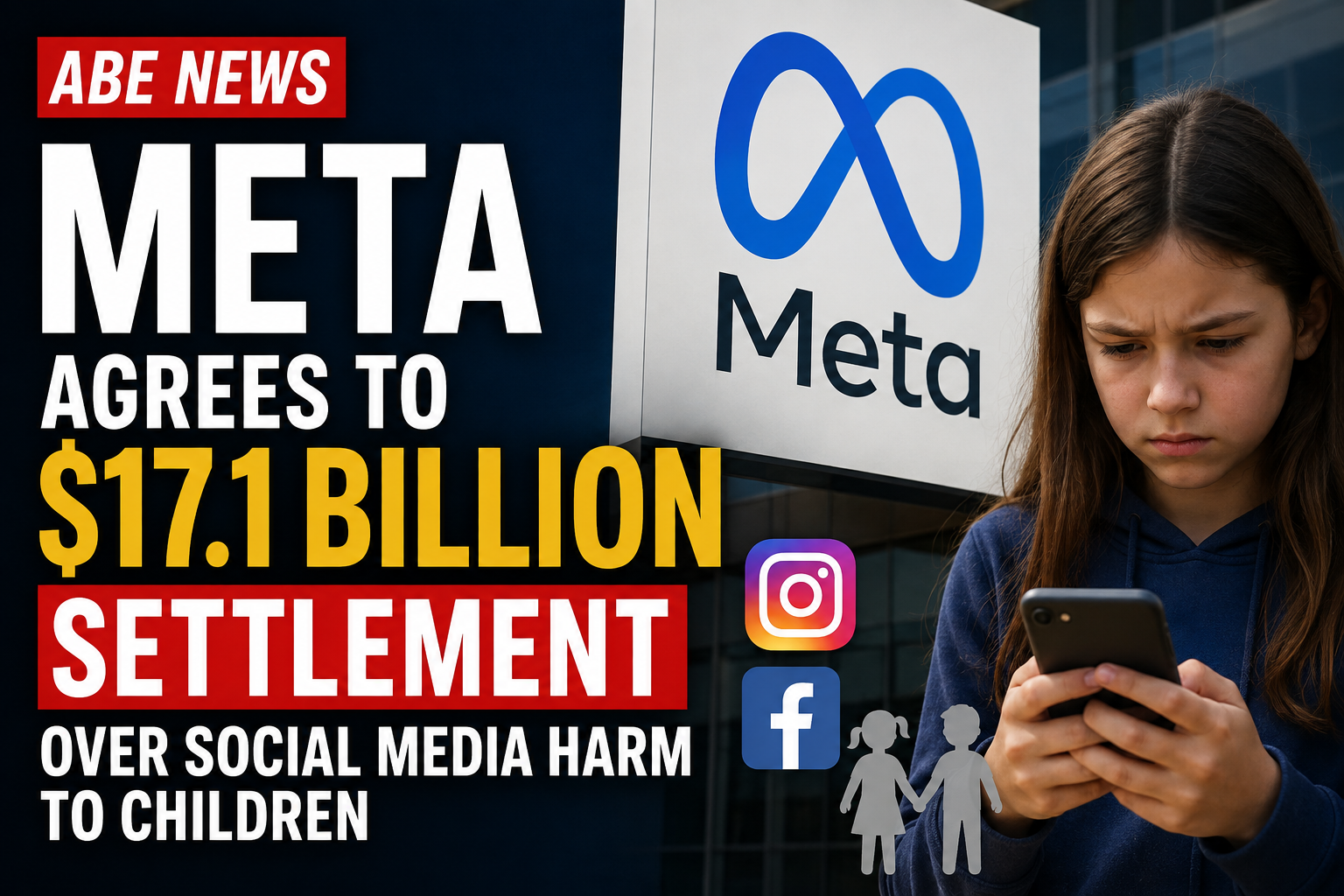
Meta Platforms, the parent company of Instagram and Facebook, has agreed to pay up to roughly $17.1 billion and make sweeping changes to how its platforms work for children and teenagers, resolving claims from a broad coalition of U.S. states and territories that accused the company of designing social-media products that encouraged compulsive use among young people while failing to adequately protect them from harm.
The proposed settlement is extraordinary not simply because of its price tag. State officials describe it as the largest state consumer-protection settlement in U.S. history outside the Big Tobacco settlements of the 1990s, placing the dispute among the most consequential corporate accountability cases in recent American history.
For Meta, the agreement could bring an end to a major front in years of litigation over the effects of Instagram and Facebook on younger users. For the broader technology industry, however, the consequences may only be beginning.
A Multibillion-Dollar Deal With Much More Than Money at Stake
The settlement resolves allegations that Meta designed features on Instagram and Facebook in ways that encouraged children and teenagers to spend excessive amounts of time on the platforms, while allegedly misleading users and families about the risks.
The states also accused Meta of violating children’s privacy protections, including allegations involving the collection of data from users under the age of 13. Meta has denied wrongdoing.
The agreement remains subject to court approval, an important distinction as the legal process is not yet formally complete.
But if approved, Meta will face obligations extending far beyond writing a multibillion-dollar cheque.
The company will have to change important parts of the experience younger users encounter on Instagram and Facebook.
Among the most significant provisions is a combined two-hour daily limit for minors across the two platforms, along with mandatory pauses intended to interrupt prolonged scrolling. The agreement also establishes stronger protections around nighttime use, notifications, content and other features associated with extended engagement.
That makes this settlement fundamentally different from a conventional corporate fine.
Governments are effectively reaching deeper into the design of social-media products themselves.
The Fight Over the Attention Economy
For years, the world’s largest social-media companies have built businesses around a valuable resource: human attention.
The longer people remain on a platform, the more opportunities companies generally have to show advertisements, recommend content, collect engagement signals and strengthen the network effects that keep users coming back.
But that business model has increasingly collided with concerns about what happens when the people being encouraged to remain online are children.
State attorneys general alleged that Meta knowingly used features that could encourage compulsive behaviour among young people even as concerns mounted about social media’s potential effects on mental and physical well-being.
The case therefore became about more than Instagram.
It became part of a much larger question confronting governments around the world:
How much responsibility should technology companies carry for the behaviour their products are deliberately designed to encourage?
That question could shape the next era of internet regulation.
Instagram and Facebook Could Feel Different for Teenagers
If the agreement receives judicial approval, younger users in participating U.S. jurisdictions could begin encountering a significantly more restrictive version of Instagram and Facebook.
Meta will be required to introduce stronger age-assurance measures and limits intended to reduce excessive use.
The agreement includes a combined two-hour daily limit for under-18 users, mandatory interruptions during extended sessions and restrictions during certain hours. Other protections address potentially harmful content and features, including some appearance-related filters and engagement mechanics.
Parents would receive greater control over some restrictions.
The broader objective is clear: instead of relying primarily on teenagers to decide when they have spent too much time scrolling, safeguards would increasingly be built directly into the product.
That represents a major philosophical change for an industry that has historically competed intensely for engagement.
Why $17.1 Billion Matters
The scale of the financial settlement is itself a message.
Individual states stand to receive hundreds of millions of dollars, and in some cases more than $1 billion, depending on the final payments.
New York, for example, could receive as much as $1.15 billion, with money intended for education and services addressing unhealthy social-media use among young people.
Texas officials say their state will receive more than $1 billion, while Pennsylvania expects at least $516 million and potentially considerably more under the settlement structure.
The total amount is expected to be paid over a period of years, with portions of the potential maximum linked to developments involving other social-media companies.
But Meta is one of the world’s largest and most profitable technology companies.
That means the lasting significance of this case may not be whether Meta can financially absorb the settlement. The bigger issue is whether the agreement establishes a regulatory model that governments can apply across the social-media industry.
Meta Wants Its Rivals to Follow
Meta is already framing the agreement as something that should extend beyond its own platforms.
The company says meaningful protection for teenagers cannot work effectively if restrictions apply only to Instagram and Facebook while young users can simply move to competing services.
Meta has specifically called on TikTok and YouTube to adopt similar standards, arguing that teenagers move between numerous apps and that child-safety measures should apply across the industry.
That argument is commercially significant.
If Meta alone must impose strict limits while competing platforms remain comparatively unrestricted, the company could face a disadvantage in the battle for younger users’ attention.
If similar rules spread across the industry, however, the settlement could effectively help establish a new baseline for how social-media companies operate in the United States.
That is why competitors should be watching this case closely.
The Legal Pressure on Social Media Isn’t Going Away
The Meta settlement also arrives amid a broader legal assault on the social-media industry’s relationship with young people.
Governments, school districts and individual plaintiffs have pursued litigation alleging that social-media platforms contributed to harmful patterns of use among children and teenagers.
Meta is not the only company facing scrutiny. Other major platforms, including TikTok, Snap and YouTube, have been drawn into the wider legal and political debate over youth social-media use.
That raises the possibility that Meta’s settlement becomes a template rather than an endpoint.
If other companies eventually accept comparable restrictions, the social-media experience of American teenagers could look very different within a few years.
Features once designed almost entirely around increasing engagement may increasingly have to account for mandatory limits, age verification, parental controls and restrictions on the way algorithms and notifications interact with minors.
The Business Model Is Now Part of the Debate
There is also an important business dimension.
Social-media companies generate enormous advertising businesses from engagement. Any policy that reduces the amount of time users spend on a platform therefore raises questions about growth, advertising inventory and long-term user behaviour.
The immediate market reaction, however, suggested investors did not view the settlement as an existential threat to Meta. The company’s shares rose about 2.3% following news of the agreement, according to Reuters.
That reaction illustrates an important distinction.
Investors may view a large but manageable settlement as preferable to years of unpredictable litigation—particularly if the agreement creates clearer rules for operating social platforms for younger users.
But the longer-term financial consequences will depend on whether restrictions materially change engagement and whether similar requirements spread to other markets and competitors.
A Case Bigger Than Meta
The significance of this agreement extends well beyond one corporation.
For much of the social-media era, technology developed faster than regulation.
Platforms introduced new algorithms, recommendation systems, notifications, filters and engagement tools to billions of users while governments struggled to understand their effects and determine where legal responsibility should begin.
The Meta settlement suggests that gap may be narrowing.
Regulators are no longer focusing solely on what content appears on social networks.
They are increasingly examining how the platforms themselves are engineered.
That distinction could prove enormous.
If governments begin treating product design as a legitimate target of consumer-protection enforcement, some of Silicon Valley’s most fundamental growth strategies could face much greater scrutiny.
What Happens Next
The settlement still requires judicial approval.
Assuming it receives that approval, attention will shift toward implementation: how Meta verifies users’ ages, how effectively time restrictions operate, how parents interact with the new controls and whether the company meets the agreement’s requirements.
The next major question will involve Meta’s competitors.
State attorneys general have made clear that concerns about youth social-media use extend beyond Instagram and Facebook. Meta itself is publicly urging rival platforms to adopt comparable standards.
If that happens, August 2026 could eventually be remembered as a turning point in the relationship between America’s technology giants, governments, parents and young internet users.
🔴 THE ABE NEWS TAKE
The most important number in this story may not ultimately be $17.1 billion.
It may be two hours.
For years, the central economic incentive of social media has been remarkably simple: keep people watching, scrolling, clicking and returning.
This settlement challenges that model where children are concerned.
A multibillion-dollar payment is enormous, but Meta can account for a financial settlement. Mandatory changes to the architecture of engagement are potentially more consequential because they reach into the machinery that makes social media so commercially powerful.
There is also a wider lesson here for Big Tech.
The era in which digital platforms could argue that users alone were responsible for how they interacted with carefully engineered recommendation systems is facing increasingly serious legal resistance.
Governments are beginning to ask not merely what people do online, but what platforms were designed to make them do.
Meta is the first major social-media company to reach this kind of comprehensive resolution with states over youth safety. It is unlikely to be the last.
The real test begins now: whether these restrictions genuinely create healthier digital environments for children—or simply mark the beginning of another long battle over who controls the attention of the next generation.
ABE NEWS
Business. Money. Style. The News.
Understand More. Think Bigger.