









ABE NEWS | August 27, 2026
The question hanging over the artificial-intelligence boom has been getting louder: How long can this extraordinary spending continue?
Nvidia just delivered its answer.
The world’s dominant supplier of artificial-intelligence chips reported another enormous quarter, with revenue reaching $96.2 billion, more than double the level recorded a year earlier. Its data-center business alone generated $89 billion, highlighting the extraordinary amounts of money flowing into the infrastructure behind the global AI race.
But Nvidia did more than report another record-breaking set of numbers.
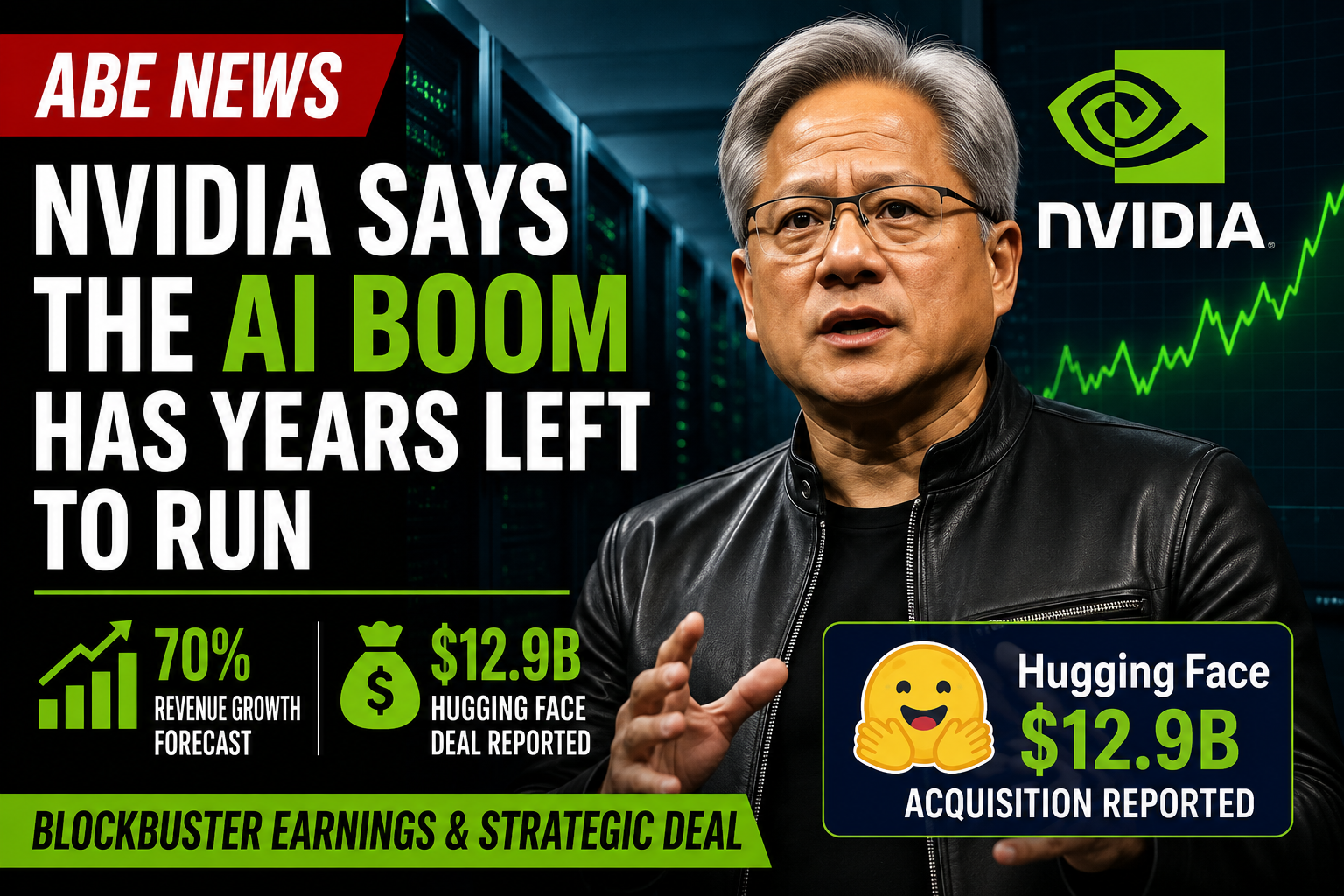
The company forecast approximately 70% revenue growth in its next fiscal year, an unusually aggressive long-term outlook that suggests Nvidia believes the global AI infrastructure boom is nowhere near finished. For the current quarter, Nvidia expects revenue of about $108 billion, plus or minus 2%, above Wall Street’s expectations.
Investors responded enthusiastically. Nvidia shares jumped in extended trading Wednesday and were up about 6.7% before Thursday’s opening bell, putting the company on course at one stage to add roughly $340 billion in market value.
Then came another potentially enormous development.
Nvidia has reportedly agreed to acquire Hugging Face for $12.9 billion, according to a report from The Information cited by Reuters. Hugging Face operates one of the world’s most important repositories and development platforms for open-source artificial-intelligence models and datasets. Neither Nvidia nor Hugging Face had publicly confirmed the reported agreement when Reuters sought comment.
Taken together, the developments paint an increasingly clear picture.
Nvidia isn’t preparing for the AI boom to slow down.
It is positioning itself for the possibility that this is only the beginning.
Nvidia’s Revenue Has More Than Doubled
The scale of Nvidia’s growth remains difficult to overstate.
For its fiscal second quarter ended July 26, Nvidia reported $96.2 billion in revenue, up 18% from the previous quarter and an extraordinary 106% from a year earlier.
Just one year ago, Nvidia’s comparable quarterly revenue stood at $46.7 billion. The company has therefore added almost $50 billion in quarterly sales in only twelve months.
The engine remains Nvidia’s Data Center division.
Revenue from that business reached $89 billion, up 117% from a year earlier, as technology companies, AI laboratories, cloud providers and governments continue racing to build the computing infrastructure required to train and operate increasingly sophisticated AI systems.
Nvidia also reported GAAP earnings of $2.46 per diluted share, while adjusted earnings came in at $2.22 per share. Gross margins stood at 75%.
Wall Street had already become accustomed to enormous Nvidia numbers.
The company still managed to surprise.
$108 Billion — In One Quarter
Nvidia’s outlook may be even more significant than the quarter it just completed.
The company expects approximately $108 billion in third-quarter revenue, plus or minus 2%.
Wall Street had expected about $104.2 billion, according to estimates cited by Reuters.
If Nvidia reaches its forecast, the company will cross another extraordinary threshold: generating more than $100 billion in sales in a single three-month period.
But CEO Jensen Huang went considerably further.
Nvidia expects revenue to grow approximately 70% in fiscal 2028, the company’s next fiscal year.
That is an unusually ambitious forecast for a company that has already become enormous.
Normally, growth rates slow substantially as corporations become larger because every additional percentage point requires increasingly massive amounts of new business.
Nvidia is telling investors that this conventional slowdown may not happen yet.
The company believes demand for AI computing remains powerful enough to support another enormous expansion.
Jensen Huang: AI Has Reached an ‘Inflection Point’
Nvidia’s argument rests on a fundamental shift in how artificial intelligence is being used.
For several years, businesses poured billions into AI experiments, large language models, data centers and computing infrastructure without always being able to demonstrate how those investments would generate equivalent economic returns.
That uncertainty has increasingly worried investors.
Huang argues the transition from experimentation toward economically productive AI is now happening.
Speaking alongside the results, the Nvidia CEO said AI had reached an “inflection point,” arguing that AI-generated computational output is increasingly becoming economically productive.
That distinction matters enormously.
If companies conclude AI can consistently reduce costs, increase productivity, automate valuable work or create new revenue, spending on AI infrastructure could continue expanding.
If those returns fail to materialize, today’s enormous capital expenditures become much harder to justify.
Nvidia is effectively betting on the first scenario.
Wall Street Likes What It Heard
Investors initially sent Nvidia shares lower following Wednesday’s report before sentiment reversed sharply.
The stock eventually climbed nearly 5% in extended trading. By Thursday morning, shares were approximately 6.7% higher in premarket trading, according to Reuters.
The reaction spread beyond Nvidia.
AI-related semiconductor stocks in Europe and China also benefited as investors interpreted Nvidia’s outlook as evidence that the global infrastructure race remains intact.
At least 10 brokerages raised their Nvidia price targets following the results, according to LSEG data reported by Reuters.
That response is particularly significant because Nvidia’s stock had fallen nearly 12% from its May peak before the report as investors demanded stronger evidence that AI spending could continue at its current pace.
Nvidia just gave them its strongest answer yet.
But Nvidia Has a Different Problem: Supply
The remarkable part of Nvidia’s outlook is that demand may not be the company’s biggest constraint.
Supply is.
Nvidia warned that shortages of memory components continue limiting how quickly it can expand production.
That creates an unusual corporate problem.
Most companies worry about finding enough customers for the products they can manufacture.
Nvidia is trying to manufacture enough products for customers who already want them.
The company has been working aggressively with suppliers to expand the broader ecosystem needed for AI systems, including advanced memory.
Earlier this year Nvidia and SK hynix announced a multiyear partnership aimed at expanding next-generation memory supply for AI infrastructure.
If supply bottlenecks ease faster than expected, Nvidia could potentially have additional room to grow.
If they worsen, however, the company may struggle to fully satisfy the extraordinary demand it is forecasting.
Amazon Is Going Even Deeper With Nvidia
Another important signal comes from Amazon Web Services.
Nvidia and AWS plan to deploy two million additional Nvidia GPUs during 2027 and 2028, according to the company.
That commitment demonstrates just how large the AI infrastructure race has become.
Cloud computing giants are not buying thousands of processors.
They are planning deployments measured in millions of GPUs.
Those chips will power the data centers used to train models, generate AI responses, run autonomous agents and support an expanding range of enterprise applications.
And every major expansion of AI computing infrastructure strengthens Nvidia’s position at the center of the ecosystem.
Then Came Hugging Face
Hours after Nvidia’s results, another potentially transformative development emerged.
Nvidia has agreed to purchase Hugging Face for approximately $12.9 billion, The Information reported, citing a person familiar with the deal. Reuters subsequently reported the claim but noted that Nvidia and Hugging Face had not immediately responded to requests for comment.
That distinction is important: the acquisition is reported, not yet publicly confirmed by the companies.
If completed on the reported terms, however, the deal would be strategically significant.
Hugging Face has become one of the central hubs of the open-source AI world.
Developers use its platform to share and access models, datasets and tools. The company occupies an influential position between researchers, startups and major technology companies building artificial-intelligence applications.
Nvidia already knows the company well.
Nvidia participated alongside Salesforce and Google’s parent Alphabet in a $235 million Hugging Face funding round in 2023, which valued the startup at approximately $4.5 billion.
A $12.9 billion acquisition would therefore value Hugging Face at almost three times that 2023 level.
Why Nvidia Would Want Hugging Face
The strategic logic is powerful.
Nvidia already dominates much of the hardware layer underlying modern artificial intelligence.
Its GPUs power enormous amounts of AI training and inference.
Its CUDA software ecosystem has also become deeply embedded across AI development.
Buying Hugging Face could potentially extend Nvidia’s influence further upward—from the physical computing infrastructure into one of the platforms developers use to discover, share and deploy AI models.
That becomes particularly important as some of Nvidia’s largest customers simultaneously attempt to reduce their dependence on Nvidia.
Major technology companies are developing their own AI accelerators, while leading AI laboratories are exploring alternatives to conventional Nvidia infrastructure.
Hugging Face could give Nvidia another powerful connection to the developers actually building AI products—especially within the open-source ecosystem.
Reuters noted that the reported deal comes as builders of proprietary AI models increasingly pursue their own chip strategies as alternatives to Nvidia’s GPUs.
The battle for AI may therefore no longer be simply about who manufactures the fastest chip.
It is increasingly about who controls the ecosystem surrounding the chips.
Nvidia Is Becoming More Than a Chip Company
That transformation has been developing for years.
Nvidia began as a company best known for graphics processors used by gamers.
Then GPUs became essential for cryptocurrency mining.
Then researchers discovered that the parallel processing architecture of GPUs was extraordinarily well suited to training neural networks.
Generative AI transformed that technical advantage into one of the biggest corporate opportunities in modern history.
Now Nvidia is expanding again.
The company is involved in chips, networking, AI software, cloud infrastructure, robotics, autonomous systems, investments in AI companies and increasingly the financing and construction of the broader AI ecosystem.
Nvidia disclosed that it has $18 billion committed to equity investments through fiscal 2027, according to Reuters.
The strategy appears increasingly clear.
Nvidia doesn’t simply want to sell the machinery used during the AI revolution.
It wants to occupy as many strategically important positions inside that revolution as possible.
There Are Still Serious Risks
None of this means Nvidia’s extraordinary trajectory is guaranteed.
One of the biggest unanswered questions surrounding the AI boom remains whether the enormous amounts being spent on infrastructure will eventually generate sufficient economic returns.
Technology companies are committing hundreds of billions of dollars to data centers, processors, electricity, networking equipment and AI development.
Those investments ultimately need to produce sustainable revenue or productivity gains.
There are also competitive risks.
AMD and other semiconductor companies want a larger share of AI computing. Major cloud providers are developing proprietary processors. AI laboratories are exploring custom chips.
Regulators may also scrutinize Nvidia’s expanding influence across the AI ecosystem, particularly if the company continues acquiring or investing in strategically important AI businesses.
And Nvidia’s supply-chain constraints demonstrate that explosive demand creates its own vulnerabilities.
But for now, none of those challenges has stopped the growth.
What Happens Next
Investors will now watch whether Nvidia can deliver its approximately $108 billion third-quarter revenue forecast and whether the company can overcome the memory and supply constraints limiting production.
Attention will also turn toward the reported Hugging Face acquisition.
Until Nvidia or Hugging Face formally confirms the transaction, the reported $12.9 billion agreement should be treated accordingly.
If confirmed, investors will want to know how Hugging Face fits into Nvidia’s broader strategy, whether it will retain its existing identity and open-source orientation, and whether regulators will examine the combination.
Beyond Nvidia itself, however, the most important test will happen across the broader economy.
Companies have spent extraordinary amounts building AI.
Now they have to prove that AI can make extraordinary amounts of money.
🔴 THE ABE NEWS TAKE
Nvidia’s latest results tell us something bigger than how many GPUs the company sold last quarter.
They show that the AI infrastructure race is accelerating even after reaching a scale that once seemed almost unimaginable.
Consider the numbers.
$96.2 billion in quarterly revenue.
$89 billion from Data Center.
$108 billion expected next quarter.
And approximately 70% growth forecast for another fiscal year after revenue has already more than doubled.
Those are not startup growth rates.
They are startup growth rates being produced by one of the largest corporations on Earth.
But the most important part of Nvidia’s story may now be changing.
The first stage of the AI boom was about building models.
The second was about acquiring computing power.
The next stage may be about controlling the infrastructure, software, developer ecosystems and economics surrounding AI.
That is why the reported Hugging Face deal matters.
Nvidia already sells much of the computing machinery powering artificial intelligence. If it increasingly owns or influences the platforms, companies and developer infrastructure built around that machinery, Nvidia becomes something far more consequential than the world’s leading AI-chip manufacturer.
It starts looking like an operating layer for the AI economy.
There is still one enormous question hanging over everything.
Can the real economy eventually generate enough value from artificial intelligence to justify this historic investment boom?
Nvidia is betting billions that the answer is yes.
After these results, Wall Street appears increasingly willing to make the same bet.
ABE NEWS
Business. Money. Style. The News.
Understand More. Think Bigger.