





Oil is climbing again.
But this story is no longer just about the price of a barrel.
It’s about a narrow stretch of water connecting the Persian Gulf to the rest of the world.
The Strait of Hormuz.
Before the current war, roughly one-fifth of the world’s oil and liquefied natural gas flows passed through this route. Today, tanker traffic remains severely disrupted, negotiations between Iran and the United States are stalled, and businesses around the world are being forced to ask an uncomfortable question:
What happens if this doesn’t end soon?
Because when one of the world’s most important energy routes stops functioning normally, the consequences don’t stay in the Middle East.
They eventually reach gas stations, airlines, factories, supermarkets — and your wallet.
🛢️ First, Look at Oil
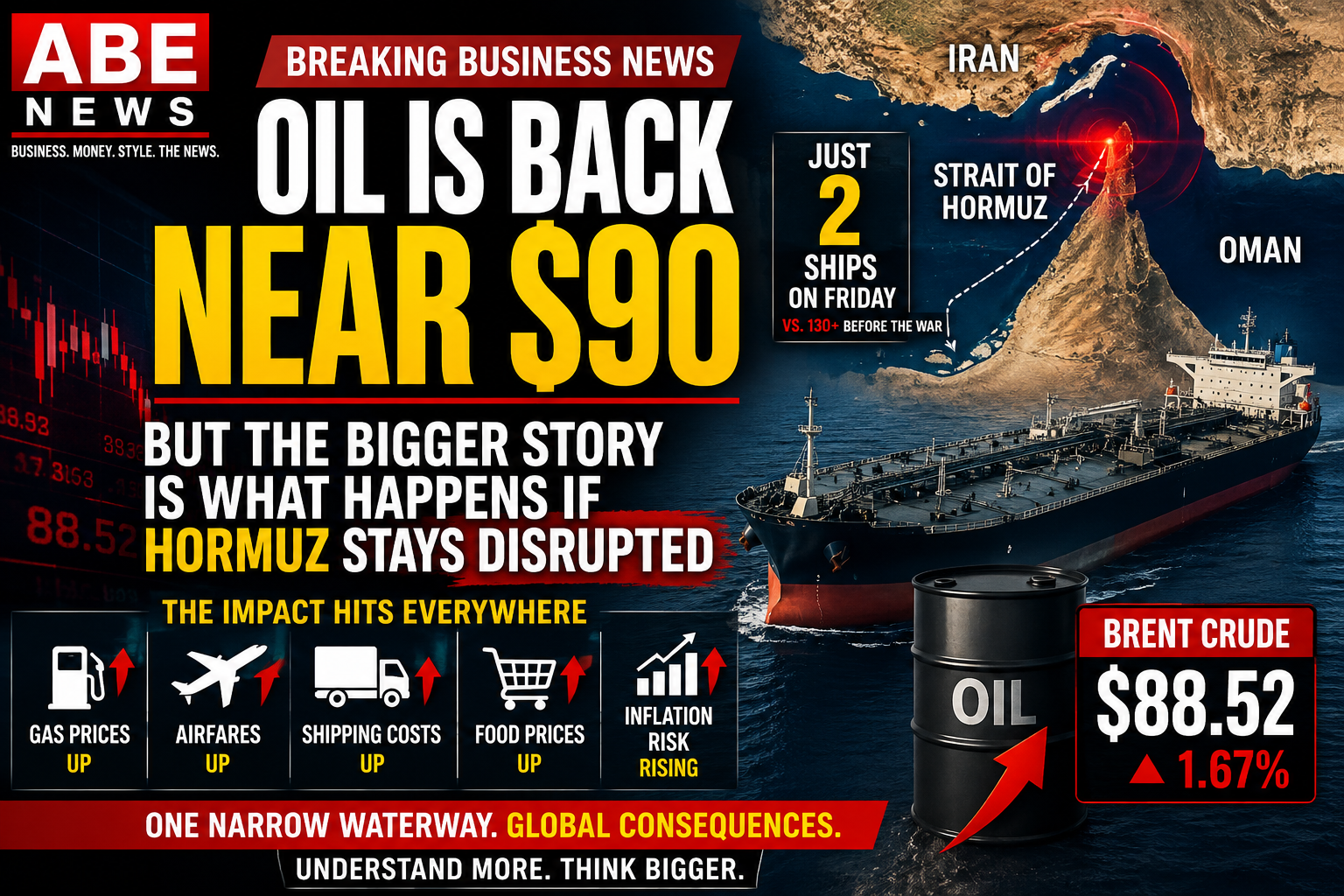
Brent crude settled Friday at $88.52 per barrel, rising 1.67% on the day.
That puts the world’s main oil benchmark back within striking distance of $90.
And this isn’t just traders reacting to scary headlines.
There is a physical shipping problem underneath the price.
Reuters reported that only two vessels passed through the Strait of Hormuz on Friday, according to Kpler ship-tracking analysis.
There were no visible crude-oil shipments among them.
Before the war?
More than 130 ships crossed the strait each day.
Think about that difference.
More than 130.
Now, on Friday:
Two.
Some vessels may travel without their tracking systems operating, so the figures don’t capture absolutely everything.
But the direction is unmistakable.
Normal shipping has not returned.
Why Hormuz Matters So Much
Look at a map and the Strait of Hormuz doesn’t seem particularly impressive.
It’s simply a narrow waterway between Iran and Oman.
Economically, however, it is one of the most important pieces of geography on Earth.
Major energy producers including Saudi Arabia, the United Arab Emirates, Kuwait, Iraq and Qatar rely heavily on Gulf shipping routes.
Oil and LNG move from the region toward enormous markets in Asia and elsewhere.
When Hormuz functions normally, most consumers barely think about it.
When it doesn’t?
Suddenly geography becomes economics.
Because you cannot simply pick up an oil field and move it to the other side of the ocean.
🇮🇷 Iran Isn’t Backing Down
This is where the problem becomes more complicated.
Iran says the waterway remains under its control and has insisted that its conditions must be met before normal traffic resumes.
Meanwhile, the United States says it can maintain its naval pressure on Iran indefinitely.
The two sides reached an interim agreement in June.
It fell apart.
Attempts to revive it have made no meaningful progress, according to recent reporting.
And the rhetoric has intensified.
Iran has said it will continue restricting the strait until its demands are addressed, while Washington is preparing additional economic pressure against Tehran.
So the market isn’t simply waiting for oil production to increase.
It’s waiting for a geopolitical problem to be solved.
Those are much harder to predict.
⛽ Then Oil Reaches the Gas Pump
This is where an international conflict starts becoming a household story.
The average U.S. gasoline price stood around $4.08 per gallon Friday, according to AAA figures cited by Reuters.
That’s approximately 29% higher than a year earlier.
And gasoline doesn’t exist in isolation inside a household budget.
Imagine someone who has $500 left each month after paying rent, utilities and other fixed expenses.
If commuting suddenly costs another $60 or $80?
That money has to come from somewhere.
Maybe fewer restaurant meals.
Maybe fewer clothes.
Maybe no new phone.
Maybe the weekend trip gets cancelled.
One household doing that means almost nothing to the economy.
Millions doing it?
That’s a consumer-spending story.
✈️ Businesses Feel It Too
Now think about an airline.
Fuel is one of its biggest expenses.
Higher oil prices can mean higher operating costs.
The airline then has choices.
Absorb the cost and accept smaller profits.
Raise ticket prices.
Cut less-profitable routes.
Or find efficiencies elsewhere.
Trucking companies face a similar calculation.
So do delivery businesses.
Manufacturers.
Farmers.
Shipping companies.
Eventually, the cost can move through the economy.
Oil → transportation → production → businesses → consumers.
That’s why economists pay so much attention to energy shocks.
Oil doesn’t stay inside the oil industry.
🛒 And Then Comes Inflation
This is where the story becomes especially important.
Central banks have spent years fighting inflation.
Now imagine energy costs staying elevated for months.
Transportation becomes more expensive.
Producing some goods becomes more expensive.
Food distribution becomes more expensive.
Air travel becomes more expensive.
Companies then have to decide whether they can absorb those costs or pass them on.
And if enough companies raise prices?
Inflation becomes harder to control.
That could complicate decisions for central banks — including the Federal Reserve.
Suddenly:
A shipping disruption in the Persian Gulf can influence an interest-rate decision in Washington.
That’s how connected the modern economy has become.
🌏 Asia Has a Particular Problem
Some of the countries watching Hormuz most closely aren’t in Europe or North America.
They’re in Asia.
Asian refiners have already been looking for alternative supplies, including additional U.S. crude, as companies try to protect themselves against Gulf disruption.
That’s another important lesson from this crisis.
Businesses don’t wait for politicians to solve everything.
They adapt.
If one supplier becomes unreliable, they search for another.
If one shipping route becomes dangerous, they look for alternatives.
If one source becomes too expensive, they reconsider the economics.
But changing supply chains isn’t free.
And the longer the disruption lasts, the more permanent some of those changes could become.
📈 Yet Gulf Stock Markets Rose Today
Now here’s the strange part.
Despite all this uncertainty, most Gulf stock markets rose Sunday.
Saudi Arabia’s benchmark index gained 0.9%, with Saudi Aramco rising around 1%.
Qatar’s market edged higher.
Egypt’s EGX30 rose about 1.1%.
At first that seems contradictory.
Shipping is disrupted.
Oil is expensive.
Peace talks are stalled.
And stocks rise?
But markets don’t simply price today’s problems.
They price expectations about tomorrow.
Investors may believe businesses can continue operating through the disruption.
They may believe higher oil prices benefit some regional companies.
Or they may believe the conflict eventually gets resolved.
That’s why markets can sometimes rise during terrible headlines.
The market isn’t asking:
“Is everything good?”
It’s asking:
“Is the future better or worse than investors already expected?”
Very different question.
🌊 There’s Another Cost Nobody Should Ignore
The economic consequences aren’t the entire story.
There are growing environmental concerns around Gulf shipping as well.
Satellite imagery has shown significant oil slicks in the region, including pollution near Iran’s Qeshm Island.
Separately, a grounded tanker off Oman carrying Russian crude has produced a massive oil slick, though that incident has not been linked to the Iran conflict.
The longer instability makes assessment and cleanup difficult, the greater the potential environmental damage.
And once again:
Environmental damage eventually becomes economic damage.
Fishing.
Tourism.
Coastal communities.
Cleanup costs.
Marine ecosystems.
War rarely sends only one bill.
So What Happens Next?
There are essentially two paths.
SCENARIO 1 — Hormuz Reopens
A political agreement allows normal commercial shipping to resume.
Oil markets suddenly regain confidence in Gulf supply.
The geopolitical risk premium falls.
Oil prices could face downward pressure.
Gasoline eventually follows.
Inflation concerns ease.
Markets breathe.
But then there’s the second scenario.
SCENARIO 2 — The Disruption Continues
Tankers remain restricted.
Shipping risk stays elevated.
Alternative supplies become increasingly valuable.
Businesses begin making longer-term changes.
And every new military incident risks another oil-price spike.
That’s the scenario companies around the world have to prepare for — even if they hope it never happens.
🔴 THE ABE NEWS TAKE
People often think oil prices are controlled by oil companies.
Sometimes they’re influenced by production.
Sometimes demand.
Sometimes inventories.
But every once in a while, the world receives a reminder that one of the most powerful forces in economics is something nobody can manufacture:
Geography.
The Strait of Hormuz is narrow.
It doesn’t produce smartphones.
It doesn’t run banks.
It doesn’t manufacture cars.
Yet what happens there can influence how much a family in Toronto pays for transportation, what an airline in London charges for a flight, what a factory in Germany pays for energy and what a central banker in Washington thinks about inflation.
That’s extraordinary.
And it exposes one of the weaknesses hidden inside globalization.
We’ve built an incredibly efficient global economy.
But efficiency often depends on a surprisingly small number of ports, canals, shipping lanes and suppliers working exactly as expected.
When they work, nobody notices them.
When they stop?
Everybody notices.
So don’t just watch whether Brent crosses $90.
Watch the ships.
Watch the negotiations.
Watch gasoline.
Watch inflation.
Because the biggest story isn’t that oil is getting expensive again.
It’s how quickly a problem in one narrow stretch of water can become everybody else’s problem.
ABE NEWS
Business. Money. Style. The News.
Understand More. Think Bigger.