






ABE NEWS ORIGINAL | SUNDAY, AUGUST 16, 2026
The stock market is breaking records.
Corporate profits are strong.
Inflation is cooling.
And economists can point to plenty of numbers suggesting the American economy is still standing.
There is just one problem.
A lot of ordinary people don’t feel it.
Ask someone whether the S&P 500 reached another record this week and they may shrug.
Ask them how much groceries cost?
They’ll probably know.
Ask about rent.
Gas.
Car payments.
Insurance.
A mortgage.
They’ll have an answer.
And that creates one of the strangest contradictions in today’s economy:
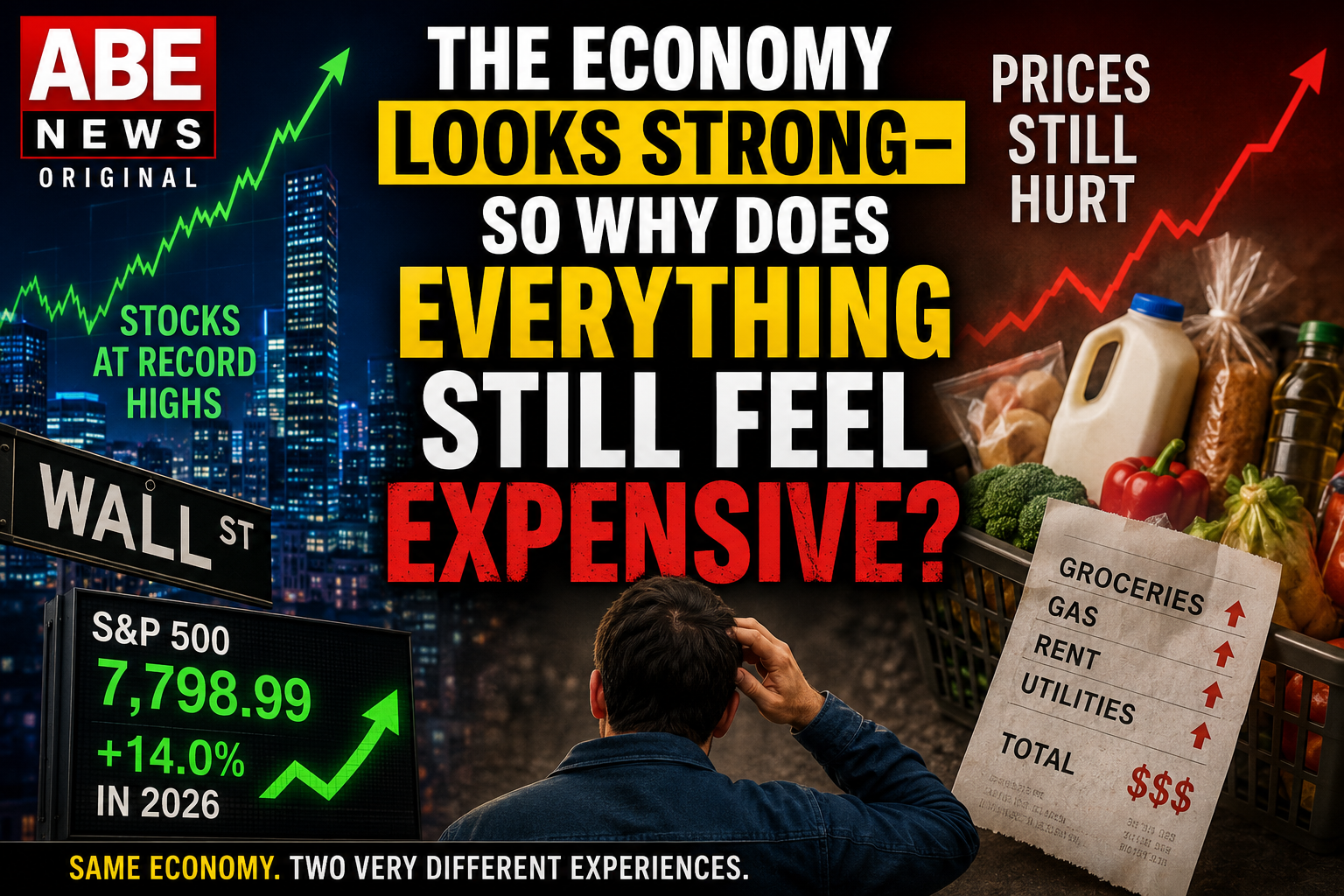
How can the economy look strong on paper while life still feels so expensive?
The answer begins with something we often forget.
There isn’t really one economy.
There are millions of different experiences happening inside the same economy.
📈 WALL STREET IS HAVING A VERY DIFFERENT YEAR
If you only looked at the stock market, you might wonder what everyone is complaining about.
The S&P 500 closed at a record 7,798.99 on Thursday.
It’s up roughly 14% in 2026.
The Nasdaq is up around 15%.
Corporate America is doing remarkably well too.
Of the 436 S&P 500 companies that had reported their latest quarterly earnings by August 7, approximately 85% beat analysts’ expectations.
The historical average is around 68%.
That’s an enormous difference.
Companies are making money.
Investors are making money.
Stock prices are rising.
And then you leave Wall Street and enter a supermarket.
Suddenly the economy looks different.
🛒 INFLATION GOING DOWN DOESN’T MEAN PRICES GO DOWN
This may be the single biggest misunderstanding about inflation.
When someone hears:
“Inflation fell.”
It’s natural to think:
“Great. Things should become cheaper.”
Usually, that’s not what it means.
Imagine something costs $100.
Then inflation pushes it to $110.
Next year inflation slows dramatically.
The item might now cost $112 instead of $121.
Inflation improved.
But the price?
It still went up.
That’s basically what millions of households are experiencing.
U.S. consumer prices increased just 0.1% in July, while annual inflation eased from 3.5% to 3.4%.
That’s good news.
But 3.4% inflation doesn’t mean prices returned to where they were.
It means the overall price level is still increasing — just more slowly.
And that distinction explains a lot of today’s frustration.
💵 NOW LOOK AT PAYCHECKS
There’s another number buried inside the latest inflation report that’s arguably more important to ordinary households.
Inflation-adjusted average hourly earnings fell 0.2% from a year earlier in July.
Real wages have been either flat or declining since April.
Think about what that means.
Your salary can increase.
You can technically be earning more dollars.
And you can still become less able to afford things if your purchasing power isn’t keeping pace.
That’s the number people actually feel.
Your bank account doesn’t care that your nominal salary increased 3% if the things you need increased faster.
What matters is:
What can my paycheck buy?
🥩 ONE GROCERY ITEM EXPLAINS THE PROBLEM
Here’s a fascinating example.
Ground beef prices actually fell 1.6% in July.
Sounds great.
Except they were still approximately 9% higher than one year earlier.
Both statements are true.
Beef became cheaper last month.
And beef remained much more expensive than last year.
That’s today’s economy in miniature.
Economists look at the first number and see progress.
Consumers remember the second number and feel pain.
Neither side is necessarily wrong.
They’re measuring different things.
⛽ THEN ENERGY ENTERED THE PICTURE
July’s inflation report benefited from gasoline prices falling 2.9% during the month.
But the Middle East crisis has since pushed energy prices higher again, creating concerns that some of July’s relief could prove temporary.
And energy is especially dangerous for household budgets because people can’t easily stop using it.
You can delay buying a television.
You can skip a restaurant.
You can postpone buying new shoes.
But if you drive 30 kilometres to work?
You still need gasoline Monday morning.
That’s why higher energy prices can squeeze everything else.
You aren’t necessarily spending more because you want more.
You’re spending more just to maintain the same life.
🏠 AND BORROWING IS STILL EXPENSIVE
Then there’s the part of inflation that doesn’t appear on a supermarket receipt.
Interest.
Higher interest rates affect:
Mortgages.
Car loans.
Credit cards.
Business loans.
Home-equity borrowing.
And other forms of financing.
So two households earning identical salaries can experience today’s economy completely differently.
One family bought its house years ago with a cheap fixed-rate mortgage.
Another is trying to buy its first home today.
Same city.
Same economy.
Completely different financial reality.
One may see rising asset values and feel wealthier.
The other may look at monthly payments and wonder how homeownership became so difficult.
📊 THIS IS WHY THE STOCK MARKET CAN BE MISLEADING
The S&P 500 is important.
But it isn’t a national happiness meter.
When stocks rise, the benefits aren’t distributed equally.
Someone with a $500,000 investment portfolio feels a 14% market rally very differently from someone with $300 in their chequing account.
That’s not an argument against the stock market.
It’s simply arithmetic.
Assets create different experiences of inflation.
If you own appreciating assets — stocks, businesses, property — rising asset prices can increase your wealth.
If most of your income goes toward rent, food, transportation and debt?
Higher living costs can consume your paycheck before you have much left to invest.
And over time, those two experiences can move further apart.
😟 CONSUMERS ARE TELLING US SOMETHING
We don’t have to guess whether households feel uneasy.
They’re telling us.
The University of Michigan’s preliminary U.S. Consumer Sentiment Index fell from 55.2 in July to 51.0 in August.
Economists had expected 54.5.
The survey found particularly large declines among lower-income consumers, older Americans and people without college degrees.
Consumers also expect prices to rise 4.3% over the next year.
And that’s important.
Because economies don’t run on statistics alone.
They also run on expectations.
If people become worried about tomorrow, they can change what they do today.
🛍️ WATCH WHAT PEOPLE BUY — NOT JUST HOW MUCH THEY SPEND
This week could give us another clue.
Major American retailers including Walmart, Target, Home Depot and Lowe’s are reporting results.
Investors will be watching whether households are shifting more spending toward necessities as higher fuel and transportation costs squeeze budgets.
That’s an important distinction.
Imagine a household spends $1,000 this month and $1,000 next month.
At first glance:
Consumer spending didn’t change.
But suppose last month they bought:
Groceries.
Dinner out.
Clothes.
A small vacation.
And entertainment.
This month the same $1,000 buys:
Groceries.
Gasoline.
Utilities.
And debt payments.
The spending number looks identical.
The quality of that spending is completely different.
That’s why headline economic numbers can miss something people instinctively understand.
Having money leave your bank account isn’t the same thing as feeling financially comfortable.
🌎 AND THIS ISN’T JUST AN AMERICAN PROBLEM
The squeeze becomes even more serious in countries where households spend a larger percentage of their income on food and energy.
Now the world faces another potential problem.
A strong El Niño, higher energy costs, fertilizer shortages connected to the Middle East conflict and disruption to Ukrainian grain shipments are raising fears of another wave of food inflation.
JPMorgan estimates that a strong El Niño alone could add roughly 0.7 percentage points to global food inflation at its peak.
For a wealthy household, another increase in food prices is annoying.
For a low-income household already spending most of its money on necessities?
It can become a crisis.
That’s why inflation is never just one number.
Who experiences the inflation matters.
🧠 SO… IS THE ECONOMY ACTUALLY STRONG?
Here’s where things get interesting.
The answer can genuinely be:
Yes.
And:
No.
At the same time.
Corporate profits can be strong.
Stock markets can rise.
Inflation can improve.
And millions of households can still feel financially squeezed.
Those things aren’t contradictions once you understand that economic averages hide enormous differences.
An economy is not one person.
It’s the billionaire whose portfolio gained millions.
The small-business owner paying more for supplies.
The renter whose lease just renewed.
The homeowner sitting on a cheap mortgage.
The student buying groceries.
The retiree watching gasoline prices.
The corporation reporting record earnings.
They’re all participating in the same economy.
They’re just not experiencing the same economy.
🔴 THE ABE NEWS TAKE
Maybe we’ve been asking the wrong question.
We constantly ask:
“Is the economy good or bad?”
But that’s almost too simple to be useful.
A better question is:
“Good for whom?”
Because an economy can produce record stock prices while making homeownership feel impossible.
It can produce enormous corporate profits while households cut restaurant visits.
It can produce lower inflation while prices remain painfully high.
And it can produce wage increases that disappear once you adjust for what those wages can actually buy.
That’s why economic statistics and public sentiment sometimes seem to contradict each other.
They aren’t necessarily contradicting each other.
They’re describing different parts of the same machine.
Wall Street measures opportunity.
GDP measures production.
Inflation measures how quickly prices are changing.
Employment measures jobs.
But ordinary people often use a much simpler economic indicator:
How much money is left after I pay for everything I need?
And if that number keeps getting smaller, telling someone that the S&P 500 reached another record probably isn’t going to make them feel richer.
That doesn’t mean the official numbers are fake.
It means the numbers were never designed to describe every person’s life.
So the next time someone says:
“The economy is strong.”
Ask one more question.
Whose economy?
Because right now, the answer may depend entirely on which side of the balance sheet you’re standing on.
ABE NEWS ORIGINAL
Business. Money. Style. The News.
Understand More. Think Bigger.