



ABE NEWS | September 12, 2026
For years, Washington’s message to China’s auto industry has been remarkably clear: Chinese cars are not welcome in the United States.
Tariffs have made imported Chinese electric vehicles prohibitively expensive. National-security rules targeting Chinese software and hardware have created another formidable barrier. Republicans and Democrats have increasingly treated China’s rapidly expanding automobile industry not simply as commercial competition, but as a strategic challenge to American manufacturing and technology.
President Donald Trump has now introduced a potentially important distinction into that policy.
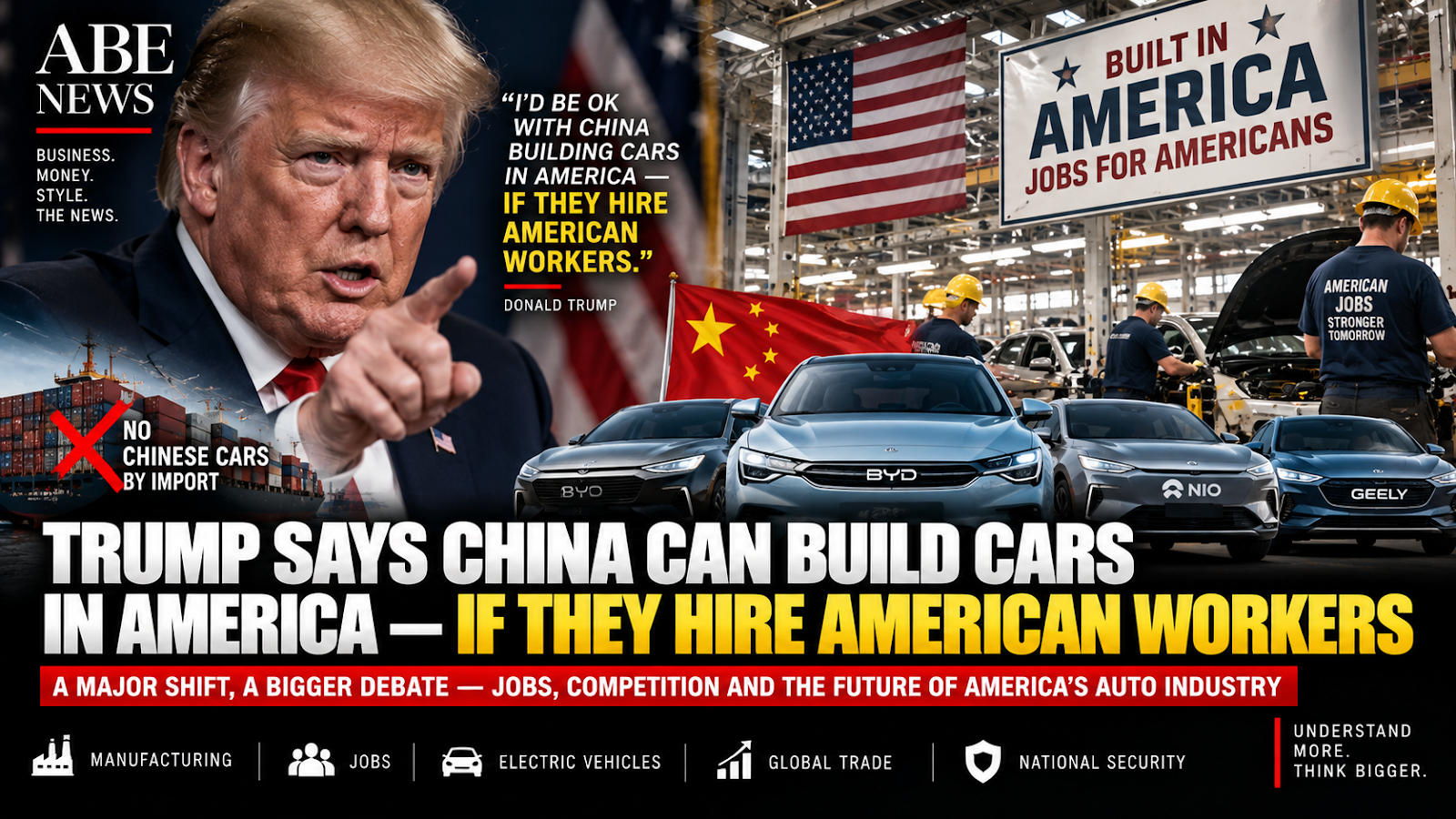
He says Chinese automakers should be able to manufacture vehicles in the United States — provided they build their factories in America and employ American workers.
In remarks aired Friday, Trump said he would be comfortable with Chinese companies entering the American market if their investment created domestic jobs. He contrasted that approach with Chinese companies manufacturing vehicles in Mexico and then shipping them across the border into the United States, something he opposes. Trump pointed to Japanese automakers as an example of foreign companies that built substantial manufacturing operations inside America.
On the surface, the argument is straightforward: if Chinese automakers want access to one of the world’s largest automobile markets, make them manufacture there.
But beneath that seemingly simple proposition sits one of the most complicated questions facing the global auto industry.
Would allowing Chinese automakers to build in America strengthen U.S. manufacturing by creating factories, jobs and competition? Or would it give some of the world’s most formidable new car companies a foothold from which they could eventually challenge Ford, General Motors, Tesla and other manufacturers on their home turf?
That debate is no longer theoretical. Chinese automakers have become increasingly competitive internationally, while American politicians, regulators and car companies are trying to determine whether the correct response is to keep them out entirely — or find a way to make their expansion work in America’s economic interest.
TRUMP IS DRAWING A LINE BETWEEN IMPORTS AND INVESTMENT
Trump’s position fits a broader philosophy that has shaped much of his trade policy: foreign companies can sell to Americans, but Washington should push them to manufacture more of what they sell inside the United States.
The distinction matters. A vehicle imported from China creates most of its manufacturing employment, supplier activity and industrial investment in China. A vehicle manufactured at a Chinese-owned factory in the United States could create American assembly jobs, purchase components from U.S. suppliers, generate local tax revenue and support communities around the plant.
That is essentially the model foreign automakers from Japan, South Korea and Europe followed over several decades.
Toyota, Honda, BMW, Mercedes-Benz, Hyundai and other international manufacturers eventually built large American production networks. Today, consumers rarely think of a Toyota assembled in Kentucky or a BMW built in South Carolina simply as an imported product. Foreign ownership and domestic manufacturing became capable of coexisting.
Trump appears to be suggesting that Chinese automakers could, at least in principle, follow a similar path.
But China presents a very different political challenge.
American policymakers increasingly view Chinese automobiles as connected computers capable of collecting data, communicating with external networks and incorporating software developed by companies subject to Chinese law. Washington has therefore treated the issue as one involving national security as well as manufacturing competition.
That means building the cars in Michigan, Texas or Tennessee would not automatically resolve every concern.
THE EXISTING RULES ARE A MASSIVE OBSTACLE
Trump’s comments do not mean Chinese automakers can simply announce U.S. factories tomorrow.
Existing American policy makes that extremely difficult.
Rules finalized in January 2025 effectively restrict Chinese-linked connected-vehicle technology, including key software and hardware. The Trump administration has retained those restrictions, and lawmakers have been pursuing legislation that could tighten them further.
The security argument centres on how dramatically the automobile has changed. Modern vehicles contain cameras, microphones, navigation systems, cellular connections, sensors and enormous quantities of software. They can collect information about drivers, locations and surrounding infrastructure while communicating with manufacturers and external services.
Washington fears that Chinese control over critical software or connectivity systems could create opportunities for surveillance, data collection or remote interference.
Those concerns have already produced tangible consequences. The United States denied Polestar authorization to continue selling certain vehicles beginning with the 2027 model year under connected-vehicle restrictions, illustrating how seriously regulators are applying the rules.
So even if Trump wants Chinese-owned factories employing American workers, another question immediately follows: what technology would those factories be allowed to put inside the cars?
That could determine whether Trump’s idea is commercially practical.
AMERICAN AUTOMAKERS ARE NOT ASKING FOR MORE COMPETITION
Trump’s openness also puts him at odds with an unusually broad coalition within the American automobile industry.
The Alliance for Automotive Innovation, which represents nearly every major automaker operating in the United States, has urged Congress to permanently restrict Chinese vehicles from the American market. Lawmakers from both parties have also pushed measures aimed at strengthening existing restrictions.
Their concern is understandable.
Chinese manufacturers have developed formidable advantages in electric vehicles, batteries, manufacturing scale and cost. Companies that were once treated primarily as competitors within China increasingly sell vehicles across Asia, Europe, Latin America and other international markets.
Allowing them to establish factories inside the United States would therefore create a strange dynamic. American manufacturers would gain some of the economic benefits associated with domestic investment and potentially learn from new technologies, but they would also face new competitors with enormous manufacturing experience and established supply chains.
Ford and General Motors have spent more than a century building their positions in the American market. Tesla helped turn the United States into an early centre of modern electric vehicles.
Chinese companies would not enter that market simply to participate quietly.
They would enter to compete.
BYD IS THE COMPANY EVERYONE WOULD WATCH
No company better represents the debate than BYD.
The Chinese automaker has grown from a battery manufacturer into one of the world’s most important electric-vehicle companies. Its strength comes not only from selling cars but from controlling significant portions of the technologies and manufacturing processes underneath them.
BYD also demonstrates why the discussion about Chinese manufacturing inside America is not entirely hypothetical.
The company already operates an electric-bus manufacturing plant in California. Reuters Breakingviews noted earlier this year that research found buses from that facility could cost substantially less than competing U.S.-made alternatives even while using significant American content.
Passenger cars would be a dramatically larger and more politically sensitive step.
A hypothetical BYD automobile plant in the United States could employ thousands of American workers and purchase parts from domestic suppliers. Consumers might gain access to more affordable vehicles, while local governments could compete for billions of dollars in industrial investment.
But the same factory could eventually produce cars competing directly against Tesla, Ford and GM.
That creates the central tension in Trump’s proposal: America wants manufacturing investment, but it does not necessarily want the competitive consequences that can accompany it.
MEXICO MAKES THE QUESTION EVEN MORE COMPLICATED
Trump was particularly clear that he does not want Chinese automakers manufacturing vehicles in Mexico and then shipping them north into the United States.
That concern is not imaginary.
BYD and Geely were among companies that explored acquiring a major vehicle plant in Mexico earlier this year, illustrating Chinese automakers’ interest in expanding their North American manufacturing footprint.
Mexico has spent decades developing an enormous automobile industry integrated with the United States and Canada. Vehicles and components routinely cross borders several times during production, creating a continental manufacturing network rather than three completely separate national industries.
A large Chinese presence inside Mexico would therefore create difficult questions for Washington. Policymakers would have to determine whether Chinese-owned vehicles produced there should receive the same market access as vehicles made by American, Japanese, Korean or European companies operating in Mexico.
Trump’s answer appears increasingly clear: if Chinese manufacturers want access to American consumers, he would rather have the factory and jobs located inside the United States.
That is industrial policy disguised as a simple trade argument.
CHEAPER CARS COULD CHANGE THE POLITICAL CALCULATION
There is another reason this debate will not disappear: American consumers increasingly care about affordability.
New vehicles have become expensive, while the transition toward electric cars has created a particular challenge at the lower end of the market. Chinese manufacturers have demonstrated an ability to produce EVs at price points that have attracted attention from consumers outside China.
Reuters reported earlier this year that some American buyers were increasingly interested in affordable Chinese EVs they could not purchase because of U.S. restrictions.
That creates a conflict between two legitimate policy objectives.
Washington wants to protect American industrial capacity, supply chains and national security. Consumers want better products at lower prices.
Those goals do not always align.
Keeping Chinese vehicles out can protect domestic manufacturers from powerful new competition, but less competition can also reduce the pressure on existing companies to lower prices and innovate faster. Opening the market could increase consumer choice, but could expose American companies and workers to competition from manufacturers benefiting from China’s enormous industrial ecosystem.
Neither side of that equation is trivial.
FORD SHOWS HOW BLURRED THE LINES ALREADY ARE
The idea of simply separating the Chinese and American automobile industries becomes even more difficult when technology partnerships are considered.
Ford has already worked with Chinese companies in areas including batteries and has explored other relationships involving Chinese automotive technology. Earlier this week, the Trump administration publicly criticized Ford over dealings involving Chinese companies including CATL, Geely and BYD, while Ford defended its strategy.
Ford and Geely have also held discussions about potential manufacturing and technology cooperation.
This demonstrates why the debate cannot be reduced to “China versus America.”
Modern automobiles are built through global supply chains. Batteries can involve Chinese technology, minerals sourced elsewhere, components manufactured in multiple countries and final assembly inside the United States.
The politically attractive idea of a completely national automobile supply chain collides quickly with the economic reality of how cars are actually manufactured.
The more advanced vehicles become, the more important software, batteries, semiconductors and intellectual property become alongside traditional steel and assembly.
That makes determining what exactly constitutes a “Chinese car” increasingly complicated.
TESLA COULD FACE A PARTICULARLY INTERESTING CHALLENGE
Tesla occupies an unusual position in this debate because it is simultaneously one of America’s most globally recognizable automakers and a company deeply familiar with competing inside China.
Its Shanghai factory became an important part of Tesla’s global manufacturing system, giving the company direct experience operating within the world’s largest auto market.
If Chinese automakers were eventually permitted to manufacture passenger vehicles inside the United States, Tesla could face the reverse situation: companies it competes against in China would begin manufacturing on its home territory.
Competition could become particularly intense in affordable electric vehicles.
Tesla helped establish the modern EV market, but Chinese companies have spent years competing aggressively on battery technology, software, manufacturing efficiency and price. Their arrival would likely force every manufacturer operating in America to reconsider product strategy.
For consumers, that competition could be beneficial.
For incumbent automakers, it could be brutal.
THERE IS A BIGGER QUESTION ABOUT WHAT “AMERICAN-MADE” ACTUALLY MEANS
Trump’s proposal raises a philosophical question that extends well beyond automobiles.
What makes a company economically American?
Is it ownership?
Headquarters?
Workers?
Factories?
Suppliers?
Technology?
Taxes?
A Toyota assembled by American workers in Kentucky is owned by a Japanese corporation, yet its factory supports American employment and local suppliers. BMW is German, but its South Carolina operation is deeply integrated into the U.S. manufacturing economy.
If BYD eventually built a factory in Ohio employing thousands of Americans and sourcing most of its components domestically, policymakers would have to decide whether that investment should be treated fundamentally differently because the parent company is Chinese.
National-security concerns may make the answer yes.
But economically, the distinction becomes less straightforward.
That is why Trump’s comments matter. He appears to be separating the nationality of the corporation from the location of production and employment.
For a president who has built much of his economic message around restoring American manufacturing, the logic is consistent: if you want American customers, build in America.
BUT THERE IS NO OPEN DOOR YET
It would be a mistake to interpret Trump’s comments as a policy change that has already opened the American market to Chinese carmakers.
It has not.
Major regulatory barriers remain. Heavy tariffs remain. Connected-vehicle restrictions remain. Bipartisan opposition in Congress remains. The American automobile industry is actively lobbying for stronger protections, not weaker ones.
Trump’s statement therefore matters less as an immediate market-opening measure and more as a signal about the kind of arrangement he might eventually consider.
That distinction becomes particularly interesting ahead of further U.S.-China diplomacy. Automobile access could become one piece of a much broader negotiation involving trade, investment, technology and industrial policy.
Whether anything comes from that remains uncertain.
But the president has now publicly articulated a potential pathway that previously seemed politically difficult: Chinese ownership might be acceptable if manufacturing and employment are sufficiently American.
🔴 THE ABE NEWS TAKE
The most interesting part of Trump’s statement is not that he suddenly wants Chinese cars flooding American roads. He doesn’t.
His argument is almost the opposite.
Trump appears to be telling Chinese automakers that access to American consumers could come with a price: bring the factory with you.
That creates a much more complicated debate than simply imposing another tariff.
If a Chinese company manufactures a vehicle in China and ships it to America, the economic benefits of production largely remain overseas. If that same company spends billions building a factory in the United States, hires American workers, purchases American components and pays American taxes, part of the economic equation changes.
But the competitive equation does not.
Ford, GM and Tesla would suddenly have to compete domestically against companies that have become exceptionally strong at producing affordable electric vehicles and batteries. American workers might gain jobs at new factories while American-owned automakers simultaneously face greater pressure.
Consumers might gain cheaper cars and more choice, while policymakers worry about software, data and dependence on Chinese technology.
That is why there is no easy answer.
The United States spent decades welcoming Japanese, German and Korean automakers and eventually turned many of their American factories into important parts of its manufacturing economy. China poses additional national-security and geopolitical concerns that make repeating that model much more difficult.
But permanently keeping the world’s largest and increasingly sophisticated automobile industry outside the American market may also become harder as Chinese manufacturers expand everywhere else.
Trump has therefore opened a question that Washington will eventually have to answer.
Does America protect its auto industry by keeping Chinese companies out — or by forcing them to become American manufacturers if they want in?
The answer could shape not only the next generation of cars sold in the United States, but the future meaning of “Made in America” itself.
ABE NEWS
Business. Money. Style. The News.
Understand More. Think Bigger.