


ABE NEWS | September 12, 2026
For several years, the story surrounding Hong Kong’s financial centre seemed to be moving in only one direction.
Bankers were leaving. Fund managers were relocating. International companies were reconsidering their presence. Families with substantial wealth were looking toward Singapore and Dubai. Political upheaval after the 2019 protests, Beijing’s imposition of a national security law in 2020 and some of the world’s strictest pandemic restrictions damaged confidence in a city that had spent decades positioning itself as one of the principal gateways between China and global capital.
For competitors, Hong Kong’s difficulties created an opportunity. Singapore attracted money, companies and financial professionals seeking another Asian base. Dubai accelerated its transformation into a global wealth and business centre. London remained an obvious destination for international finance. For a time, the question was whether Hong Kong had permanently surrendered part of the position that made it one of the world’s great financial cities.
The numbers coming out of Hong Kong in 2026 suggest something very different is happening.
Capital is returning. Companies are expanding. Prime office space is filling again. Financial professionals who once moved to Singapore, Dubai, London and elsewhere are reconsidering Hong Kong. And perhaps most significantly, the city has overtaken Switzerland to become the world’s largest cross-border wealth-management centre.
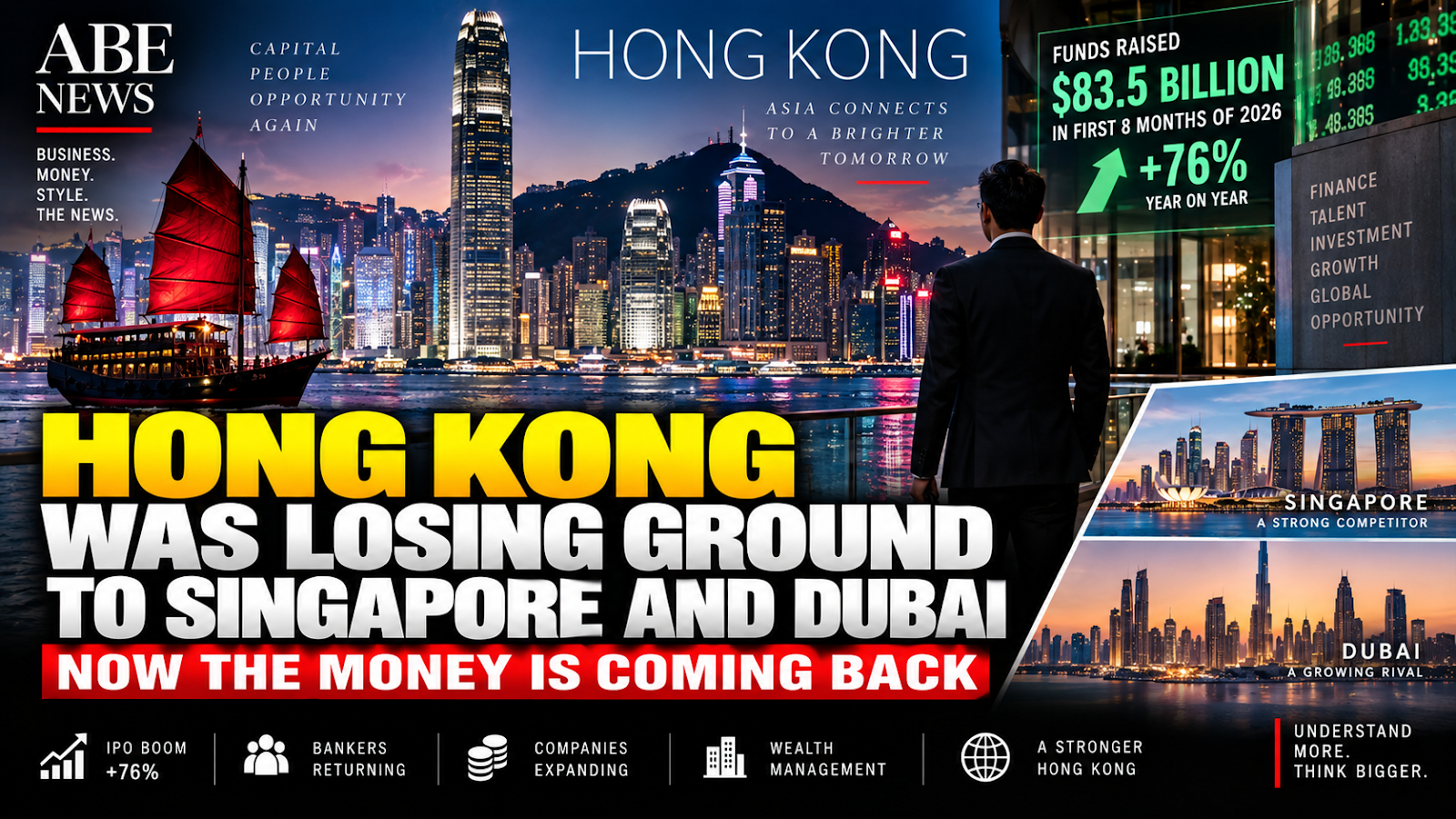
In the first eight months of 2026 alone, total funds raised in Hong Kong, including initial public offerings, climbed 76% from a year earlier to approximately $83.5 billion. More than 400 companies established or expanded operations in the city during the first half of the year, with those businesses expected to bring more than HK$53 billion — roughly US$6.8 billion — in foreign direct investment and create more than 8,600 jobs.
Hong Kong isn’t simply trying to recover what it lost.
It may be emerging as a somewhat different financial centre from the one that entered the crisis.
HONG KONG’S GREAT ADVANTAGE NEVER COMPLETELY DISAPPEARED
Hong Kong’s financial importance has always rested on an unusual combination of characteristics. It operates under Chinese sovereignty while maintaining a financial, legal and commercial system that historically made it far easier for international investors to interact with Chinese companies and capital.
That position turned Hong Kong into a bridge.
Chinese companies seeking international investors could list shares there. Global banks could use Hong Kong as a base for business connected to mainland China. Wealthy Chinese families could access international financial services, while foreign investors gained exposure to the world’s second-largest economy through a market that was considerably more internationally connected than mainland exchanges.
The city developed deep capital markets, a sophisticated banking system and an enormous professional-services industry around that role.
Today, Hong Kong’s stock market is worth approximately $6 trillion, while financial services account for roughly one-fifth of its economy.
That infrastructure did not disappear when professionals left during the city’s difficult years. The exchanges, banks, asset managers, lawyers, accountants and relationships connecting Hong Kong with mainland China remained.
Once capital-market activity began accelerating again, those advantages became valuable again too.
$83.5 BILLION CHANGES THE CONVERSATION
The strongest evidence of Hong Kong’s revival can be found in its capital markets.
Approximately $83.5 billion was raised during the first eight months of 2026, including IPO activity, representing a 76% increase from the same period a year earlier.
That kind of activity creates an economic ecosystem around itself. A company preparing to list needs investment bankers, lawyers, accountants, consultants and institutional investors. Once listed, it requires analysts, traders, market makers and asset managers. Successful offerings attract additional companies considering their own listings, which in turn creates more business for the financial industry.
The momentum can become self-reinforcing.
Hong Kong is benefiting particularly from Chinese companies seeking enormous amounts of capital. Beijing-based Z.AI, for example, launched transactions this week involving approximately $2 billion in new Hong Kong shares and $3 billion in convertible bonds, as Chinese technology companies race to finance increasingly expensive computing infrastructure and expansion.
Other major Chinese technology businesses are also considering public listings, including companies looking at Hong Kong alongside mainland exchanges. That reinforces Hong Kong’s position as an international capital-raising centre for Chinese businesses even as the financial relationship between China and the United States becomes more complicated.
For bankers, lawyers and investors, the implications are straightforward: when transactions return, jobs return with them.
THE BANKERS ARE FOLLOWING THE MONEY
Financial professionals are responding.
Executive-search firms and relocation specialists have reported increasing numbers of finance workers returning from Singapore, London, Dubai and mainland China, particularly for opportunities connected to private wealth, asset management and China-related business.
This is an important reversal because financial centres are built as much around people as around buildings.
A city can have skyscrapers, exchanges and favourable tax rates, but sophisticated financial activity depends on networks of experienced professionals. Portfolio managers need analysts. Banks need compliance specialists. Family offices need wealth advisers. Trading firms need quantitative researchers and engineers. International businesses need lawyers, accountants and executives who understand multiple jurisdictions.
When those people leave simultaneously, the damage can compound. Companies become more willing to relocate because other companies have relocated, and workers become more willing to leave because opportunities are appearing elsewhere.
The opposite can happen during a recovery.
As transactions increase, companies begin hiring. As companies hire, professionals become willing to return. As experienced workers return, firms gain another reason to expand.
Hong Kong appears to be entering that second cycle.
EVEN THE OFFICE MARKET IS TELLING THE STORY
One of the clearest physical signs of the change is appearing in Hong Kong’s famously expensive Central business district.
For years, weak demand placed pressure on prime office space. Now the trend is beginning to reverse.
Grade A office rents in Central increased 4.8% during the second quarter compared with the previous three months, while vacancy declined from 10.2% to 9.4%, according to Savills data reported by Reuters. Knight Frank separately found that vacancy in premium Central office space had fallen to 9.7% in July from 14.5% at the beginning of the year.
Those numbers matter because financial companies do not lease expensive office space merely to make a statement. Large commitments to prime real estate usually reflect expectations about future staffing and business activity.
Hedge funds and quantitative investment firms have been securing larger spaces in anticipation of expansion. U.S. trading firm Susquehanna International Group is planning to triple its Hong Kong office footprint as part of a substantial hiring push.
That is a stronger signal than optimistic rhetoric from government officials.
Companies are committing money.
HONG KONG HAS ALSO PASSED SWITZERLAND IN WEALTH MANAGEMENT
Perhaps the most striking development is occurring in private wealth.
Hong Kong has overtaken Switzerland as the world’s leading cross-border wealth-management centre, putting the city at the centre of one of the most profitable areas of global finance.
That achievement matters because managing the assets of wealthy families is a remarkably sticky business. Relationships can last decades, generating fees across investments, trusts, succession planning, lending and other financial services.
Asia is also creating enormous quantities of new wealth.
Entrepreneurs across China and the wider region have built fortunes through technology, manufacturing, property, consumer businesses and international trade. As those fortunes mature, families increasingly need sophisticated structures to invest and preserve their capital.
Hong Kong wants to capture as much of that business as possible.
The government is working to extend tax incentives to more fund firms and managers as part of an effort to strengthen the city’s competitiveness as an asset-management centre.
That puts Hong Kong into increasingly direct competition with Singapore and Dubai, both of which have aggressively courted wealthy families and investment firms.
SINGAPORE BENEFITED ENORMOUSLY FROM HONG KONG’S DIFFICULT YEARS
Hong Kong’s revival does not mean Singapore has lost.
Far from it.
Singapore remains one of the world’s most attractive financial centres, combining political stability, strong institutions, sophisticated infrastructure and proximity to Southeast Asia’s rapidly expanding economies.
During Hong Kong’s period of uncertainty, Singapore became a natural alternative for businesses and wealthy families seeking another Asian base. Family offices expanded rapidly, financial companies increased hiring and international professionals relocated there.
But there is an important difference between becoming an alternative to Hong Kong and replacing Hong Kong.
Singapore cannot reproduce Hong Kong’s exact relationship with mainland China. Hong Kong’s role as the largest offshore centre for Chinese capital and its direct connections with mainland financial markets give it advantages that are extremely difficult for another city to replicate.
The competition may therefore evolve differently than many expected.
Instead of Asia having one dominant international financial centre, Hong Kong and Singapore may increasingly specialise around different strengths. Singapore can deepen its position as a hub for Southeast Asia, international wealth and multinational businesses, while Hong Kong becomes even more closely connected to Chinese capital while remaining accessible to global investors.
Both can grow.
But the battle for talent and money between them will remain intense.
DUBAI HAS ENTERED THE COMPETITION TOO
Dubai adds another dimension.
The emirate has spent years turning itself into a global destination for entrepreneurs, investors, financial institutions and wealthy families. Its geographic position between Asia, Europe and Africa gives it a natural advantage, while low taxation, modern infrastructure and an aggressively business-friendly environment have helped attract international capital.
During periods of uncertainty elsewhere, Dubai has been particularly effective at presenting itself as a place where wealth can move quickly.
That means Hong Kong’s competition is no longer confined to traditional financial centres such as London, New York, Singapore and Switzerland.
Capital has become more mobile.
A hedge-fund manager can live in Dubai while investing globally. A wealthy family can establish a family office in Singapore. A Chinese entrepreneur can maintain business interests across Hong Kong, London and the Middle East.
Financial centres therefore compete not only for companies, but for people whose location is increasingly flexible.
Hong Kong’s ability to lure some of those people back suggests its fundamental attraction remains powerful.
BUT THIS IS NOT THE SAME HONG KONG THAT PEOPLE LEFT
Calling the current development a simple “comeback” would miss an important part of the story.
Hong Kong has changed.
Beijing’s national security law transformed the city’s political environment after the protests of 2019. The legislation criminalises activities including secession, subversion, terrorism and collusion with foreign forces and has been used against opposition politicians, activists and media figures.
Those changes contributed to the concerns that drove some expatriates and businesses away in the first place.
They have not been reversed.
What appears to be changing instead is the calculation being made by businesses and professionals. Relative political stability, renewed financial opportunity and China’s growing need for international capital are making Hong Kong commercially attractive again despite the city’s changed political environment.
This distinction matters.
The Hong Kong returning to prominence is not necessarily restoring the exact identity it had a decade ago. It is becoming what executive-search professionals described to Reuters as a more China-integrated international hub.
That may ultimately prove to be the defining feature of its next era.
BEIJING STILL NEEDS HONG KONG
China has enormous domestic financial markets, but Hong Kong performs functions that remain difficult to reproduce entirely on the mainland.
International investors understand Hong Kong’s market infrastructure. Its currency is freely convertible. Its financial system remains deeply connected to global institutions. The city offers mechanisms through which mainland and international capital can interact.
As geopolitical competition makes Chinese access to American capital markets more uncertain, Hong Kong can become more valuable rather than less.
Chinese technology companies provide a particularly good example.
Building advanced artificial intelligence systems, semiconductor infrastructure and other frontier technologies requires extraordinary amounts of money. Public markets offer companies a way to raise that capital at scale.
Hong Kong gives Chinese businesses access to a major exchange with international participation without requiring them to depend entirely on New York.
That dynamic could make the city strategically important to Beijing’s economic ambitions.
THE ECONOMY IS FEELING THE EFFECT
The financial revival is beginning to appear in Hong Kong’s broader economy.
Economic growth accelerated to 5.9% in the first quarter of 2026 and remained strong during the second quarter, with officials pointing to cross-border financial activity, domestic consumption and demand for technology-related products among the contributors.
More than 400 companies established or expanded their local presence during the first six months of the year, 9% more than during the comparable period in 2025. Their planned investment of more than HK$53 billion and creation of over 8,600 jobs demonstrate how financial-market confidence can spill into the real economy.
New companies need employees. Employees rent apartments, eat at restaurants and purchase services. Businesses lease offices and hire professional advisers. Higher capital-market activity generates tax revenue and supports industries surrounding finance.
A financial centre can therefore influence an economy far beyond the trading floor.
THE COST OF LIVING REMAINS A SERIOUS WEAKNESS
Hong Kong’s resurgence does not eliminate its longstanding problems.
Housing remains extraordinarily expensive, and the overall cost of living can be difficult even for highly paid professionals. Those costs were among the factors that made competing cities attractive during the exodus.
Yet financial professionals often make decisions based not simply on how much a city costs, but on how much they can earn and save there.
That distinction is crucial.
A cheaper city is not necessarily financially better if salaries and career opportunities are significantly lower. Conversely, an expensive city can remain attractive when compensation, tax treatment and professional advancement outweigh the additional costs.
Reuters spoke with returnees who made precisely that calculation: Hong Kong costs more, but the opportunities can make it possible to accumulate more wealth over time.
For a financial centre, that is an enormously important advantage.
THIS COULD BE MORE THAN A CYCLICAL RECOVERY
The biggest question now is whether Hong Kong is experiencing a temporary rebound caused by strong markets or a deeper structural revival.
There are arguments for caution.
IPO markets are cyclical. A major market downturn could slow new listings quickly. China’s economy still faces structural challenges. Relations between Beijing and Western governments remain complicated. Political concerns that drove some professionals away have not disappeared.
And Singapore and Dubai are not standing still. Both continue investing aggressively in the infrastructure, regulation and lifestyle required to attract global wealth.
But Hong Kong also possesses advantages that would be extremely difficult to build from scratch: decades of financial expertise, enormous capital markets, close access to China, a sophisticated professional-services industry and an established global reputation.
If Chinese companies increasingly use Hong Kong to raise international capital while wealthy Asian families use the city to manage their assets, those two forces could support a much more durable revival.
The city does not necessarily need to become what it was before.
It needs to become indispensable in a new way.
🔴 THE ABE NEWS TAKE
Hong Kong’s comeback tells us something important about how global financial centres actually work.
Money is remarkably pragmatic.
Political uncertainty matters. Regulation matters. Quality of life matters. Taxes matter. But when enormous amounts of capital begin moving through a city again, bankers, investors, lawyers, traders and companies eventually notice.
Hong Kong spent several years appearing to lose momentum while Singapore and Dubai gained it. It would have been easy to conclude that the hierarchy of global finance had permanently changed.
Instead, Hong Kong is demonstrating how difficult it is to replace a financial ecosystem built over generations.
The $83.5 billion raised in the first eight months of this year is impressive, but the more revealing signs may be elsewhere: companies are expanding, prime office vacancies are falling, trading firms are hiring and professionals are returning from competing financial centres.
Those are behaviours, not promises.
But this revival comes with an important qualification. Hong Kong is not simply returning to its old identity. Its relationship with mainland China is becoming even more central to what the city offers the world.
That could ultimately become its greatest advantage and its greatest vulnerability.
Closer integration gives Hong Kong access to Chinese companies, entrepreneurs and capital on a scale Singapore or Dubai cannot easily reproduce. At the same time, it means the city’s fortunes will increasingly be tied to China’s economy and its relationship with the rest of the world.
The competition among Hong Kong, Singapore and Dubai should therefore not be viewed as a race in which one city must win and the others lose. Global wealth is growing, financial activity is becoming more geographically distributed and each city offers something different.
What has changed is the assumption that Hong Kong was inevitably fading.
For now, the evidence points in the opposite direction.
The bankers are coming back because the deals are coming back. The companies are taking more space because the business is coming back. And after years of questions about whether Hong Kong could remain one of the world’s great financial centres, money is beginning to provide its own answer.
ABE NEWS
Business. Money. Style. The News.
Understand More. Think Bigger.