




SATURDAY ABE ORIGINALS | September 12, 2026
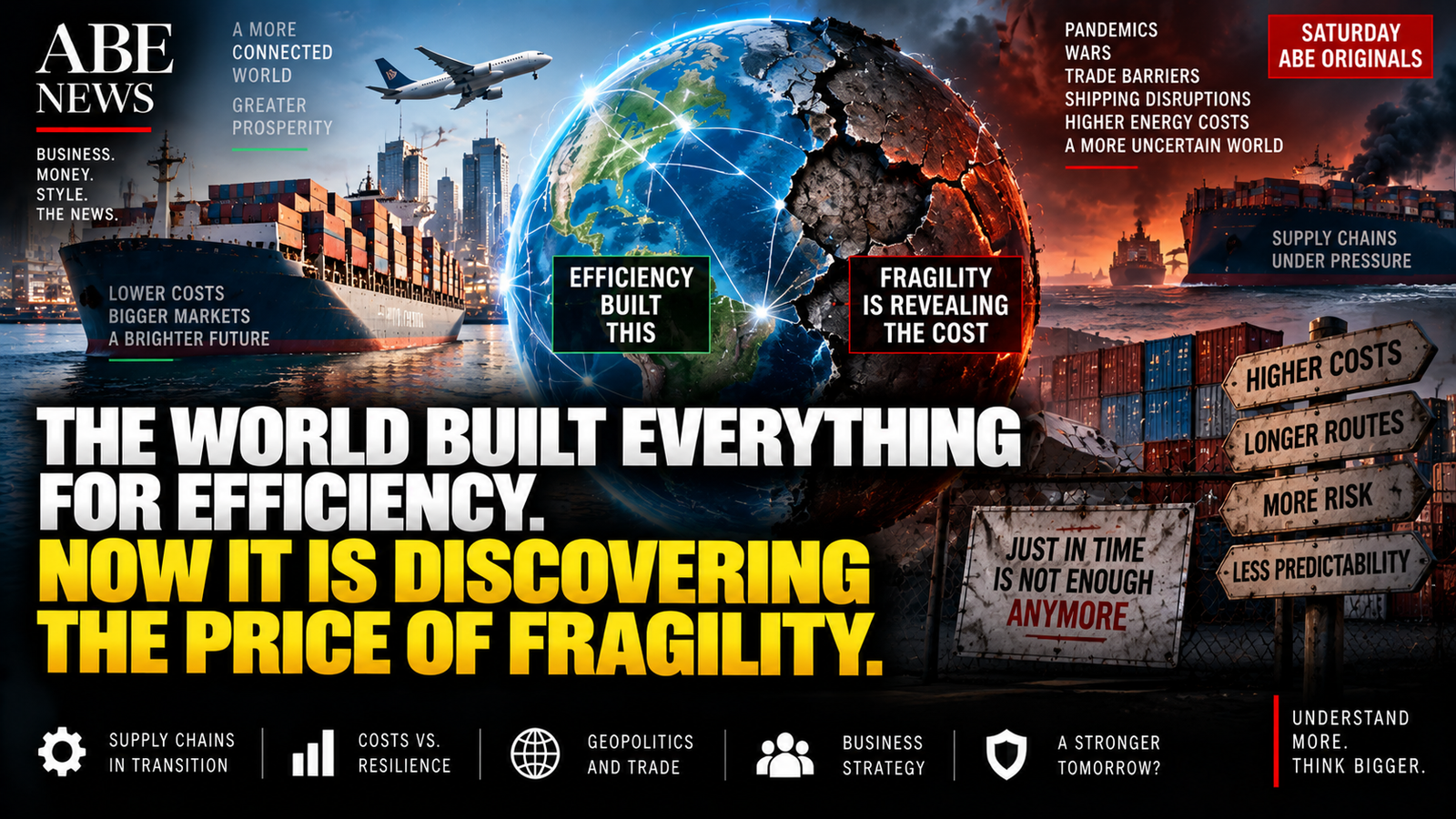
For much of the past forty years, one idea quietly shaped the way the global economy was built: waste is bad.
Factories should not hold more inventory than necessary. Companies should buy components wherever they can be produced most cheaply. Ships should follow the shortest and most economical routes. Businesses should outsource activities that another company can perform for less. Warehouses should become leaner, supply chains faster and production more specialized.
The philosophy had a name in manufacturing: just in time.
But the idea extended far beyond factories.
Banks optimized capital. Airlines optimized aircraft utilization. Retailers optimized inventory. Energy companies optimized distribution networks. Manufacturers concentrated production in locations where scale made costs extraordinarily low. Technology allowed companies to coordinate suppliers scattered across continents with a precision that previous generations could barely imagine.
The results were remarkable.
Globalization helped businesses lower costs, expand markets and deliver products at prices that would once have seemed impossible. A smartphone could contain components designed and manufactured across several countries before reaching a consumer thousands of kilometres away. A retailer could sell inexpensive clothing produced on another continent. A manufacturer could receive exactly the component it needed almost exactly when it needed it.
Efficiency became more than a business strategy.
It became the architecture of the global economy.
But efficiency has an uncomfortable weakness.
The system works brilliantly when everything works.
Over the past several years, businesses have repeatedly discovered what happens when it doesn’t.
The pandemic closed factories and ports. Semiconductor shortages halted automobile production. Russia’s invasion of Ukraine disrupted energy and commodity markets. Drought affected the Panama Canal. Attacks in the Red Sea forced ships onto longer routes. Trade disputes pushed governments toward tariffs and industrial subsidies. And now conflict around the Strait of Hormuz is again demonstrating how much economic activity can depend on a remarkably small piece of geography.
The lesson emerging from all of these events is not that globalization has failed.
It is something more interesting.
For decades, companies asked how they could remove every unnecessary cost from their systems. The defining business question of the next era may instead become:
How much inefficiency are we willing to pay for security?
WE BUILT A WORLD WITH VERY LITTLE SLACK
Consider a simple factory.
Imagine that it needs 1,000 specialized components every day.
One strategy would be to keep 100,000 components sitting in a warehouse. If the supplier experiences a problem, the factory could continue operating for months.
But inventory costs money.
The company has already paid for components it has not yet used. It needs a warehouse in which to store them. The parts could become obsolete. Employees must manage them. Capital that could have been invested elsewhere is sitting on shelves.
A more efficient company might therefore keep only a few days of inventory and arrange for suppliers to replenish the factory continuously.
When everything works, the second company looks considerably better.
It requires less warehouse space, less working capital and less excess inventory. Investors may reward its higher returns. Managers can point to improved efficiency.
Then the supplier stops delivering.
Suddenly, what looked like waste in the first company begins to look like insurance.
That is the fundamental tension confronting modern business.
Redundancy looks inefficient until the moment you need it.
The same logic applies to entire supply chains. Purchasing one critical component from the world’s cheapest supplier can produce excellent margins. Purchasing the same component from three suppliers in three countries will probably cost more.
But if the first supplier becomes unavailable, the diversified company has options.
The cheapest supply chain is therefore not necessarily the cheapest supply chain once the cost of failure is included.
GLOBALIZATION REWARDED CONCENTRATION
One of globalization’s great economic achievements was allowing countries and companies to specialize.
Instead of every country attempting to manufacture everything, production could migrate toward locations that did particular things extremely well.
China developed enormous manufacturing ecosystems capable of producing everything from electronics to industrial equipment. Taiwan became indispensable to advanced semiconductor manufacturing. South Korea built formidable positions in chips, batteries and shipbuilding. Germany developed world-class industrial and automotive capabilities. Gulf states became central to global energy supply.
Specialization created extraordinary efficiencies because scale matters.
A manufacturer surrounded by hundreds of suppliers, trained workers, logistics companies and specialized factories can often produce something much more cheaply than a competitor trying to recreate the entire ecosystem somewhere else.
Consumers benefited enormously.
But specialization also concentrated risk.
When one region produces a disproportionate share of something the rest of the world desperately needs, a local disruption can become a global problem.
The semiconductor shortage during the pandemic provided one of the clearest examples. Automakers discovered that a relatively inexpensive chip could determine whether an entire vehicle worth tens of thousands of dollars could leave the factory.
The missing component did not have to be the most expensive part of the product.
It only had to be irreplaceable.
THE PANDEMIC CHANGED THE BOARDROOM CONVERSATION
COVID-19 was probably the moment when supply-chain resilience moved permanently from operations departments into executive boardrooms.
Factories shut down while consumer demand changed dramatically. Containers accumulated in the wrong places. Ports became congested. Shipping prices surged. Companies struggled to obtain everything from semiconductors to medical equipment.
Businesses that had spent years optimizing inventory suddenly discovered the downside of operating with little room for error.
The International Monetary Fund has since studied this trade-off directly. Its research finds that diversifying import sources can make supply chains more resilient to major shocks, but that resilience comes at a cost because companies may have to purchase from more expensive suppliers. The IMF’s work therefore describes precisely the dilemma businesses now face: efficiency and resilience are both valuable, but maximizing one can reduce the other.
That does not mean just-in-time manufacturing was a mistake.
It means companies optimized for a world in which certain risks appeared less important than they do today.
The assumptions changed.
Business strategy must change with them.
THEN GEOPOLITICS ENTERED THE SUPPLY CHAIN
The pandemic eventually ended as an emergency, but the supply-chain conversation did not return to normal.
Instead, another risk grew larger: geopolitics.
The United States and China increasingly view technologies such as semiconductors, artificial intelligence, batteries and telecommunications equipment through the lens of national security. Governments are spending enormous sums encouraging domestic production of strategically important goods.
Words that once belonged mostly to policy papers have entered ordinary business discussions: reshoring, nearshoring, friend-shoring and de-risking.
All describe versions of the same idea.
A company should not decide where to manufacture something solely by asking where production is cheapest.
It should also ask what happens if the relationship between countries deteriorates, tariffs suddenly change, shipping becomes impossible or a government restricts exports.
That is a profound change.
For decades, businesses tried to remove politics from supply chains by following economics.
Politics has inserted itself back into the calculation.
THE OCEANS ARE REMINDING US THAT GEOGRAPHY STILL MATTERS
The digital economy can create the illusion that geography has become less important.
Money moves electronically. Meetings happen by video. Software can be distributed instantly. A company can coordinate operations across several continents from a laptop.
Physical goods remain stubbornly physical.
Oil needs tankers.
Cars need ships.
Food needs trucks, trains and vessels.
Containers must travel through ports.
And much of that movement depends on a surprisingly small number of geographical passages.
The Strait of Hormuz, Bab el-Mandeb, the Suez Canal, the Panama Canal and the Strait of Malacca are not simply locations on a map. They are pieces of infrastructure created by geography itself.
When one becomes difficult to use, there may be another route.
But another route usually means additional distance, fuel, time and money.
The events unfolding around Hormuz and the Red Sea make that vulnerability unusually visible. Saudi Arabia’s East-West pipeline was built partly to provide an alternative to Hormuz, yet that pipeline has now been attacked while Houthi advances are raising fresh concerns around Bab el-Mandeb.
Meanwhile, the cost of moving oil through dangerous waters has risen sharply. An Emirates National Oil Company executive said insurance and war-risk expenses associated with Hormuz can now add millions of dollars to a voyage, illustrating how geopolitical danger can become an economic cost even when a ship ultimately reaches its destination.
The lesson is larger than oil.
Businesses built global supply chains assuming transportation corridors would remain sufficiently predictable.
That assumption can no longer be taken for granted.
SMALL BUSINESSES HAVE LESS ROOM TO PROTECT THEMSELVES
Large multinational companies can respond to disruption in ways smaller businesses often cannot.
A global retailer can negotiate with several shipping companies. A major manufacturer can build factories in multiple countries. A multinational corporation can hire teams dedicated entirely to procurement, logistics and geopolitical risk.
A small business may have one supplier.
It may operate with limited cash reserves.
It may not have the bargaining power to secure scarce shipping capacity when prices rise.
That is why disruption can produce an unexpected second-order consequence: the companies least able to afford resilience can be the companies that need it most.
This week, UN trade officials warned that disruptions around Hormuz are disproportionately hurting small and medium-sized businesses and could push some out of international supply chains altogether.
That matters because resilience should not simply mean protecting enormous corporations.
If repeated disruptions eliminate smaller competitors while larger companies absorb the cost, global business could become more concentrated.
A system built to become resilient could paradoxically become less diverse.
COMPANIES ARE BEGINNING TO BUY CONTROL
One of the most revealing signs of the shift is what companies are willing to own.
For decades, corporate strategy frequently encouraged businesses to focus on their core competencies and outsource activities that specialist suppliers could perform more efficiently.
But control has value when suppliers become bottlenecks.
This week provided a striking example. GE Aerospace agreed to acquire precision-components supplier Consolidated Precision Products for $12 billion, bringing a critical source of sophisticated engine castings closer under its control as the aerospace industry continues struggling with supply constraints.
The deal is specific to aerospace, but the philosophy behind it is much broader.
Sometimes owning more of the supply chain is inefficient.
Sometimes it is expensive.
Sometimes Wall Street would prefer that capital be deployed elsewhere.
But when a missing component can prevent delivery of an aircraft engine worth millions of dollars, control begins to acquire an entirely different value.
Vertical integration can function as insurance.
INVENTORY MAY STOP LOOKING LIKE WASTE
The same philosophical change could happen inside warehouses.
For years, excess inventory was something executives tried to eliminate. Unsold goods tie up capital, occupy space and create risk.
Those principles remain valid.
But companies increasingly have to distinguish between unnecessary inventory and strategic inventory.
A manufacturer may decide that holding several months of an inexpensive but essential component is worthwhile because running out would halt an entire production line.
A government may make the same calculation with oil, medicine or critical minerals.
A retailer may carry additional stock before a period of anticipated shipping disruption.
The balance sheet becomes slightly less efficient.
The business becomes harder to break.
That trade-off may increasingly be intentional.
RESILIENCE DOES NOT MEAN BRINGING EVERYTHING HOME
There is a danger of taking the resilience argument too far.
If every country attempted to produce every important product domestically, the result would be extraordinarily expensive and, in many cases, unrealistic.
Modern economies benefit enormously from trade.
Different regions possess different natural resources, expertise, infrastructure and labour forces. Recreating every supply chain within national borders would sacrifice many of the productivity gains globalization created.
And domestic production is not automatically resilient.
A company with one factory in Ohio is still dependent on one factory.
A fire, flood, cyberattack or power failure could disrupt it.
A company sourcing from facilities in Canada, Mexico, Japan and Poland may actually have greater resilience despite operating a more international network.
That is why diversification may be a more useful concept than simply reshoring.
IMF research makes the same distinction. Diversifying suppliers can reduce exposure to country-specific shocks, particularly for strategically important products, while indiscriminate relocation can impose substantial efficiency costs.
The objective should not be to end globalization.
It should be to remove the assumption that the cheapest supplier must always be the only supplier.
CYBERSECURITY HAS CREATED ANOTHER KIND OF SUPPLY-CHAIN RISK
The physical supply chain is not the only network becoming more vulnerable.
Modern logistics depends heavily on software.
Warehouses use connected systems. Trucks use GPS. Freight companies operate digital platforms. Manufacturers exchange information electronically with suppliers. Ports and shipping companies depend on sophisticated scheduling and tracking systems.
Efficiency increased because everything became connected.
Connectivity created another attack surface.
Recent cyber incidents affecting logistics and supply-chain companies illustrate how disruption can now arrive without a blocked canal or damaged factory. A compromised software provider can transmit risk through an entire network of customers.
That creates another uncomfortable trade-off.
Companies need technology to make supply chains faster and more efficient, but greater digital integration can also increase the consequences when one part of the system is compromised.
Resilience therefore increasingly includes cybersecurity, backup systems and the ability to operate when technology fails.
The resilient company is not merely the company with another supplier.
It is the company with another way to continue operating.
THE CHEAPEST COMPANY MAY NOT BE THE STRONGEST COMPANY
For investors, this shift could eventually change how businesses are valued.
Imagine two companies selling the same product.
Company A has higher profit margins because it purchases almost everything from one exceptionally efficient supplier.
Company B has slightly lower margins because it purchases from three suppliers, maintains additional inventory and operates backup production capacity.
During normal conditions, Company A looks superior.
Its return on capital is higher. Its costs are lower. Its executives appear more disciplined.
Then the supplier experiences a six-month disruption.
Company A cannot deliver products.
Company B continues operating.
Which company was actually better managed?
Traditional financial analysis tends to measure the visible cost of redundancy very well. It is much harder to measure the value of a disaster that never happened.
That may begin to change.
Investors increasingly have reason to ask not simply how profitable a company is today, but how much of that profitability depends on nothing going wrong.
WE MAY BE ENTERING THE AGE OF “JUST IN CASE”
The phrase is already familiar in supply-chain circles.
The old model was just in time: receive what you need when you need it.
The emerging model is sometimes described as just in case: maintain enough alternatives and capacity to survive when assumptions fail.
The smartest businesses will probably choose neither extreme.
Keeping enormous quantities of every component in warehouses would destroy capital efficiency. Relying on a single supplier for every critical input creates unnecessary vulnerability.
The future is more likely to involve selective redundancy.
Businesses will identify the components whose absence could stop operations entirely. Those products may receive multiple suppliers, larger inventories or domestic alternatives.
Less critical items can remain optimized primarily for cost.
That requires something businesses have always tried to do but will now need to do more systematically:
price risk.
If an alternative supplier costs 8% more but reduces the probability of a catastrophic shutdown, that extra 8% is not necessarily waste.
Part of it is an insurance premium.
CONSUMERS WILL ULTIMATELY PAY FOR SOME OF THIS
There is no free version of resilience.
Additional factories cost money.
Larger inventories cost money.
Alternative suppliers may charge more.
Longer shipping routes consume more fuel.
Domestic manufacturing can have higher labour costs.
Strategic reserves require governments to purchase and store resources.
Cybersecurity requires investment.
Some of those costs will be absorbed by businesses through lower margins. Governments will absorb others through public spending.
Consumers will eventually pay for part of the rest.
That means the era of extreme resilience could produce somewhat higher prices than an economy optimized entirely for cost.
This creates an uncomfortable political problem.
People understandably want cheaper products.
They also want secure jobs, reliable supply chains, energy security and access to essential goods during crises.
Those objectives can conflict.
A world with more insurance generally has to pay the premium.
BUT FRAGILITY HAS A PRICE TOO
The mistake would be comparing the cost of resilience with zero.
The correct comparison is the cost of resilience against the expected cost of disruption.
A second supplier costs money.
So does shutting a factory for three months.
Maintaining inventory costs money.
So does being unable to serve customers.
Building alternative energy infrastructure costs money.
So does discovering during a geopolitical crisis that there is only one route available.
The challenge is that resilience costs are visible immediately, while the benefits may remain invisible for years.
An executive can point to a warehouse and calculate exactly how much inventory is sitting inside.
It is much harder to place a precise number on the crisis that inventory might someday prevent.
That psychological asymmetry helped make efficiency so attractive.
Efficiency produces measurable savings now.
Resilience often produces hypothetical savings later.
Until the hypothetical crisis arrives.
🔴 THE ABE ORIGINALS TAKE
The great business lesson of the past few decades was that efficiency creates wealth.
That lesson was correct.
The next lesson may be that efficiency without resilience can destroy it just as quickly.
We should not romanticize the old world of enormous warehouses, inefficient factories and expensive domestic production. Globalization, specialization and just-in-time manufacturing created genuine prosperity. They allowed businesses to produce more with less and gave consumers access to products at prices previous generations could not have imagined.
The mistake was not becoming efficient.
The mistake was sometimes confusing efficiency with strength.
They are not the same thing.
A system can be extraordinarily efficient precisely because everything unnecessary has been removed from it. But some of what appears unnecessary during ordinary times is what allows the system to survive extraordinary ones.
The extra supplier.
The additional warehouse.
The second factory.
The alternative shipping route.
The strategic reserve.
The backup server.
The spare capacity.
Each looks like a cost until the primary option disappears.
That is why the most important companies of the next decade may not be those that squeeze the final fraction of a percentage point from every cost line. They may be the companies that understand exactly where efficiency should end and resilience should begin.
The world does not need to abandon globalization.
It needs a more mature version of it.
One that understands that the cheapest route is not always the safest, the biggest supplier should not always be the only supplier, and an asset that appears idle today may become priceless tomorrow.
For forty years, business leaders became exceptionally good at asking:
“How can we make this system leaner?”
The events reshaping global trade suggest they now need to become equally good at asking another question:
“What happens when this system breaks?”
The companies that can answer both questions may define the next era of global business.
ABE NEWS
Business. Money. Style. The News.
Understand More. Think Bigger.