






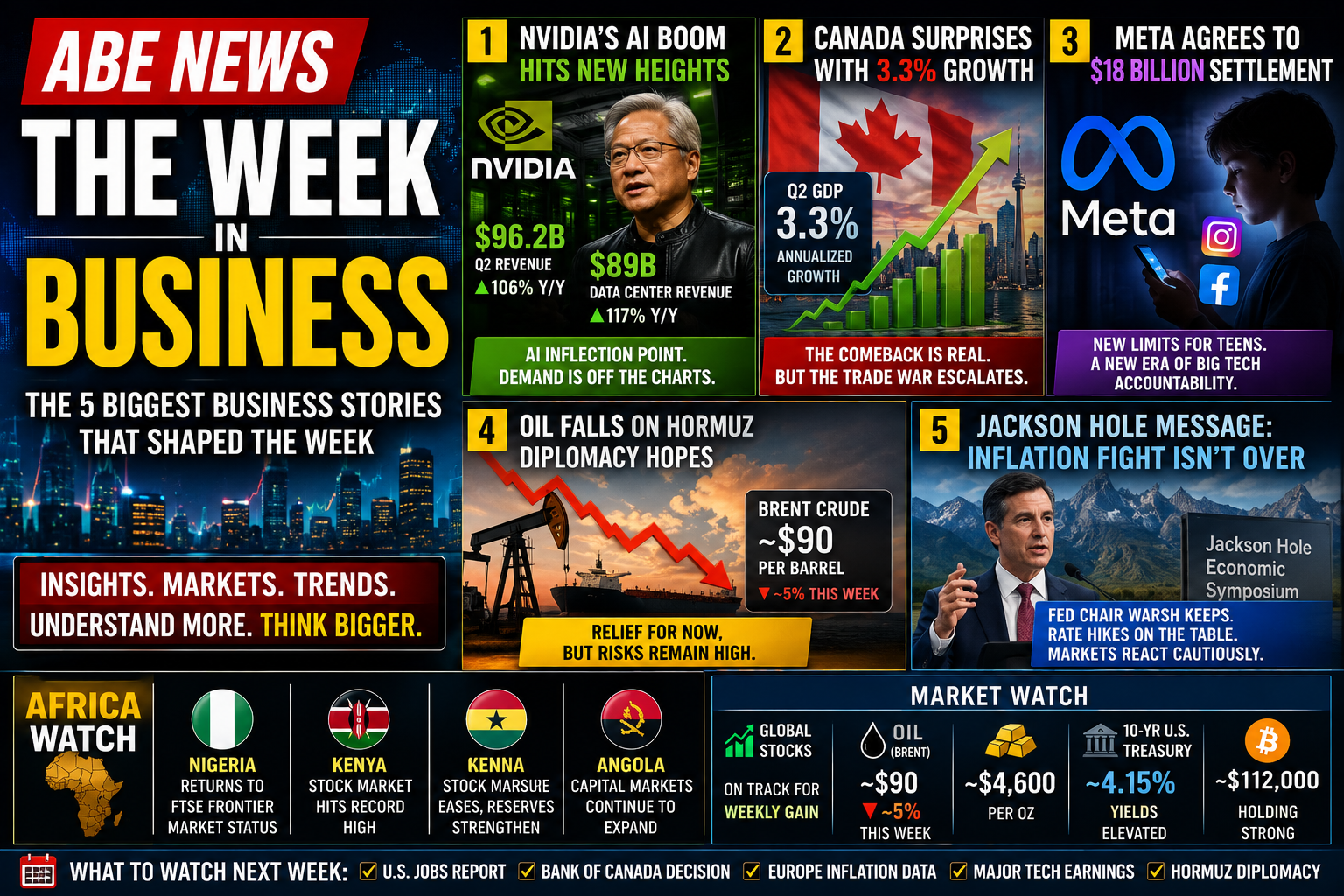
ABE NEWS | THE WEEK IN BUSINESS | August 28, 2026
It was a week when artificial intelligence delivered staggering numbers, Canada discovered its economy was stronger than expected just as another trade shock arrived, one of the world’s biggest social-media companies agreed to one of the most consequential settlements in the industry’s history, and oil markets once again moved to the rhythm of war and diplomacy.
Then the world’s central bankers gathered in Jackson Hole.
Federal Reserve Chair Kevin Warsh used his closely watched Friday speech to reinforce the Fed’s commitment to bringing inflation back to 2%, without providing investors with a simple roadmap for where interest rates go next.
Markets responded cautiously.
And beneath all of it sat the defining economic contradiction of 2026:
Businesses are investing enormous sums in the technologies of tomorrow while governments, wars, tariffs and debt are making the global economy increasingly difficult to predict.
From Silicon Valley to Ottawa, Wall Street to the Strait of Hormuz and African capital markets, here are the stories that defined The Week in Business.
1. NVIDIA JUST SHOWED HOW ENORMOUS THE AI ECONOMY HAS BECOME
If anyone needed evidence that artificial intelligence has moved beyond the experimental stage of the technology cycle, Nvidia provided it this week.
The chipmaker reported $96.2 billion in quarterly revenue for its fiscal second quarter.
That was an increase of 106% from a year earlier.
Even more extraordinary was the company’s Data Center business.
Revenue there reached $89 billion, up 117% year over year.
Nvidia’s GAAP net income reached almost $59.7 billion during the quarter, while GAAP operating income surged 124% from a year earlier.
And the company isn’t forecasting an immediate slowdown.
For the current quarter, Nvidia expects approximately $108 billion in revenue, plus or minus 2%.
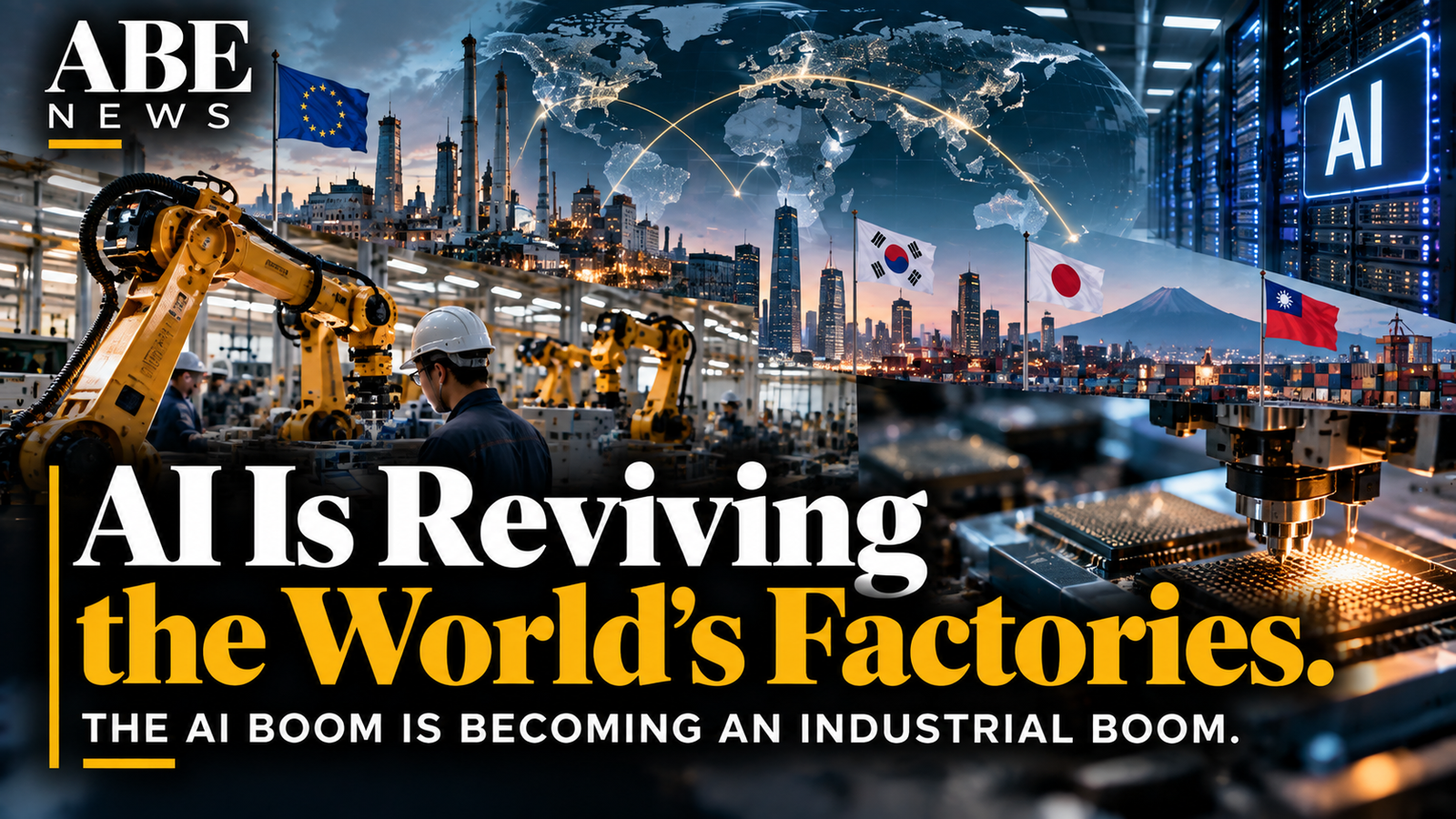
Those numbers put into perspective how dramatically the AI infrastructure boom has transformed the technology industry.
A few years ago, the central question was whether generative AI would become a sustainable business.
Today, the question is how quickly enough chips, data centres, electricity, networking equipment and memory can be produced to meet demand.
Nvidia CEO Jensen Huang declared that AI had reached an “inflection point,” arguing that computing power itself was increasingly becoming a revenue-generating resource.
The market initially loved what it heard.
Technology stocks rallied Thursday as Nvidia’s outlook reassured investors that enormous spending on AI infrastructure had not yet reached its ceiling.
But by Friday, some of that enthusiasm had cooled as investors turned their attention from AI growth to interest rates and inflation.
That tension may define markets for some time.
AI can be booming while money remains expensive.
Both things can be true simultaneously.
Why It Matters
Nvidia is no longer simply a semiconductor earnings story.
Its results function almost like an economic indicator for the AI investment cycle.
Cloud companies, startups, governments and major corporations are collectively spending hundreds of billions of dollars building AI infrastructure.
Nvidia sits at the centre of much of that spending.
If demand remains strong, the effects spread outward:
More data centres.
More electricity demand.
More memory chips.
More networking equipment.
More construction.
More financing.
More competition for engineers.
And potentially much larger productivity gains if companies successfully turn all that computing infrastructure into useful products and services.
But there is another side.
The larger the spending becomes, the larger the expectations become.
Eventually investors will demand evidence that the companies purchasing all this computing power can generate returns large enough to justify the investment.
For now, Nvidia’s numbers say the building phase is still moving at extraordinary speed.
2. CANADA GETS A 3.3% SURPRISE — JUST AS THE TRADE WAR GETS WORSE
Canada received some unexpectedly good economic news Friday.
The country’s economy expanded at a 3.3% annualized rate during the second quarter, considerably stronger than the Bank of Canada’s 2.5% forecast.
First-quarter growth was also revised upward to 0.3%, meaning Canada avoided the technical recession that earlier data had suggested might be developing.
Exports increased 3.6%, their strongest performance in more than three years.
Household consumption increased 0.8%.
Business investment grew 2.3%, ending a lengthy period of contraction.
Final domestic demand rose 1%.
Taken together, the numbers showed an economy that was beginning to regain momentum after months of weakness.
Then came the problem.
Canada’s economic rebound is arriving during another escalation of its trade confrontation with the United States.
Washington imposed a new 50% tariff on roughly $20 billion of Canadian goods this week following the collapse of trade negotiations.
Ottawa responded with countermeasures.
That puts Canada’s economy in an unusual position.
The country is stronger than many economists thought.
But it may need that strength immediately.
Why It Matters
Few major economies are as deeply integrated as Canada and the United States.
Automobiles and components move through cross-border supply chains.
Canadian energy flows south.
American machinery and consumer goods move north.
Businesses on both sides built their operations around the assumption that the border would remain one of the world’s easiest major commercial crossings.
Tariffs challenge that assumption.
At 50%, the economics of some transactions can change dramatically.
Companies may absorb costs temporarily.
Eventually, however, they may raise prices, cut production, reduce hiring, change suppliers or move investment.
Canada’s 3.3% quarter therefore represents more than a good GDP report.
It gives the country a stronger starting position for the next phase of the trade fight.
The warning sign is July.
Statistics Canada’s preliminary indication suggests the economy was largely flat as the third quarter began.
Canada escaped recession.
Whether it can maintain its rebound is now another question entirely.
3. META’S $18 BILLION SETTLEMENT CHANGES THE BUSINESS OF SOCIAL MEDIA
For years, governments, parents and researchers have argued over whether social-media platforms are doing enough to protect children.
This week, that argument entered a new phase.
Meta agreed to pay up to $18 billion and make major changes to Facebook and Instagram to resolve claims brought by most U.S. states alleging that the platforms were designed in ways that harmed or addicted young users.
Meta has denied wrongdoing.
But the settlement is significant not only because of its enormous potential price tag.
It changes the operating rules.
Among the measures are restrictions affecting how teenagers use Meta’s platforms, including a default two-hour daily limit for users under 18.
The agreement arrived amid a much broader international push to regulate children’s access to social media.
Australia has already introduced restrictions for young users.
Governments elsewhere are examining age-verification requirements, platform-design rules and penalties.
And Meta’s settlement does not end the legal battle facing the wider industry.
Thousands of cases involving social-media companies remain pending in federal and state courts.
Why It Matters
The internet’s dominant business model was built around attention.
More time on an app meant more engagement.
More engagement created more opportunities to show advertisements.
More advertising produced more revenue.
For adults, regulators largely tolerated that bargain.
Children are becoming the line where governments are increasingly unwilling to accept it.
If regulators force social-media companies to limit engagement, redesign recommendation systems, verify age or reduce addictive features for minors, the effects could eventually reach the economics of the platforms themselves.
And Meta is not the only company watching.
Every major social platform now has to consider whether the rules being imposed on one company could become the regulatory blueprint for an entire industry.
This week may therefore be remembered not simply for an $18 billion settlement.
It may be remembered as the week the cost of youth engagement became impossible for Big Tech to ignore.
4. OIL FALLS — BUT THE STRAIT OF HORMUZ STILL HOLDS THE WORLD ECONOMY HOSTAGE
Energy markets received some relief this week.
Brent crude was trading around $90 a barrel on Friday morning and was on track for a weekly decline of roughly 5% as traders watched diplomatic efforts involving Iran and Oman over shipping through the Strait of Hormuz.
The prospect of improved navigation through the strait helped reduce some of the immediate fear premium that had been built into crude prices.
But this is not the same thing as saying the energy crisis is over.
Far from it.
Iran and Oman are still working on arrangements involving navigation through Hormuz.
The United States has introduced new economic pressure on Iran.
Tehran has condemned the sanctions and urged other governments not to participate.
And the underlying Middle East conflict remains unresolved.
The Strait of Hormuz continues to be one of the most economically important pieces of water on Earth.
A huge share of globally traded oil and liquefied natural gas normally passes through the narrow route connecting the Persian Gulf to the Arabian Sea.
Any sustained disruption affects far more than oil companies.
Why It Matters
Oil is buried inside the cost structure of the global economy.
Higher crude prices raise transportation costs.
Airlines pay more for fuel.
Shipping becomes more expensive.
Manufacturers face higher logistics bills.
Farmers pay more to operate machinery.
Consumers pay more at the pump.
And central banks suddenly have another inflation problem.
That is why diplomacy around Hormuz can move stock, bond and currency markets thousands of kilometres away.
This week’s decline in crude is welcome.
But investors should not confuse lower tension with no tension.
Oil remains one missile, shipping disruption or diplomatic breakdown away from another violent move.
5. JACKSON HOLE SENDS A MESSAGE: THE INFLATION FIGHT ISN’T FINISHED
By Friday morning, Wall Street had another problem to digest.
Federal Reserve Chair Kevin Warsh delivered his closely watched address at the Jackson Hole economic symposium and reinforced the central bank’s commitment to returning inflation to its 2% target.
What investors did not receive was a simple promise about the next interest-rate move.
Warsh avoided giving the market a clear policy timetable.
But his inflation emphasis was enough for traders to increase expectations that the Fed could raise rates again.
Wall Street’s initial reaction was restrained.
Around late Friday morning, the Dow was roughly flat to slightly higher, while the S&P 500 and Nasdaq were modestly lower.
Technology stocks also cooled following Thursday’s Nvidia-driven rally.
The message from markets was clear:
The AI boom has not eliminated the interest-rate problem.
Why It Matters
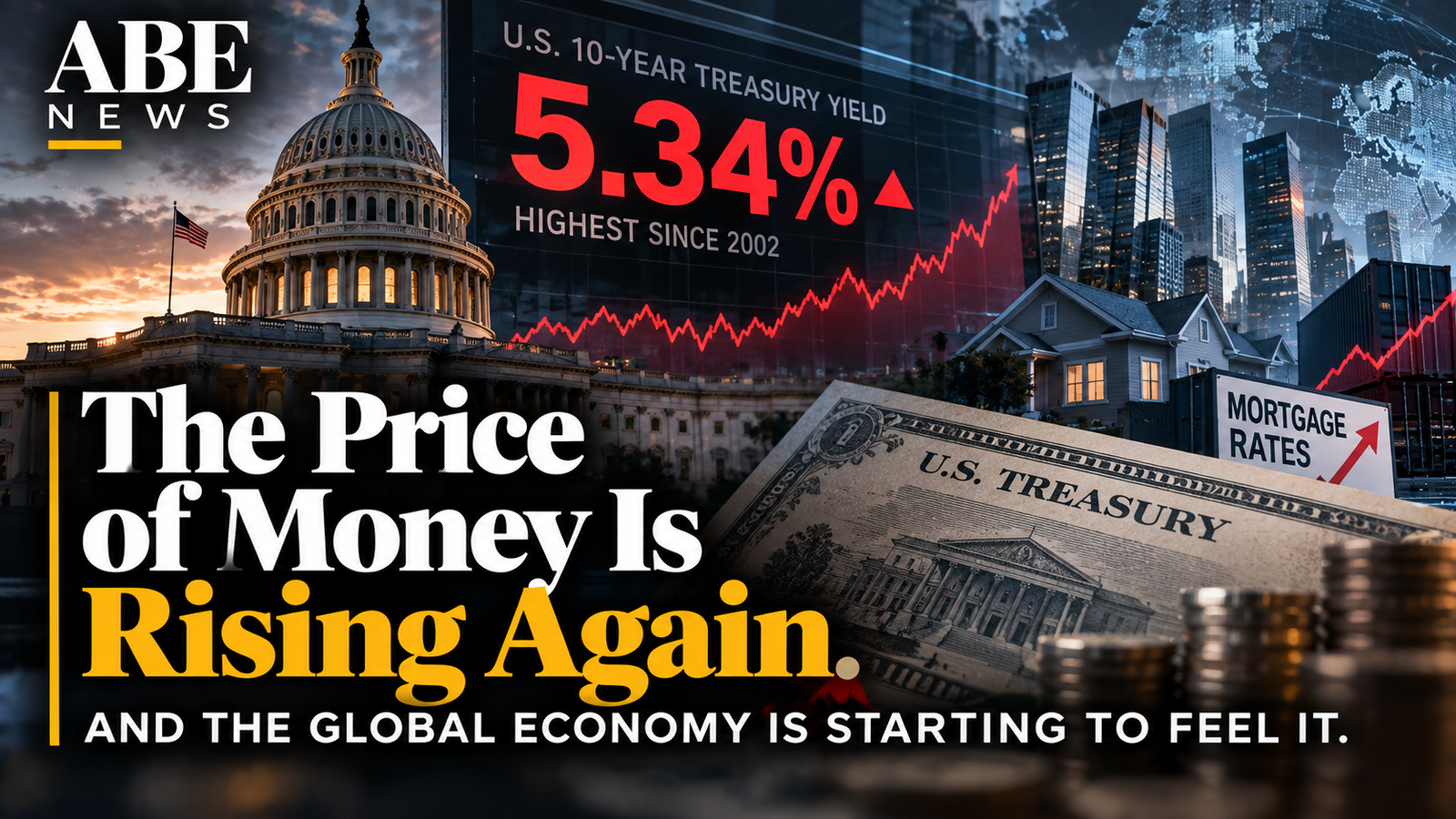
Interest rates determine the price of money.
They influence mortgages.
Credit cards.
Corporate loans.
Government borrowing.
Startup financing.
Real estate.
Stock valuations.
Currencies.
Almost every major asset class ultimately feels the effect of central-bank policy.
And the Fed has a particularly difficult balancing act.
If inflation remains too high, keeping rates low risks allowing price pressures to become entrenched.
Raise rates too aggressively and the central bank risks weakening employment, investment and economic growth.
Energy uncertainty makes that calculation even more complicated.
So does fiscal policy.
For investors hoping Jackson Hole would provide a simple roadmap, Warsh delivered something less comfortable:
The Fed is still watching the data.
And inflation has not been defeated.
📊 MARKET WATCH
The week ended with an unusual combination of optimism and anxiety.
Global equities were still positioned for a weekly gain Friday morning, helped by Nvidia’s blockbuster results and a retreat in oil prices.
The MSCI all-country world index was roughly 0.5% higher for the week and remained close to record territory.
But underneath the headline gains, investors were becoming more defensive.
U.S. equity funds suffered approximately $22.3 billion in net withdrawals in the week through August 26 — their biggest weekly outflow since March.
Large-cap funds accounted for much of the selling.
Meanwhile, bond funds attracted money for a 19th consecutive week.
That is an important signal.
Investors have not abandoned stocks.
But some are clearly looking for protection.
🛢️ OIL
Brent crude: around $90/barrel Friday morning
Direction for the week: DOWN roughly 5%
Main driver: cautious optimism around Hormuz diplomacy and crude flows, balanced against continuing geopolitical risk.
📈 STOCKS
Global stocks: on track for a weekly gain
Thursday: technology stocks strengthened after Nvidia.
Friday morning: the AI rally cooled as investors processed Warsh’s inflation message.
🏦 BONDS
Bond markets remain one of the biggest sources of tension.
Investors are weighing inflation, enormous government borrowing requirements and the possibility that interest rates remain elevated longer than markets once expected.
🪙 GOLD
Gold remained extraordinarily elevated around $4,600 an ounce on Friday, reflecting continued demand for assets perceived as protection against geopolitical instability, inflation and concerns about currencies and government debt.
₿ BITCOIN
Bitcoin and other scarce assets remain part of the same broader debate.
Investors are increasingly questioning what happens when governments run enormous deficits, debt keeps expanding and central banks face pressure to manage both inflation and financial stability.
That doesn’t guarantee cryptocurrencies rise indefinitely.
It does explain why the monetary system itself has become a major investment theme.
🌍 AFRICA WATCH
Africa’s business story this week was not dominated by a single spectacular corporate announcement.
Instead, a quieter shift took place across several markets.
And it deserves attention.
Nigeria Moves Back Toward Global Investors
Nigeria is returning to FTSE Russell’s Frontier Market classification, effective in September, after being moved to an unclassified status in 2023.
That matters because international investment funds frequently use major index classifications to determine where they can allocate capital.
Being included in an investable market index can make it easier for global funds to consider Nigerian equities again.
Nigeria still faces enormous economic challenges — including inflation, currency pressures and the difficulty of turning reforms into improvements in everyday living standards.
But restoring access to major international market classifications is a meaningful step in rebuilding investor confidence.
Kenya’s Stock Market Hits a Milestone
Kenya’s equity market has also been showing strength.
The Nairobi Securities Exchange’s market capitalization reached approximately 4.13 trillion Kenyan shillings, a record level according to this week’s regional market data.
That reflects stronger investor interest and improving valuations in one of East Africa’s most important financial centres.
Kenya continues to face fiscal pressure and debt challenges.
But stronger domestic capital markets can provide businesses and governments with more financing options beyond traditional bank lending.
Ghana’s Fiscal Story Improves
Ghana continued rebuilding credibility after its debt crisis.
Its debt-distress assessment has improved, debt-servicing pressure has declined and foreign-exchange reserves have strengthened substantially.
The recovery remains incomplete.
Infrastructure constraints and the cost of transporting goods continue to limit Ghana’s ability to diversify its economy.
Still, the direction matters.
A country that only recently became synonymous with sovereign debt distress is gradually rebuilding financial space.
Rwanda Chooses Inflation Over Easy Money
Not every African economy is moving toward easier financial conditions.
Rwanda’s central bank has pushed interest rates to their highest level in roughly 17 years as inflation remains elevated.
It is another reminder that Africa cannot be treated as one economy.
Some countries are fighting inflation.
Others are rebuilding debt credibility.
Others are attracting equity investment.
Others are trying to deepen domestic capital markets.
Africa Watch Takeaway
The most interesting African business trend this week may therefore be financial normalization.
Nigeria is returning to an international market classification.
Kenya’s stock market is reaching new heights.
Ghana is rebuilding fiscal credibility.
Capital markets in countries including Angola are expanding.
None of that means Africa has suddenly solved its structural problems.
But investors who only look at Africa when there is a crisis risk missing the slower changes happening underneath the headlines.
🔭 WHAT TO WATCH NEXT WEEK
The calendar is about to become busy.
1. THE U.S. JOBS REPORT
The next U.S. employment report could become the single most important economic number of the week.
Economists surveyed ahead of the release expect only modest job creation after weakness in July.
A surprisingly strong number could increase expectations of another Fed rate increase.
A weak number could revive concerns about the labour market.
Either way, Wall Street will react.
2. BANK OF CANADA
Canada’s central bank is expected to make its next interest-rate decision.
Friday’s stronger-than-expected 3.3% GDP report reduces pressure for immediate stimulus.
But tariffs complicate the outlook.
The Bank has to judge whether Canada’s rebound is sustainable or whether the newest U.S. trade measures will drag growth lower again.
3. EUROPEAN INFLATION
Eurozone inflation data will provide another major test for central banks.
Inflation running hotter than expected could increase pressure on the European Central Bank to tighten monetary policy.
That would add Europe to the list of major economies where the era of easy money remains difficult to restore.
4. THE AI TRADE AFTER NVIDIA
Nvidia passed its test.
Now investors will examine the rest of the ecosystem.
Broadcom earnings are among the upcoming events likely to attract significant attention.
Investors will want evidence that Nvidia’s extraordinary demand is flowing through the wider semiconductor and AI infrastructure supply chain.
5. HORMUZ
Diplomacy remains one of the most important variables in global markets.
If Iran and Oman make meaningful progress toward restoring more normal shipping through the Strait of Hormuz, oil could receive further relief.
If negotiations fail or military tensions increase, energy markets could reverse rapidly.
🔴 THE ABE NEWS TAKE
This week produced one of the clearest pictures yet of the strange economy the world has entered.
On one side sits extraordinary technological optimism.
Nvidia generated more than $96 billion in three months.
Companies are building data centres at a scale that would have sounded almost absurd only a few years ago.
Artificial intelligence is attracting capital, reshaping corporate strategy and creating entirely new infrastructure industries.
Canada showed that even an economy battered by tariffs can surprise on the upside.
Global stocks remained close to record territory.
There is real economic strength here.
But turn the picture around.
The world’s most important oil route remains vulnerable to war.
Canada and the United States are imposing enormous tariffs on each other despite operating one of the deepest trading relationships on Earth.
Central banks are still fighting inflation.
Government debt continues to worry bond investors.
Billions of dollars are moving out of U.S. equity funds.
And one of the world’s largest technology companies has agreed to pay up to $18 billion to settle allegations surrounding the impact of its products on children.
That is not an economy moving peacefully from one era into another.
It is an economy being pulled in opposite directions.
Technology is accelerating.
Politics is fragmenting.
Capital is becoming more selective.
Governments are becoming more interventionist.
Energy security is becoming economic security.
And the price of money still matters.
Perhaps the biggest mistake investors, businesses and governments can make now is assuming that one headline tells the entire story.
Nvidia’s numbers do not mean every AI investment will succeed.
Falling oil prices this week do not mean the energy crisis has disappeared.
Canada’s 3.3% growth does not mean tariffs no longer matter.
A stock market near record highs does not mean investors have stopped worrying.
The global economy in 2026 is increasingly defined by contradictions.
Growth and fear.
Innovation and regulation.
Globalization and protectionism.
Record investment and record debt.
Opportunity and instability.
The winners will probably not be those who correctly predict every headline.
They will be the businesses, investors and countries capable of adapting when the headline changes.
Because if this week taught us anything, it is this:
The future is arriving very quickly.
And it is arriving in a world that is becoming much harder to predict.
ABE NEWS
Business. Money. Style. The News.
Understand More. Think Bigger.