








ABE NEWS | August 28, 2026
Canada’s economy has delivered a surprisingly powerful comeback.
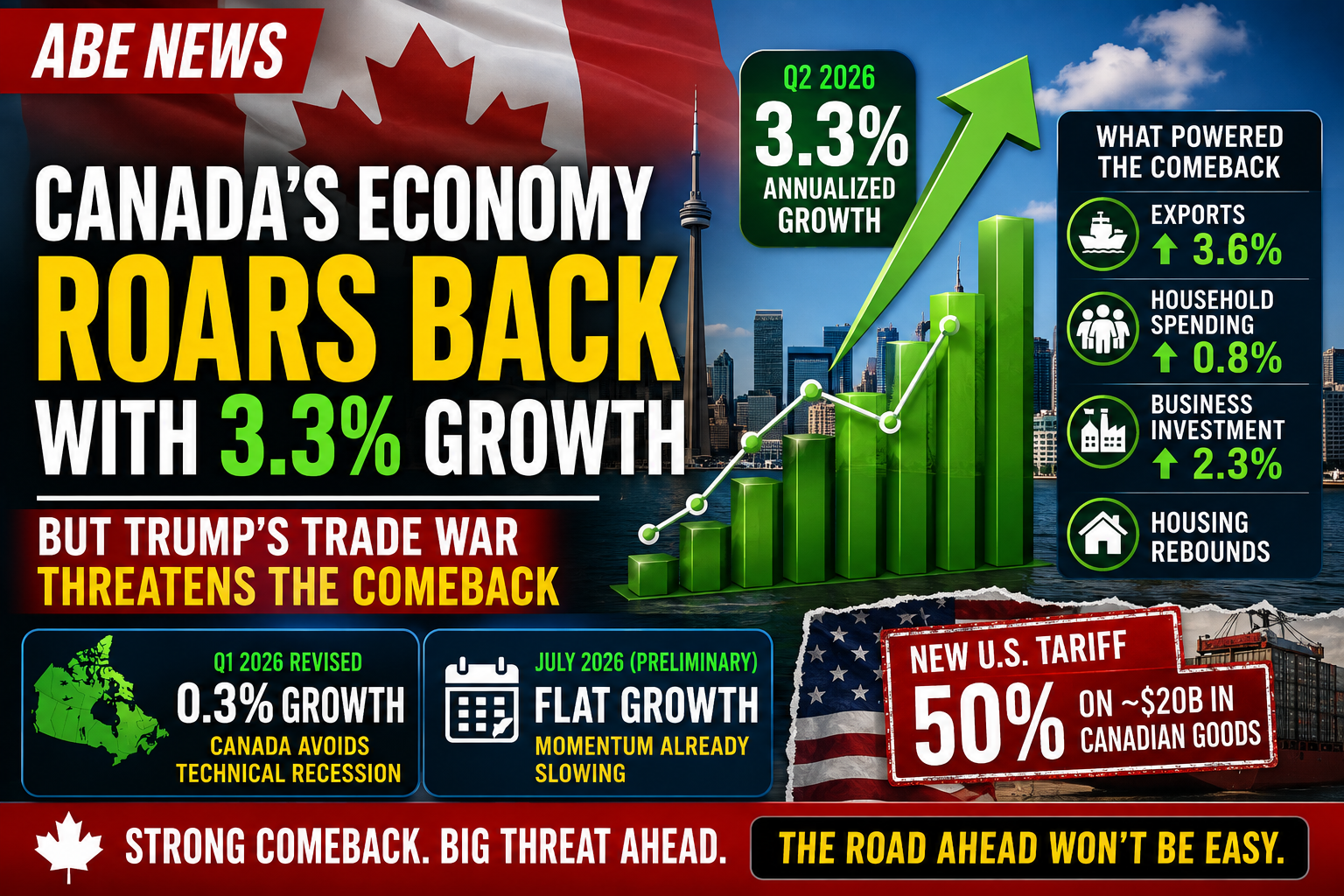
After months of weak growth, recession fears and mounting pressure from its trade confrontation with the United States, the Canadian economy expanded at an annualized rate of 3.3% in the second quarter of 2026, its strongest pace of growth since 2023.
The rebound was powered by a sharp increase in exports, stronger household spending and a long-awaited recovery in business investment.
It was also considerably stronger than the 2.5% growth rate the Bank of Canada had forecast for the quarter.
Even more importantly, Statistics Canada revised first-quarter growth upward to 0.3%, erasing what had previously appeared to be a contraction and confirming that Canada avoided the technical recession that had worried economists earlier this year.
But the celebration comes with a warning.
The newest data also suggests economic momentum was already slowing as the third quarter began — and Canada is now facing another major escalation in its trade war with the United States.
President Donald Trump’s administration has imposed a new 50% U.S. tariff on approximately $20 billion worth of Canadian exports, while Ottawa has responded with countermeasures of its own.
Canada may have escaped recession.
The bigger question is whether the comeback can survive what comes next.
Canada’s Economy Beats Expectations
Statistics Canada’s latest GDP report paints a much stronger picture of the Canadian economy than many expected only a few months ago.
Real gross domestic product grew 0.8% during the second quarter, equivalent to an annualized growth rate of 3.3%.
That followed an upwardly revised 0.3% annualized increase during the first quarter.
The revision matters.
Earlier estimates had suggested Canada’s economy contracted at the beginning of 2026, raising concerns that another weak quarter could push the country into a technical recession — commonly defined as two consecutive quarters of shrinking economic output.
That did not happen.
Instead, the revised numbers show Canada barely grew in the first quarter before accelerating sharply between April and June.
The second-quarter performance was the country’s fastest annualized growth rate since 2023.
For an economy that spent much of the past year struggling with high borrowing costs, weak productivity, trade uncertainty and cautious consumers, that is a significant turnaround.
Exports Surge 3.6%
One of the biggest engines behind the recovery was international trade.
Canadian exports jumped 3.6% during the second quarter, their largest increase in more than three years.
A rebound in shipments of passenger cars and light trucks helped drive the improvement after automobile production had declined during the previous two quarters.
That is particularly important because Canada’s manufacturing sector has been among the industries most exposed to U.S. trade policy.
Canada and the United States operate some of the world’s most deeply integrated industrial supply chains.
A vehicle assembled in Ontario, for example, can contain components that have crossed the Canada-U.S. border multiple times before final production.
Canadian energy, minerals, machinery, agricultural products and manufactured goods also flow extensively into the American market.
That means stronger exports can rapidly lift Canadian economic growth.
It also means tariffs can rapidly threaten it.
Canadian Consumers Are Spending Again
The recovery was not driven by exports alone.
Domestic demand also strengthened considerably.
Final domestic demand — a broad measurement combining household consumption and capital spending — increased 1% during the second quarter after slipping slightly in the previous quarter.
Household consumption expenditure increased 0.8%, its strongest performance in three quarters.
That suggests Canadian consumers, who had spent much of the previous period under pressure from high living costs and elevated borrowing expenses, became more willing to spend.
Higher wages and government benefits helped support household finances.
That matters because consumer spending represents an enormous share of economic activity.
When households become cautious, businesses feel the impact quickly.
Restaurants receive fewer customers.
Retailers sell fewer goods.
People postpone vehicle purchases.
Housing activity slows.
Businesses become reluctant to expand.
The second-quarter figures suggest at least some of that caution was beginning to ease.
Businesses Start Investing Again
Perhaps one of the most encouraging signals came from business investment.
Business gross fixed capital formation increased 2.3% during the second quarter.
That ended five consecutive quarters of declining business capital investment.
Companies increased spending on residential and non-residential structures, machinery and equipment.
Spending on machinery and equipment reached its highest level in two years.
There was also a striking technology component.
Investment in computers and peripherals jumped 16.7% during the quarter, with Statistics Canada linking some of that spending to processing equipment used in data centres.
That is particularly notable during a week in which the global technology industry has again been dominated by enormous spending on artificial intelligence infrastructure.
For Canada, stronger capital investment is important for reasons that extend beyond one quarter of GDP.
The country has struggled for years with weak productivity growth compared with the United States.
Businesses investing more heavily in machinery, technology, infrastructure and equipment could eventually help improve how much economic output Canadian workers and companies produce.
Housing Makes a Comeback
Canada’s housing sector also contributed to the recovery.
Residential investment rebounded as housing resale activity strengthened during the spring, particularly in Ontario, Quebec and British Columbia.
Housing has an unusually large influence on Canada’s economy.
Real estate transactions support mortgage lending, construction, renovation, legal services, insurance and consumer spending associated with moving and furnishing homes.
When Canada’s housing market slows, the effects can therefore spread well beyond real estate.
The second-quarter recovery provided another source of economic momentum.
But affordability remains a major challenge.
Home prices and rents remain extremely high in several of Canada’s largest metropolitan areas, and stronger economic activity does not automatically resolve the financial pressure facing younger Canadians and lower-income households.
A growing economy and an affordable economy are not necessarily the same thing.
June Was Stronger Than Expected
The quarter also ended positively.
Canada’s economy expanded 0.3% in June, slightly above forecasts for approximately 0.2% growth.
Growth was broad-based across industries.
Manufacturing — one of the sectors most exposed to tariff disruption — expanded for a third consecutive month.
Canada’s hosting of 10 FIFA World Cup matches in June also provided a boost to parts of the tourism and hospitality industries.
Hotels, restaurants, transportation providers and entertainment businesses benefited from the influx of visitors associated with the tournament.
That helped Canada finish the quarter with considerable momentum.
Then came July.
The Warning Hidden Inside the Numbers
Statistics Canada’s preliminary estimate indicates that economic output was largely unchanged in July.
That is the first warning against assuming the second-quarter boom will simply continue.
GDP data looks backward.
Today’s 3.3% figure tells Canadians what happened primarily between April and June.
It does not guarantee the same performance during August, September or the remainder of the year.
And the economic environment has changed significantly since the second quarter ended.
Most importantly, Canada’s trade confrontation with the United States has escalated again.
Trump’s New 50% Tariff Changes the Picture
The United States has imposed a new 50% import tariff on approximately $20 billion worth of Canadian goods.
Canada has responded with retaliatory measures against U.S. imports.
The escalation comes after more than 18 months of trade disruption between the two countries.
For Canada, the stakes are enormous.
The United States is by far Canada’s largest trading partner.
Canadian factories sell heavily into the American market.
Canadian oil and natural gas flow south.
Agricultural producers depend on cross-border customers.
Manufacturers operate supply chains stretching through Ontario, Quebec, Michigan, New York, Ohio and other industrial regions.
When tariffs raise the cost of crossing that border, businesses face difficult choices.
They can absorb the cost and accept lower profits.
They can increase prices.
They can reduce production.
They can move investment.
Or they can search for new markets.
None of those adjustments happens without consequences.
Canada Was Learning to Live With the Trade War
The second-quarter figures suggest something interesting had begun happening before the latest escalation.
Canadian households and businesses appeared to be adapting.
After more than a year of trade uncertainty, companies had begun adjusting supply chains, consumers continued spending and investment finally started expanding again.
That resilience helped produce the 3.3% growth rate.
But the latest round of protectionism could disrupt that progress.
A business may be able to adapt to a 10% tariff.
A 25% tariff creates a more difficult calculation.
At 50%, entire business models can become uneconomic.
That is why the latest trade escalation could matter much more than the headline GDP number suggests.
Canada entered the confrontation in stronger shape than previously believed.
It still has to survive it.
The Bank of Canada Now Has a Complicated Decision
The GDP report arrives just days before the Bank of Canada’s next interest-rate decision on September 2.
Before Friday’s report, financial markets were already expecting the central bank to leave rates unchanged.
The stronger GDP numbers strengthen the argument for patience.
Canada’s economy is growing.
Household spending has improved.
Business investment is recovering.
A recession has been avoided.
Those conditions do not immediately scream for emergency monetary stimulus.
But the Bank of Canada cannot simply look backward.
Policymakers also need to assess the impact of new tariffs, global energy prices and inflation.
Trade wars create a particularly difficult problem for central banks.
Tariffs can weaken economic growth by reducing trade and investment.
At the same time, they can increase prices by making imported products more expensive.
That means a central bank can simultaneously face weaker growth and higher inflation.
Cut interest rates too aggressively and inflation could worsen.
Keep rates too high and economic weakness could deepen.
Friday’s GDP report gives the Bank of Canada some breathing room.
The trade war makes the next decision considerably harder.
The Canadian Dollar Barely Moves
Despite the surprisingly strong GDP report, Canada’s currency showed relatively little reaction.
The Canadian dollar traded around C$1.3856 per U.S. dollar, equivalent to roughly 72 U.S. cents, shortly after the release.
That muted reaction suggests investors were already looking beyond the headline number.
Markets understand that the second quarter is history.
The question is what happens under the new tariff environment.
Canadian government bond yields moved slightly higher following the report, while Toronto stocks opened modestly stronger.
The reaction was positive.
It was not euphoric.
Canada’s Bigger Economic Problem Hasn’t Disappeared
A single strong quarter also does not erase Canada’s deeper structural challenges.
Productivity remains a major concern.
Business investment has been weak for years.
Housing affordability remains severe.
Canadian households carry high levels of debt.
Population growth and infrastructure capacity remain politically sensitive issues.
And Canada’s dependence on the United States remains both an enormous economic advantage and a strategic vulnerability.
For decades, geographic proximity to the world’s largest economy gave Canadian businesses extraordinary access to American consumers.
That relationship helped create integrated industries stretching across the border.
Now that integration can transmit political shocks just as efficiently as it transmits goods.
The trade war has forced Canada to confront an uncomfortable question:
How dependent should its economy remain on the United States?
A Push Toward New Markets
Ottawa has increasingly argued that Canada needs to diversify its trade relationships.
Europe is one potential destination.
Asia is another.
Canada also has opportunities to deepen commercial relationships with emerging markets in Africa and Latin America.
But diversification is much easier to announce than to achieve.
Geography matters.
The United States sits directly beside Canada.
Moving goods by truck from Ontario to Michigan is fundamentally easier than shipping those same products across an ocean.
American consumers are wealthy.
The two countries share infrastructure.
Their businesses understand one another’s regulatory environments.
Entire industries were built around that proximity.
Canada can diversify.
It cannot simply replace the United States overnight.
That makes repairing the trading relationship economically valuable even as Ottawa searches for alternatives.
What Happens Next
There are now three numbers to watch.
The first is July GDP.
Statistics Canada’s preliminary estimate suggests little or no growth, but the final figure will show whether the second-quarter momentum carried into the summer.
The second is inflation.
If tariffs and global energy disruptions push prices higher, the Bank of Canada’s room to support the economy could shrink.
The third is trade.
If Washington and Ottawa return to negotiations and reduce tariffs, Canada’s second-quarter rebound could prove to be the beginning of a broader recovery.
If the confrontation escalates, businesses may delay investment, exporters may lose competitiveness and consumer confidence could weaken again.
The 3.3% number is therefore significant.
But the next quarter may matter even more.
🔴 THE ABE NEWS TAKE
For months, Canada’s economic story looked increasingly gloomy.
Growth was disappearing.
Businesses were cautious.
Consumers were stretched.
Tariffs were disrupting trade.
And there was serious debate about whether the country had slipped into recession.
Friday’s numbers change that picture.
Canada didn’t fall into recession.
It grew.
And then it accelerated.
Exports increased.
Consumers spent more.
Housing activity recovered.
Businesses invested again.
A 3.3% annualized growth rate — stronger than the Bank of Canada expected — is not a statistical footnote.
It is evidence that the Canadian economy was more resilient than many believed.
But there is a danger in celebrating too quickly.
This report describes the economy Canada had during the second quarter.
The country now faces a different environment.
A new 50% American tariff on billions of dollars of Canadian exports is not a small obstacle.
It is a new economic shock.
And Canada’s preliminary July growth reading is already much weaker than the second-quarter headline.
So the real story is not simply:
Canada is booming.
Nor is it:
Canada is heading for recession.
The more accurate story is more interesting.
Canada has shown that its economy can take a hit, adapt and recover.
Now it is about to find out how much punishment that resilience can withstand.
The 3.3% rebound gives Canada momentum.
The trade war will determine whether it gets to keep it.
ABE NEWS
Business. Money. Style. The News.
Understand More. Think Bigger.