








Canada and the United States have been talking almost every day.
Ministers are meeting.
Negotiators are working behind the scenes.
Both governments say they want an agreement.
But with only days remaining before a major tariff deadline, there is one uncomfortable problem:
They still don’t have a deal.
Canadian Trade Minister Dominic LeBlanc told an advisory committee Friday that Canada and the United States remain “quite far away” from an agreement that Canada’s government could accept, according to a source briefed on the meeting.
And now something unusual is happening.
LeBlanc isn’t heading home for the weekend.
He’s staying in Washington.
Multiple meetings are expected as negotiators race toward August 19.
This isn’t just another political deadline.
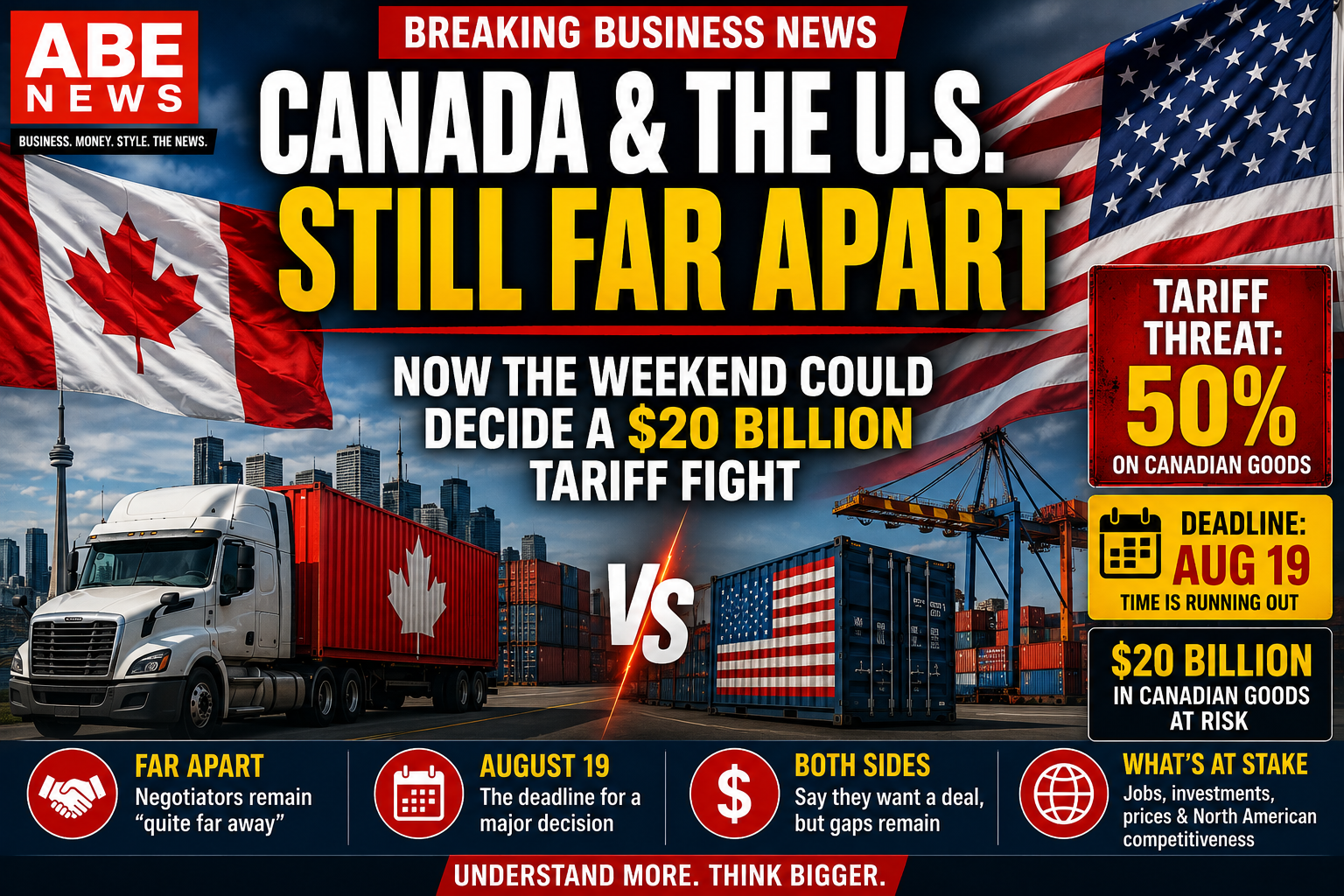
Nearly $20 billion worth of Canadian goods could be caught in the middle.
August 19 Is Getting Very Close
President Donald Trump has threatened new 50% tariffs on a range of Canadian imports beginning August 19.
According to the U.S. Trade Representative’s office, the measures would cover nearly $20 billion of Canadian goods — approximately 5.2% of the goods Canada exported to the United States in 2025.
But there’s something particularly important about this round.
Previous U.S. tariff measures provided exemptions for many goods qualifying under the United States-Mexico-Canada Agreement.
These proposed tariffs would also hit qualifying USMCA goods.
That makes the threat considerably more serious for businesses that assumed the North American trade agreement would protect their products.
Both Countries Want a Deal
Here’s where things get interesting.
Despite the disagreements, Canada isn’t the only country interested in reaching an agreement.
A Canadian government source told Reuters Thursday that Washington also wanted a deal before August 19.
That means this isn’t necessarily a negotiation where one side wants compromise and the other wants confrontation.
Both sides appear to want something.
The disagreement is over what each side is prepared to give up to get it.
And that’s where negotiations become difficult.
What Does Washington Want?
The United States has raised several complaints about Canadian trade policies.
Among them:
Canadian tariffs on American automobiles.
How Canada allocates dairy import quotas.
And decisions by some Canadian provinces not to stock certain American alcoholic products.
Washington wants changes.
Canada wants something in return.
Most importantly, Ottawa is seeking relief from existing U.S. tariffs, including measures affecting Canadian steel and aluminum.
That creates the basic negotiation:
What is Canada willing to change — and how much tariff relief is Washington willing to provide in exchange?
So far, they haven’t found the answer.
The Latest American Offer Wasn’t Enough
Earlier this week, the United States reportedly presented Canada with a proposal that would lower some tariffs.
Canada wasn’t satisfied.
According to CBC reporting cited by Reuters, Canadian officials believed the reductions didn’t go far enough.
Then Friday brought another warning.
LeBlanc reportedly told Canada’s Advisory Committee on Canada-U.S. Economic Relations that the two sides remained far apart on important issues.
Technical negotiations are continuing constantly.
But the fundamental disagreements remain.
In other words:
They’re talking a lot.
That doesn’t necessarily mean they’re agreeing.
Why Staying in Washington Matters
Normally, the weekend slows government business down.
Not this weekend.
LeBlanc and Canada’s negotiating team are remaining in Washington while talks continue.
Multiple meetings are planned.
That’s significant because there aren’t many negotiating days left.
Saturday.
Sunday.
Monday.
Tuesday.
Then:
August 19.
A breakthrough could still happen quickly.
Trade negotiations sometimes appear completely stuck until the final hours.
But the opposite is also possible.
The deadline could arrive without an agreement.
And businesses have to prepare for both outcomes.
Why This Matters for Canadian Businesses
A 50% tariff doesn’t mean a Canadian company automatically loses 50% of its revenue.
But it can completely change the economics of selling a product in America.
Imagine a Canadian manufacturer selling something to a U.S. customer.
If importing that product suddenly becomes dramatically more expensive, someone has to absorb the cost.
The Canadian exporter could lower its price.
The American importer could accept lower margins.
The American customer could pay more.
Or the buyer could simply find another supplier.
None of those choices is painless.
And that is why tariffs can affect more than trade statistics.
They can influence:
investment.
hiring.
factory production.
consumer prices.
supply chains.
And eventually:
where companies decide to do business.
The Bigger Problem Is Uncertainty
Businesses can adapt to rules.
Even expensive rules.
What businesses struggle with is not knowing what the rules will be.
Imagine running a company that exports to the United States.
Do you hire another 50 workers?
Do you build another production line?
Do you sign a three-year contract with an American customer?
Do you open a U.S. factory instead?
Do you wait?
Every decision depends partly on what crossing the border will cost.
And right now, some companies don’t know what that cost will look like four days from now.
That’s not simply a tariff problem.
It’s an uncertainty problem.
And Canada Can’t Easily Ignore America
Canada can diversify its trade.
It can build stronger relationships with Europe.
Asia.
Africa.
Latin America.
And other markets.
But geography doesn’t disappear.
The United States remains Canada’s overwhelmingly important trading partner.
The countries share one of the world’s largest commercial relationships and deeply integrated supply chains.
Automotive parts can cross the border multiple times during production.
Canadian materials feed American factories.
American products fill Canadian stores.
Energy moves across the border.
Food moves across the border.
Workers and investment move across the border.
You can’t untangle that overnight.
And that is precisely why a trade fight between Canada and the United States is different from a normal disagreement between two distant economies.
They’re already inside each other’s supply chains.
The Bigger Picture
There’s another reason this weekend matters.
The current negotiations aren’t happening in isolation.
Canada, the United States and Mexico are also heading toward the broader future of the USMCA trade relationship.
So every dispute today becomes part of a larger question:
What will North American trade look like for the next decade?
For years, businesses built strategies around the idea that goods could move relatively predictably across North America.
If that assumption changes, companies will adapt.
But those adaptations could be expensive.
Factories may move.
Suppliers may change.
Investment may shift.
And companies may begin choosing resilience over efficiency.
That would change far more than one $20 billion group of imports.
What’s Next?
There are really three possibilities.
One: a deal.
Canada makes concessions, Washington provides enough tariff relief, and both governments announce an interim agreement before August 19.
Two: an extension.
Negotiators make enough progress that the deadline is delayed while talks continue.
Three: no agreement.
The new tariffs take effect and Canada must decide how to respond.
Right now, all three remain possible.
That’s why this weekend matters.
THE ABE NEWS TAKE
Trade wars are usually described using enormous numbers.
Billions of dollars.
Tariff percentages.
Import volumes.
Export figures.
But businesses don’t experience trade wars as statistics.
They experience them as decisions.
Do we hire?
Do we invest?
Do we raise prices?
Do we move production?
Do we wait?
That’s what makes the Canada-U.S. negotiations more important than another argument between politicians.
Two countries that spent decades making their economies more connected are now negotiating how expensive that connection should become.
And here’s the strange part:
Both sides say they want a deal.
Yet they’re still far apart.
That tells us something about modern trade negotiations.
The difficult question isn’t whether countries want commerce.
Of course they do.
The difficult question is:
Who gets the better terms?
This weekend may bring an answer.
Or it may simply bring Canada and the United States even closer to a deadline neither side appears particularly eager to reach.
Either way, businesses won’t be watching August 19 because politicians told them to.
They’ll be watching because their next investment decision may depend on it.
ABE NEWS
Business. Money. Style. The News.
Understand More. Think Bigger.