






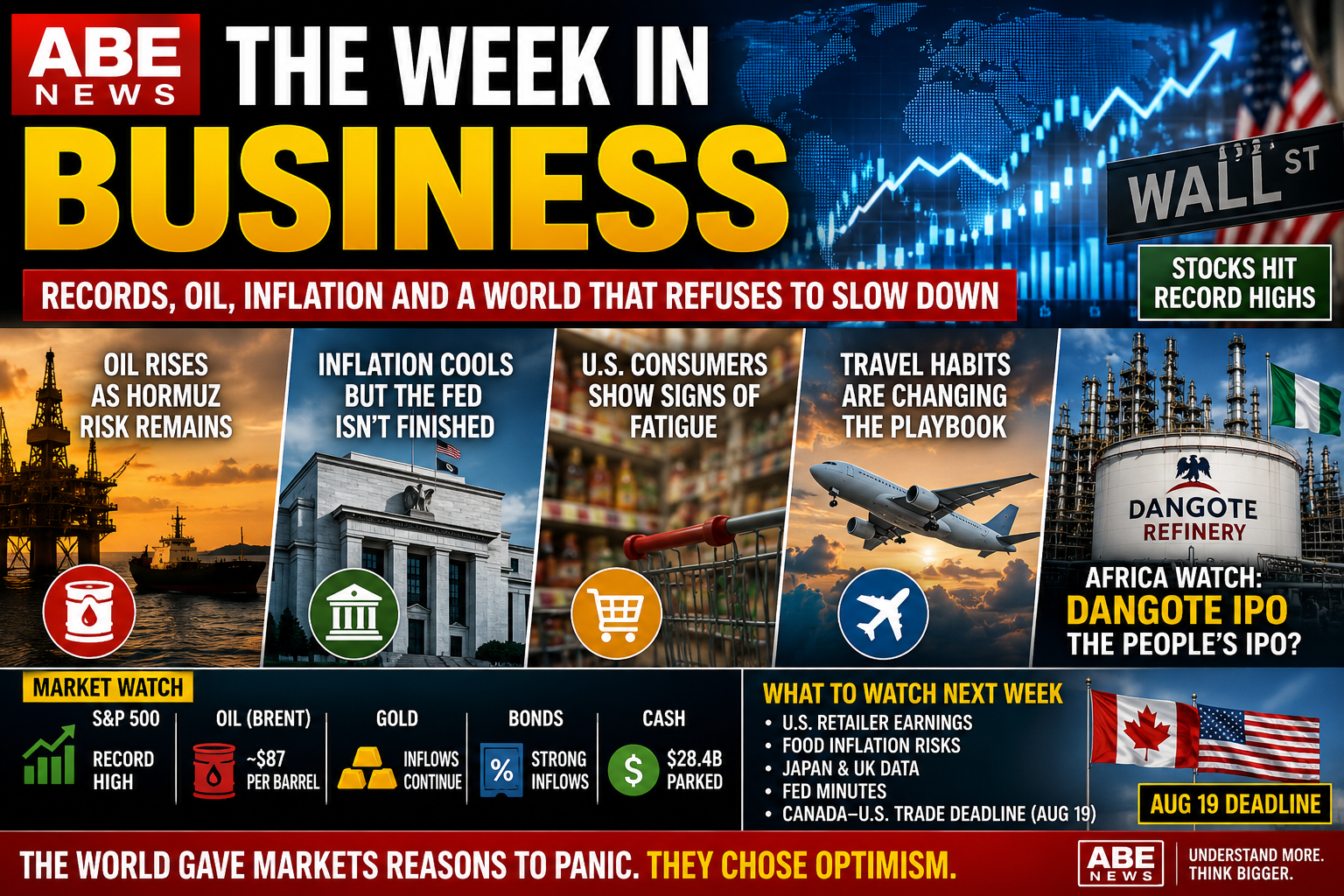
The world gave investors plenty of reasons to worry this week.
Oil remained expensive.
The Strait of Hormuz remained severely disrupted.
Washington and Tehran remained far apart.
Long-term U.S. borrowing costs flashed warning signs.
Consumers showed signs of becoming more cautious.
And businesses continued trying to figure out what an increasingly unpredictable global economy means for them.
Yet Wall Street did something remarkable.
It went back to record highs.
That contradiction may be the best way to understand this week.
The global economy didn’t suddenly become safer.
Investors simply decided that — for now — the good news was powerful enough to outweigh the bad.
Welcome to THE WEEK IN BUSINESS.
1. 📈 WALL STREET RETURNED TO RECORD TERRITORY
Start with the number everyone watches.
The S&P 500 reached another record this week as investors reacted to encouraging inflation data and another strong corporate earnings season.
Global investors weren’t exactly running for the exits either.
Global equity funds attracted approximately $18.6 billion during the week through August 12, marking the 12th consecutive week of inflows.
And the earnings picture has been unusually strong.
Of the 436 S&P 500 companies that had reported second-quarter results by last Friday, roughly 85% beat analyst expectations, according to LSEG data cited by Reuters.
That’s far above the long-term average.
It helps explain something that otherwise looks strange.
War?
Investors bought.
Oil uncertainty?
Investors bought.
Questions about interest rates?
Investors bought.
Why?
Because companies keep making money.
And as long as earnings remain strong, investors appear willing to tolerate a surprising amount of uncertainty.
But there is an important distinction.
The stock market is not the economy.
A record S&P 500 tells us investors are optimistic about corporate profits.
It doesn’t necessarily tell us that every household or every business feels optimistic.
We’ll come back to that.
2. 🛢️ OIL REMINDED EVERYONE THAT GEOGRAPHY STILL MATTERS
One of this week’s biggest stories happened thousands of kilometres from Wall Street.
The Strait of Hormuz remains at the centre of the global energy story.
The route historically handles roughly one-fifth of global oil and liquefied-natural-gas flows, making disruption there potentially important far beyond the Middle East.
Brent crude briefly approached $90 per barrel this week as hopes for a quick resolution to the Iran conflict faded.
Then came another twist.
Oil fell more than 2% Thursday after U.S. crude inventories unexpectedly surged by 17.4 million barrels, their largest weekly increase since January 2023, while forecasts pointed toward softer demand. Brent settled Thursday at $87.07.
That tells us something important.
The oil market is being pulled in opposite directions.
On one side:
Geopolitical risk and potential supply disruption push prices upward.
On the other:
Large inventories and weaker demand expectations push prices downward.
Nobody knows which force ultimately wins.
But businesses can’t simply wait to find out.
Asian refiners are already reconsidering where they source crude.
Shipping companies have to reconsider routes and risk.
Airlines have to think about fuel costs.
Manufacturers have to think about transportation.
And households eventually see some of those costs at the gasoline pump.
This is why Hormuz isn’t simply a foreign-policy story.
It’s a business story.
3. 💵 INFLATION COOLED — BUT THE FED ISN’T FINISHED
This may have been the piece of news Wall Street liked most.
Two relatively calm U.S. inflation reports reduced pressure on the Federal Reserve to raise interest rates again immediately.
By Friday, futures markets had reduced the probability of a September rate increase to roughly one in three, down from around 50-50 before the inflation reports.
That helped stocks.
It helped bonds.
And it gave investors another reason to believe the economy might navigate higher energy costs without requiring dramatically tighter monetary policy.
But declaring victory would be premature.
The Fed’s preferred inflation measure remains well above its 2% target.
And the Cleveland Fed’s nowcast cited by Reuters had headline PCE inflation around 3.7% for July and August and core PCE around 3.3%.
Then there’s the bond market.
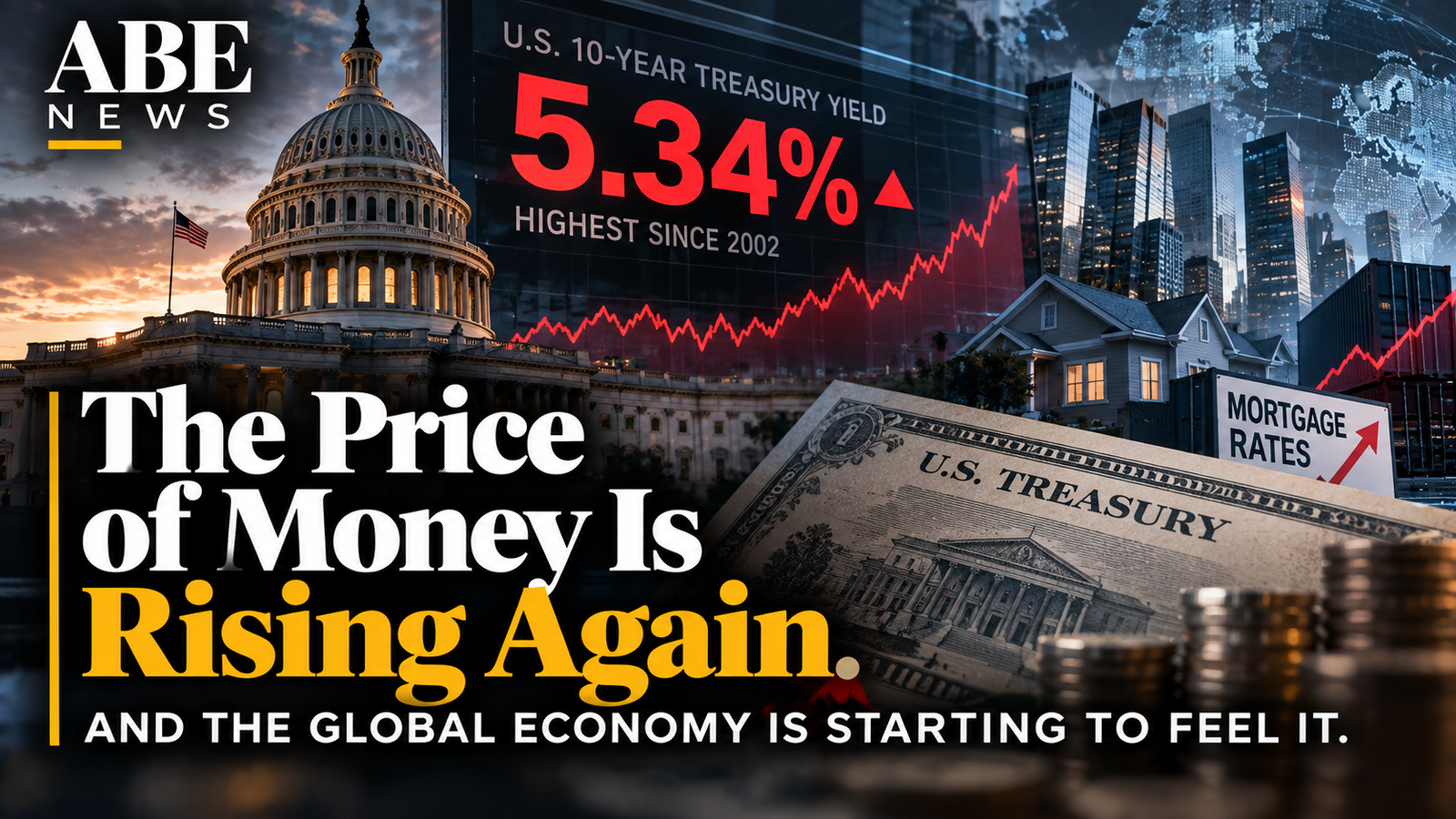
The U.S. Treasury sold 10-year debt this week at its highest auction rate in 19 years.
Thirty-year bonds were sold at their highest auction rate in 25 years.
And the average 30-year U.S. mortgage rate is around 6.7%.
So there are really two interest-rate stories happening simultaneously.
The short-term story says:
Maybe the Fed doesn’t need to raise rates next month.
The long-term story says:
Borrowing money is still expensive.
For households buying homes and companies financing investments, that second story matters enormously.
4. 🛒 THE AMERICAN CONSUMER FINALLY SHOWED SOME FATIGUE
For much of the past few years, economists have repeatedly predicted that the American consumer would eventually slow down.
Consumers repeatedly proved them wrong.
But there are new reasons to watch spending carefully.
High gasoline prices are eating into household budgets, while retailers are preparing to tell investors what they’re seeing inside their stores.
Next week brings results from Walmart, Target, Home Depot and Lowe’s, giving markets a major check on consumer health.
The question isn’t whether Americans suddenly stop shopping.
That’s unlikely.
The more important question is whether they begin changing what they buy.
When fuel costs rise, households don’t necessarily stop spending entirely.
They prioritize.
Groceries before clothing.
Rent before restaurants.
Gasoline before entertainment.
Necessities before upgrades.
Those tiny decisions don’t look dramatic inside one household.
Multiply them across more than 100 million households?
They become macroeconomics.
And that is why next week’s retailer earnings could tell us considerably more than whether Walmart sold enough televisions.
They could tell us whether the American consumer is becoming defensive.
5. ✈️ EVEN WHEN PEOPLE SPEND, THEY’RE CHANGING WHEN THEY SPEND
Here’s one of the more interesting business stories that emerged Friday.
Air Canada expects September and October revenue to reach records for those months.
Why?
Not simply because more people are traveling.
Premium travelers are increasingly avoiding the hottest, busiest months in destinations such as Europe and Japan and shifting vacations toward spring and autumn.
Air Canada’s chief commercial officer says the trend has accelerated over the past two or three years.
Business-class travelers heading to Italy, Spain, France, the Mediterranean and Japan are increasingly moving outside the traditional summer peak.
The airline is adapting.
It’s adding service to leisure destinations and even reconsidering aircraft-maintenance schedules so more planes are available during September.
This sounds like a travel story.
It’s actually something larger.
Climate, consumer preferences and business strategy are colliding.
If extreme summer heat continues changing when wealthy travelers want to visit certain destinations, airlines, hotels, restaurants and tourism economies may eventually have to rethink the traditional definition of “peak season.”
Sometimes businesses don’t create consumer behaviour.
They adapt to it.
🌍 AFRICA WATCH
Dangote Wants Nigerians to Own Part of Africa’s Industrial Future
Africa delivered one of the week’s most interesting capital-market stories Friday.
Dangote Petroleum Refinery is preparing a Nigerian IPO targeted for October 2026.
An application for an offering of as much as $5 billion has been submitted to Nigeria’s Securities and Exchange Commission, although the final amount remains undecided.
The company’s CEO calls it:
“the people’s IPO.”
And that phrase matters.
The refinery wants broad Nigerian participation rather than immediately pursuing a foreign listing.
A July private placement already raised $2.5 billion, valuing the refinery at approximately $40 billion, and demand was reportedly 3.7 times the amount offered.
Meanwhile, Dangote plans to approximately double refining capacity to 1.4 million barrels per day within three years.
But the bigger ABE NEWS story isn’t merely the IPO.
It’s what the refinery represents.
Africa has enormous resources.
Yet the continent frequently exports those resources before most of the value has been added.
Crude leaves.
Fuel returns.
Cocoa leaves.
Chocolate returns.
Minerals leave.
Finished technology returns.
Dangote’s refinery represents an attempt to keep more of that transformation — and therefore more of the economic value — inside Africa.
And the IPO adds another question:
If Africa builds increasingly valuable companies, can African investors participate in the ownership of those businesses too?
That’s a story worth watching long after October.
📊 MARKET WATCH
What Investors Actually Did This Week
Strip away the headlines and investor behaviour gives us a fascinating picture.
Stocks: Global equity funds received approximately $18.6 billion, their 12th consecutive week of inflows.
Global equities: The MSCI All-Country World Index reached a record on Wednesday.
Bonds: Bond funds received roughly $18 billion, the strongest weekly inflow in four weeks.
Gold: Precious-metals funds received another $2.62 billion, extending their buying streak to five weeks.
Oil: Brent remained elevated around the upper-$80 range Thursday after a volatile week shaped by both geopolitical risk and concerns about demand.
And here’s the interesting part.
Investors bought stocks.
They bought bonds.
They bought gold.
They parked another $28.4 billion in money-market funds.
That’s not necessarily blind optimism.
It looks more like:
“I want to participate — but I also want protection.”
That’s a very different message.
👀 WHAT TO WATCH NEXT WEEK
Next week could answer several questions raised this week.
The American consumer: Walmart, Target, Home Depot and Lowe’s earnings should give us a clearer picture of whether expensive fuel and economic uncertainty are changing spending behaviour.
Food prices: A powerful El Niño, expensive energy, fertilizer disruptions and continued problems around Ukrainian grain shipments are increasing concern about another wave of global food inflation.
Japan: Economists expect Japan’s economy to have expanded at an annualized rate of roughly 2% during the second quarter, while pressure builds for another Bank of Japan rate increase.
Britain: Inflation and employment figures will test whether recent economic strength can survive renewed energy and food-price pressure.
The Federal Reserve: Investors will examine minutes from the Fed’s previous meeting for clues about just how divided policymakers are over the next rate move.
And above all:
Watch energy.
Because another major escalation around Iran or Hormuz could change every inflation calculation markets made this week.
🔴 THE ABE NEWS TAKE
There is one word that describes markets this week better than anything else:
Confidence.
Not peace.
Not certainty.
Not stability.
Confidence.
Investors looked at war.
They looked at expensive oil.
They looked at high mortgage rates.
They looked at enormous government borrowing costs.
And then they looked at corporate earnings and relatively calm inflation reports —
and kept buying.
Maybe they’re right.
Strong companies can continue producing strong profits.
Inflation may continue cooling.
Energy markets may stabilize.
Consumers may remain resilient.
And the world economy may once again absorb a shock that looked frightening at first.
But confidence has a dangerous cousin:
complacency.
And sometimes it’s difficult to tell them apart until something breaks.
That’s what makes this moment fascinating.
Businesses aren’t behaving as though the world is perfectly safe.
Asian refiners are diversifying oil supplies.
Airlines are changing schedules around new travel patterns.
Investors are buying stocks while simultaneously putting billions into bonds, gold and cash.
African companies are thinking differently about capital and ownership.
Consumers are reconsidering where their money goes.
Everyone is adapting.
And perhaps that’s the real story of this week.
The global economy hasn’t become calmer.
Businesses and investors have simply become better at operating inside the chaos.
The question is how much chaos they can absorb.
Because markets can ignore headlines.
Companies can redesign supply chains.
Consumers can change spending habits.
Central banks can delay decisions.
But eventually, economics still comes back to the same things:
What does it cost?
Who pays?
Who profits?
And who owns what gets built next?
Those are the questions ABE NEWS will be watching next week.
Until then —
that’s the week in business.
ABE NEWS
Business. Money. Style. The News.
Understand More. Think Bigger.