







The Hook
For years, Canada’s manufacturing sector struggled with slowing demand, supply-chain disruptions and trade uncertainty.
Now, there are signs that factories are finding their footing again.
Production is rising.
New orders are increasing.
Companies are hiring.
But one major challenge continues to cast a shadow over the recovery.
And it’s happening beyond Canada’s borders.
The Story
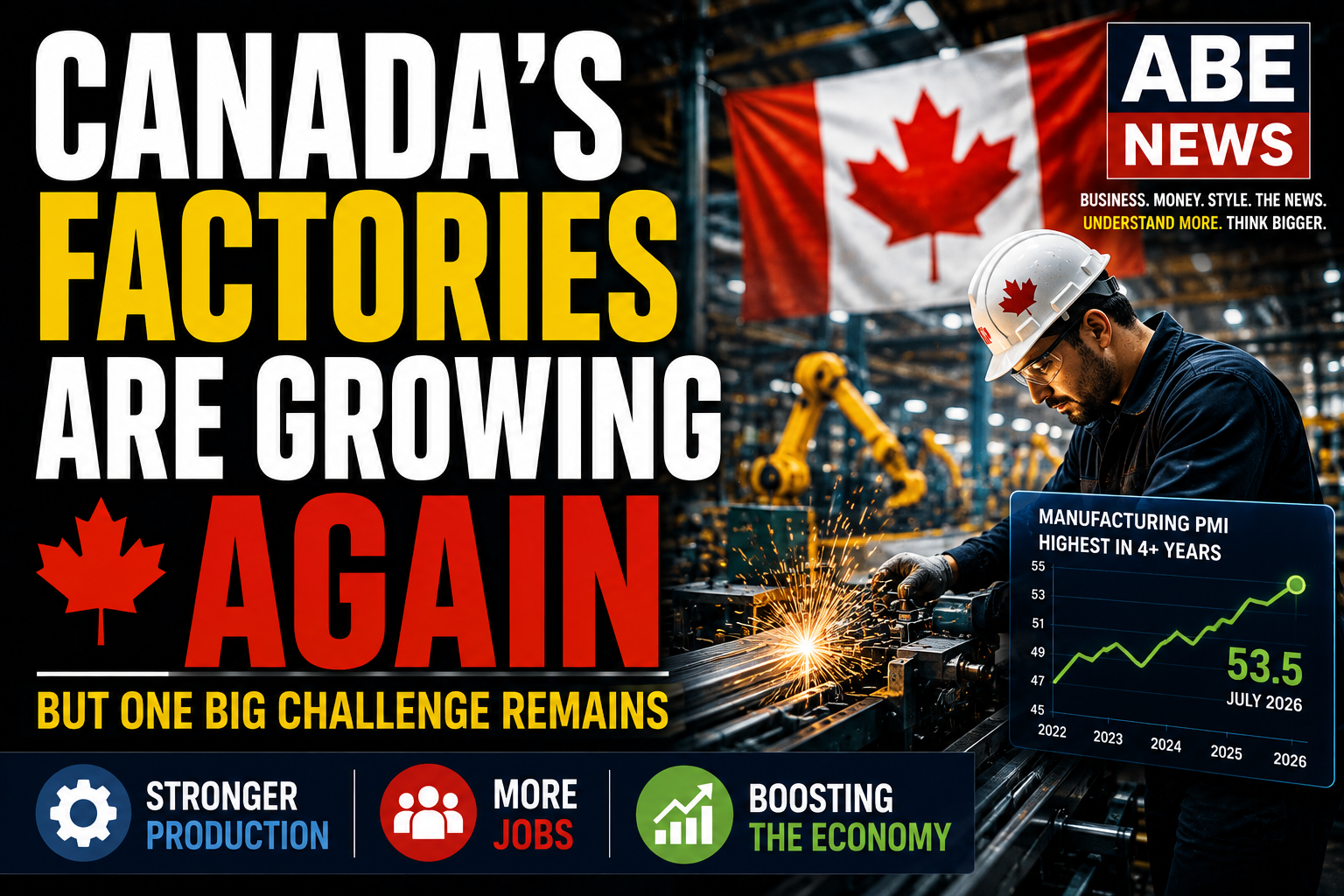
Canada’s manufacturing sector expanded for the seventh consecutive month in July, according to the latest S&P Global Canada Manufacturing PMI.
The index climbed to 53.5, its highest level in more than four years. Any reading above 50 signals that the manufacturing sector is growing rather than shrinking.
Manufacturers reported stronger domestic demand, more new orders and higher production. As activity increased, many businesses also added workers to keep up with growing workloads.
For an industry that has faced years of uncertainty, those are encouraging signs.
Why Manufacturing Matters
Manufacturing is much more than factories.
It supports supply chains.
Creates skilled jobs.
Drives exports.
Encourages innovation.
And helps build products that businesses and consumers use every day.
A stronger manufacturing sector can ripple across the wider economy, benefiting transportation, logistics, technology and local communities.
The Recovery Isn’t Complete
Despite the positive momentum, manufacturers remain cautious.
Many businesses continue to face weaker international demand, particularly because of ongoing trade tensions and tariffs affecting exports.
At the same time, higher energy costs have pushed up production expenses, making it more expensive to manufacture goods. Those pressures have also weakened business confidence about the months ahead.
In other words…
Canada’s factories are growing again.
But the road ahead is still uncertain.
Why It Matters
Manufacturing remains one of the foundations of Canada’s economy.
When factories receive more orders, they often hire more workers, invest in new equipment and strengthen local supply chains.
But manufacturers also depend on stable international trade.
If global demand weakens or tariffs increase, growth can slow quickly.
That’s why business leaders are watching both domestic demand and international trade conditions closely.
What’s Next?
The key question is whether this recovery can continue through the rest of the year.
If domestic demand remains strong while international trade conditions improve, Canadian manufacturing could continue expanding.
If trade tensions intensify or production costs rise further, businesses may become more cautious about investing and hiring.
The next few months will help determine whether this is the beginning of a longer recovery—or simply a strong stretch in a more challenging environment.
THE ABE NEWS TAKE
Manufacturing doesn’t usually dominate the headlines.
Artificial intelligence does.
Stock markets do.
Billion-dollar mergers do.
But behind almost every modern economy is a manufacturing sector that quietly keeps businesses moving.
Canada’s latest factory data is encouraging because it shows resilience.
Companies are still producing.
Still hiring.
Still investing.
But resilience shouldn’t be mistaken for certainty.
Long-term success will depend on more than one strong month.
It will require competitive businesses, reliable trade relationships and continued investment in innovation.
A growing factory today is good news.
A competitive manufacturing sector for the next decade is the real goal.
ABE NEWS
Business. Money. Style. The News.
Understand More. Think Bigger.
Sources
- Reuters — Canada’s manufacturing sector reaches a four-year high as domestic demand strengthens.