









ABE NEWS | THURSDAY, AUGUST 20, 2026
For years, scientists have talked about a future where cancer treatment could be designed specifically for one person’s tumor.
That future may have just moved significantly closer.
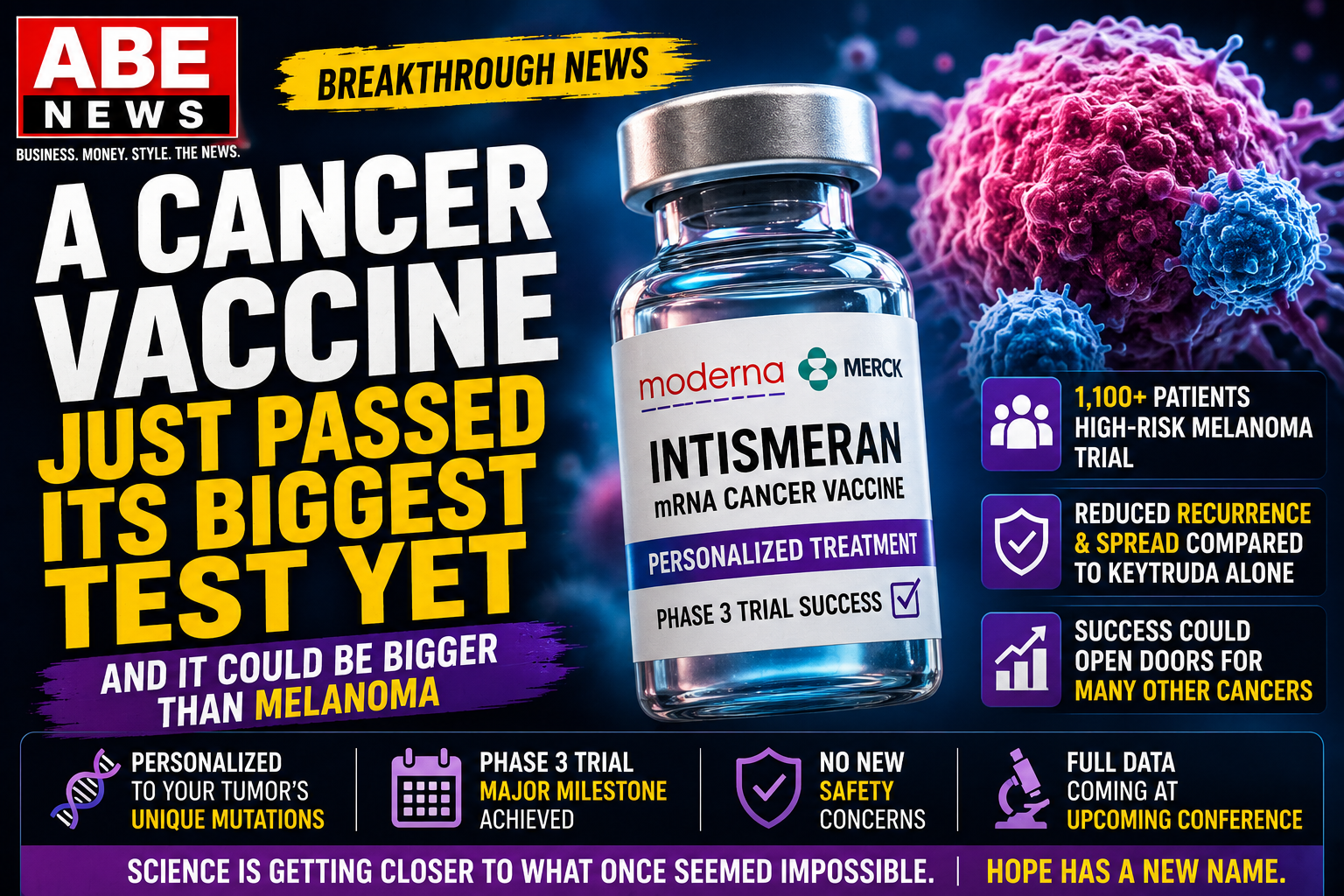
Moderna and Merck announced that their experimental personalized mRNA cancer vaccine, intismeran, succeeded in a large Phase 3 trial involving 1,137 patients with high-risk melanoma whose tumors had been surgically removed.
When the vaccine was combined with Merck’s immunotherapy drug Keytruda, patients went longer without their cancer returning and were less likely to have it spread elsewhere than patients receiving Keytruda alone.
It’s the first positive late-stage trial for an mRNA cancer vaccine.
But there’s an important distinction:
This is not a cure for cancer.
The complete trial results haven’t been released yet, overall-survival data are still being collected, and regulators haven’t approved the treatment.
What happened is still potentially a major milestone.
🧬 This Isn’t a Normal Vaccine
When most people hear “vaccine,” they think about preventing an infection before it happens.
This treatment works differently.
Intismeran is designed for people who already have cancer. Doctors analyze genetic mutations from an individual patient’s tumor and create a personalized mRNA treatment designed to teach that person’s immune system what cancer cells to recognize and attack.
In other words, two melanoma patients may receive different versions of the vaccine because their tumors contain different mutations.
That’s what makes this technology particularly interesting.
Traditional cancer treatments are often developed for large groups of patients.
This approach asks a different question:
What if we design part of the treatment specifically for you?
Why This Trial Matters
We’ve seen encouraging cancer-vaccine results before. The difference now is the size and stage of the evidence.
This was a Phase 3 trial — typically the crucial late-stage test used to determine whether an experimental treatment works well enough and is safe enough to support regulatory approval.
The combination met the trial’s main goal of improving recurrence-free survival and also met an important secondary goal involving distant metastasis-free survival. No new safety concerns were identified.
That doesn’t tell us everything.
Moderna and Merck haven’t yet disclosed exactly how large the benefit was in this Phase 3 study. Detailed results are expected at an upcoming medical conference, and analysts are waiting for information about overall survival, safety and the practical challenge of manufacturing an individualized vaccine for every patient.
So there’s reason for excitement — but also reason for patience.
Investors certainly chose excitement.
Moderna’s stock surged dramatically after the announcement, while Merck shares also jumped as investors began reconsidering the commercial potential of personalized cancer vaccines.
🌍 Why This Could Become Bigger Than Melanoma
This may be the most important part of the story.
Moderna and Merck aren’t developing personalized mRNA treatments only for melanoma.
The technology is also being investigated across other cancers, including lung, bladder, kidney, pancreatic and stomach cancers.
That doesn’t mean the melanoma results prove those treatments will work. Different cancers behave differently, and each indication needs its own clinical evidence.
But a successful Phase 3 melanoma trial provides something the entire field desperately needed:
Proof that the concept can work in a large late-stage study.
If researchers can repeatedly identify mutations unique to a patient’s tumor, encode selected targets into mRNA and train the immune system to attack cells carrying them, personalized cancer vaccines could eventually become another major weapon alongside surgery, chemotherapy, radiation and immunotherapy.
There’s still a long road between today’s announcement and that future.
But we’ve crossed an important checkpoint.
🔴 THE ABE NEWS TAKE
The most remarkable thing about this vaccine isn’t simply that it uses mRNA.
It’s the word:
Personalized.
Medicine has traditionally been built around categories.
You have this disease.
You receive this treatment.
But cancer isn’t one disease, and even two people diagnosed with the same type of cancer can have tumors with different genetic characteristics.
Personalized medicine turns that problem into an opportunity.
Instead of asking only:
“What treatment works against melanoma?”
Scientists can increasingly ask:
“What does this patient’s tumor look like — and how can we teach their immune system to recognize it?”
We shouldn’t call this a cure.
We shouldn’t assume it will work against every cancer.
And we shouldn’t get ahead of the detailed Phase 3 data that scientists still need to examine.
But after years of promises surrounding personalized cancer vaccines, Moderna and Merck have now cleared one of the biggest hurdles in medicine:
A successful late-stage clinical trial.
The next question isn’t whether the idea sounds futuristic anymore.
It’s whether regulators, doctors and future trials can turn that idea into something patients routinely receive.
ABE NEWS
Business. Money. Style. The News.
Understand More. Think Bigger.