








ABE NEWS | August 30, 2026
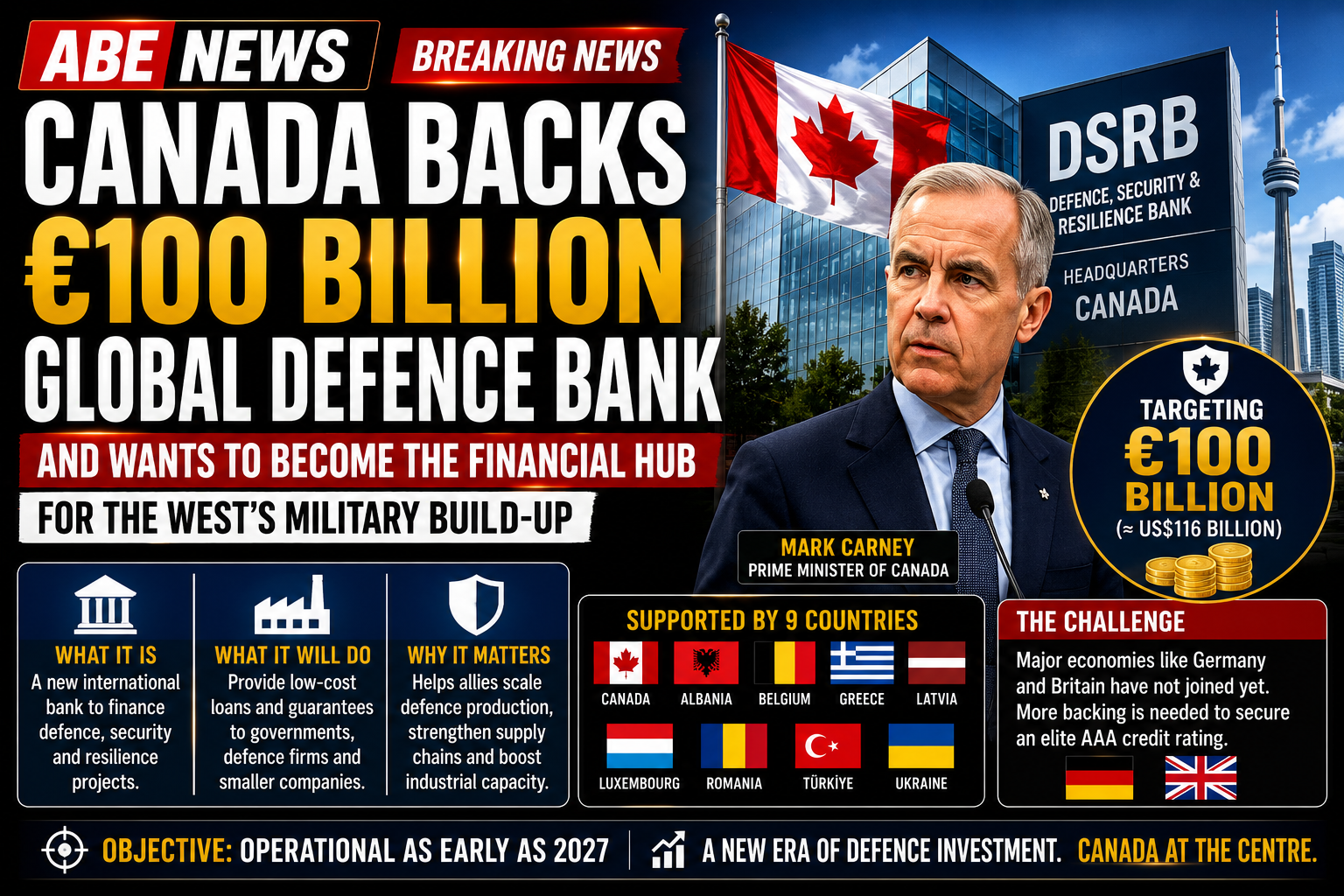
Canada is positioning itself at the centre of an ambitious attempt to transform how Western countries finance defence, as Prime Minister Mark Carney throws Ottawa’s weight behind a proposed international bank seeking to mobilize roughly €100 billion — about US$116 billion — for defence, security and military-industrial investment.
The proposed Defence, Security and Resilience Bank, or DSRB, would operate differently from a traditional commercial bank. Its purpose would be to use the financial strength of participating governments to raise capital cheaply and then provide long-term loans and guarantees for governments, defence contractors and smaller companies struggling to obtain affordable financing.
And Canada would sit at the centre of it.
Participating countries have selected Canada to host the future global headquarters of the institution, while Luxembourg is expected to serve as its European base. Ottawa has become one of the strongest political forces behind the project as Western governments dramatically increase military spending in response to a more unstable global security environment.
Canada is joined by Albania, Belgium, Greece, Latvia, Luxembourg, Romania, Türkiye and Ukraine in supporting the establishment of the bank.
But the project is also entering a crucial test.
Major economies including Germany and Britain have not yet committed to joining, and without additional large sovereign backers, questions remain about whether the bank can obtain the elite credit rating it wants — and whether it can truly become the financial engine behind a new era of Western defence investment.
If it succeeds, however, Canada could find itself hosting something unprecedented:
a global multilateral financial institution built specifically to finance security and defence.
THE IDEA: BUILD A BANK FOR DEFENCE
For decades, international development banks have used the financial backing of governments to raise enormous amounts of money.
The World Bank finances development.
The European Investment Bank supports infrastructure and investment.
Regional development banks finance projects across Africa, Asia and Latin America.
The DSRB would attempt to apply elements of that model to defence.
Instead of every government relying exclusively on its own budget and borrowing capacity to finance military expansion, participating countries would establish a common financial institution capable of raising money from capital markets.
The bank would then provide lower-cost, longer-term financing for defence and security projects.
It would also provide guarantees to private lenders financing smaller defence companies that banks might otherwise consider too risky.
That second function could prove particularly important.
Large defence corporations generally have access to major banks and capital markets.
Smaller manufacturers often do not.
Yet those smaller companies can produce critical components, drones, sensors, software, cyber-security systems, artificial intelligence technologies and other equipment increasingly important to modern warfare.
The DSRB’s supporters believe financing has become one of the bottlenecks preventing those businesses from expanding quickly enough.
The bank is designed to attack that bottleneck with money.
€100 BILLION IS THE AMBITION
The scale being discussed is enormous.
The DSRB is seeking to mobilize roughly €100 billion, equivalent to approximately US$116 billion.
According to people familiar with the plans cited by Reuters, the project had secured roughly €5 billion in commitments by August.
The longer-term structure under discussion would involve approximately €20 billion in paid-in capital, with another €80 billion available to be called upon when necessary.
That financial foundation could allow the institution to borrow in global markets.
The key would be its credit rating.
If the DSRB can secure a AAA rating, it could potentially borrow at very favourable rates and pass some of that advantage on to participating governments and companies.
That is one of the fundamental ideas behind multilateral financial institutions.
Governments combine their financial credibility.
The institution raises capital.
That capital is then deployed toward projects considered strategically important.
In this case, those projects would be connected to defence, security and resilience.
WHY CANADA WANTS TO LEAD IT
For Canada, this is about much more than hosting another international institution.
Carney has increasingly argued that middle powers need to build stronger economic and strategic institutions as the international order becomes more fragmented.
The DSRB fits directly into that worldview.
Rather than depending entirely on the United States or existing European institutions, participating countries would create another mechanism capable of financing their own security requirements.
Canada’s government says the bank could expand defence production, strengthen supply chains and help smaller companies scale.
It also sees an economic opportunity.
Defence spending is no longer simply being treated as a government expense.
Across NATO, governments increasingly describe it as industrial policy.
New factories must be built.
Production lines must expand.
Engineers must be hired.
Artificial-intelligence systems must be developed.
Cyber-security infrastructure must be strengthened.
Space technologies must be financed.
Supply chains for ammunition, aircraft, drones, ships and other equipment must become more resilient.
Billions of dollars flowing into those industries can create companies, jobs, exports and technological capabilities.
Hosting the institution responsible for financing part of that expansion could give Canada greater influence over the financial architecture surrounding the defence boom.
CANADA’S OWN DEFENCE INDUSTRY COULD BENEFIT
Canada already has a significant defence-industrial sector.
According to the federal government, more than 530 companies directly participated in Canada’s defence sector in 2024.
Those businesses directly accounted for approximately 37,700 jobs, while the broader defence value chain supported about 62,100 jobs.
The sector generated approximately C$17.3 billion in revenue and contributed roughly C$8.6 billion to Canadian GDP across the defence value chain.
Ottawa believes those numbers could grow considerably.
Canada’s broader Defence Industrial Strategy points to approximately C$180 billion in defence procurement opportunities and another C$290 billion in defence-related capital investment opportunities over the coming decade.
That means the DSRB is emerging while Canada itself is preparing for one of the largest defence-investment cycles in its recent history.
For Canadian manufacturers, aerospace companies, AI businesses, cyber-security firms and advanced-technology startups, that could create opportunities extending well beyond traditional military contracting.
If the DSRB finances projects across member countries, companies located in participating economies could potentially gain access to a much larger international market.
That is one reason membership matters.
This isn’t simply about governments borrowing money.
It could determine which countries’ companies participate in the next generation of defence supply chains.
UKRAINE EXPLAINS WHY THIS IS HAPPENING
The bank cannot be separated from the dramatic transformation of global security over the past several years.
Russia’s full-scale invasion of Ukraine exposed how difficult it can be for Western countries to rapidly increase military production.
Ammunition stocks were depleted.
Factories struggled to expand quickly.
Supply chains faced shortages.
Governments discovered that maintaining military readiness requires enormous industrial capacity — capacity that cannot simply be created overnight when a war begins.
Ukraine has also demonstrated how quickly military technology is changing.
Drones that can cost a fraction of traditional weapons have transformed battlefields.
Artificial intelligence is increasingly being integrated into targeting, intelligence and autonomous systems.
Electronic warfare has become critical.
Software updates can alter military capabilities.
Commercial technology companies increasingly overlap with national-security infrastructure.
The defence industry is therefore expanding beyond traditional companies manufacturing tanks, fighter jets and missiles.
That creates a financing problem.
Many of the companies developing emerging defence technologies are smaller businesses.
Some banks have historically been reluctant to finance weapons-related companies because of regulatory, reputational or environmental, social and governance considerations.
The DSRB is intended partly to change that equation.
THE BIG PROBLEM: SOME OF THE WEST’S LARGEST ECONOMIES AREN’T IN
Despite Canada’s enthusiasm, the project faces a major obstacle.
Several of the world’s most financially powerful governments have not joined.
Germany has remained cautious.
Britain previously declined to participate.
Japan has not made a decision.
Other G7 economies are also absent from the current group.
That matters because the bank’s financial strength will depend partly on the creditworthiness of its shareholders.
A multilateral institution backed by numerous wealthy governments has a stronger argument for receiving the AAA credit rating the DSRB wants.
Without enough large economies participating, achieving that rating could become more difficult.
And without a top credit rating, the bank may not be able to borrow as cheaply.
That could weaken one of its central selling points.
There is therefore a chicken-and-egg problem.
Countries may hesitate to join until they are convinced the bank can offer genuinely attractive financing.
But the bank may need those countries to join before it can achieve the financial strength necessary to provide that financing.
Canada is trying to break that cycle.
WHY BRITAIN AND GERMANY ARE HESITATING
The debate is not simply about whether governments support defence spending.
Most European governments are already increasing military budgets.
The question is whether they need another institution to finance it.
The European Union already operates its €150 billion Security Action for Europe programme, commonly known as SAFE, which provides financing intended to strengthen European defence capabilities.
Britain is separately developing a Multilateral Defence Mechanism with countries including the Netherlands, Finland and Poland, focused on joint procurement.
Some governments therefore question whether another defence-financing institution would create unnecessary duplication.
There are also concerns about governance.
Who decides which projects receive financing?
How much capital must each country contribute?
Which industries qualify?
How much influence does each member receive?
Would governments with strong national credit ratings actually save money by borrowing through the DSRB?
Those questions remain central to negotiations.
Supporters argue that the DSRB would be permanent, global and capable of working alongside existing procurement programmes rather than competing with them.
Critics and undecided governments still need convincing.
THERE IS ALSO A BUSINESS BATTLE UNDERNEATH THE POLITICS
Countries considering membership have another reason to pay attention:
their companies.
If the DSRB becomes a major source of financing for defence projects, membership could influence which national industries gain access to those projects.
That possibility is already attracting interest from business groups.
British and German defence-industry representatives have reportedly encouraged their governments to participate.
Their concern is straightforward.
If countries outside the bank cannot access certain DSRB-financed opportunities as easily as members, domestic defence companies could find themselves at a competitive disadvantage.
That changes the political calculation.
Governments aren’t simply deciding whether to join another international organization.
They may also be deciding whether their domestic companies participate fully in a potentially enormous new defence-investment market.
WALL STREET AND EUROPEAN BANKS ARE WATCHING
Private finance is also paying attention.
Around a dozen banks, including major financial institutions such as JPMorgan and Deutsche Bank, have provided approximately $10 million in funding or services to support efforts to establish the DSRB, according to Reuters reporting.
There is a commercial reason for their interest.
A €100-billion financing institution could generate major opportunities for banks involved in arranging debt, underwriting transactions and financing defence projects.
The defence build-up is therefore creating an ecosystem extending far beyond weapons manufacturers.
Governments provide capital.
Multilateral institutions borrow.
Commercial banks arrange financing.
Private investors provide additional money.
Manufacturers expand factories.
Technology companies develop systems.
And governments purchase the resulting equipment.
The DSRB is attempting to become one of the institutions sitting near the centre of that financial network.
CANADA COULD BECOME A DEFENCE-FINANCE CENTRE
Hosting the bank could have longer-term implications for Canada’s financial sector.
Major multilateral institutions attract more than office workers.
They attract bankers.
Lawyers.
Risk specialists.
Economists.
Investment professionals.
Government delegations.
Defence executives.
Technology companies.
Consultants.
International conferences.
And financial transactions.
Canada has strong banking institutions and deep capital markets, but Toronto and Montreal still compete globally with financial centres such as New York, London, Singapore and Frankfurt.
Hosting a new international institution managing potentially tens of billions of euros could give Canada a specialized role in an emerging sector:
defence finance.
That doesn’t mean Canada suddenly becomes the world’s military banking capital.
The DSRB still has to be formally established, capitalized and successfully launched.
But the opportunity is unusual.
International financial institutions of this scale are not created every year.
And when they are created, the location of their headquarters can matter for decades.
THE TARGET IS 2027
The participating governments have already negotiated founding Articles of Agreement.
Canada was unanimously selected during those negotiations to host the future headquarters.
The next phase involves countries completing their domestic treaty and ratification processes.
Canada says the objective is for the DSRB to begin operating as early as 2027.
Before that happens, several important questions must be answered.
Which additional countries will join?
How much capital will they commit?
Will Britain reconsider?
Will Germany participate?
Can the institution secure its desired AAA credit rating?
And will governments conclude that the DSRB can genuinely provide cheaper or more effective financing than existing programmes?
Those answers will determine whether this becomes a major global financial institution or a smaller initiative supported primarily by middle powers and countries facing immediate security threats.
🔴 THE ABE NEWS TAKE
Something much bigger than another defence programme is taking shape here.
For decades, Western military power depended not only on armies and weapons but on an enormous economic system capable of financing them.
Now that system is being redesigned.
Governments have realized that promising to spend more on defence is easy.
Building factories, expanding supply chains, financing smaller manufacturers and producing enough equipment for a prolonged period of geopolitical instability is much harder.
Canada sees an opportunity inside that problem.
The proposed Defence, Security and Resilience Bank would turn military preparedness into a financial architecture — using government backing and global capital markets to fund the factories, technologies and companies behind Western security.
And Canada wants the institution headquartered on Canadian soil.
That could mean investment.
It could mean influence.
It could mean contracts for Canadian companies.
It could strengthen Canada’s position within NATO and among middle powers.
And it could give the country a new role in an industry likely to attract hundreds of billions of dollars in investment over the coming decade.
But €100 billion remains an ambition, not money already sitting inside a Canadian defence bank.
The institution still needs more capital.
It still wants more major countries.
It still needs its credit rating.
And it still has to prove that it can offer governments something existing European and national programmes cannot.
That distinction matters.
Canada isn’t hosting a €100-billion defence bank yet.
It is trying to build one.
If Carney succeeds, however, Canada may have done more than attract the headquarters of another international institution.
It may have positioned itself near the financial centre of one of the largest military-industrial expansions the Western world has seen in decades.
And that is a story about defence.
But it is just as much a story about money, industry, technology — and Canada’s place in the changing global economy.
ABE NEWS
Business. Money. Style. The News.
Understand More. Think Bigger.