










ABE MAGAZINE | CANADA • BUSINESS & ECONOMY
October 11, 2026
After years of industrial pressure, declining factory employment and growing trade uncertainty, Canada is trying to strengthen its manufacturing base. But rebuilding the country’s industrial economy will require more than government incentives and promises of new investment.
The Factories Behind Canada’s Economic Future
For decades, manufacturing helped define Canada’s economic identity. From automobile assembly plants in Ontario to aerospace facilities in Quebec, steel production in Hamilton and food-processing operations across the Prairies, Canadian factories supported communities, created skilled employment and connected the country to global markets.
Manufacturing was never simply about producing goods. It was about building industries, developing technical expertise and creating economic opportunities that could sustain families across generations.
Today, that industrial foundation faces growing pressure. According to Statistics Canada’s review of manufacturing employment in 2025, the sector had just over 1.5 million payroll employees in December 2025, approximately 40,600 fewer than a year earlier. Manufacturing output fell by 2.6% during 2025, marking a third consecutive annual decline. Total manufacturing sales slipped to $848.7 billion.
These figures suggest an industry confronting more than a temporary slowdown. Canada must now decide whether it can strengthen its industrial competitiveness in a world where trade relationships are changing and governments increasingly regard domestic production as a strategic priority.
The question is not whether Canada should return to the factories of the past. It is whether the country can build the manufacturing economy of the future.
How Canada Became Dependent on American Demand
Canada’s manufacturing economy is deeply connected to the United States. The two countries share extensive supply chains, particularly in automotive production, machinery, metals and industrial components. A vehicle assembled in Ontario may contain parts produced on both sides of the border.
This integration has provided Canadian manufacturers with access to one of the world’s largest consumer markets. But it has also created a significant vulnerability.
Statistics Canada research on manufacturing exports and employment found that manufacturing employment grew by approximately 229,000 jobs between 2020 and 2024. About 161,000 of those jobs were directly or indirectly associated with export production, with roughly 139,000 linked to American demand.
That dependence becomes particularly important when trade policies change. Tariffs, border restrictions and uncertainty over market access can influence where companies invest and how they organize production. The risk is not simply that exports become more expensive; international companies may reconsider whether Canada remains the most attractive location for their next major expansion.
The Trade Pressure Facing Canadian Industry
The return of aggressive trade policies has complicated Canada’s industrial outlook. American tariffs have affected Canadian producers and contributed to uncertainty over future investment.
Statistics Canada business surveys have found that many manufacturers reported negative effects from U.S. tariffs, while some businesses also experienced increased demand for Canadian-made products. The contrast illustrates the complexity of trade disruption: some companies face declining competitiveness in their largest export market, while others benefit when customers seek domestic alternatives.
Canada cannot easily replace the American market. Its geographic proximity, established infrastructure and integrated production networks remain substantial advantages. A more realistic objective may be to reduce excessive dependence while preserving a commercially valuable relationship.
The Automotive Industry Is at a Crossroads
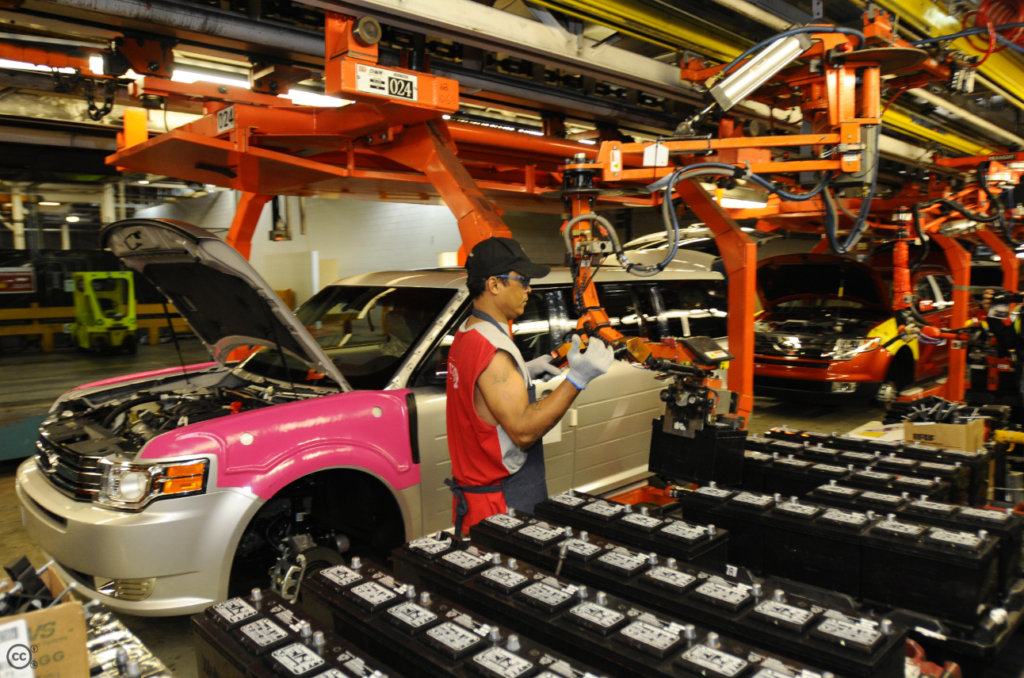
Few industries illustrate Canada’s manufacturing challenge more clearly than automotive production. Ontario’s automotive sector has supported generations of skilled workers, suppliers and manufacturing communities. But the industry now faces changing trade policies, international competition and major shifts in vehicle production.
In February 2026, the federal government announced a new Canadian automotive strategy, including $3 billion from the Strategic Response Fund and up to $100 million through the Regional Tariff Response Initiative to help the sector adapt and expand.
Public investment alone cannot guarantee industrial success. Automakers consider production costs, labour availability, transportation infrastructure, market access and long-term profitability when deciding where to build vehicles. The central challenge is ensuring that industrial support produces lasting economic value rather than temporary investment announcements.
Why Factory Jobs Matter Beyond the Factory
Manufacturing employment has consequences far beyond production floors. A successful factory creates demand for transportation, maintenance, engineering, packaging, logistics and professional services. Its workers spend money in nearby communities, supporting local businesses and contributing to municipal tax revenues.
When a major employer reduces operations, suppliers may lose contracts, local businesses may experience lower spending and younger workers may encounter fewer opportunities to enter skilled trades.
Manufacturing can also offer pathways to financial stability for workers who do not necessarily follow a traditional university education. That makes industrial competitiveness an issue of economic opportunity, not simply trade statistics.
The Investment Problem Canada Cannot Ignore
Rebuilding manufacturing requires investment. Factories need modern machinery, reliable infrastructure, efficient transportation networks and workers with specialized skills.
According to Statistics Canada’s February 2026 capital expenditure report, manufacturing capital investment declined by 2.6% in 2025 to approximately $34 billion. Investment intentions for 2026 indicated further weakness, particularly in transportation equipment and primary metal manufacturing.
Factories cannot remain internationally competitive indefinitely without renewing their equipment and improving production processes. Improving productivity can help manufacturers increase wages while remaining competitive.
In September, Ottawa proposed a Productivity Mega Deduction, intended to encourage businesses to invest by allowing faster tax deductions on qualifying capital expenditures. But projected benefits are not guaranteed: the measure’s impact will depend on whether businesses respond by expanding productive capacity.
Can Canada Compete Without Becoming Protectionist?
The desire to rebuild domestic manufacturing often leads to calls for buying Canadian products, restricting imports or subsidizing national industries. Governments may reasonably want to protect strategically important capabilities, respond to unfair trade practices or reduce vulnerabilities in essential supply chains.
However, protectionism also carries costs. Import restrictions can raise prices for consumers and businesses. Domestic manufacturers may depend on imported components that cannot easily be produced locally. Subsidies can support investment, but poorly designed programs risk directing public money toward projects that would not otherwise be commercially viable.
Canada benefits from international trade. Rebuilding manufacturing should not mean withdrawing from global markets; it should mean becoming a more competitive participant in them.
A More Diverse Industrial Future
Canada has opportunities beyond traditional automotive and steel production. Food processing, aerospace, pharmaceuticals, machinery, industrial equipment, advanced materials and value-added resource processing all offer potential areas for development.
But converting advantages into competitive industries requires more than resource availability. Companies need access to financing, dependable infrastructure, skilled workers and customers.
Canada’s August 2026 international trade report showed exports to the United States increasing during the month while goods exports to non-American destinations declined. Diversification takes commercial relationships, transportation connections, regulatory compliance and sustained investment—not simply announcements about new trading partners.
The Next Generation of Canadian Manufacturing Workers

Canada’s industrial future also depends on people. Manufacturing requires electricians, welders, machinists, industrial mechanics, engineers, technicians, production workers and logistics professionals.
As factories modernize, some occupations will change and new technical skills will become increasingly valuable. Apprenticeships, technical education and employer-supported training are essential, but workforce development must be connected to actual employment opportunities.
Training thousands of workers for industries that are not expanding would accomplish little. Similarly, attracting new factories without developing the local workforce could leave businesses struggling to fill specialized positions.
What the Latest Numbers Tell Us
The most recent labour-market figures offer another reminder of the industry’s vulnerability. Statistics Canada reported that manufacturing employment fell by approximately 13,000 positions in September 2026, following an increase of about 22,000 in August. Compared with September 2025, manufacturing employment was little changed.
These fluctuations should not be interpreted as proof of a permanent decline or recovery. They show an industry operating in an uncertain economic environment.
Statistics Canada’s preliminary estimate suggested manufacturing sales increased by 1.1% in August, although the agency cautioned that the figure could be revised. The official August manufacturing sales release is scheduled for October 15.
THE ABE TAKE
Canada does not need to recreate the manufacturing economy of the twentieth century. It needs to build an industrial economy capable of competing in the twenty-first.
Industrial strength cannot be measured simply by the number of factories opened or the size of government investment announcements. It must be measured by productivity, sustainable employment, export competitiveness, private investment and the ability of Canadian businesses to succeed without permanent dependence on public support.
Canada has significant advantages: natural resources, an educated workforce, established industrial expertise and access to major international markets. But advantages alone do not guarantee success.
Trade diversification is necessary, but it will take time. Government support can help, but it must be disciplined and accountable. And workers must have access to the skills and opportunities required to participate in a changing industrial economy.
The real test of Canada’s manufacturing revival will not be how much money is promised. It will be how much lasting economic value is created.
If Canada can build industries that are productive, internationally competitive and capable of supporting good employment, manufacturing can remain a central part of its economic future. If it cannot, ambitious industrial strategies may become little more than expensive promises.
ABE MAGAZINE
Understand More. Think Bigger.