






ABE NEWS | September 6, 2026
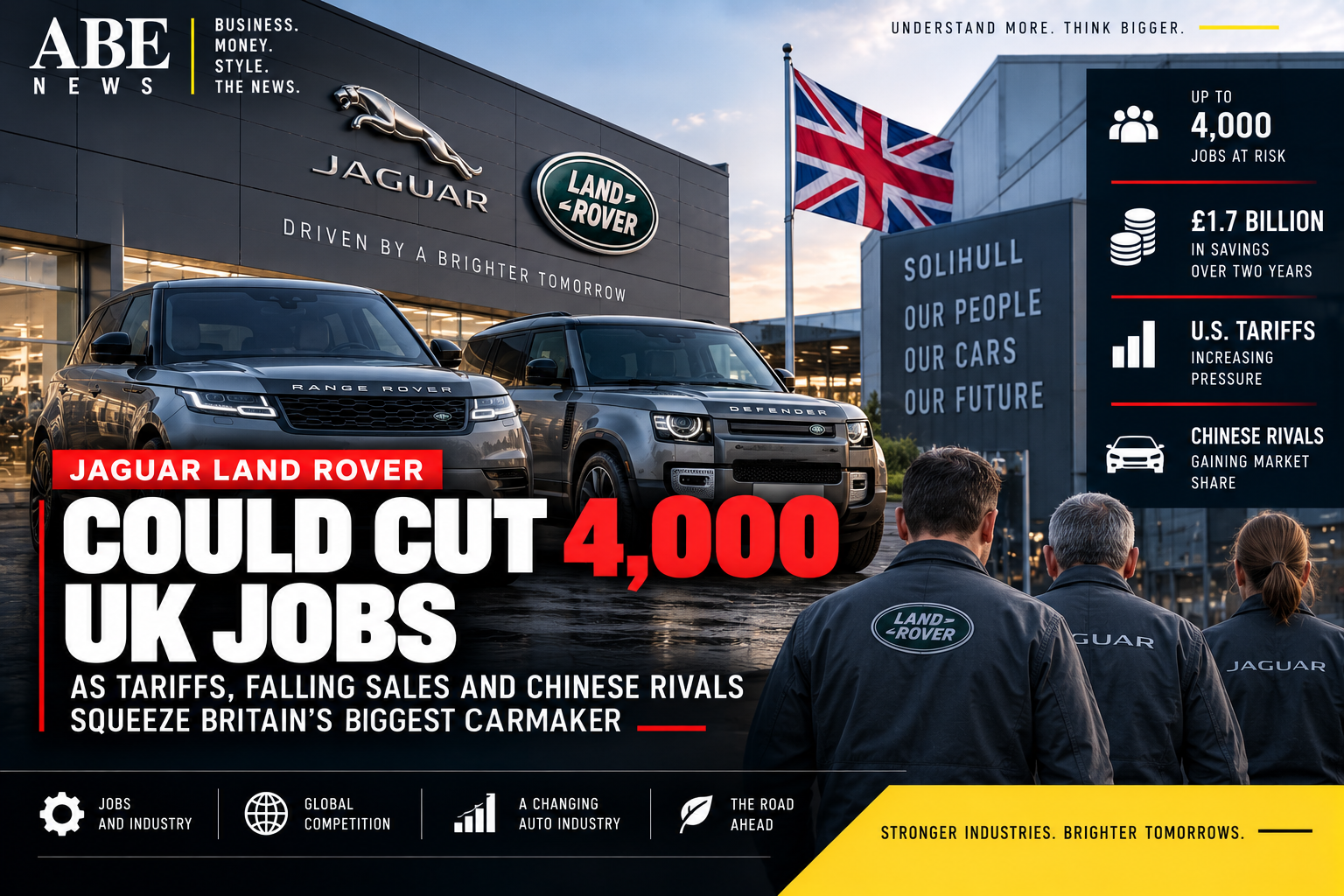
Jaguar Land Rover is preparing for a significant restructuring of its British operations as the luxury carmaker tries to cut £1.7 billion in costs over the next two years, confronting weaker sales, trade barriers and intensifying competition from Chinese manufacturers.
The company has confirmed that it will open a voluntary redundancy programme, while British media reports suggest that as many as 4,000 jobs could eventually be affected. Jaguar Land Rover has not confirmed that figure, making the scale of the final reductions uncertain ahead of a formal announcement expected on Monday.
For a company employing roughly 30,000 people in Britain, however, even the possibility of reductions on that scale has attracted government attention. UK Business Secretary Jonathan Reynolds is expected to meet Jaguar Land Rover’s leadership this week to discuss the restructuring and explore whether job losses can be minimized.
The immediate story is about jobs. The bigger story is about the rapidly changing economics of the global automobile industry.
Jaguar Land Rover — maker of the Range Rover, Defender, Discovery and Jaguar brands — is confronting pressure from several directions at once. U.S. tariffs are making access to one of its most important luxury markets more difficult, Chinese manufacturers are becoming increasingly competitive, and Europe’s traditional automakers are being forced to reconsider how much they spend, where they manufacture and what kinds of vehicles they build.
JLR’s restructuring therefore isn’t happening in isolation. It is part of a much larger transformation now sweeping through the global car industry.
£1.7 BILLION IN SAVINGS
Jaguar Land Rover, owned by India’s Tata Motors, is Britain’s largest carmaker and one of the country’s most recognizable industrial companies.
Its largest manufacturing operation is in Solihull in the West Midlands, where vehicles including the Range Rover and Range Rover Sport are produced. The company also operates major facilities elsewhere in Britain and supports a much larger network of suppliers, engineering businesses and service companies.
That makes significant reductions at JLR economically important beyond the company’s own payroll.
The restructuring is intended to deliver approximately £1.7 billion in savings over two years. The voluntary redundancy programme is expected to focus heavily on salaried and management positions rather than immediately targeting thousands of production-line workers.
But the cost-cutting target illustrates the pressure management believes the company is facing.
JLR sells premium vehicles with relatively high margins, meaning it does not need to compete for the same enormous volumes as mass-market manufacturers such as Toyota or Volkswagen. Its Range Rover and Defender brands also give the company considerable pricing power.
But luxury positioning does not protect an automaker from tariffs, economic weakness or structural changes in the industry.
And all three are now affecting the company.
AMERICA HAS BECOME MORE EXPENSIVE
The United States is particularly important to Jaguar Land Rover because wealthy American consumers are major buyers of its luxury SUVs.
Trade barriers therefore matter disproportionately.
Higher U.S. tariffs on imported vehicles increase the cost of selling British-built cars into the American market. Automakers then face an unpleasant choice: absorb some of the additional cost and accept lower margins, increase prices and risk losing customers, or change where vehicles are produced.
None is painless.
For a company such as JLR, which has spent decades building manufacturing operations and supply chains around Britain, relocating production cannot happen quickly.
Factories require enormous investment. Supplier relationships take years to establish. Workers need specialized skills. Vehicles must meet regulatory standards. Production lines are designed around particular models.
Tariffs can therefore alter the economics of a car long before a company has the ability to redesign its manufacturing footprint.
JLR’s situation also demonstrates why the current wave of global trade tensions is so consequential for the automobile industry. Cars are among the world’s most internationally integrated manufactured products. Components can cross borders multiple times before a completed vehicle reaches a customer.
When governments put barriers into that system, manufacturers eventually have to decide who absorbs the cost.
THEN THERE IS CHINA
Perhaps the more fundamental challenge comes from competition.
Chinese manufacturers have spent years improving vehicle quality, design, battery technology, software and manufacturing efficiency. Companies that were once viewed primarily as domestic Chinese competitors are increasingly expanding into Europe, the Middle East, Latin America and other international markets.
The competitive pressure is no longer limited to inexpensive electric vehicles.
Chinese brands are moving into SUVs, hybrids and increasingly premium segments traditionally dominated by European, Japanese and American manufacturers.
Britain provides a particularly interesting example.
Chery’s Jaecoo brand has grown rapidly, with the Jaecoo 7 emerging as one of the country’s best-selling vehicles. That puts Chinese manufacturers increasingly close to the territory occupied by established European SUV brands.
For JLR, this matters because Range Rover and Defender are central to its profitability.
Chinese competitors do not necessarily need to persuade every Range Rover customer to switch brands. They only need to become credible enough that consumers begin comparing them.
Once that happens, pricing power becomes harder to protect.
EUROPE’S AUTOMAKERS ARE ALL ASKING THE SAME QUESTION
Jaguar Land Rover is far from the only established manufacturer cutting costs.
Volkswagen’s supervisory board approved a sweeping transformation programme this week as Europe’s largest automaker confronts overcapacity, tariffs and Chinese competition. The plan includes tens of thousands of additional job reductions across the group and difficult decisions about German manufacturing plants.
Honda is also pursuing more than $9 billion in cost reductions by 2030, according to internal documents reviewed by Reuters, as it tries to respond to Chinese competition and losses associated with its electric-vehicle strategy.
These companies have different products, markets and financial positions, but the pressures are increasingly similar.
Manufacturing costs are high.
Vehicle development is expensive.
Software requires enormous investment.
Electrification requires capital.
Trade barriers are changing supply chains.
Chinese manufacturers are expanding.
Consumers remain price-sensitive.
And many traditional manufacturers carry large industrial structures built for a different era.
The result is a global race to become leaner before competitors become stronger.
JAGUAR’S TRANSFORMATION ADDS ANOTHER RISK
JLR also has a challenge unique to its portfolio: the reinvention of Jaguar.
Jaguar has spent recent years attempting one of the most dramatic repositionings in the automotive industry, moving away from its previous range and toward a much more exclusive luxury identity.
The strategy is risky.
Jaguar possesses one of Britain’s most historic automotive names, but heritage alone does not guarantee future sales.
The company needs to convince a new generation of affluent buyers that Jaguar belongs in a much more expensive segment while simultaneously competing with established luxury manufacturers.
That requires new vehicles, new technology, marketing and enormous capital expenditure at precisely the moment the wider company is trying to reduce costs.
Land Rover’s brands give JLR a strong foundation. Range Rover and Defender remain globally recognizable products.
But Jaguar’s transformation demonstrates the difficult balance management faces: cut spending without cutting away the investments required for future growth.
That is much harder than simply reducing headcount.
WHY 4,000 JOBS WOULD MATTER
The reported figure of up to 4,000 potential reductions should still be treated cautiously until JLR formally confirms the final scope.
But if cuts eventually approached that level, they would represent more than 10% of JLR’s approximately 30,000-person British workforce.
The effect would also extend beyond direct employees.
Large automobile plants support networks of suppliers producing components, engineering services, logistics, maintenance and other industrial services.
Automotive manufacturing also tends to create relatively well-paid skilled employment.
That is why the British government is becoming involved.
The restructuring arrives at an awkward moment for Prime Minister Andy Burnham’s government, which has pledged to strengthen British industry and pursue reindustrialisation.
A major reduction at Britain’s largest carmaker would underline how difficult that ambition may be when companies are simultaneously responding to global forces largely outside Westminster’s control.
Government policy can encourage investment.
But it cannot eliminate Chinese competition.
It cannot guarantee foreign demand.
And it cannot fully protect companies from trade policies imposed by other countries.
BRITAIN STILL HAS SOMETHING WORTH PROTECTING
Despite the challenges, Britain’s automotive industry remains significant.
The country has engineering expertise, major manufacturing plants, motorsport capabilities, luxury brands and a sophisticated supplier ecosystem.
JLR itself is evidence of that strength.
Range Rover has become a global luxury product while Defender has successfully evolved from a utilitarian vehicle into a highly desirable premium brand.
Those products demonstrate that British manufacturing can still create vehicles consumers around the world are willing to pay significant amounts to own.
The challenge is maintaining that advantage while the competitive environment changes.
The next generation of successful car companies will need expertise in more than engines and manufacturing.
Software increasingly matters.
Battery technology matters.
Electronics matter.
Supply-chain resilience matters.
Manufacturing efficiency matters.
And geopolitical strategy matters.
A vehicle company can design an excellent car and still struggle if tariffs make the economics unattractive or a competitor can manufacture a comparable product substantially more cheaply.
That is the reality traditional automakers are confronting.
THE CHINESE COMPETITION STORY IS BIGGER THAN PRICE
It would also be a mistake to assume Chinese automakers compete only by selling cheaper cars.
That may have been a useful description years ago.
It is increasingly outdated.
Chinese manufacturers have invested heavily in product development and have shortened the time required to bring new vehicles to market. They have built sophisticated domestic supply chains and gained experience in the world’s largest automobile market.
That combination allows companies to iterate quickly.
European automakers therefore face a competitor that can sometimes offer more technology at lower prices while developing new models faster.
A recent survey of German companies found 83% of industrial firms reported feeling competitive pressure from Chinese businesses. Companies said they were responding through innovation, cost reductions and expansion into new markets.
JLR’s cost programme fits directly into that broader response.
The issue isn’t simply whether Britain can prevent Chinese cars from entering its market.
It is whether established manufacturers can become competitive enough that consumers continue choosing them when given increasingly credible alternatives.
WHAT HAPPENS NEXT
More detail on Jaguar Land Rover’s restructuring is expected shortly, and the final number of redundancies remains one of the biggest unanswered questions.
The British government’s meeting with JLR leadership will also be important.
But the company’s longer-term performance will ultimately matter more than the immediate political response.
Can JLR deliver £1.7 billion in savings without damaging product development?
Can Range Rover maintain its pricing power?
Can Defender continue growing?
Can Jaguar’s reinvention produce commercially successful vehicles?
Can the company manage U.S. trade barriers?
And can it respond quickly enough to increasingly sophisticated Chinese competitors?
Those are much harder questions than deciding how many positions to eliminate.
🔴 THE ABE NEWS TAKE
The potential loss of thousands of jobs at Jaguar Land Rover deserves attention because of the people directly affected.
But focusing exclusively on the redundancies would miss the larger story.
The economics of making cars are changing.
For decades, European automakers benefited from some of the strongest brands, engineering capabilities and manufacturing systems in the world.
Those advantages still matter.
They are simply no longer enough on their own.
Chinese manufacturers have become serious international competitors. Trade barriers are reshaping where vehicles can be profitably manufactured. Electrification and software require huge investments, while consumers continue demanding better technology without unlimited tolerance for higher prices.
Traditional automakers are therefore being squeezed between the cost of protecting today’s business and the cost of building tomorrow’s.
Jaguar Land Rover’s £1.7 billion savings programme is one response.
Volkswagen’s enormous restructuring is another.
Honda’s cost-reduction programme is another.
Different companies. Different countries. Similar pressure.
That should tell us something.
This is not merely a bad quarter for one British manufacturer.
The global automobile industry is undergoing a redistribution of competitive power.
The companies that dominated the last several decades are being forced to prove they can dominate the next ones.
JLR enters that competition with significant advantages. Range Rover is one of the world’s best-known luxury automotive brands. Defender has become a major global product. Britain still possesses deep engineering talent.
But heritage does not guarantee competitiveness.
Customers ultimately buy the vehicle in front of them, not the history behind the badge.
That may be the uncomfortable lesson facing much of Europe’s automotive establishment.
The next few years will determine whether companies such as Jaguar Land Rover can use restructuring to become stronger — or whether cost cutting simply becomes a defensive response to competitors moving faster.
For Britain, there is another question.
If the country wants to remain a serious industrial economy, it needs companies such as JLR not merely to survive, but to invest, manufacture and grow.
Saving jobs today matters.
Creating globally competitive industries capable of supporting those jobs tomorrow matters even more.
ABE NEWS
Business. Money. Style. The News.
Understand More. Think Bigger.