




ABE NEWS | SEPTEMBER 25, 2026
The world of business spent this week confronting two realities at once.
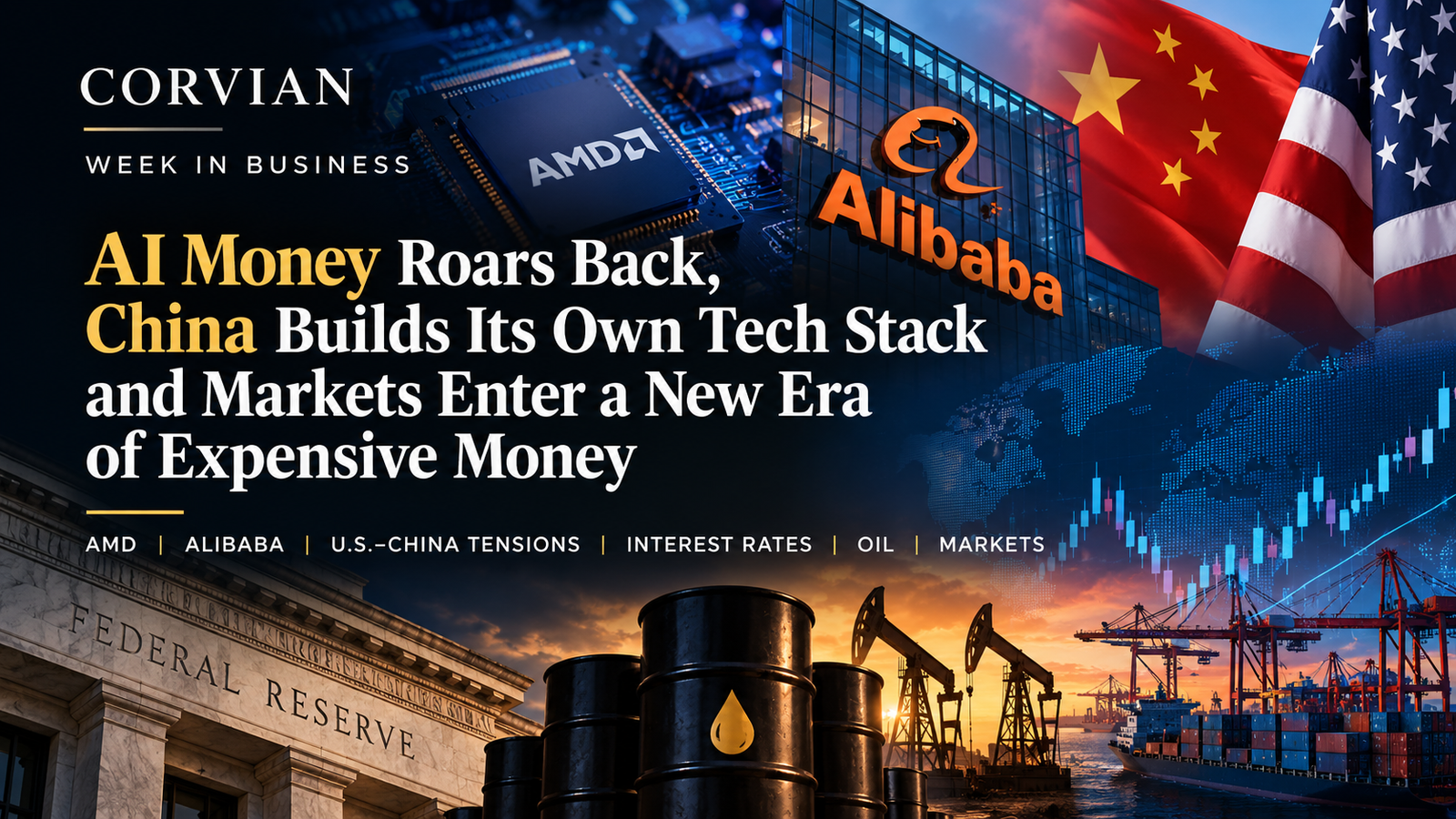
The first was exuberance. Artificial intelligence returned to the center of the market, pushing semiconductor companies higher, lifting the Nasdaq to a record and propelling AMD beyond a valuation once reserved for only the largest corporations on Earth. Alibaba, meanwhile, made clear that China does not intend to remain dependent on American technology for the infrastructure powering the AI era.
The second reality was much less comfortable. Interest rates are rising across major economies. Oil, despite retreating from recent highs, remains a source of inflation and geopolitical risk. The United States and China continue trying to manage an economic rivalry that stretches from tariffs and currencies to semiconductors, artificial intelligence and supply chains.
And in Sudan, a collapsing currency showed what happens when geopolitical fracture reaches deep into the foundations of an economy.
This was the week when markets rediscovered their appetite for technology — without escaping the risks surrounding it.
1. AMD JOINS THE $1 TRILLION CLUB AS AI MONEY RETURNS
One number captured Wall Street’s renewed enthusiasm for artificial intelligence this week: $1 trillion.
AMD crossed that market-value threshold for the first time on Monday as its shares surged 9.6% to a record $613.31. The milestone made AMD only the fourth U.S. chipmaker to reach a trillion-dollar valuation, following Nvidia, Broadcom and Micron. AMD shares had risen about 185% in 2026 at the time of the milestone, dramatically outperforming the Nasdaq’s roughly 15.8% gain.
The significance goes beyond another enormous technology valuation.
AMD has been trying to transform itself from a company selling individual processors into a supplier of complete AI computing systems, combining processors, networking equipment and other hardware. That puts it into a much broader contest with Nvidia for the infrastructure companies need to train and operate artificial-intelligence systems.
Investors had spent months questioning whether the extraordinary sums being invested in AI infrastructure could continue. This week’s rally suggested that, at least for now, that skepticism has not displaced enthusiasm.
AMD’s trillion-dollar moment therefore represents something larger: investors are still willing to assign extraordinary value to companies they believe could control important pieces of the AI economy.
2. ALIBABA WANTS CHINA TO CONTROL MORE OF THE AI STACK
If AMD’s rise illustrated America’s AI investment boom, Alibaba demonstrated how quickly China is trying to build an alternative technology ecosystem.
At its Apsara conference in Hangzhou, Alibaba announced that it is developing future AI models with roughly 5 trillion to 10 trillion parameters. Its current flagship Qwen 3.8 Max has 2.4 trillion parameters. The company also unveiled the Zhenwu V900, a new processor developed by its T-Head semiconductor unit. Alibaba says the chip delivers three times the performance of its predecessor and is expected to enter commercial production in the first quarter of 2027.
Alibaba is not stopping at models or chips.
Chief Executive Eddie Wu said Alibaba Cloud aims to build more than 20 gigawatts of global data-center capacity by 2032. The company’s Hong Kong-listed shares climbed 5.1% following the announcements.
That combination matters.
The global AI competition is increasingly about controlling an entire stack: chips, computing infrastructure, data centers, models, software and distribution.
U.S. export restrictions have made access to advanced American processors more difficult for Chinese companies. Rather than ending China’s AI ambitions, those restrictions have also created powerful incentives for Chinese companies to develop domestic alternatives.
Alibaba is now attempting exactly that.
The AI race is therefore becoming more than a competition between individual companies. It is increasingly a competition between technology ecosystems.
3. U.S.–CHINA ECONOMIC RIVALRY MOVES BACK TO CENTER STAGE
Few relationships matter more to global business than the one between Washington and Beijing.
Ahead of this week’s high-level U.S.–China meetings, trade, artificial intelligence, supply chains and geopolitical tensions were all under scrutiny. One of the central economic questions was whether the two countries could preserve the relative stability created by their existing trade truce.
China entered the week with considerable economic leverage.
Its global trade surplus is on course to exceed $1 trillion for a second consecutive year, according to Reuters. More than half of roughly 6,500 categories of Chinese products sold to the United States had increased compared with 2025, despite Washington’s efforts to reshape the trading relationship.
Even China’s currency became part of the story.
The yuan strengthened to its highest level in more than three and a half years against the U.S. dollar on Monday. The People’s Bank of China had eased some of its resistance to currency appreciation ahead of the summit, although analysts cautioned that this did not necessarily signal the beginning of a long-term strengthening cycle.
This is why U.S.–China competition can no longer be understood simply as a tariff dispute.
It now reaches semiconductors, artificial intelligence, rare earths, currencies, manufacturing, agricultural purchases, technology standards and global supply chains.
For companies operating across these markets, geopolitics is becoming part of ordinary business strategy.
4. MARKET WATCH — AI LIFTS STOCKS, OIL RETREATS, BUT HIGHER RATES REMAIN
Markets received some relief this week.
The Nasdaq reached an intraday record on Tuesday, rising to 27,231.59, as investors returned to technology and AI-related stocks. European markets also benefited earlier in the week from strength in technology and banking shares.
Oil moved in the opposite direction.
U.S. crude fell to about $95.33 a barrel on Tuesday while Brent slipped just below $100, as improved Middle Eastern supply prospects eased some fears about disruption. Saudi Arabia had restarted operations on its East-West Pipeline and was positioned to resume exports through the Red Sea port of Yanbu.
Lower oil matters because energy prices feed into transportation, manufacturing and ultimately inflation.
But cheaper crude does not mean the pressure on businesses has disappeared.
The Federal Reserve and Bank of Japan raised interest rates last week, following an earlier increase from the European Central Bank. Investors have continued considering the possibility of additional tightening as policymakers confront persistent inflation.
That creates an unusual environment.
Technology valuations are climbing at the same time that borrowing remains expensive.
Businesses therefore face two very different signals: enormous optimism around technological investment and a monetary environment that makes capital harder and more expensive to obtain.
The companies capable of generating strong cash flows — or convincing investors that their future growth will justify today’s spending — may have a considerable advantage.
5. AFRICA WATCH — SUDAN’S WAR IS BECOMING AN ECONOMIC DIVISION
Not every important business story this week came from a stock exchange or technology conference.
Sudan’s continuing conflict is increasingly dividing not only territory, but economic systems.
The Sudanese pound has suffered a severe collapse in army-controlled territory. Reuters reported this week that the currency’s black-market rate had fallen to around 7,500 pounds per U.S. dollar, compared with roughly 4,100 in May and around 600 before the war.
For ordinary Sudanese, currency depreciation means something brutally simple: imported food, medicine, fuel and other necessities become dramatically more expensive.
But there is a deeper economic problem.
When control over territory fragments, so can control over trade routes, exports, taxation and access to foreign currency. That makes rebuilding a functioning national economy increasingly difficult even before the fighting ends.
Sudan is an extreme example of a broader lesson for emerging economies: institutions, currency credibility and political stability are not abstract ideas. They determine whether businesses can price goods, workers can preserve savings and families can afford necessities.
WHAT TO WATCH NEXT WEEK
The first question is whether the renewed AI rally can hold. AMD’s trillion-dollar valuation and Alibaba’s enormous infrastructure ambitions show that investors and technology companies are still prepared to make extraordinary bets on AI. The next test will be whether revenue and productivity can eventually justify the scale of that investment.
The second is oil. Prices have retreated, but Middle Eastern supply conditions remain sensitive to geopolitical developments. Any renewed disruption could quickly bring inflation concerns back to the forefront.
Then there are interest rates. Businesses and investors will be watching incoming economic data for clues about how much further central banks may tighten.
And above everything sits the U.S.–China relationship.
Every development involving tariffs, AI, semiconductors, rare earths, currencies and supply chains has consequences far beyond Washington and Beijing. Multinationals, manufacturers, investors and governments around the world are increasingly making decisions around that rivalry.
🔴 THE ABE NEWS TAKE
The biggest business story of this week was not AMD reaching $1 trillion, Alibaba unveiling another AI chip or oil falling below $100.
It was the collision of all of them.
For decades, globalization encouraged companies to search for the cheapest capital, the most efficient supply chains and the largest possible markets. The emerging system is different.
Technology capability is becoming national strategy. Semiconductor access is becoming geopolitical leverage. Energy security is once again influencing monetary policy. Supply chains are increasingly designed around resilience as well as cost. And the world’s two largest economies are competing while remaining deeply connected.
AI sits directly in the middle of that transformation.
The enormous valuations being placed on companies such as AMD show how much investors believe could be created by the technology. Alibaba’s determination to develop chips, models and data centers simultaneously shows how governments’ technology restrictions can accelerate efforts to build alternative ecosystems.
The companies that dominate the next decade may therefore need more than great products.
They will need access to computing power, energy, capital, talent and resilient supply chains — while navigating governments that increasingly view those same resources as strategic assets.
The AI boom is still a technology story.
But it is rapidly becoming an industrial, financial and geopolitical story too.
ABE NEWS
Business. Money. Style. The News.
Understand More. Think Bigger.