







ABE NEWS | September 3, 2026
Nvidia has spent years building one of the most powerful positions in artificial intelligence.
Its GPUs train AI models.
Its chips power data centres.
Its networking technology connects enormous computing systems.
Its software helps developers make those machines useful.
Now Nvidia is making a move into another crucial layer of the AI economy:
the place where millions of developers actually find, share and build with AI models.
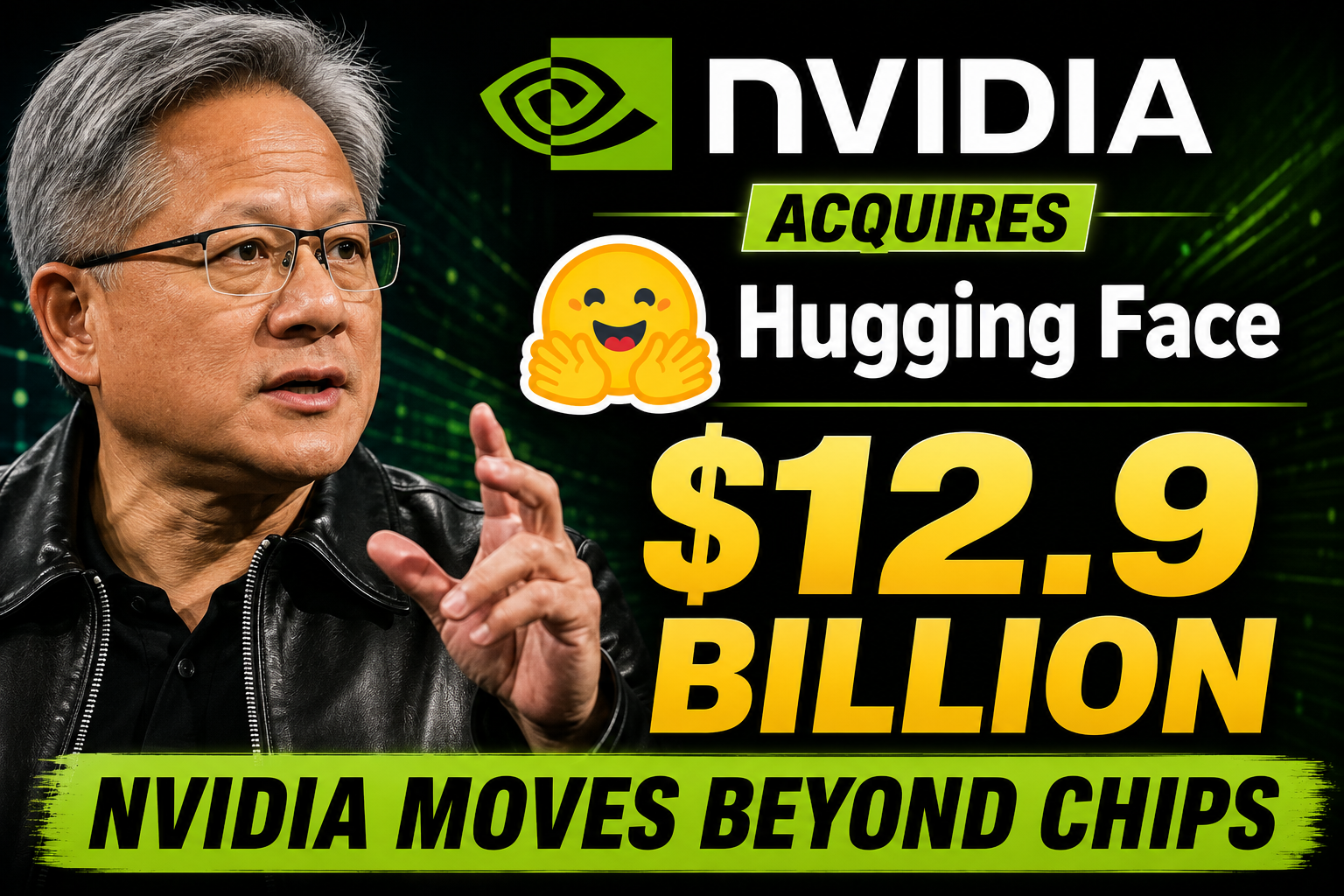
Nvidia announced Thursday that it has agreed to acquire Hugging Face for approximately $12.93 billion, transforming one of the world’s most influential AI developer platforms into part of the world’s dominant AI-computing company.
The acquisition ranks among Nvidia’s largest deals and could have consequences far beyond the purchase price.
Hugging Face has become one of the central meeting places of the open-AI ecosystem. More than 18 million developers, researchers and creators use its platform, according to Nvidia, while more than 200,000 companies use it to discover, evaluate, customize and deploy artificial-intelligence technology.
Its community has shared more than 3 million AI models, 500,000 datasets and 1 million applications.
For Nvidia, buying that ecosystem represents something potentially much larger than acquiring another software company.
Nvidia already dominates much of the infrastructure underneath artificial intelligence.
Now it is moving closer to the developers—and the models—that run on top of it.
WHAT EXACTLY IS HUGGING FACE?
For people outside the AI industry, Hugging Face may not be a familiar name.
Inside AI development, it is enormously important.
One useful comparison is GitHub.
GitHub became a major platform where software developers store, share and collaborate on code.
Hugging Face has developed a somewhat similar role for artificial intelligence.
Developers can use the platform to discover AI models created by researchers and companies around the world.
They can find datasets.
Test models.
Download model weights where available.
Build applications.
Share research.
Fine-tune models.
And deploy AI systems.
That makes Hugging Face an important piece of infrastructure behind the explosion of open and open-weight artificial intelligence.
Instead of every startup needing to train an enormous AI model from scratch—a process that can cost vast amounts of money—a developer can potentially take an existing model, adapt it for a particular task and build a product around it.
That has helped dramatically lower the barrier to entering AI development.
And Nvidia has now agreed to buy the platform at the centre of much of that activity.
THE PRICE: $12.93 BILLION
Under the agreement, Nvidia will pay approximately $11.9 billion to Hugging Face investors.
The company will also establish an equity-based employee retention program worth up to $1 billion for Hugging Face employees who join Nvidia.
Combined, the transaction is valued at approximately $12.93 billion.
The price represents an extraordinary jump from Hugging Face’s last publicly disclosed valuation.
In August 2023, Hugging Face raised $235 million in a funding round that valued the company at approximately $4.5 billion.
Investors in that round included major technology companies such as Salesforce, AMD and Amazon.
Three years later, Nvidia is paying nearly three times that valuation.
That alone shows how dramatically the strategic value of AI infrastructure has increased.
But Nvidia isn’t simply buying revenue.
It is buying position.
NVIDIA WANTS THE OPEN-AI ECOSYSTEM
The AI industry is developing along two major paths.
One involves highly controlled proprietary systems.
Companies such as OpenAI and Anthropic have built powerful models that users generally access through products or APIs without freely downloading the underlying model weights.
The other side of the industry revolves around open-source and open-weight models.
Those models can give developers substantially greater control.
Companies may be able to run models on their own infrastructure.
Modify them.
Fine-tune them.
Build specialized systems.
And potentially reduce dependence on expensive proprietary AI services.
Demand for those alternatives has been growing.
Chinese companies including DeepSeek and Z.ai have also demonstrated that lower-cost models can compete with some leading American systems in important areas.
That has intensified competition around open AI.
And Hugging Face sits near the centre of that ecosystem.
For Nvidia, owning it provides a powerful strategic position.
NVIDIA SAYS HUGGING FACE WILL REMAIN OPEN
The obvious concern is what happens when the world’s dominant AI-chip company buys a platform designed to work across the AI ecosystem.
Nvidia CEO Jensen Huang attempted to address that immediately.
He said Hugging Face would remain an open platform for the entire AI ecosystem.
Developers will continue to be able to choose their models.
Their frameworks.
Their cloud providers.
Their inference providers.
And importantly:
Nvidia hardware will not be required to build or deploy AI through Hugging Face.
The platform is also expected to continue supporting multiple hardware accelerators and cloud providers.
That promise matters.
Hugging Face’s influence partly comes from its neutrality.
Its value to developers would be very different if the platform suddenly became little more than a storefront for Nvidia products.
Nvidia appears to understand that.
The question will be whether the company can preserve that openness while simultaneously extracting strategic value from owning the platform.
NVIDIA WAS ALREADY DEEPLY INVOLVED
The acquisition did not emerge from nowhere.
Nvidia and Hugging Face have worked together for years.
In 2023, the companies announced a partnership integrating Nvidia’s DGX Cloud computing infrastructure with Hugging Face, giving developers easier access to Nvidia computing resources for training and customizing large AI models.
Nvidia has since become an enormous contributor to the Hugging Face ecosystem.
According to Nvidia, the company has released more than 500 models and more than 250 open datasets through the platform.
It has also developed its own open-model families, including Nemotron.
The relationship was therefore already substantial.
Acquisition takes it to another level.
WHY WOULD NVIDIA NEED THIS?
At first glance, Nvidia doesn’t appear to need much help.
The company became one of the world’s most valuable businesses because demand for AI computing exploded.
Technology companies raced to buy Nvidia GPUs.
Cloud providers built enormous Nvidia-powered data centres.
AI laboratories needed thousands—and eventually hundreds of thousands—of advanced chips.
Nvidia became one of the biggest beneficiaries of the generative-AI revolution.
But there is a vulnerability.
Some of Nvidia’s largest customers don’t want to remain completely dependent on Nvidia forever.
Microsoft.
Meta.
Google.
Amazon.
And other major technology companies have been developing their own AI processors.
OpenAI has also pursued alternatives and custom-chip strategies.
The motivation is obvious.
Nvidia’s most advanced processors are expensive.
Demand has frequently exceeded supply.
And enormous technology companies don’t like depending on a single supplier for infrastructure this important.
Nvidia therefore has an incentive to expand beyond simply selling GPUs.
And that is exactly what it has been doing.
NVIDIA IS BUILDING AN AI STACK
Think about the artificial-intelligence economy as a giant stack.
At the bottom:
chips.
Above that:
networking and computing infrastructure.
Then:
software and development tools.
Then:
AI models.
Then:
applications.
Nvidia’s original strength was primarily at the hardware level.
But the company has spent years moving upward.
CUDA turned Nvidia GPUs into a software ecosystem developers could build around.
Nvidia expanded into networking.
AI software.
Enterprise tools.
Cloud computing.
Robotics.
Automotive technology.
Physical AI.
Open models.
And increasingly entire AI systems.
Hugging Face gives Nvidia a major position even closer to the model-development community.
That is strategically important because the company doesn’t necessarily need every developer to buy a GPU directly.
It wants developers building AI systems inside an ecosystem where Nvidia technology is everywhere.
18 MILLION DEVELOPERS MATTER
The most valuable part of Hugging Face may not be any individual AI model.
It may be the community.
Nvidia says more than 18 million developers, researchers and creators use Hugging Face.
More than 200,000 companies use the platform.
Those numbers represent something every technology platform wants:
distribution.
If Nvidia launches a new model, development tool, inference technology or computing service, it now owns a platform capable of putting that technology in front of an enormous AI-development community.
That doesn’t mean developers will automatically use Nvidia products.
Nvidia explicitly says they won’t be required to.
But proximity matters.
Microsoft understood this when it acquired GitHub.
Google understood it when it built Android.
Apple understood it with the App Store.
Technology companies don’t only compete by building products.
They compete by building ecosystems around the people who create products.
Hugging Face gives Nvidia another ecosystem.
THE OPEN-MODEL BATTLE IS GETTING BIGGER
There is also a geopolitical dimension.
Open AI models have become an increasingly important front in competition between American and Chinese technology companies.
DeepSeek shocked the AI industry by demonstrating how quickly Chinese developers could produce highly capable models.
Other Chinese laboratories have continued advancing.
Open models can spread rapidly because developers around the world can experiment with them, modify them and deploy them.
That means whichever country’s technology becomes widely adopted by developers can gain influence across the global AI ecosystem.
Nvidia has argued that strong American open-model development is therefore strategically important.
Hugging Face provides the infrastructure where much of that competition takes place.
Owning it puts Nvidia in an extraordinary position.
BUT THERE’S A COMPETITION QUESTION
The acquisition will inevitably raise another question:
How powerful is too powerful?
Nvidia already holds an extraordinary position in advanced AI computing.
Its GPUs power a significant portion of the infrastructure used to train and run leading AI systems.
Its CUDA software ecosystem has created deep developer loyalty.
Its networking products connect massive AI clusters.
And Nvidia is expanding into additional layers of AI infrastructure.
Now add one of the world’s most important AI-model communities.
The combination is strategically impressive.
But regulators and competitors may examine whether Nvidia’s growing reach gives it excessive influence over the infrastructure underlying artificial intelligence.
Even if Hugging Face remains technically open, ownership matters.
Nvidia would control the company.
It would understand platform trends.
It would see where developer interest is moving.
It would gain insight into how open models are being used.
And it would have an extremely valuable relationship with millions of AI builders.
The acquisition therefore isn’t simply about technology.
It is about information, distribution and influence.
NVIDIA CAN AFFORD IT
The company also has the financial firepower to make a deal of this scale.
Nvidia ended its July quarter with approximately $22.44 billion in cash and cash equivalents, according to Reuters.
That was more than double its level in January.
And Nvidia’s core business continues growing rapidly as companies spend enormous amounts building AI infrastructure.
That cash gives Nvidia options.
It can invest.
Acquire.
Partner.
Build data-centre infrastructure.
Fund new ecosystems.
And use the extraordinary profits generated by the AI-chip boom to strengthen its position elsewhere in the industry.
The Hugging Face deal is a perfect example.
Nvidia is using the wealth created by its hardware dominance to expand beyond hardware.
HUGGING FACE COULD GET MUCH BIGGER
There is another side to the transaction.
Hugging Face gains access to Nvidia’s resources.
Infrastructure.
Engineers.
Capital.
Global reach.
Enterprise customers.
Computing technology.
Nvidia says the combination will allow Hugging Face to improve areas including platform reliability, model evaluation, safety, inference and deployment.
That could make Hugging Face substantially more capable.
Imagine an open-AI platform with millions of developers backed by one of the richest and most technically sophisticated companies in the technology industry.
That combination could accelerate development across the open-model ecosystem.
But maintaining trust will be essential.
Hugging Face’s community must continue believing the platform belongs to the broader AI ecosystem—not simply Nvidia.
THE BIGGER QUESTION: WHAT DOES NVIDIA WANT TO BECOME?
This acquisition forces a larger question about Nvidia.
Is Nvidia still primarily a semiconductor company?
Increasingly, that description looks incomplete.
Nvidia wants to provide the chips.
The networking.
The software.
The models.
The development infrastructure.
The data-centre architecture.
The robotics platforms.
And now one of the major communities connecting AI developers around the world.
That begins to resemble something different.
Not merely a chipmaker.
An AI platform company.
And perhaps eventually an AI infrastructure empire.
🔴 THE ABE NEWS TAKE
Nvidia buying Hugging Face for $12.93 billion isn’t really a story about another technology acquisition.
It is a story about control of the AI stack.
Nvidia won the first phase of the generative-AI boom because almost everyone needed its GPUs.
But Jensen Huang knows something important:
Hardware dominance does not last forever simply because it exists today.
Customers are building competing chips.
AI models are becoming more efficient.
Open models are becoming more capable.
Inference is changing.
Competition is intensifying.
So Nvidia is doing what the strongest technology companies have historically done.
It is building an ecosystem around its advantage.
CUDA made developers dependent on Nvidia software.
Networking expanded Nvidia’s role inside data centres.
AI systems pushed Nvidia beyond individual processors.
And Hugging Face gives Nvidia access to something equally valuable:
the people building the future of AI.
More than 18 million developers, researchers and creators use the platform.
More than 3 million models have been shared there.
More than 200,000 companies use it.
Those aren’t merely impressive statistics.
They are distribution.
And distribution is one of the most powerful advantages in technology.
The smartest part of Nvidia’s announcement may therefore be its promise not to force Nvidia hardware on Hugging Face users.
If Nvidia keeps Hugging Face genuinely open, developers using AMD chips, competing clouds, Chinese models and other technologies could remain on the platform.
Nvidia would own the marketplace without necessarily requiring everyone in the marketplace to buy from Nvidia.
That could be more valuable than closing it.
There is risk.
Regulators may scrutinize Nvidia’s growing influence.
Developers could migrate if they believe Hugging Face has lost its independence.
Competitors may build alternatives.
And Nvidia will have to prove that “open” still means open after the acquisition.
But strategically, the direction is unmistakable.
Nvidia isn’t waiting for the day when its customers no longer need as many Nvidia GPUs.
It is spending today’s extraordinary AI profits to make itself important in more parts of tomorrow’s AI economy.
The company already supplies much of the machinery powering artificial intelligence.
Now it is buying one of the places where the builders gather.
And that tells us something about where the AI race may be heading.
The next battle won’t only be about who builds the fastest chip.
Or even who builds the smartest model.
It will be about who owns the ecosystems connecting chips, models, developers and applications together.
Nvidia just spent nearly $13 billion to make sure it has a seat at the centre of that battle.
ABE NEWS
Business. Money. Style. The News.
Understand More. Think Bigger.