









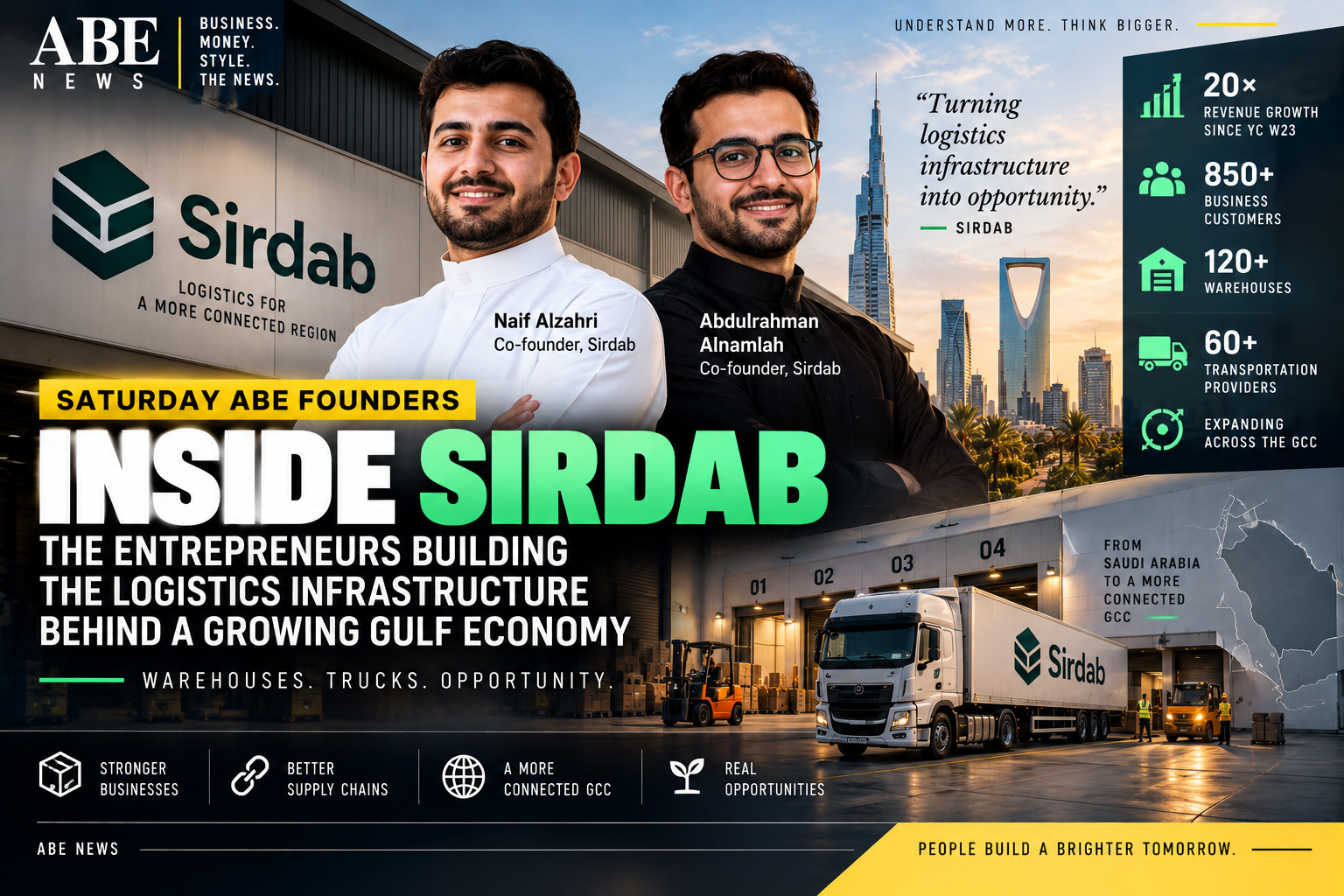
SATURDAY ABE FOUNDERS | September 5, 2026
Warehouses are rarely glamorous.
Neither are trucks.
Inventory management doesn’t dominate dinner-table conversations.
And few children grow up telling their parents they dream of optimizing warehouse capacity.
But Naif Alzahri and Abdulrahman Alnamlah saw something different.
They saw infrastructure.
More specifically, they saw businesses across Saudi Arabia needing warehouses, transportation and inventory infrastructure — while logistics providers simultaneously had capacity sitting unused.
One side needed space.
Another side had space.
One side needed trucks.
Another side had trucks.
The problem was connecting everything efficiently.
So in 2022, the two entrepreneurs founded Sirdab.
Four years later, their company says it serves more than 850 businesses, connects a network of 120+ warehouses and 60+ transportation providers, has grown revenue 20-fold since Y Combinator, and has reached profitability.
And this week, Sirdab raised another $10 million.
The Series A was co-led by PIF-backed Saudi digital-solutions company Elm and BECO Capital, with Y Combinator, COTU Ventures and D Global Ventures also participating.
Now Alzahri and Alnamlah want to take what they built in Saudi Arabia and expand it across the Gulf.
But the most interesting part of their story isn’t the $10 million.
It’s the problem they chose to solve.
Because Sirdab represents an increasingly important type of startup:
a company attempting to build a huge business around something most people barely notice — until it doesn’t work.
BEFORE THE STARTUP, THERE WAS A LOGISTICS PROBLEM
Imagine running a growing business.
You import products.
Or manufacture them.
Or distribute food.
Or operate stores.
Or sell online.
At some point, the digital side of the business meets the physical world.
Your products need somewhere to go.
You need warehouse space.
Inventory needs to be tracked.
Orders need to be prepared.
Goods need to be transported.
Different products may require different environments.
Some can sit in ordinary dry storage.
Others require temperature control.
Food may require chilled or frozen facilities.
Then inventory must move between warehouses, stores and customers.
As a business expands, coordinating all of this becomes increasingly complicated.
Meanwhile, logistics companies may already possess warehouses and transportation capacity that isn’t being fully utilized.
Sirdab’s founders saw an opportunity between those two realities.
Instead of every business having to build or individually negotiate its own logistics infrastructure, what if companies could access a broader network through one platform?
That became the foundation of Sirdab.
WHAT SIRDAB ACTUALLY DOES
Sirdab describes itself as a cloud warehousing and supply-chain platform.
The idea is relatively straightforward.
Businesses can use Sirdab to access warehousing and transportation capacity while managing inventory, orders and logistics operations through a unified system.
The network includes:
dry storage,
ambient storage,
chilled warehousing,
and
frozen warehousing.
Y Combinator says businesses can acquire warehousing space through Sirdab in as little as 48 hours.
That can fundamentally change the logistics equation for a growing company.
Traditionally, expanding into another city might require finding a warehouse, negotiating a lease, establishing operations, hiring people and building relationships with transportation providers.
That requires capital.
And time.
Sirdab’s proposition is different:
Use infrastructure that already exists.
THE AIRBNB COMPARISON IS TEMPTING — BUT INCOMPLETE
At first glance, Sirdab can sound like an Airbnb for warehouses.
Someone has unused space.
Someone else needs space.
A platform connects them.
But the actual business goes further.
Sirdab also provides software for logistics providers.
Warehouse and transportation operators can expose available capacity while using the system to manage operations, billing and compliance.
Businesses can manage inventory and orders across multiple locations.
And Sirdab combines third-party capacity with facilities it manages directly in strategic locations.
That makes the model more than a simple marketplace.
Sirdab is attempting to create an operating layer connecting fragmented logistics infrastructure.
And that distinction could become extremely important as the company grows.
THEN CAME Y COMBINATOR
In 2023, Sirdab joined Y Combinator’s Winter batch.
YC has helped launch companies including Airbnb, Stripe, Coinbase, DoorDash and Dropbox.
Getting accepted does not guarantee success.
Thousands of startups have gone through accelerators without becoming enormous businesses.
But YC gave the young Saudi company access to a global startup network, investors and an environment built around rapid company building.
What happened afterward is more interesting.
Sirdab says its revenue has increased 20× since YC W23.
And unlike many venture-backed startups still burning enormous amounts of money while pursuing growth, Sirdab says it reached profitability within 24 months.
That combination deserves attention.
Growth is good.
Profitable growth is better.
850+ BUSINESSES
Sirdab now says more than 850 businesses use its platform.
Its network spans more than:
120 warehouses
and
60 transportation providers.
Those numbers tell us something important about marketplace businesses.
A logistics platform becomes more useful as its network becomes deeper.
More warehouse capacity can give businesses more options.
More businesses can make the network more attractive to logistics providers.
More transportation partners can improve coverage.
More locations can make geographic expansion easier.
If managed well, each side can reinforce the other.
That creates what investors often describe as network effects.
But logistics is harder than building a purely digital network.
A social network moves information.
Sirdab helps coordinate physical goods.
And physical goods introduce an entirely different set of problems.
LOGISTICS IS MESSY
A warehouse cannot simply disappear when something goes wrong.
A truck cannot teleport through traffic.
Frozen products cannot sit indefinitely in the wrong temperature.
A delivery delay can shut down part of a customer’s business.
Inventory can be damaged.
Orders can be incorrect.
Transport providers can be late.
Customers can change demand unexpectedly.
Warehouses have capacity limits.
Regulations vary.
Compliance matters.
That means Sirdab isn’t merely selling software.
It operates in the uncomfortable space between technology and physical operations.
That is harder.
But it can also create stronger businesses.
Once a company becomes deeply integrated into a customer’s supply chain, replacing it can become difficult.
Reliability becomes the product.
WHY SAUDI ARABIA?
Timing matters.
Saudi Arabia is undergoing one of the largest economic transformations in the Middle East.
Under Vision 2030, the Kingdom has been investing heavily in economic diversification, infrastructure, tourism, manufacturing, technology and logistics.
Saudi Arabia’s geography also matters.
The country sits between major trade routes connecting Asia, Africa and Europe.
And the government wants the Kingdom to become a major global logistics hub.
That creates opportunity for companies building the infrastructure underneath commerce.
Ports matter.
Airports matter.
Roads matter.
Warehouses matter.
Transportation networks matter.
And increasingly, the software connecting all of those assets matters too.
Sirdab is positioning itself inside that transformation.
THE FOUNDERS DIDN’T NEED TO BUILD EVERY WAREHOUSE
This may be one of the most important entrepreneurial lessons in the Sirdab story.
Suppose Alzahri and Alnamlah had decided:
“We want to become a logistics company.”
One approach would have been buying land.
Constructing warehouses.
Purchasing fleets of trucks.
Hiring thousands of workers.
That would require enormous amounts of capital before the company could scale.
Instead, Sirdab adopted an asset-light model.
Much of the infrastructure already exists.
Warehouses already exist.
Transportation companies already exist.
Capacity already exists.
Sirdab’s opportunity is to connect, standardize and coordinate it.
That changes the economics.
Instead of asking:
“How do we own all the infrastructure?”
the founders asked something closer to:
“How do we make existing infrastructure work as one network?”
That is a very different company.
UNUSED CAPACITY IS AN OPPORTUNITY
Imagine a warehouse operating at 70% capacity.
Thirty percent is unused.
The building still exists.
Rent or financing still needs to be paid.
Security still needs to be provided.
Electricity still needs to run.
Employees still work there.
That empty space generates little value.
Now imagine a small business that desperately needs storage but cannot justify leasing an entire warehouse.
Individually, both sides have a problem.
Together, they may have a transaction.
This is one of the most powerful patterns in modern entrepreneurship.
Find an underutilized asset.
Then connect it with demand.
Airbnb did it with rooms and homes.
Uber did it with vehicles and drivers.
Cloud computing did something conceptually similar with computing infrastructure.
Sirdab is applying the principle to logistics capacity.
BUT THE HARD PART IS TRUST
Matching supply and demand sounds easy on a PowerPoint slide.
Real operations are different.
A business entrusting inventory to a warehouse needs confidence.
Will the goods be secure?
Will inventory records be accurate?
Will orders be handled correctly?
Will temperature requirements be maintained?
Will transportation arrive?
Will service standards remain consistent?
This is why Sirdab says it works with vetted logistics providers and provides businesses with visibility over service levels.
If the company wants to become infrastructure rather than simply a directory, standardization and trust will matter enormously.
A customer should not feel as if it is dealing with dozens of disconnected warehouses.
The experience needs to feel like one network.
That is much harder to build than a marketplace.
THEN CAME BECO, COTU AND OTHER INVESTORS
Sirdab’s investor journey developed gradually.
COTU Ventures backed the company at pre-seed.
Sirdab went through Y Combinator.
BECO Capital invested at seed stage in 2024.
And now BECO has returned as a co-lead investor in the company’s $10 million Series A.
That repeat investment is worth noticing.
Existing investors possess more information about a company than most outsiders.
They’ve watched management.
Seen performance.
Observed problems.
Reviewed numbers.
When an existing investor increases its commitment in a later round, it can signal continued conviction in the business.
But the other co-lead creates perhaps the most interesting circle in the founders’ story.
ABDULRAHMAN’S FORMER EMPLOYER IS NOW AN INVESTOR
Before Sirdab, co-founder Abdulrahman Alnamlah spent four years working at Elm.
Elm is a Saudi digital-solutions company backed by the country’s Public Investment Fund.
Now Elm is on the other side of the table.
Not employing Alnamlah.
Investing in the company he helped build.
There is something powerful about that progression.
Employee.
Founder.
Then former employer becomes investor.
It is also a reminder that entrepreneurship rarely begins from nowhere.
A job can provide more than a salary.
It can provide industry knowledge.
Relationships.
Operational experience.
An understanding of how large organizations function.
Exposure to problems worth solving.
And eventually, perhaps, the foundations for a company.
Young entrepreneurs sometimes become impatient to leave employment as quickly as possible.
But employment itself can be education.
What matters is whether you’re paying attention.
$10 MILLION — AND NOW THE GCC
The new Series A gives Sirdab additional capital to expand.
The company plans to deepen its network across Saudi Arabia and move further into the Gulf Cooperation Council markets.
That potentially means opportunities across:
Saudi Arabia,
the United Arab Emirates,
Qatar,
Kuwait,
Bahrain,
and Oman.
But expansion across the Gulf won’t simply mean copying and pasting the Saudi operation.
Every market has different regulations.
Customers.
Infrastructure.
Competition.
Commercial practices.
Logistics networks.
Sirdab will need to prove that the model travels.
And this is where the next chapter becomes harder.
SUCCESS IN ONE COUNTRY DOESN’T GUARANTEE REGIONAL SUCCESS
Startups often celebrate geographic expansion.
New market.
New office.
New flag on the website.
But expansion can destroy companies when executed badly.
Operations become more complex.
Management attention becomes divided.
Costs increase.
Local competitors may understand customers better.
Regulatory requirements change.
A company can grow revenue while weakening its economics.
Sirdab therefore faces an important strategic decision:
How quickly should it expand?
The Gulf offers enormous opportunity.
But the strongest regional company may not be the one that enters the most countries first.
It may be the one that builds the deepest, most reliable network in each market it enters.
THE COMPETITION WILL COME
A business opportunity this large will not remain uncontested.
Traditional logistics companies can digitize.
Warehouse operators can build their own platforms.
Other startups can compete.
Large global logistics companies can expand.
Customers themselves can build internal capabilities.
Sirdab therefore needs more than first-mover advantage.
Its long-term defensibility may depend on the depth of its network.
Operational data.
Customer relationships.
Software integration.
Service quality.
And how difficult it becomes for customers to replace the platform.
The company has demonstrated impressive early traction.
The next test is whether that traction becomes a durable competitive advantage.
WHY SIRDAB FITS ABE FOUNDERS
Saturday ABE Founders isn’t supposed to become a weekly parade of billionaires.
You already know Elon Musk.
You already know Jeff Bezos.
You already know Mark Zuckerberg.
You already know many of the world’s celebrity entrepreneurs.
There is value in studying them.
But there is another kind of founder worth watching:
the entrepreneur still building.
The person whose company isn’t yet a household name.
Whose outcome isn’t predetermined.
Whose biggest decisions are happening now.
Naif Alzahri and Abdulrahman Alnamlah fit that description.
Sirdab isn’t a trillion-dollar corporation.
It hasn’t conquered global logistics.
A $10 million Series A does not guarantee anything.
The company could become enormous.
It could remain a strong regional business.
It could struggle during expansion.
It could fail.
That’s precisely what makes this stage interesting.
We’re watching the story while it is still being written.
LESSON #1: BORING PROBLEMS CAN BUILD EXCELLENT COMPANIES
Warehousing isn’t glamorous.
Neither is inventory management.
That doesn’t matter.
Customers don’t pay companies because their problem sounds exciting.
They pay because the problem is painful.
Entrepreneurs should therefore stop asking:
“What sounds impressive?”
and start asking:
“What costs customers time or money?”
The second question creates businesses.
LESSON #2: YOU DON’T ALWAYS NEED TO OWN THE ASSET
This is particularly relevant in capital-intensive industries.
Before buying trucks, ask whether someone already owns trucks that aren’t fully utilized.
Before constructing warehouses, ask whether existing warehouses have spare capacity.
Before building expensive infrastructure, ask whether technology can make existing infrastructure more efficient.
Ownership can create advantages.
But coordination can create enormous businesses too.
LESSON #3: YOUR JOB MAY BE PREPARING YOU FOR YOUR COMPANY
Abdulrahman’s journey from Elm employee to Sirdab co-founder to Elm-backed founder is worth remembering.
Not everyone needs to quit their job tomorrow.
Sometimes the job is where you learn.
Watch how companies operate.
Study customers.
Understand industries.
Notice inefficiencies.
Build relationships.
Develop skills.
Then, when you discover the right opportunity, you may be far better prepared to pursue it.
LESSON #4: TRACTION MATTERS MORE THAN HYPE
The $10 million funding round makes headlines.
But these numbers matter more:
20× revenue growth.
Profitability.
850+ businesses.
120+ warehouses.
60+ transportation providers.
Funding is fuel.
It is not the destination.
The purpose of raising money is to build a stronger business.
And eventually, a company must prove that customers value what it sells.
LESSON #5: START WITH ONE PAINFUL PROBLEM
Sirdab’s ambition today is broad.
Warehousing.
Transportation.
Inventory.
Orders.
Logistics operations.
Regional expansion.
But great companies often begin with something narrower.
Solve one painful problem.
Solve it well.
Earn trust.
Then expand.
Trying to build everything from day one can prevent founders from building anything particularly well.
🔴 THE ABE FOUNDERS TAKE
There is a line connecting today’s two Saturday features.
Earlier, Saturday ABE Originals asked whether Africa’s next billion-dollar companies might emerge from ordinary problems.
Then we travel northeast to Saudi Arabia and find two founders demonstrating the same entrepreneurial principle.
Naif Alzahri and Abdulrahman Alnamlah didn’t need to invent a new human behaviour.
Businesses already needed warehouses.
Businesses already needed transportation.
Warehouses already had capacity.
Trucks already existed.
Inventory already needed management.
The opportunity was hidden between those facts.
Make the system work better.
That sounds simple.
Building it isn’t.
And perhaps that is one of the most important lessons for young founders.
Entrepreneurship doesn’t always begin with invention.
Sometimes it begins with observation.
Look around.
Where is capacity being wasted?
Where are businesses losing money?
Where are customers waiting?
Where are five companies required to accomplish something that should require one?
Where is information fragmented?
Where are assets sitting unused?
Where does the customer say:
“There has to be an easier way.”
Those sentences are clues.
Sirdab followed one of them into warehouses.
Then trucks.
Then inventory.
Then hundreds of businesses.
Then Y Combinator.
Then profitability.
Then a $10 million Series A.
Now comes the difficult part.
Can Naif Alzahri and Abdulrahman Alnamlah turn a successful Saudi logistics startup into infrastructure businesses across the Gulf actually depend on?
We don’t know yet.
And that’s exactly why ABE Founders is watching them now.
Not after an IPO.
Not after a billion-dollar valuation.
Not after everyone knows their names.
Now.
While the warehouses are still being connected.
While the network is still growing.
While the founders are still building.
Because sometimes the most interesting time to discover a great entrepreneur is before the rest of the world decides they’re great.
SATURDAY ABE FOUNDERS
Discovering the builders before everyone knows their names.
ABE NEWS
Business. Money. Style. The News.
Understand More. Think Bigger.