









ABE NEWS | September 6, 2026
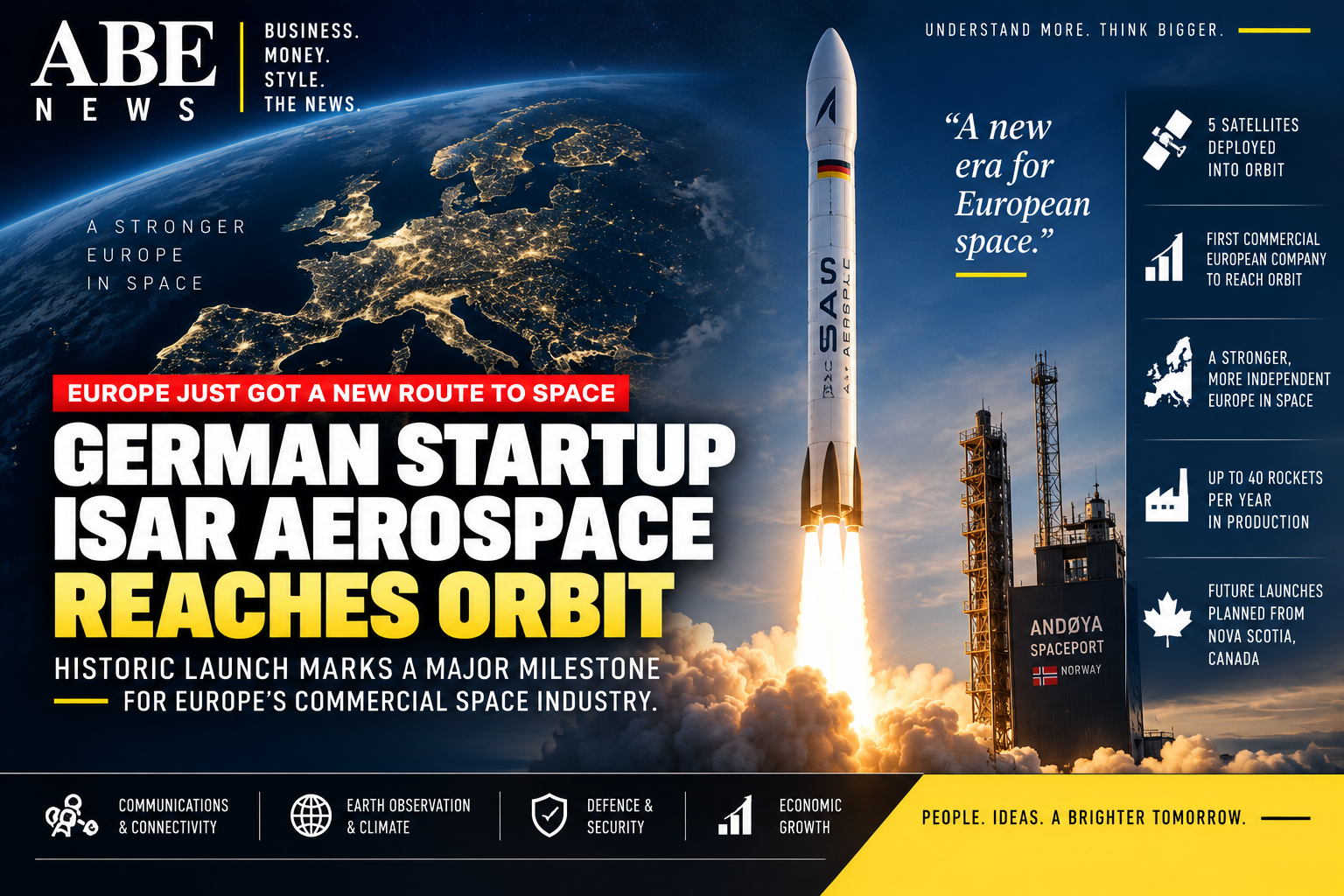
Europe’s effort to rebuild its independent access to space reached an important milestone this weekend after German startup Isar Aerospace successfully sent its Spectrum rocket into orbit from northern Norway, becoming the first commercial European company to place satellites into orbit with its own launch vehicle.
The rocket lifted off from Andøya Spaceport at 10:12 p.m. Central European Summer Time on Saturday, carrying five small satellites and a technology experiment. Spectrum successfully reached orbit and deployed its payloads, completing a mission that was particularly significant because it was only the rocket’s second flight.
For Isar Aerospace, the achievement marks a dramatic turnaround from its first launch attempt in March 2025, when Spectrum lost control shortly after liftoff and fell into the sea. For Europe, however, the implications are much broader. The successful mission provides evidence that a new generation of privately developed European rockets could eventually complement established launch systems such as Ariane 6 and reduce Europe’s reliance on foreign providers.
It comes at a time when access to space is becoming increasingly important not only commercially, but strategically.
FROM FAILED FIRST FLIGHT TO ORBIT
Founded in 2018 by Daniel Metzler, Josef Peter Fleischmann and Markus Brandl, Isar Aerospace emerged from the Technical University of Munich and has grown into one of Europe’s most closely watched private rocket companies.
Its Spectrum vehicle is a two-stage rocket approximately 28 metres tall, designed primarily for small and medium-sized satellites. It can carry payloads of up to roughly 1,000 kilograms into low-Earth orbit, placing the company in a market serving Earth-observation companies, communications providers, scientific missions and government customers.
Its first flight did not go according to plan.
During the March 2025 test, a technical problem led to a loss of attitude control roughly half a minute after liftoff. The rocket ultimately crashed into the sea without reaching orbit.
Failures during early rocket development are not unusual, but they can be devastating for young launch companies. Rockets require enormous amounts of capital to design, manufacture and test, while every failed launch can delay customer missions and undermine investor confidence.
Isar spent the following period investigating the failure, making technical changes and preparing another vehicle. Saturday’s successful second attempt therefore represents more than a launch milestone: it demonstrates that the company was able to identify problems from its first mission, return to flight and successfully deliver customer payloads.
That is an important step toward proving that Spectrum can become a commercial product rather than simply an experimental rocket.
WHY EUROPE NEEDS MORE ROCKETS
Europe has a long history in space. The Ariane family has launched satellites for governments and commercial customers for decades, while European companies remain important manufacturers of spacecraft, satellites and aerospace components.
But Europe’s launch sector has faced significant difficulties in recent years.
The retirement of Ariane 5 and delays surrounding Ariane 6 created a period of reduced European launch capacity. Russia’s invasion of Ukraine also ended European access to Russian Soyuz rockets, removing another launch option that European institutions had previously relied upon.
The result was uncomfortable: Europe, despite possessing one of the world’s most advanced aerospace industries, became increasingly dependent on launch providers outside the continent — including Elon Musk’s SpaceX.
That dependence has become more politically sensitive as satellites take on greater importance in communications, navigation, weather forecasting, Earth observation and defence.
Governments increasingly describe the ability to independently place satellites into orbit as “sovereign access to space.”
In practical terms, that means Europe wants the ability to launch critical spacecraft without having to rely entirely on American or other foreign companies.
Isar Aerospace is not replacing Ariane 6, nor is Spectrum designed to perform exactly the same missions. But a successful private launch company would give European governments and businesses another option, particularly for smaller satellites and missions requiring more flexible schedules or specific orbital destinations.
A COMMERCIAL SPACE INDUSTRY IS EMERGING
Isar is part of a wider transformation taking place in European spaceflight.
For much of the space age, launch vehicles were primarily government-led projects. That model began changing dramatically in the United States as companies such as SpaceX demonstrated that private businesses could develop rockets, win government contracts and compete for commercial customers.
Europe is now trying to cultivate a similar ecosystem.
Companies including Rocket Factory Augsburg and HyImpulse in Germany, PLD Space in Spain, MaiaSpace in France and Orbex in Britain are developing their own launch vehicles. Some will inevitably encounter technical and financial difficulties, and not all are likely to survive.
Isar has now achieved something particularly important within that group: it has reached orbit.
That doesn’t make it “Europe’s SpaceX,” a comparison that would be premature. SpaceX operates reusable rockets at high launch frequencies, transports astronauts, launches national-security missions and operates the enormous Starlink satellite network. Isar remains at the beginning of commercial operations.
The more useful comparison is structural. Europe is attempting to create a competitive private launch industry alongside its established institutional programs, and Isar’s success provides evidence that such an industry can move beyond prototypes and test stands.
NOW COMES THE BUSINESS TEST
Reaching orbit is an engineering achievement. Building a sustainable launch company is a different challenge.
Isar Aerospace ultimately needs to prove that Spectrum can launch reliably, frequently and at prices customers are prepared to pay.
That will not be easy.
The small-launch industry has already claimed several startups because its economics can be unforgiving. Large rockets can carry many satellites simultaneously, spreading launch costs across much greater payload mass. SpaceX’s rideshare missions, for example, allow small satellite operators to purchase space on larger launches at competitive prices.
Dedicated smaller rockets therefore need to offer customers something beyond simply reaching orbit. That could include greater control over launch schedules, access to specific orbits, faster deployment, European-based launch capability or secure services for government and defence customers.
Isar is betting that sufficient demand exists for those advantages.
The company is also preparing to manufacture Spectrum at a much larger scale. Its new production facility near Munich covers approximately 40,000 square metres and is designed to eventually support production of as many as 40 rockets per year. Spectrum vehicles three through seven are already in production.
That manufacturing strategy is crucial. A commercial launch company cannot depend on occasionally producing a handcrafted rocket. To compete seriously, Isar needs to turn rocket manufacturing into a repeatable industrial process.
Whether it can achieve anything close to 40 launches annually will take years to determine. But the ambition demonstrates that Isar sees Saturday’s mission as the beginning of commercial operations rather than the completion of its development program.
THE CANADIAN CONNECTION
The company’s expansion plans also extend beyond Europe.
Isar Aerospace is working with Maritime Launch Services to establish Spectrum operations from Spaceport Nova Scotia in Canada, with launches potentially beginning as early as 2028, subject to regulatory approvals and development progress.
That could eventually give the German company launch access from both Norway and Canada.
For Canada, the partnership is significant because the country has a sophisticated space industry but has historically lacked a major domestic orbital-launch capability. Canadian companies have contributed satellites, robotics and other technologies to international space programs for decades, yet spacecraft have generally needed to be launched from facilities outside the country.
A functioning commercial spaceport in Nova Scotia could help expand Canada’s role from building space technology to actually launching it.
Isar’s successful flight strengthens the credibility of that possibility. A proposed launch site becomes considerably more meaningful when the vehicle expected to operate from it has already demonstrated that it can reach orbit.
SPACE IS BECOMING ECONOMIC INFRASTRUCTURE
The larger story extends beyond rockets.
Satellites increasingly support ordinary economic activity on Earth. Financial transactions rely on precise timing signals. Farmers use satellite imagery. Shipping companies use navigation systems. Telecommunications providers depend on orbital infrastructure. Governments use satellites for weather forecasting and disaster response.
Defence has made the strategic importance even clearer.
Modern militaries depend on satellites for intelligence, communications, navigation and surveillance. The war in Ukraine demonstrated how commercial satellite systems can become critical infrastructure during conflict, pushing governments to reconsider how dependent they are on foreign space providers.
That gives European launch companies a potential customer base that extends beyond traditional commercial satellite operators.
Governments may be willing to pay for reliable launch capacity simply because possessing multiple independent routes to orbit has strategic value.
For Isar Aerospace, that could become one of the most important parts of its business.
🔴 THE ABE NEWS TAKE
Isar Aerospace’s successful launch matters because Europe has spent the past several years confronting an uncomfortable contradiction.
It is one of the world’s most technologically advanced regions. European companies build sophisticated satellites, aerospace components and scientific instruments. European governments depend heavily on space infrastructure.
Yet Europe has struggled to maintain enough independent launch capacity to consistently put those assets into orbit.
Saturday’s mission doesn’t solve that problem overnight. One successful Spectrum flight cannot compete with SpaceX’s launch frequency, and Isar still needs to demonstrate reliability, commercial demand and sustainable economics.
But it changes something important.
Europe now has a privately developed commercial rocket that has successfully reached orbit and deployed satellites.
The next stage is no longer simply proving that Spectrum can fly. It is proving that Isar Aerospace can turn that achievement into a business.
That means producing rockets repeatedly, building a reliable launch schedule, winning customers and demonstrating that smaller dedicated launch vehicles can remain economically competitive in a market increasingly dominated by large rockets.
If Isar succeeds, the consequences could extend beyond one German startup.
It could help establish a broader European commercial launch industry, create another route to orbit for European governments and businesses, and strengthen Europe’s ability to control infrastructure that is becoming increasingly important to both its economy and its security.
And with Isar planning future operations from Nova Scotia, the company’s ambitions could eventually stretch across the Atlantic as well.
The first Spectrum flight lasted only seconds before failing.
The second reached orbit.
The third, fourth and fifth will tell us whether Europe has simply witnessed an impressive engineering achievement — or the beginning of a serious new space company.
ABE NEWS
Business. Money. Style. The News.
Understand More. Think Bigger.