



ABE NEWS | SEPTEMBER 18, 2026
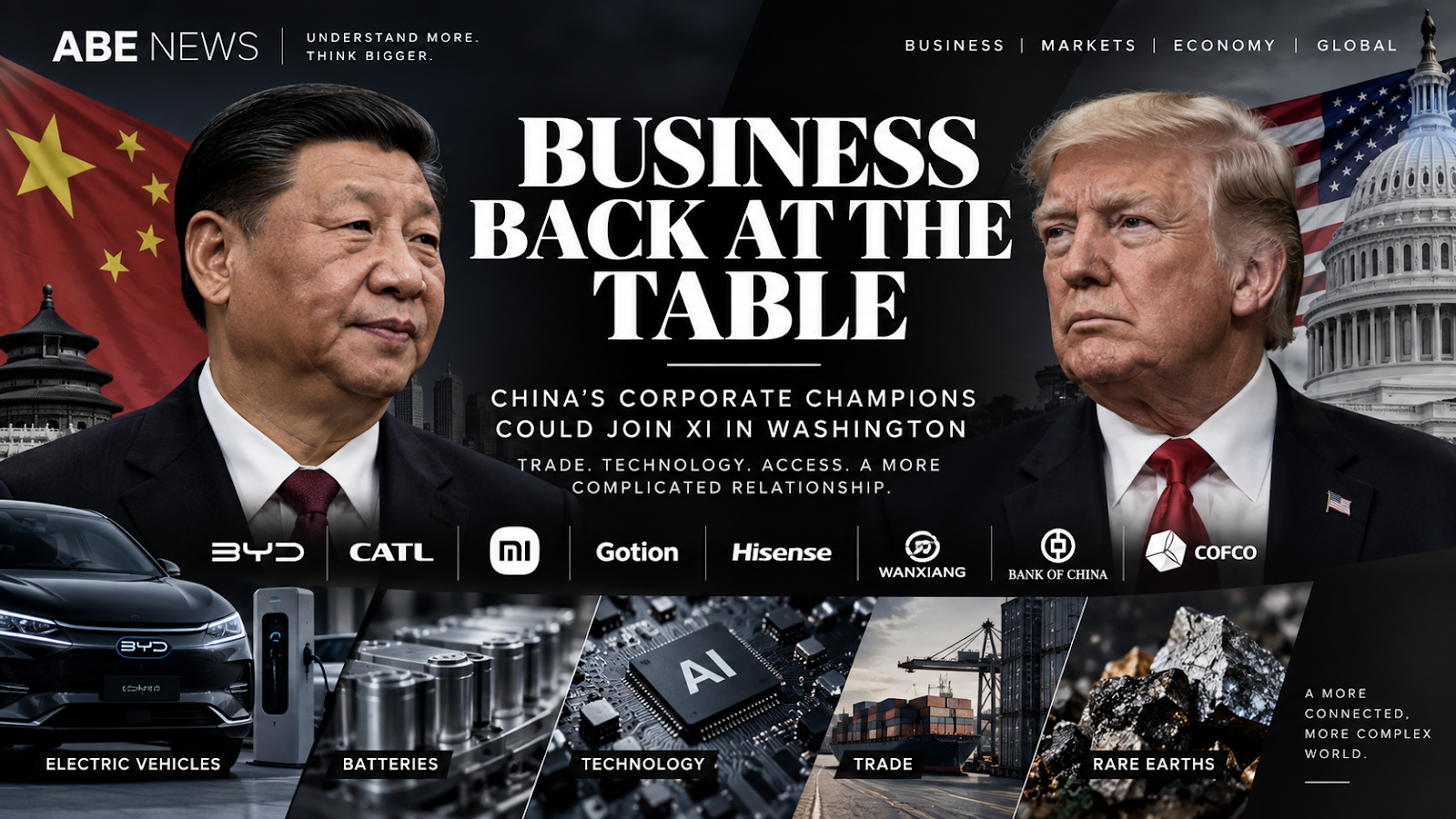
When Chinese President Xi Jinping arrives in Washington next week, some of the most consequential people accompanying him may not be diplomats.
Washington and Beijing are finalizing plans for a potential delegation of major Chinese business leaders to join Xi during his state visit, according to Reuters. Companies under consideration include electric-vehicle giant BYD, smartphone and EV maker Xiaomi, battery manufacturers CATL and Gotion, electronics group Hisense, auto-parts company Wanxiang Group, state-owned Bank of China and agricultural conglomerate COFCO Group. The final delegation has not yet been confirmed.
The possible guest list is significant because these are not simply some of China’s largest corporations. Several operate in industries at the center of the economic rivalry between the world’s two largest economies: electric vehicles, batteries, advanced technology, manufacturing, agriculture and finance.
Some also face substantial restrictions or regulatory pressure in the United States.
That makes Xi’s visit about much more than diplomatic ceremony. It could provide another glimpse of how Washington and Beijing are attempting to manage an increasingly complicated relationship in which trade, technology, national security and corporate power are becoming difficult to separate.
CHINA MAY BRING THE COMPANIES AT THE CENTER OF THE DISPUTE
The selection of companies being considered is striking.
BYD has become one of the world’s most important electric-vehicle manufacturers. CATL is a dominant force in EV batteries. Xiaomi, historically known for smartphones and consumer electronics, has expanded aggressively into automobiles. Gotion operates in batteries, while Hisense, Wanxiang, Bank of China and COFCO extend the potential delegation across manufacturing, finance and agriculture.
But several of these businesses operate under significant U.S. restrictions or scrutiny.
Chinese-made electric vehicles face a 100% U.S. tariff, while a Biden-era connected-vehicle rule is set to prevent China-linked manufacturers from selling new connected passenger vehicles in the United States beginning with model year 2027 and restrict Chinese software and hardware used in those vehicles.
CATL and BYD have also been placed on a Pentagon list of companies alleged to have links to China’s military — an allegation the companies have disputed or challenged in various contexts. Meanwhile, Gotion has been involved in a dispute over its proposed multibillion-dollar battery-components investment in Michigan.
The result is an unusual situation: executives from companies confronting American barriers could soon be attending events in Washington alongside the Chinese president.
BEIJING APPEARS TO BE SEEKING RECIPROCITY
There is another reason for the potential corporate delegation.
When President Donald Trump traveled to Beijing in May, he brought American executives from companies that themselves had encountered regulatory or market-access difficulties in China. That group included leaders from semiconductor companies Micron and Qualcomm and genetic-sequencing company Illumina.
China’s potential delegation appears partly designed to mirror that approach.
Reuters reported that Beijing wants a group similar in size to Trump’s May entourage, with China’s commerce ministry involved in contacting companies. Chinese executives are expected to attend the White House state dinner, although plans remain subject to change.
The symbolism is important.
The two governments have spent years placing restrictions on one another’s companies while simultaneously relying on business engagement to stabilize a relationship neither side can easily unwind.
Now those same corporations could become part of the diplomatic machinery.
THE REAL NEGOTIATION IS ABOUT ACCESS
Behind the ceremony sits a much harder economic question: what access will each country give the other’s companies?
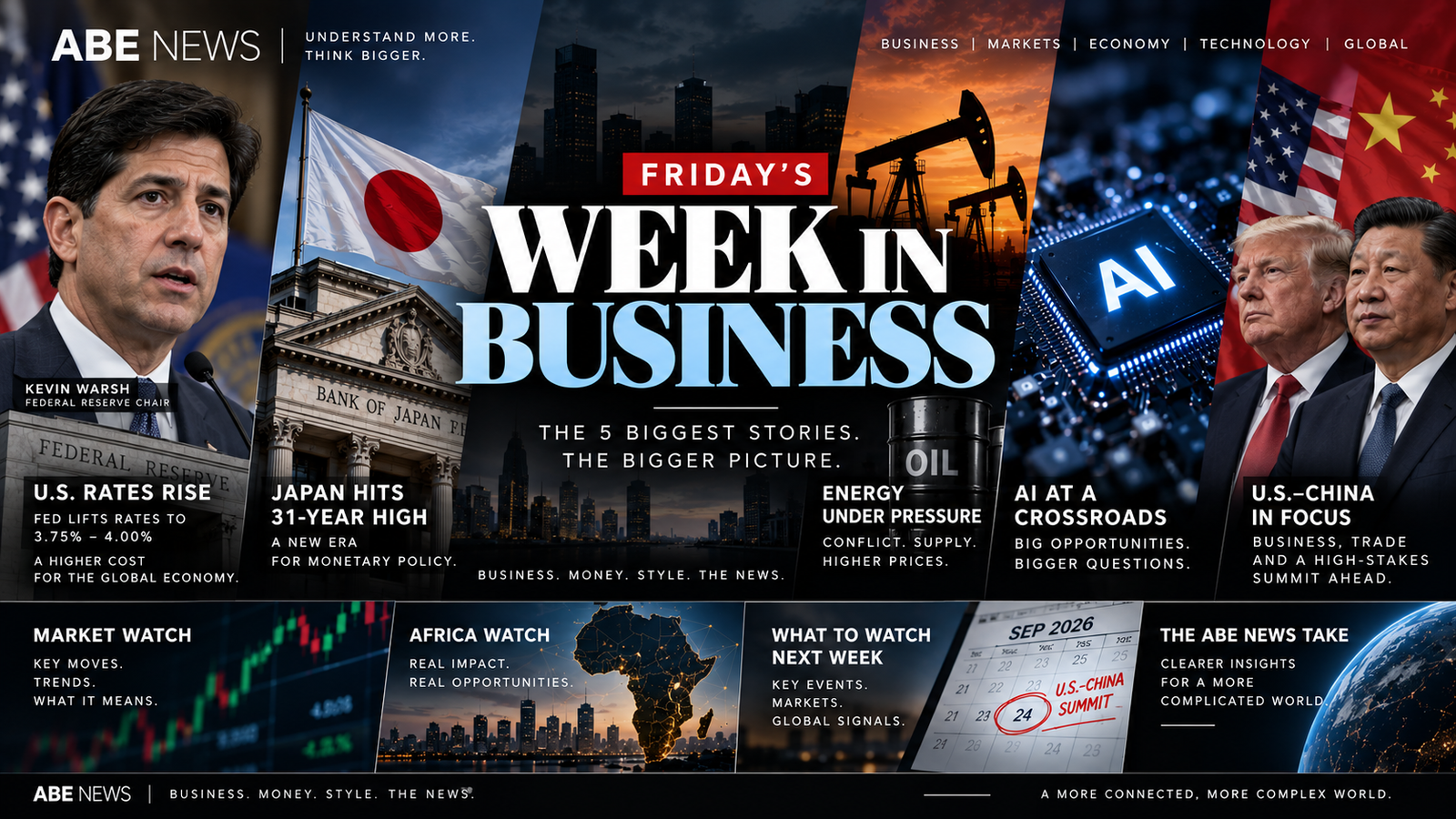
Trump and Xi are scheduled to meet in Washington on September 24 for their second summit of the year. Trade is expected to be central to the discussions, including whether the two countries extend a tariff truce scheduled to expire November 10.
Washington is seeking greater Chinese access for American goods and additional rare-earth export licences for U.S. companies. Beijing, meanwhile, has pushed for relief from restrictions affecting Chinese access to advanced American technology.
Aircraft and agriculture could also become important bargaining pieces.
China previously said it would purchase another 200 Boeing aircraft following the leaders’ May summit, while discussions over a potentially much larger aircraft transaction have continued. Agricultural purchases and non-tariff barriers are also expected to feature in negotiations.
The negotiations therefore stretch from soybeans and aircraft to semiconductors and rare earths.
That breadth demonstrates how deeply the two economies remain connected despite years of efforts to reduce strategic dependence.
EVs AND BATTERIES SHOW THE CONTRADICTION MOST CLEARLY
Perhaps nowhere is that tension clearer than in automobiles.
Chinese companies have built enormous capabilities in electric vehicles and batteries. But the United States increasingly views dependence on Chinese technology in strategically important industries as a national-security and industrial-policy problem.
That has produced tariffs, investment scrutiny and technology restrictions.
Yet the commercial connections have not disappeared.
Ford, for example, licenses battery technology from CATL for its Michigan battery operation, even as American lawmakers have criticized the relationship. Trump has also recently said he would support Chinese companies manufacturing automobiles inside the United States.
That raises a question likely to become increasingly important.
Can Washington restrict Chinese imports while encouraging Chinese companies to manufacture inside America?
The answer would have enormous implications for factories, jobs, supply chains and the future structure of the global automobile industry.
AI AND SEMICONDUCTORS ARE MOVING INTO THE SAME CONVERSATION
The summit extends beyond traditional trade.
Artificial intelligence is expected to feature in discussions between Trump and Xi as both governments confront the strategic consequences of increasingly capable AI systems.
There may be limited room for cooperation around shared AI risks, but technological competition between the countries remains intense. Washington continues to restrict China’s access to some advanced technologies, while Beijing has scrutinized American technology companies operating in its market.
That makes the technology relationship unusually complicated.
The United States wants to preserve its advantage in advanced computing while American technology companies still see China as an enormous market. China wants greater technological independence while continuing to depend on parts of the global semiconductor ecosystem.
Companies increasingly find themselves operating between those competing national objectives.
Nvidia CEO Jensen Huang and OpenAI CEO Sam Altman are expected to attend the White House state dinner during Xi’s visit, according to Reuters.
If Chinese technology and manufacturing executives join them, one room could contain representatives from several of the industries defining the next era of economic competition.
RARE EARTHS HAVE BECOME ECONOMIC LEVERAGE
Another important part of the negotiations involves materials most consumers rarely think about.
Rare earths and other critical minerals are essential to products ranging from automobiles and electronics to aerospace and defense equipment.
China’s position in processing and supplying many of those materials has given Beijing significant leverage as economic competition with Washington has intensified.
The United States is seeking additional Chinese export licences for American companies, while Beijing wants concessions involving technology restrictions.
The dynamic demonstrates how economic power is changing.
National influence is no longer determined only by who manufactures the final product. Increasingly, it depends on who controls the materials, technologies, factories and intellectual property buried inside global supply chains.
THE BUSINESS DELEGATION DOES NOT MEAN A RESET
It would be easy to interpret a large Chinese corporate delegation in Washington as evidence of a major thaw.
The available evidence does not yet support that conclusion.
Expectations for the summit remain modest, and many of the most difficult disagreements between Washington and Beijing remain unresolved. Taiwan, advanced technology, tariffs, critical minerals, Iran and fentanyl precursor flows are among the issues expected to appear in discussions.
Even the business engagement has limits.
Reuters reported that Chinese executives are not expected to hold meetings with U.S. think tanks or business groups. Beijing had proposed a U.S.–China CEO roundtable, but the White House rejected the idea, according to one source cited by Reuters.
So this is not necessarily the return of the globalization model that defined earlier decades.
It may instead represent something different: strategic engagement between two economies that increasingly compete with one another but remain too important to each other to disengage completely.
🔴 THE ABE NEWS TAKE
The companies potentially traveling with Xi reveal something important about the next stage of the U.S.–China relationship.
Economic competition is no longer happening mainly through tariffs.
It is moving deeper — into batteries, electric vehicles, semiconductors, artificial intelligence, critical minerals, industrial investment and the rules governing which companies can operate in which markets.
That changes the role of corporations.
BYD, CATL, Xiaomi and their American counterparts are not merely businesses trying to sell products. Their factories, technologies and supply chains increasingly intersect with national economic strategies.
And that creates a paradox.
Washington wants less strategic dependence on China but still has reasons to attract investment and preserve access to Chinese markets. Beijing wants greater technological independence from the United States but still has powerful reasons to maintain access to American technology, capital and consumers.
Neither side has solved that contradiction.
Xi’s potential business delegation will not solve it either.
But if executives from companies facing American restrictions sit in Washington next week while the two governments negotiate technology access, critical minerals and trade, it will provide a remarkably clear picture of the relationship taking shape:
The United States and China are simultaneously competitors, customers, suppliers and negotiating partners — and global business increasingly sits directly between them.
ABE NEWS
Business. Money. Style. The News.
Understand More. Think Bigger.